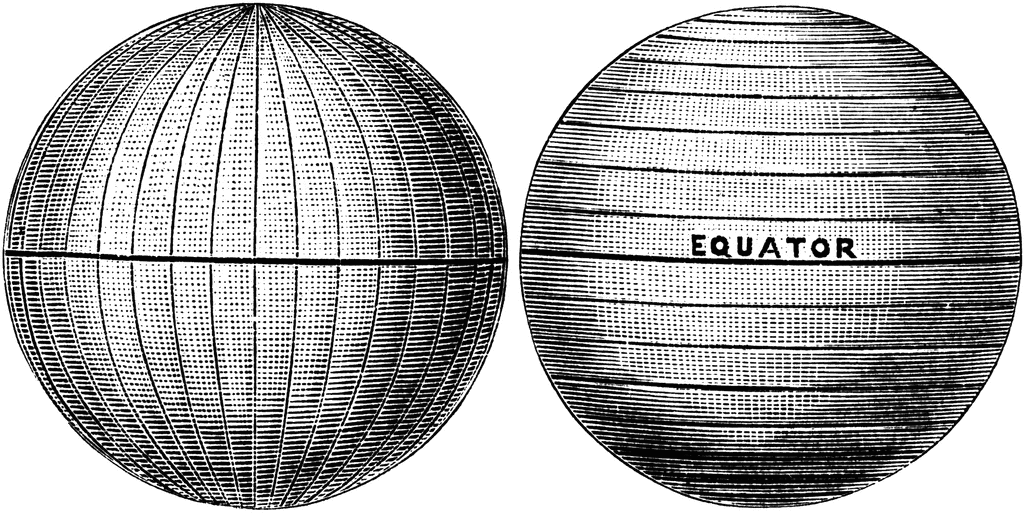
Meridians and Parallels
To use any of the clipart images above (including the thumbnail image in the top left corner), just click and drag the picture to your desktop. You may also control-click (Mac) or right-click (Windows) and choose "Save file to disk" from the pop-up menu. Click here for help downloading and using clipart files.
* A TIFF file is a high-resolution (240 dpi) format. TIFF files should be used only if you are printing the clipart. Do NOT use TIFF files for clipart that will displayed on a computer screen. Click here for help downloading and using TIFF files.File Name: merpar_30592
Description: The Meridian of any given place is that half of the meridian circle which passes through that place and both poles. A meridian of any place reaches from that place to both poles, and therefore is equal to one-half of a great circle, and, with the meridian directly opposite to it, forms a great circle called a meridian circle. There are as many meridians as there are places on the equator or on any parallel. Parallels are small circles which pass around the earth parallel to the equator.
Source: Edwin J. Houston, The Elements of Physical Geography, for the use of Schools, Academies, and Colleges. (Philadelphia: Eldredge & Brother, 1891)14
Keywords: Geography, curve, earth, longitude, latitude,
Copyright: 2009, Florida Center for Instructional Technology. See license.
Main Menu Site Map Search License Clipart Help
Clipart ETC is a part of the Educational Technology Clearinghouse and is funded by various grants. Produced by the Florida Center for Instructional Technology, College of Education, University of South Florida. Email the project manager.