Genus Quercus, L. (Oak)
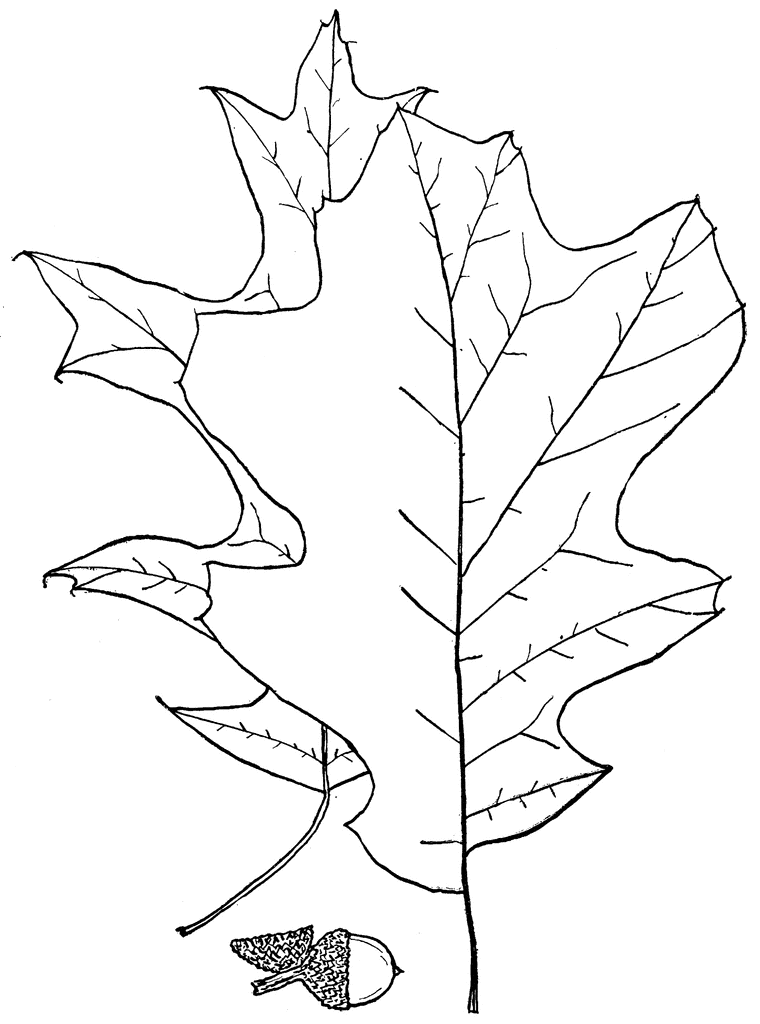
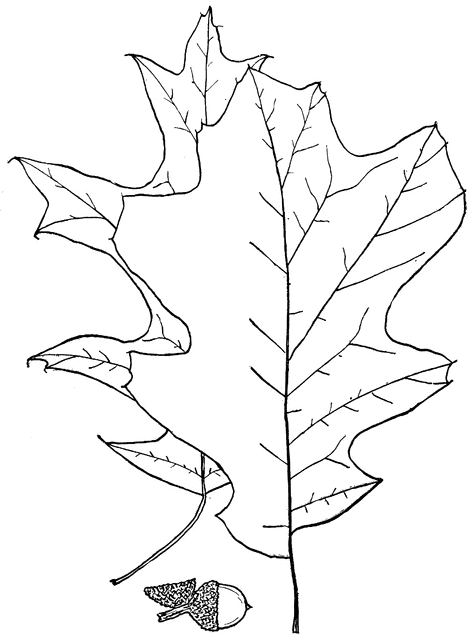
Leaves - simple; alternate; edge lobed (edge of the lobes mostly entire, but oftenest with a few teeth toward the end). Outline - reverse egg-shape or oval. Base - usually rounded. Ends of the lobes and of the few teeth, sharp and bristle-pointed, especially when young. Leaf - five to eight inches long; three to five inches wide; very variable. The two types, a and b, are often found on the same tree; b is a variation toward the leaf of the Scarlet Oak. The upper surface is roughish, becoming smoother when mature; the undersurface, rusty-downy until mid-summer, when the down mostly disappears, except from the angles of the ribs. Bark - of trunk, blackish and deeply and roughly furrowed, with an inner bark that is very thick and yellow and bitter. Acorns - variable; usually small; on short stems. Cups - thick; somewhat top-shaped; scales distinct and rather large. . Nut - one half to two thirds of an inch long; rounded; nearly one third covered by the cup. Kernel, bright yellow or orange and bitter. October. Found - from Southern Maine southward and westward. Very common, especially in the Atlantic forests. General Information - A tree fifty to a hundred feet high, with wood that is inferior to that of the White Oak. The yellow inner bark (quercitron of the shops) is a valuable dye, and is rich in tannin. Late in the autumn the leaves turn to a rich yellowish-brown or russet. It is very probable that the “Black Oak” and the “Scarlet Oak” ought to be considered as one, and described, not as species and variety, but as slightly different forms of the single species Q. coccinea. Though the most distinctive leaves of the “Black Oak” are easily recognized, often others are so nearly like those of the “Scarlet Oak” that it is not easy to distinguish between then; and the same is true of the fruit and the bark. Michaux f. says: “The only constant difference between the acorns of the Scarlet Oak and the Black Oak is in the kernel, which is white in the Scarlet Oak and yellow in the Black Oak.” The Gray Oak (Q. c., ambigua, Gray) is a variety sometimes found along the northeastern boundary of the States (as far as Lake Champlain) and northward. It combines the foliage of the Red Oak with the acorn of the Scarlet Oak. Quercus, possible from a Celtic word meaning to inquire, because it was among the oaks that the Druids oftenest practised their rites.
Keywords
koak, leaf, trees of northeast America, trees of northeast United States, tree with simple leaves, leaves alternate, edge lobedGalleries
Trees: BSource
Newhall, Charles S. The Trees of North-Eastern America (New York: The Knickerbocker Press, 1900) 121
Downloads
1782×2400, 270.8 KiB
760×1024, 50.2 KiB
475×640, 27.5 KiB
237×320, 11.0 KiB