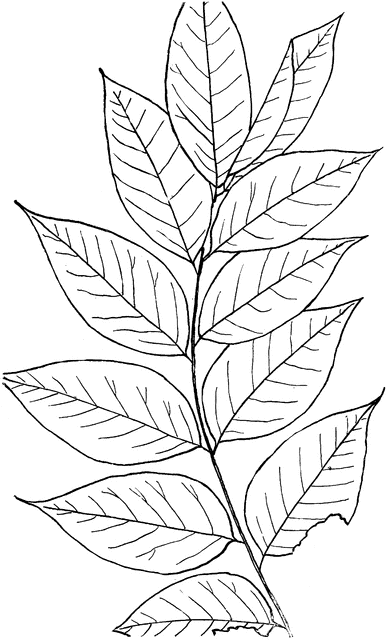
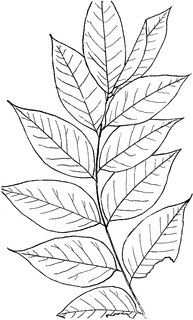
Genus Gymnocladus, Lam. (Coffee Tree)

Leaves - unequally twice-compound (odd-feathered; leaflets very numerous - seven to thirteen on the different branches of the main leaf-stem; alternate; edge of leaflets entire. Outline - leaflets, egg-shape or oval. Apex - sharply taper-pointed. Base, slightly heart-shaped or rounded. Leaf-stem - in the autumn takes a violet tinge. Leaf - one and one half to three feet long, about one half as wide. Leaflets, one to two and one half inches long, of a dull green. Bark - of trunk, rough and scaly, separating in small and hard crosswise and backward-curled strips. Branchlets stout and not thorny. Flowers - in white spikes along the branches. May-July. Fruit - in large curved pods (Six to ten inches long, by two inches broad), pulpy within, of a reddish-brown color, flattened and hard. Each pod contains several hard, gray seeds one half of an inch or more in diameter. September, October. Found - in Franklin County, Pennsylvania (Porter), Western New York, westward and southward to Middle Tennessee. Not common. General information - A tree sixty to eighty feet high, or more, with a rather small and regular head. The fewness and the abruptness of its large branches give to it in the winder a dead and stumpy look, whence one of its common names. Its bruised and sweetened leaves are used at the South for poisoning flies. Its seeds were formerly used as a substitute for coffee.
Keywords
leaf, trees of northeast America, trees of northeast United States, leaves alternate, tree with compound leaves, feather-shaped leaves, edge entire leavesGalleries
Trees: I-NSource
Newhall, Charles S. The Trees of North-Eastern America (New York: The Knickerbocker Press, 1900) 191
Downloads
1448×2400, 354.7 KiB
617×1024, 72.1 KiB
386×640, 40.0 KiB
193×320, 15.2 KiB