Genus Fraxinus, L. (Ash)
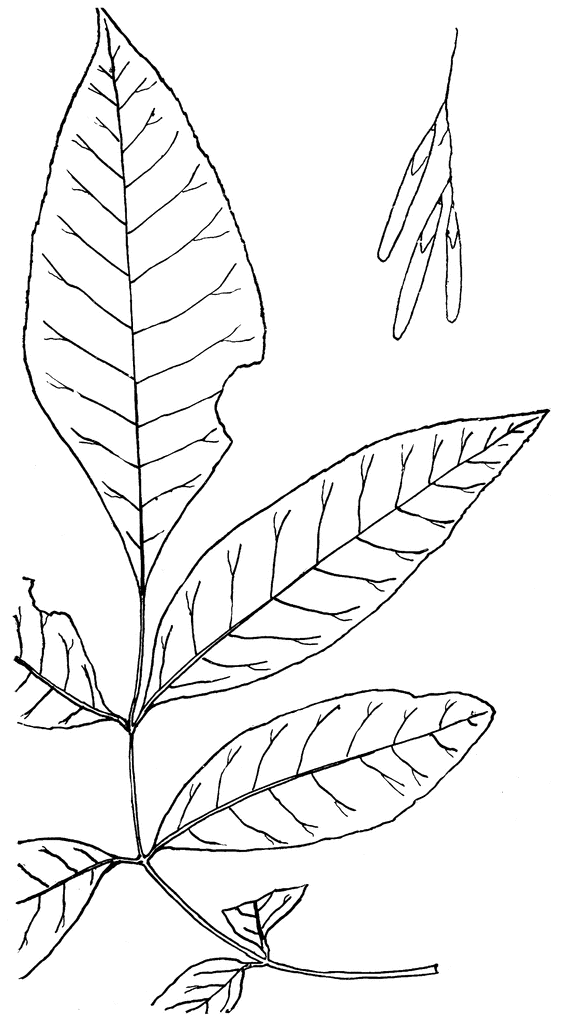
Leaves - compound (odd-feathered; leaflets, seven to nine); edge of leaflets nearly entire or slightly toothed. Outline - of leaflet, long oval or egg-shape. Apex - taper-pointed. Base - somewhat pointed. Leaf/Stem - velvety-downy. Leaflet/Stem - about one fourth of an inch long, or somewhat less, and velvety-downy. Leaf/Bud - rounded, nearly concealed by the leaf-stem, downy, and of a dark, rusty brown. Leaflet - two to six inches long, downy beneath, and pale, becoming reddish. Bark - of the trunk, dark ashy or granite-gray, or of a deep brown. It is slightly furrowed up and does, the furrows seldom joining or crossing. The branches are grayish. The young shoots are velvety, with a grayish or rusty down. Winged seeds - resembling those of the White Ash, but usually with the end of the wing more rounded. Found - along borders of streams and in low and swampy ground - New Brunswick to Minnesota, and southward to Northern Florida and Alabama; but rare west of the Alleghany Mountains. Its finest growth is in the Northern Atlantic States. General Information - A medium-sized tree, usually thirty to fifty feet high, of less value than the White Ash. Fraxinus from a Greek word meaning “separation,” because of the ease with which the wood of the Ash can be split. I find in the notes of an old copy of White’s “Natural History of Selborne” this comment: “The Ash, I think, has been termed by Gilpin the Venus of British trees.” Gerardes’ “Herbal” comments: “The leaves of the Ash are of so great a vertue against serpents, as that the serpents dare not be so bolde as to touch the morning and evening shadowes of the tree, but shunneth them afarre off, as Pliny reporteth in his 16 book, 13 chap. He also affirmeth that the serpent being penned in with boughes laide rounde about, will sooner run into the fire, if any be there, than come neere to the boughes of the Ash.” In Scandinavian mythology the great and sacred tree, Yggdrasil, the greatest and most sacred of all trees, which binds together heaven and earth and hell, is an Ash. Its roots spread over the whole earth. Its branches reach above the heavens. Underneath lies a serpent; above is an eagle; a squirrel runs up and down the trunk, trying to breed strife between them.
Keywords
leaf, trees of northeast America, trees of northeast United States, leaves opposite, tree with compound leaves, feather-shaped leaves, edge toothed leaves, edge-toothed or entire, edge-toothed and entireGalleries
Trees: Q-SSource
Newhall, Charles S. The Trees of North-Eastern America (New York: The Knickerbocker Press, 1900) 223
Downloads
1316×2400, 271.7 KiB
561×1024, 51.2 KiB

350×640, 27.9 KiB

175×320, 10.9 KiB