Maps Site map
  Maps > Asia > Russia
Site Map  

  Record   1   to   20  of   20

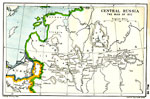
Central Russia,
Map of Central Russia, subtitled "The War of 1812." Map is color-coded to highlight boundaries between countries.

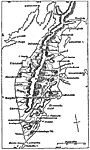
Map of Kamchatka, 1903
Map of the Kamchatka Peninsula in the Russian Far East.

Map of Nova Zembla, 1903
A map of the Russian island of Nova Zembla. Shows the main island and the smaller islands surrounding it.

Mouths of the Volga, 1919
A map showing the mouths of the Volga river.

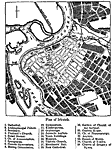
Plan of Irkutsk, 1686
Map showing plan for city of Irkutsk, Russia.

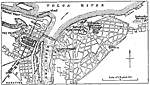
Plan of Nijni-Novgorod, 1903
A map of the Russian city of Nijni-Novgorod showing streets, rivers, railways, and landmarks. Nijni-Novgorod "is situated at the confluence of the Oka and Volga, 276 miles by rail to the east of Moscow." —Kellogg, 1903

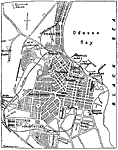
Plan of Odessa, 1903
A map of Odessa, Russia showing streets, railroads, and landmarks.

Russia, 1920
Map of Russia.

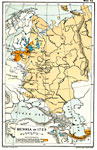
Russia, 1725
Map of Russia in 1725. Map is color-coded to show land acquired during the reign of Peter the Great. Those south of the Turek were restored in 1732-1735.

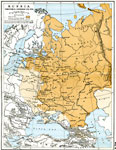
Russia , 1725/1795
Map of Russia, subtitled, "Territorial Expansion 1725-1795." Map is color-coded to show territories acquired during this period.

Russia, 1914
Physical map of Russia. Includes an insert of the St. Petersburg vicinity.

Russia in Europe and Caucasia, 1920
Russian in Europe and Caucasia, showing railroads, submarine cables, and canals. Also shows "conjectural boundaries of new states with sovereignty to be decided by plebiscite."—Leslie's New World Atlas, 1920

Russian Central Asia, 1920
Russian Central Asia.

Sebastopol, 1919
A map showing the Russian port on the Black Sea.

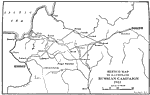
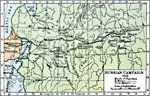
Sketch Map to Illustrate Russian Campaign, 1812
" The disastrous campaign which opened in June, 1812, was conducted on so vast a scale that a brief sketch can provide only the slightest conception of the magnitude of the operations. The Emperor s forces were divided into three armies. The first, 220,000 strong, which he himself commanded, with Berthier as his Chief-of-staff, was composed of the Guards, three infantry corps under Davout, Oudinot, and Ney, and two cavalry divisions. The second army, 80,000 strong, was commanded by Prince Eugene, and was composed of Eugene s own corps, that of St. Cyr, and one cavalry division. The third army, numbering 80,000 also, was under the command of the Emperor s brother, Jerome, and was made up of three infantry corps under Poniatowski, Vandamme, and Reynier, and one cavalry division. On the extreme left was MacDonald in command of 38,000 men of which the Prussian Auxiliary Corps was a part, and on the extreme right, Schwarzenberg led the Austrian Auxiliary Corps, 30,000 strong. On June 23, 1812, the Emperor s army crossed the Niemen at Kovno and set out for Vilna. One week later, Jerome crossed the river at Grodno, and on the following day Eugene crossed at a point between the other two armies, and followed the Emperor toward Vilna. " — Holt, 1920

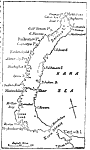
The Murman Coast and Archangel, 1918
The Murman Coast and Archangel. An Allied expedition of the British, French, and American troops held the Murman Coast and part of the railroad line south of it, chiefly to prevent its use as a naval and commercial outlet by Germany.

Vladivostok (I), 1912
The Russian city of Vladivostok resides between the bays of Amur and Usuri.

Vladivostok (II), 1912
This map shows the Trans-Siberian railway lines that connect Vladivostok to European Russia and Moscow.

Western Russia, 1914/1918
A map of Western Russia during World War One, showing major railroad lines.

Western Russia, 1920
Western Russia, showing railways.


  Maps > Asia > Russia
Site Map  

Maps is a part of the Educational Technology Clearinghouse
Produced by the Florida Center for Instructional Technology © 2007
College of Education , University of South Florida