Maps Site map
  Maps > North America > Cuba
Site Map  

  Record   1   to   9  of   9

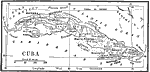
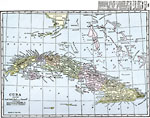
Cuba, 1909
Map of Cuba.

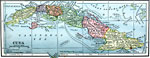
Cuba, 1919
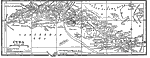
A map of Cuba in 1919, showing submarine telegraph cables.

Cuba, 1901
Map of Cuba.

Cuba, 1920
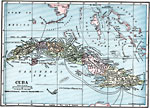
Physical map of Cuba. Includes railroads.

Cuba, 1920
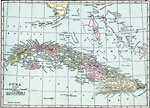
Map of Cuba.

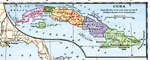
Cuba, 1912
Map of Cuba showing provinces, capitals of provinces, cities, railroads, waterways, mountain ranges, and submarine telegraph cables.

Cuba, 1898
Map of Cuba, 1898, &qout;the largest island of the West Indies. It is 720 miles long and averages 80 miles wide, and it has an area of 46,000 square miles. The surface, which is for the most part low and undulating, is broken by three distinct mountain ranges, the highest rising to an altitude of more than 7,000 feet. The eastern part of the island is more rugged and mountainous than the western, Nearly every part is well-drained by numerous water courses...The mercury ranges from 50° in winter to 100° in summer, and the average temperature the year round is about 77°. The prevailing northeast winds bring an abundant rainfall, two thirds of which occurs in the summer...The soil is of exhaustless fertility. Nearly one half of the island has been cultivated or used for pasturage; the other half is covered with forests. The chief industries are the cultivation of sugar cane and tobacco. Coffee and bananas are produced in large quantities, and oranges and garden vegetables are grown for home consumption. Fine cattle and stout Cuban ponies are bred in the central and eastern districts. In the forests are many kinds of valuable trees-palm, mahogany, ebony, cedar, and, in the west, pines...Iron ore, manganese, and copper have been mined near Santiago; and asphaltum exists abundantly at Cardenas. &qout; — Redway, 1898. The scale is in miles.

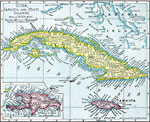
Cuba,
This is a detailed map of Cuba showing all of the major cities including Havana, inland waters, oceans, islands and railroads. "Cuba, a republic, the largest and most populous of the West India Islands. It divides the entrance to the Gulf of Mexico into two passages of nearly equal width, the Strait of Florida about 110 m. wide between the Capes Hicacos in Cuba and Arenas in Florida (Key West being a little over 100 m. from Havana); and the Yucatan Channel about 130 m. wide between Capes San Antonio and Catoche." — The Encyclopedia Britannica, 1910

Havana Harbor, 1919
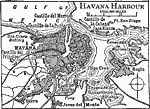
A map of the area around Havana Harbor in 1919.


  Maps > North America > Cuba
Site Map  

Maps is a part of the Educational Technology Clearinghouse
Produced by the Florida Center for Instructional Technology © 2007
College of Education , University of South Florida