Maps Site map
  Maps > South America > Complete Maps
Site Map  

  Record   1   to   10  of   58

Animals of South America, 1906
Animals found in regions of South America.

Drawing of South America, 1872
Illustrates instructions for drawing South America.

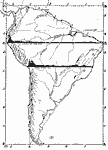
Heat Belts in South America, 1898
A map of Heat Belts in South America. "There is comparatively little difference between the temperatures of winter and summer in South America. Most of the lowlands are always hot; in the extreme south they are stormy, chilly, and disagreeable, butuj seldom very cold; the elevated plateaus of the Andes are always temperate, and the higher summits of this chain always cold. It is only a comparatively narrow belt that there is a notable difference between the temperatures of summer and winter, and in this region the winters are seldom cold enough for the formation of ice. The most plainly marked seasons are the wet and dry, and they are determined by the position of the equatorial rain belt." &mdashRedway, 1898.

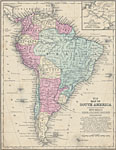
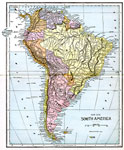
Map of South America, 1858
The Capitals of Countries are represented with a dot with a ring of dots around it. The figures attached to Cities and Towns indicate the number of thousands of the population thus Rio Janeiro 170 signifies 170,000 inhabitants. The figures attached to the Rivers indicate the number of hundreds of miles of their length of course, thus the Amazon River 36, signifies 3,600 miles long. Anchor symbols signify ship and sloop navigation, the distance of which from the sea in miles is pointed out by the attached figures. The words underscored are the names of Indian Tribes. —Mitchell's School Atlas, 1863

Natural Regions of South America, 1920
Natural regions of South America.

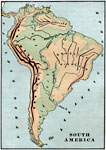
Orographic Chart of South America, 1891
Chart showing the various mountain ranges in South America.

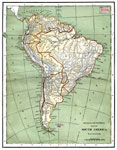
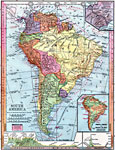
Physical Map of South America, 1910
A physical map of South America.

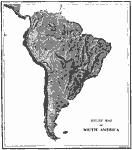
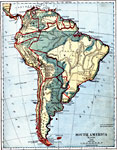
Physical Map of South America, 1901
Physical map of South America.

Physical Map of South America, 1916
A physical map of South America in 1916.

Physical Map of South America, 1898
A physical map of South America, as of 1898 AD. The map includes an insert of the Isthmus of Panama. "The Andes Mountains are much loftier than the ranges of the North American highland, and are much less broken. They follow the north and west coasts as a continuous wall, from the vicinity of the island of Trinidad nearly to the Strait of Magellan. Except near the extremities there are few passes across the chain less than two miles high, while many of the peaks are four miles in height, and are the highest in America. Even in the torrid zone these lofty peaks always bear snow and glaciers near their summits, and in the south glaciers descend to the sea. Thirty or forty active volcanoes occur along the Andes and many of the high peaks are huge volcanic cones. Severe earthquakes are common throughout the chain, and sometimes cause great loss of life. On the west slopes of the Andes are many terraces and shell deposits high above the present sea level, marking old positions of the sea beach...The Brazilian plateau is much lower than the Andean highland. Its general height is less than half a mile. Much of its surface is quite level, but there are numerous rugged divides and several mountain ranges, with at least one peak two miles high. The plateau slopes abruptly in the east to a narrow coast plain, but inland it merges gradually in to he great central lowland...The eastern highlands of South America, like those of North America, are much older than the western highlands." &mdashRedway, 1898.

Next Last


  Maps > South America > Complete Maps
Site Map  

Maps is a part of the Educational Technology Clearinghouse
Produced by the Florida Center for Instructional Technology © 2007
College of Education , University of South Florida