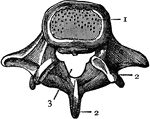
Top view of the vertebra. 1: Body; 2: Processes; 3: Opening for spinal cord.

Vertebra

Top view of the vertebra. 1: Body; 2: Processes; 3: Opening for spinal cord.

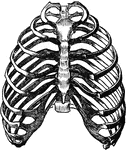
The chest or ribcage of the human body.

Chest

The chest or ribcage of the human body.

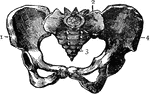
The pelvis of the human body. 1: Hip Bones; 2: Sacrum; 3: Coccyx.

Pelvis

The pelvis of the human body. 1: Hip Bones; 2: Sacrum; 3: Coccyx.

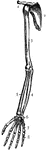
The upper extremity of the human body. 1: Clavicle; 2: Scapula; 3: Humerus; 4: Ulna; 5: Radius; 6: Carpus; 7: Metacarpal; 8: Phalanges.

Upper Extremity

The upper extremity of the human body. 1: Clavicle; 2: Scapula; 3: Humerus; 4: Ulna; 5: Radius; 6: Carpus;…
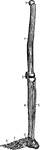
The lower extremity of the human body. 1: Head of femur; 2: Femur; 3: Patella; 4: Tibia; 5: Fibula; 6: Tarsus; 7: Metatarsus; 8: Phalanges.

Lower Extremity

The lower extremity of the human body. 1: Head of femur; 2: Femur; 3: Patella; 4: Tibia; 5: Fibula;…
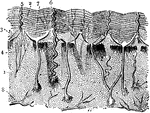
Vertical section of the skin, a microsopic view. 1: Cutis; 2: Cuticle in layers; 3: Papilla; 4: Nerves of the Papilla; 5: Opening of Perspiratory Gland; 6: Perspiratory Gland entire; 7: Vessels for secreting coloring matter; 8: Blood-vessels.

Skin

Vertical section of the skin, a microsopic view. 1: Cutis; 2: Cuticle in layers; 3: Papilla; 4: Nerves…
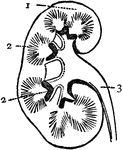
Section of Kidney. 1: Body of Kidney; 2: Internal vessels; 3: Ureter, leading to the bladder.

Kidney

Section of Kidney. 1: Body of Kidney; 2: Internal vessels; 3: Ureter, leading to the bladder.
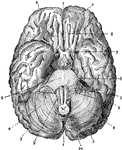
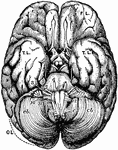
The brain seen from below. 1: Great fissure; 2: Anterior lobes of cerebrum; 3: Posterior lobes of cerebrum; 4: Lobes of cerebellum; 5: Cranial nerves; 6: Auditory nerve; 7: Optic nerve; 8: Olfactory nerve; 9: Main body of medulla oblongata; 10: End of medulla oblongata.

Brain

The brain seen from below. 1: Great fissure; 2: Anterior lobes of cerebrum; 3: Posterior lobes of cerebrum;…
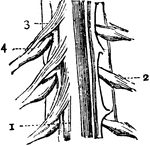
Portion of the spinal cord. 1: Body of cord; 2: A spinal nerve from left side of cord; 3: Anterior roots of a nerve; 4: Posterior roots.

Spinal Cord

Portion of the spinal cord. 1: Body of cord; 2: A spinal nerve from left side of cord; 3: Anterior roots…
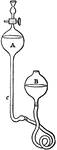
"The general scheme of Geisler's pump is shown here. A and B are pear-shaped glass vessels connected by a long narrow india-rubber tube, which must be sufficiently strong in the body (or strengthened by a linen coating) to stand an outward pressure of 1 to 1.5 atmospheres. A terminates below in a narrow vertical tube c, which is a few inched longer than the height of the barometer, and to the lower end of this tube the india-rubber tube is attached which connects A with B. To the upper end of A is soldered a glass two-way stop-cock, by turning which the vessel A can either be made to communicate through s and a hole in the hollow cock with the vessel to be exhausted." —The Encyclopedia Britannica, 1903

Air-Pump

"The general scheme of Geisler's pump is shown here. A and B are pear-shaped glass vessels connected…
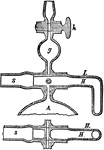
"The general scheme of Geisler's pump is shown here. A and B are pear-shaped glass vessels connected by a long narrow india-rubber tube, which must be sufficiently strong in the body (or strengthened by a linen coating) to stand an outward pressure of 1 to 1.5 atmospheres. A terminates below in a narrow vertical tube c, which is a few inched longer than the height of the barometer, and to the lower end of this tube the india-rubber tube is attached which connects A with B. To the upper end of A is soldered a glass two-way stop-cock, by turning which the vessel A can either be made to communicate through s and a hole in the hollow cock with the vessel to be exhausted." —The Encyclopedia Britannica, 1903

Air-Pump

"The general scheme of Geisler's pump is shown here. A and B are pear-shaped glass vessels connected…
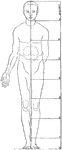
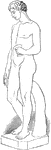
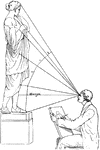
Visual perspective of the human body.

Body Perspective

Visual perspective of the human body.

An antique sculpture.

Statue

An antique sculpture.

A human's perspective of a statue.

Perspective

A human's perspective of a statue.

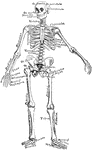
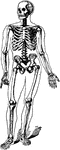
A human skeleton

Skeleton

A human skeleton

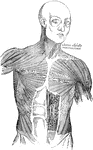
Muscles of the upper body.

Muscles

Muscles of the upper body.

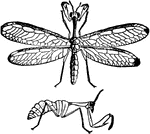
Showing the legs and body from the side.

Mantispa

Showing the legs and body from the side.

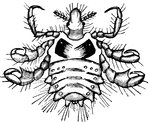
The crab louse can live in almost any form of human hair, leading to its other common name of pubic louse.

Crab-louse

The crab louse can live in almost any form of human hair, leading to its other common name of pubic…
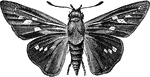
In this latter series the fore-wings are much more pointed than in the other, and the body is proportionately more robust

Pamphila Ethlius

In this latter series the fore-wings are much more pointed than in the other, and the body is proportionately…
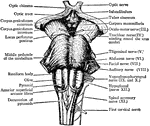
Front view of the medulla, pons and mesencephalon of a full-time human foetus.

Brain

Front view of the medulla, pons and mesencephalon of a full-time human foetus.

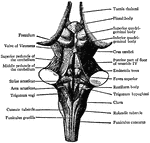
Back view of the medulla, pons and mesencephalon of a full-time human foetus

Brain

Back view of the medulla, pons and mesencephalon of a full-time human foetus

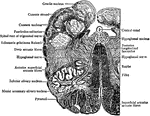
Transverse section through the human medulla in the lower olivary region

Brain

Transverse section through the human medulla in the lower olivary region

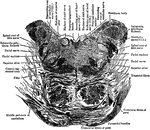
Section through the lower part of the human pons varolii imediately above the medulla

Brain

Section through the lower part of the human pons varolii imediately above the medulla

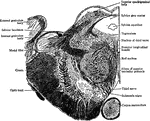
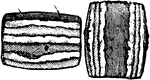
Transverse section through the human mesencephalon at the level of the superior quadrigeminal body
Brain

Transverse section through the human mesencephalon at the level of the superior quadrigeminal body

The side and top view of the segments of the Canker Worm.

Canker Worm Segments

The side and top view of the segments of the Canker Worm.

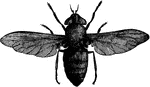
The horse-flies or <em>tabanidae</em>, comprise another set of troublesome creatures, of medium or large size. They have short, broad heads, enormous eyes, and short, though many jointed, feelers. The abdomen is oval, a little flattened, and the body convex and powerful. The mouth parts are well developed, consisting of a series of five sharped-pointed lancets so rigid that they readily pierce the skin and draw blood almost as soon as they touch.

Horse Fly

The horse-flies or tabanidae, comprise another set of troublesome creatures, of medium or large…
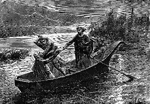
As a kind of joke, John, King Henry's youngest son, had been called Lackland, because he had nothing when his brothers each had some great dukedom. The name suited him only too well before the end of his life. The English made him king at once. Richard had never had any children, but his brother Geoffery, who was older than John had left a son named Arthur, who was about twelve years old, and who rightly the Duke of Normandy and Count of Anjou. King Philip, who was always glad to vex whoever was king of England, took Arthur under his protection, and promised to get Normandy out of John's hands. However, John had a meeting with him and persuaded him to desert Arthur, and marry his son Louis to John's own niece, Blanche, who had a chance of being queen of part of Spain. Still Arthur lived at the French King's court, and when he was sixteen years old, Philip helped him to raise an army and go to try his fortune against his uncle. He laid siege to Mirabeau, a town where his grandmother, Queen Eleanor, was living. John, who was then in Normandy, hurried to her rescue, beat Arthur's army, made him prisoner and carried him off, first to Romen, and then to the strong castle of Falaise. Nobody quite knows what was done to him there. The governor, Hubert de Burgh, once found him fighting hard, though with no weapon but a stool, to defend himself from some ruffians who had been sent to put out his eyes. Hubert saved him from these men, but shortly after this good man was sent elsewhere by the king, and John came himself to Falaise. Arthur was never seen alive again, and it is believed that John took him out in a boat in the river at night, stabbed him with his own hand, and threw his body in the river.

Murder of Prince Arthur

As a kind of joke, John, King Henry's youngest son, had been called Lackland, because he had nothing…
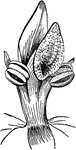
Style of a Lady's Slipper (Cypripedium), and stamens united with it; the anther of the two good stamens; an abortive stamen, what should be its anther changed into a petal-like body; the stigma.

Lady's Slipper

Style of a Lady's Slipper (Cypripedium), and stamens united with it; the anther of the two good stamens;…
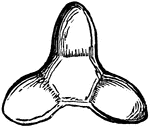
Evening Primrose, the three lobes as large as the central body.

Evening Primrose

Evening Primrose, the three lobes as large as the central body.

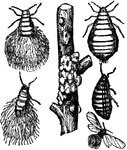
Eriosoma Lanigera, or the Wooly Apple-Tree Blight. These insects appropriate for their generic name two Greek words, signifying wool and body, the insect being partially enveloped in a cottony or wool-like secretion, furnished from its own body. The eggs are deposited in crotches or cracks of the branches or bark, often at or near the surface of the ground, or on new shoots springing from the parent tree.

Wooly Aphid

Eriosoma Lanigera, or the Wooly Apple-Tree Blight. These insects appropriate for their generic name…
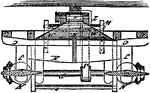
The machine is supported upon two wheels, one in the rear of the other. The body is hopper shaped, with a pair of crushing-rollers at the bottom. At each side there are revolving-wings, which sweeps the insects into the hopper, and in addition to these there are two gathering-fingers, which support the vines during the passage of the machine.

Crushing Insect Sifter

The machine is supported upon two wheels, one in the rear of the other. The body is hopper shaped, with…
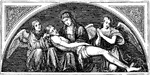
This painting, by Francesco Raibolini, represents what the Depositon of Christ represents. The only difference is that there are two angels instead of two saints. It can now be found in the National Gallery in Washington D.C.

The Virgin and Two Angels Weeping over the Dead Body of Christ

This painting, by Francesco Raibolini, represents what the Depositon of Christ represents. The only…
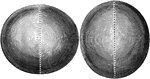
The shape of the earth is that of a round ball or sphere slightly flattened at two opposite sides. Such a body is termed a <em>spheroid</em>. There are two kinds of spheroids-<em>oblate</em> and <em>prolate</em>; the former as the shape of an orange, the latter that of a lemon. The straight line that runs through the centre of a sphere or spheroid and terminates at the circumference is called the <em>diameter</em>. If the sphere rotates-that is, moves around like a top-the diameter on which it turns is called the <em>axis</em>. In the oblate spheroid the axis is the shorter diameter; in the prolate spheroid the axis is the longer diameter.

Oblate and Prolate Spheroid

The shape of the earth is that of a round ball or sphere slightly flattened at two opposite sides. Such…
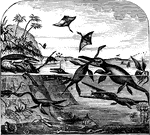
In this age the animals and plants begin to resemble existing species. The age is characterized mainly by the preponderance of reptiles, many of which were very large, as, for example, the <em>plesiosaurus</em>, an animal with a long, snake-like neck and a huge body, or the <em>ichthyosaurus</em>, with a head like a crocodile and short neck and large body. Both of these animals were furnished with fin-like paddles, and lived in water.

Reptiles

In this age the animals and plants begin to resemble existing species. The age is characterized mainly…
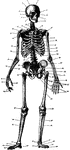
1. Frontal bone 2. Parietal bone 3. Coronal Suture 4. Squamous portion of Temporal bone 5. Mastoid process of Temporal bone 6. Zygoma 7. Superior Maxillary Bone 8. Inferior Maxillary Bone 9. Tempero-Maxillary Bone 10. Nasal Bone 11. Orbit 12. Cervical Vertebra 13. First Rib 14. Clavicle 15. Manubrium 16. Body of Sternum 17. Ensiform Process of Sternum 18. Shoulder Blade 19. Acromion Process of Scapula 20. Costal Cartilage 21. Seventh Rib 22. Eighth Rib 23. Twelfth Rib 24. Twelfth Dorsal Vertebra 25. Lumbar Vertebra 26. Head of Humerus 27. Humerus 28. Elbow-Joint 29. Radius 30. Ulna 31. Wrist 32. Metacarpal bone 33.Thumb 34. Phalanges of the Finger 35. Sacrum 36. Ilium 37. Crest of the Ilium 38. Pubic Bone 39. Ischium 40. Sacro-Iliac Symphysis 41. Pubic Symphysis 42. Obturator Foramen 43. Head of Femur 44. Neck of Femur 45. Greater trochanter 46. Femur 47 Patella knee-pan 48. Tibia 49. Fibula 50. External Malleolus 51. Internal Malleolus 52. Os Calcis 53. Tarsus 54. Metatarsal Bone 55. Phalanges of Toes

Skeleton

1. Frontal bone 2. Parietal bone 3. Coronal Suture 4. Squamous portion of Temporal bone 5. Mastoid process…
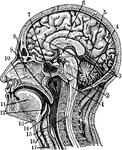
Section through the Head and Neck on the Median Line. 1. Medulla Oblongata 2. Pons 3. Right lobe of cerebrum 4. Cerebellum in section 5. Blood vessel 6. Corpus Striatum 7. Nasal Passage 8. Nasal bone 9. Soft Palate 10. Hard Palate 11. Tongue 12. Epiglottis 13. Os Hyoides 14. Oesaphagus 15. Spinal 16. Larynx 17. Windpipe

Sectional view of the Head

Section through the Head and Neck on the Median Line. 1. Medulla Oblongata 2. Pons 3. Right lobe of…
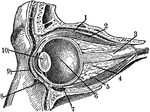
Section through the closed left eye.1. Lifting muscle 2. Upper Straight Muscle 3. Optic Nerve 4. Fatty Cushion 5. Lower straight muscle 6. Vitrous Humour 7. Lower cross muscle 8. Lower Eyelid 9. Upper eyelid 10. Crystalline lens

Eyeball

Section through the closed left eye. 1. Lifting muscle 2. Upper Straight Muscle 3. Optic Nerve 4. Fatty…
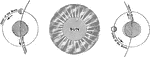
The flood tides are the highest, and the ebb tides are the lowest. These are called <em>spring tides</em>. They occur twice during every revolution of the moon-once at <em>full</em>, and once at <em>new</em> moon. When the sun and moon are 90 degrees apart, each produces a tide on the portion of the earth directly under it, diminishing somewhat produced by the other body. High tide, then, occurs under the moon, while the high tide caused by the sun, becomes by comparison, a low tide. Such tides are called <em>neap tides</em>.

Positions

The flood tides are the highest, and the ebb tides are the lowest. These are called spring tides.…
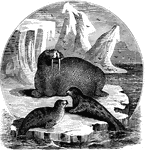
Fur Seals make up one of the two distinct groups of mammals called "seals". Both the fur seals and the true seals are members of the Pinnipedia, which is usually regarded as a suborder of the order Carnivora but sometimes as an independent order. However, the fur seals, like their close relatives the sea lions, retain some ability to walk on land as their hind limbs can be brought forward under the body to bear the animal's weight, and retain small but visible external ears.

Seals and Walrus

Fur Seals make up one of the two distinct groups of mammals called "seals". Both the fur seals and the…
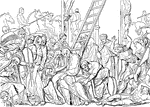
This sculpture by the great artist, Donatello, is of many people kneeling and standing around the body of Jesus Christ. It is a Bronze-relief and can now be found in S. Lorenzo, Florence.

The Deposition

This sculpture by the great artist, Donatello, is of many people kneeling and standing around the body…
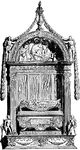
This sculpture by the great artist, Donatello, is of Carlo Marzuppini, an Italian chancellor from Florence, Italy. The body of Carlo Marzuppini is pictured laying in his tomb. The sculpture can now be found in Florence, Italy.

Monument of Carlo Marzuppini

This sculpture by the great artist, Donatello, is of Carlo Marzuppini, an Italian chancellor from Florence,…
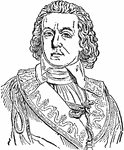
A French Jacobin, born in Province, in 1755, of an ancient family; served as second lieutenant in the regiment of Languedoc until 1775. He made, about this time, a voyage to the Isle-de-France, the governor of which was one of his relations, and entered into the garrison of Pondicherry. On his return, he gave himself up to gambling and women, and dissipated his fortune. The Revolution broke out. He immediately showed himself an opponent of the Court, and had a seat in the <em>tiers-etat</em>, while his brother was sitting in that of the nobility. July 14, 1789, he took part in the attack upon the Bastille, and Aug. 10, 1792, upon the Tuileries. In 1792 he was elected a member of the National Convention, and voted for the unconditional death of Louis XVI. He was sent, in 1793, to the South of France, and commanded the left wing of the besieging army under Dugommier, and it was here that he first met Napoleon Bonaparte, then captain of artillery. The patriotic reputation of Barras was so well established that he abd Freron were the only representatives not denounced by the popular societies. Robespierre, however, was friend of his, and often wished to arrest him. Barras, knowing this, became one of the principle actors of the 9th Thermidor, and put himself at the head of the troops which surrounded Robespierre at the Hotel de Ville. In 1794 he was named one of the Committee of Public Safety, and became a great enemy to the members of the members of the "Mountain." In February, 1795, he was elected President of the Convention, and, in that capacity, declared Paris in a state of siege, when the Assembly was attacked by the populace. Afterward, when the Convention was assailed, Bonaparte, by Barras' advice, was appointed to command the artillery; and that general, on the 13th Vendemaire, decisively repressed the royalist movement. For his services, Barras was now named one of the Directory, and took a prominent part in the changes which that body unerwent until Napoleon's <em>coup d'etat</em> on the 18th Brumaire, which effectually overthrew the power of Barrras and his colleagues. His life, from this date, was, generally speaking, one of retirement. He died in Paris, Jan. 29, 1829. His "Memoirs" appeared in 1895.

Comte de Barras

A French Jacobin, born in Province, in 1755, of an ancient family; served as second lieutenant in the…
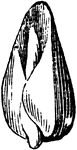
The embryo, taken out whole: the thick mass is the cotyledon; the narrow body partly enclosed by it is the plumule; the little projection at its base is the very short radicle enclosed in the sheathing base of the first leaf of the plumule.

Indian Corn Embryo

The embryo, taken out whole: the thick mass is the cotyledon; the narrow body partly enclosed by it…
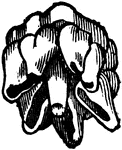
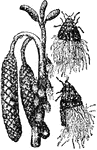
Horsetail, view of under side of the shield-shaped body, bearing a circle of spore-cases.

Horsetail

Horsetail, view of under side of the shield-shaped body, bearing a circle of spore-cases.

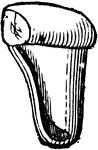
Horsetail, view spore-case from the under side of the shield-shaped body.

Horsetail

Horsetail, view spore-case from the under side of the shield-shaped body.

Eriosoma Tesselata was found on birch in Maryland, in clusters near the ends of twigs, in the autumn. It is of a black color, with white spots on the fore part of its body, and is covered with a snow white down or wool on its hinder part.

Wooly Aphid

Eriosoma Tesselata was found on birch in Maryland, in clusters near the ends of twigs, in the autumn.…
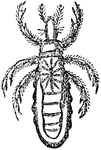
Pediculus Pubis. The crab-louse is gray-black and is a much broader square form than the other two species of louse, that has been a great scourge to soliders in time of war. This insect has been named the crab-louse from its broad crab-like appearance. It is of grayish color; the head is small, and appears to be united with the broad body without any thorax; it inhabits the hairy part of the body, under the arms or shoulders, in the beard, etc., but appears to avoid the head. These insects pierce deeply into the skin of mankind, and produce an intolerable itching.

Crab Louse

Pediculus Pubis. The crab-louse is gray-black and is a much broader square form than the other two species…
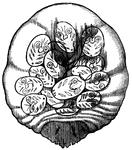
The San Jose scale, female showing the forming young through the body wall.

San Jose Scale

The San Jose scale, female showing the forming young through the body wall.

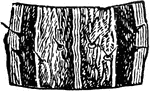
The fall army-worm; body segment.

Armyworm

The fall army-worm; body segment.

The fall army-worm; body segment.

Armyworm

The fall army-worm; body segment.

Body vesiture of Eristalis tenax species; entire hair.

Eristalis

Body vesiture of Eristalis tenax species; entire hair.

Body vesiture of Eristalis tenax species; part of entire hair.

Eristalis

Body vesiture of Eristalis tenax species; part of entire hair.

Body vesiture of Eristalis tenax species; part of entire hair.

Eristalis

Body vesiture of Eristalis tenax species; part of entire hair.

Body vesiture of Eristalis tenax species; part of entire hair.

Eristalis

Body vesiture of Eristalis tenax species; part of entire hair.

Under surface, or base of brain.

Base of Brain

Under surface, or base of brain.

(1692-1752) Butler was an English bishop, theologian, apologist, and philosopher. He is most famous for his "Fifteen Sermons on Human Nature."

Bishop Joseph Butler

(1692-1752) Butler was an English bishop, theologian, apologist, and philosopher. He is most famous…
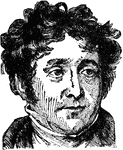
(1777-1844) Thomas Campbell was a Scottish poet and is known for his sentimental poetry dealing specially with human affairs.

Thomas Campbell

(1777-1844) Thomas Campbell was a Scottish poet and is known for his sentimental poetry dealing specially…
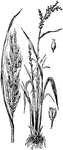
Rice is a species of grass native to tropical and subtropical southern and southeastern Asia and Africa. Rice is a staple for a large part of the world's human population.

Rice

Rice is a species of grass native to tropical and subtropical southern and southeastern Asia and Africa.…
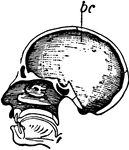
Showing the brain cavity of a human.

Human skull

Showing the brain cavity of a human.

A human skeleton.

Human skeleton

A human skeleton.