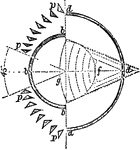
"Condensing Octant.—The central fixed apparatus bb with spherical mirror dd throws its rays directly over the angle of 45 degrees pgp, while the supplemental rays fall upon the straight condensing prisms p, each of which spreads the incident rays parallel to the corresponding rays in the central angle pgp. In this way the whole of the front hemisphere of rays is parallelized in the vertical plane and spread equally over the 45 degree in azimuth." —The Encyclopedia Britannica, 1910

Condensing Octant

"Condensing Octant.—The central fixed apparatus bb with spherical mirror dd throws its rays directly…
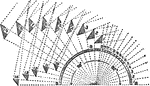
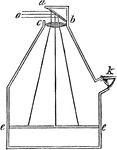
"Condensing Twin Prism Light.—Part of the Lamiash light in the Firth of Clyde. Its action will be easily understood by the numbers shown on the diagram." —The Encyclopedia Britannica, 1910

Twin Prism

"Condensing Twin Prism Light.—Part of the Lamiash light in the Firth of Clyde. Its action will…
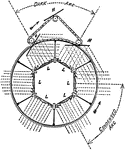
"Plane mirrors M revolve on an endless chain placed outside of the apparatus and alter the direction of the flashes after they pass into the dark arc on the landward side so as to cause the lenses L, L to repeat their flashes over the seaward are which requires strengthening. The condensing spherical mirror and mirror of unequal areas will also be found applicable in cases where the flashes do not require to sweep over the whole horizon." —The Encyclopedia Britannica, 1910

Repeating Light

"Plane mirrors M revolve on an endless chain placed outside of the apparatus and alter the direction…
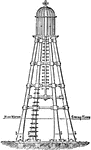
"Beacons in exposed situations are constructed sometimes of stone, and cement-concrete or cement-rubble, but generally of castiron columns let into heavy base plates which are fixed to the rock by strong lewis bats. The small class iron beacons are generally of malleable iron and the larger of cast-iron butt steel or bronze might with advantage be used in very exposed places." —The Encyclopedia Britannica, 1910

Beacon

"Beacons in exposed situations are constructed sometimes of stone, and cement-concrete or cement-rubble,…
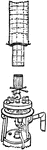
"Coal-gas was first used as a lighthouse illuminant at Salvore, near Trieste, in 1817. For many years it has been used in the harbour lights of Great Britain when in the neighborhood of gas-works. Mr. J. R. Wigham has designed a compound or crecus burner consisting of a group of twenty-eight vertical tubes, each carrying an ordinary double fish-tail burner, and the ignited gases issuing from all these jets unite into one large flame." —The Encyclopedia Britannica, 1910

Coal-gas

"Coal-gas was first used as a lighthouse illuminant at Salvore, near Trieste, in 1817. For many years…
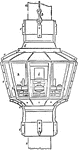
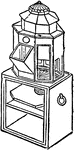
"aa is the mast, b tackle hook, c, c brass flanges for fixing parts of lantern together, e and g weather guards, h plate glass front of lantern, i shutter by which lamps are trimmed, k lamps, l silver reflector. Revolving catoptric apparatus was applied to floating lights in England, and M. Letourneau, in 1851, proposed to employ a number of sets of dioptric apparatus in one lantern." —The Encyclopedia Britannica, 1910

Floating Lights

"aa is the mast, b tackle hook, c, c brass flanges for fixing parts of lantern together, e and g weather…
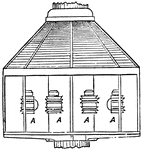
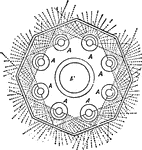
"Dioptric Floating Light. Elevation." —The Encyclopedia Britannica, 1910

Dioptric Light

"Dioptric Floating Light. Elevation." —The Encyclopedia Britannica, 1910

"Dioptric Floating Light. Horizontal Section." —The Encyclopedia Britannica, 1910

Dioptric Light

"Dioptric Floating Light. Horizontal Section." —The Encyclopedia Britannica, 1910

A perennial herb with light pink flowers. Used a a forage crop and honey.

Sanfoin

A perennial herb with light pink flowers. Used a a forage crop and honey.

A perennial herb with light pink flowers. Used a a forage crop and honey.

Sanfoin

A perennial herb with light pink flowers. Used a a forage crop and honey.

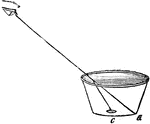
"The refraction of water is beautifully proved by the following simple experiment. Place an empty cup, with a shilling on the bottom, in such a position that the side of the cup will just hide the piece of money from the eye. Then let another person fill the cup with water, keeping the eye in the same position as before. As the water is poured in, the shilling will be come visible, appearing to rise with the water. The effect of the water is to bend the ray of light coming from the shilling, so as to make it meet the eye below the point where it otherwise would. Thus the eye could not see the shilling in the direction of c, since the line, of vision is towards a, and c is hidden by the side of the cup. But the refraction of the water bends the way downwards, producing the same effect as though the object had been raised upwards, and hence it becomes visible." —Comstock, 1850

Cup and Shilling

"The refraction of water is beautifully proved by the following simple experiment. Place an empty cup,…
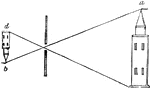
"Camera obscura strictly signifies a darkened chamber, because the room must be darkened, in order to observe its effects. To witness the phenomena of this instrument, let a room be closed in every direction, so as to exclude the light. Then from an aperture, say of an inch in diameter, admit a single beam of light, and the images of external things, such as trees and houses, and persons walking the streets, will be seen inverted on the wall opposite to where the light is admitted, or on a screen of white paper, placed before the aperture. The reason why the image is inverted will be obvious, when it is remembered that the rays proceeding from the extremities of the object must converge in order to pass through the small aperture; and as the rays of light always proceed in straight lines, they must cross each other at the point of admission. Thus the pencil a, coming from the upperpart of the tower, and proceeding straight, will represent the image of the part at b, while the lower part c, for the same reason, will be represented at d." —Comstock, 1850

Camera Obscura

"Camera obscura strictly signifies a darkened chamber, because the room must be darkened, in order to…
"Camera obscura strictly signifies a darkened chamber, because the room must be darkened, in order to observe its effects. To witness the phenomena of this instrument, let a room be closed in every direction, so as to exclude the light. Then from an aperture, say of an inch in diameter, admit a single beam of light, and the images of external things, such as trees and houses, and persons walking the streets, will be seen inverted on the wall opposite to where the light is admitted, or on a screen of white paper, placed before the aperture. The reason why the image is inverted will be obvious, when it is remembered that the rays proceeding from the extremities of the object must converge in order to pass through the small aperture; and as the rays of light always proceed in straight lines, they must cross each other at the point of admission. Thus the pencil a, coming from the upperpart of the tower, and proceeding straight, will represent the image of the part at b, while the lower part c, for the same reason, will be represented at d." —Comstock, 1850

Camera Obscura

"Camera obscura strictly signifies a darkened chamber, because the room must be darkened, in order to…
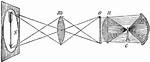
"Let a candle c, be placed on the inside of a box or tube, so that its light may pass through the plano-convex lens n, and strongly illuminate the object o. This object is generally a small transparent painting on a slip of glass, which slides through an opening in the tube. In order to show the figures in the erect position, these paintings are inverted, since their shadows are again inverted by the refraction of the convex lens m." —Comstock, 1850

Magic Lantern

"Let a candle c, be placed on the inside of a box or tube, so that its light may pass through the plano-convex…
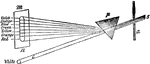
"Solar Spectrum.—If a ray, proceeding from the sun, be admitted into a darkened chamber, through an aperture in the window shutter, and allowed to pass through a triangular shaped piece of glass, called a prism, the light will be decomposed, and instead of a spot of white, there will be seen, on the opposite wall, a most brilliant display of colors, including all those seen in the rainbow." —Comstock, 1850

Solar Spectrum

"Solar Spectrum.—If a ray, proceeding from the sun, be admitted into a darkened chamber, through…
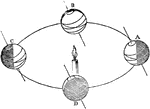
"Now it is the inclination of the Earth's axis, as above described, which causes the lengths of the days and nights to differ at the same place at different seasons of the year, for on reviewing the positions of the globe at A, it will be observed that the line formed by the enlightened and dark hemispheres, does not coincide with the line of the axis and the pole, but that the line formed by the darkness and the light, extends obliquely across the line of the Earth's axis, so that the north pole is in the light while the south is in the dark. In the position A, therefore, an observer at the north pole would see the sun constantly, while another at the south pole would not see it at all. Hence those living in the north temperate zone, at the season of the year when the earth is at A, or in the Summer, would have long days and short nights, in proportion as they approached the polar circle; while those who live in the south temperate zone, at the same time, and when it would be Winter there, would have long nights and short days in the same proportion." —Comstock, 1850

Earth Axis

"Now it is the inclination of the Earth's axis, as above described, which causes the lengths of the…
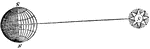
"Now it is the inclination of the Earth's axis, as above described, which causes the lengths of the days and nights to differ at the same place at different seasons of the year, for on reviewing the positions of the globe at A, it will be observed that the line formed by the enlightened and dark hemispheres, does not coincide with the line of the axis and the pole, but that the line formed by the darkness and the light, extends obliquely across the line of the Earth's axis, so that the north pole is in the light while the south is in the dark. In the position A, therefore, an observer at the north pole would see the sun constantly, while another at the south pole would not see it at all. Hence those living in the north temperate zone, at the season of the year when the earth is at A, or in the Summer, would have long days and short nights, in proportion as they approached the polar circle; while those who live in the south temperate zone, at the same time, and when it would be Winter there, would have long nights and short days in the same proportion." —Comstock, 1850

Earth Axis

"Now it is the inclination of the Earth's axis, as above described, which causes the lengths of the…
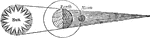
"When the Moon falls into the shadow of the Earth, the rays of the Sun are intercepted, or hid from her, and she then becomes eclipsed. when the Earth's shadow covers a part of her face, as seen by us, she suffers only a partial eclipse, one part of her disc being obscured, while the other part reflects the Sun's light. But when her whole surface is obscured by the Earth's shadow, she then suffers a total eclipse, and of a duration proportionate to the distance she passes through the Earth's shadow." —Comstock, 1850

Moon Eclipse

"When the Moon falls into the shadow of the Earth, the rays of the Sun are intercepted, or hid from…
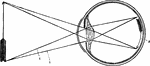
Diagram of the eye. 1: Lines of light from end of arrow; 2: Small, inverted image in the eye.

Eye Diagram

Diagram of the eye. 1: Lines of light from end of arrow; 2: Small, inverted image in the eye.
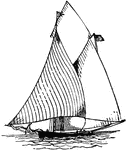
A triangular sail made of light canvas, used only in light winds and on yachts, set between the foretop mast head and the end of the jib boom.

Balloon Jib

A triangular sail made of light canvas, used only in light winds and on yachts, set between the foretop…
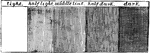
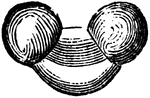
Principle of light and shade from light to dark.

Light and Shade

Principle of light and shade from light to dark.

As it were of three grains or cells united; the lateral empty and light.

Pine Pollen

As it were of three grains or cells united; the lateral empty and light.

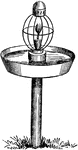
From the well known nocturnal habits of moths, and the certainty of their being destroyed by a light, a cheap and effective mode of destroying them, shown in the annexed figure. It consists of a pan of viscid matter placed upon a stake, which is set in the field of cotton at suitable distances. A block of wood is placed in the center of the pan, upon which is placed a lighted glass lantern. The moths, being attracted by the light, dash against it and fall into the pan, and are thus destroyed before depositing their eggs upon the tender leaves of the growing plant.

Moth Lantern

From the well known nocturnal habits of moths, and the certainty of their being destroyed by a light,…
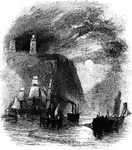
The romantisit, J. William Turner, was famous for his drawings of landscapes such as: lakes, castles, ruins, ships and coast lines. The painting was recently sold for $1,000,000.

Light-Towers of the Heve

The romantisit, J. William Turner, was famous for his drawings of landscapes such as: lakes, castles,…
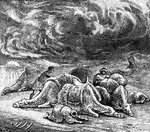
During the prevalence of the simoom, particles of fine sand are carried into the atmosphere and obscure the light of the sun. Becoming intensely heated, these particles, by their radiation, increase the temperature of the air, which sometimes rises as high as 120 degrees or 130 degrees Fahr. When powerful winds prevail, dense clouds of sand are carried about in the atmosphere, producing the so-called sand storms. The sand-drifts which are thus formed constantly change their position.

Sand Storm in the Desert

During the prevalence of the simoom, particles of fine sand are carried into the atmosphere and obscure…
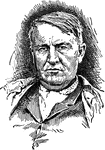
(1847-1931) Famous American inventor.

Thomas Alva Edison

(1847-1931) Famous American inventor.

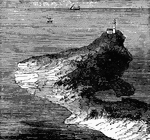
A peninsula with a lighthouse on it.

Peninsula

A peninsula with a lighthouse on it.

A wooden case or box in which the compass on board a ship is kept to protect it from injury. A light is placed within it at night to insure that its indications are seen. It is placed immediately in front of the wheel or steering apparatus, and secured to the deck, usually by metal stays. The after portion has glass windows, so that the compass is at all times visible to the helmsman, who stands at the wheel.

Binnacle

A wooden case or box in which the compass on board a ship is kept to protect it from injury. A light…
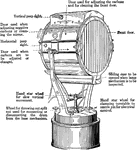
"An instrument for directing a powerful beam of electric light for the purpose of search, illumination, or signalling."—Finley, 1917

Searchlight

"An instrument for directing a powerful beam of electric light for the purpose of search, illumination,…
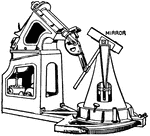
"An instrument described by Foucault for transmitting a beam of light along the optical axis of a fixed horizontal telescope."—Finley, 1917

Siderostat

"An instrument described by Foucault for transmitting a beam of light along the optical axis of a fixed…

"Hydrometers of variable immersion are usually light hollow glass spindles weighted by shot or mercury."—Finley, 1917

Standard hydrometer

"Hydrometers of variable immersion are usually light hollow glass spindles weighted by shot or mercury."—Finley,…
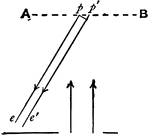
A diagram of action of diffraction grating.

Diffraction grating

A diagram of action of diffraction grating.

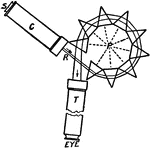
"C. Collimator; P, center of group of prisms; T, telescope; s, slit through which the ray of light enters, R, ray on its progress through prisms to telescope."—Finley, 1917

Spectroscope

"C. Collimator; P, center of group of prisms; T, telescope; s, slit through which the ray of light enters,…
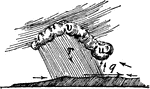
"The warmer current ascends, as indicated by the small arrows, and curls at the black wreath (u) of cloud, and then the commingling of the two currents forms an imposing dark dome (v) of cloud, from which heavy rain (r) or hail descends. The light grayish cloud which is seen behind the black wreath is the rain descending from the dark dome. The heavy raindrops bring down a large quantity of cold air, which flies straight out in advance of the storm, and produces the squall (q) indicated by the long arrow."—Finley, 1917

Line squall

"The warmer current ascends, as indicated by the small arrows, and curls at the black wreath (u) of…
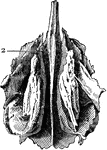
Ethmoid bone, posterior surface. The ethmoid bone is an exceedingly light, spongy bone, placed between the two orbits and at the root of the nose, contributing to form a part of each of these cavities. Label: 2, cribriform, or perforated plate.

Ethmoid Bone of the Human Skull

Ethmoid bone, posterior surface. The ethmoid bone is an exceedingly light, spongy bone, placed between…
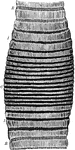
Wave of contraction passing over a muscular fiber of dytiscus, very highly magnified. When a muscle contracts, the dark bands swell up and shorten (the light bands are also constricted), and the whole fiber broadens and shortens. Labels: R, R, portions of the fiber at rest; C, contracted part; I, I, intermediate condition.

Muscular Fiber Contracting

Wave of contraction passing over a muscular fiber of dytiscus, very highly magnified. When a muscle…
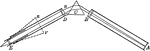
"The light to be studied is admitted through a narrow slit (A) in the end of a tube, in such a way that it will fall in parallel rays on a prism (C) with its edges parallel to the slit. When the beam emerges from the prism, the different colors are separated and the spectrum is viewed through lenses (E) placed at the end of another tube." -Brownlee 1907

Diagrammatic Representation of Spectroscope

"The light to be studied is admitted through a narrow slit (A) in the end of a tube, in such a way that…
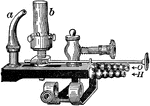
a is the burner tip for an oxy-hydrogen flame, and b is the cylinder of quicklime.

Lime-Light Burner

a is the burner tip for an oxy-hydrogen flame, and b is the cylinder of quicklime.
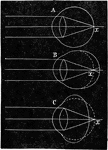
Diagram illustrating rays of light converging in a normal eye (A), a myopic eye (B), and a hypermetropic eye (C)

Vision

Diagram illustrating rays of light converging in a normal eye (A), a myopic eye (B), and a hypermetropic…
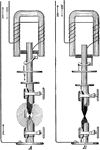
Arc lighting, which used two carbon rods conducting electricity to produce light. -Atkinson 1903

Carbon Arc Lighting

Arc lighting, which used two carbon rods conducting electricity to produce light. -Atkinson 1903
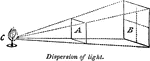
"The intensity of light from a candle decreases proportionally with an increase in distance from the candle." -Comstock 1850

Dispersion of Light

"The intensity of light from a candle decreases proportionally with an increase in distance from the…
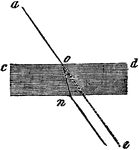
"Although a ray of light will pass in a straight line, when not interrupted, yet when it passes obliquely from one transparent body into another, of a different density, it leaves its linear direction, and is bent, or refracted more or less, out of its former course." -Comstock 1850

Refraction of Light

"Although a ray of light will pass in a straight line, when not interrupted, yet when it passes obliquely…
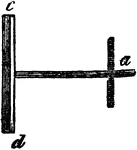
"Thus, if a sunbeam, passing through a small aperure in the window shutter a, be permitted to fall upon the plane mirror, or looking glass, c, d, at right-angles, it will be reflected back at right-angles with the mirror, and therefore will pass back again in exactl the same direction in which it approached." -Comstock 1850

Reflection of Light

"Thus, if a sunbeam, passing through a small aperure in the window shutter a, be permitted to fall upon…
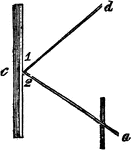
"Let a ray pass towards a mirror in the line a, c, it will be reflected off in the direction of c, d, making the angles 1 and 2 exactly equal." -Comstock 1850

Reflecion of Light

"Let a ray pass towards a mirror in the line a, c, it will be reflected off in the direction of c, d,…
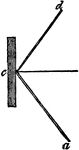
"The ray a, c, is the ray of incidence, and that from c, to d, is the ray or reflection. The angles which a, c, make with the perpendicular line, and with the plane of the mirror, is exactly equal to those made by c, d, with the same perpendicular, and the same plane surface." -Comstock 1850

Reflection of Light

"The ray a, c, is the ray of incidence, and that from c, to d, is the ray or reflection. The angles…
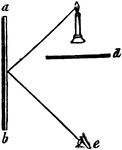
"Suppose the mirror, a b, to be placed on the side of a room, and a lamp to be set in antoher room, but so situated as that its light would shine upon the glass. The lamp itself could not be seen by the eye placed at e, because the partition d is between them; but its image would be visible at e, beacuse the angle of the incident ray, coming from the light, and that of the reflected ray which reaches the eye, are equal." -Comstock 1850

Plane Mirror

"Suppose the mirror, a b, to be placed on the side of a room, and a lamp to be set in antoher room,…

"This will be understood [here] where the ray of light A B, proceeding from the eye, falls perpendicularly on the plane mirror B D. will be reflected back in the same line; but the ray C D coming from the feet, which falls obliquely on the mirror, will be reflected back under the same angle in the line D A; and since we see objects in the direction of the reflected rays, and the image appears at the same distance behind the mirror that is object is before it, we must continue the line A D to the feet, E, and for the same reason, the rays A B, from the eye, must be prolonged to F, as far behind the mirror as the line E extends, where the whole image will be represented." -Comstock 1850

Mirror Half the Length of the Object

"This will be understood [here] where the ray of light A B, proceeding from the eye, falls perpendicularly…
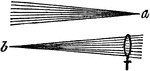
"Rays of light are said to diverge, when they proceed from the same point, and constantly recede from each other, as from the same point a. Rays of light are said to converge, when they approach each other in such a drection as finaly to meet at a point, as at b." -Comstock 1850

Rays of Light

"Rays of light are said to diverge, when they proceed from the same point, and constantly recede from…
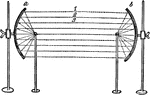
"Suppose a red hot ball to be placed in the principle focus of the mirror, a, the rays of heat and light proceeding from it will be reflected in the parallel lines 1, 2, 3 etc." -Comstock 1850

Reflection of Heat Using Concave Mirrors

"Suppose a red hot ball to be placed in the principle focus of the mirror, a, the rays of heat and light…
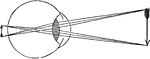
"...and the cornea will become too flat, or not suffciently convex, to make the rays of light meet at the proper place, and the image will therefore tend to be formed beyond the retina, instead of before it..." -Comstock 1850

Cornea too Concave on Eye

"...and the cornea will become too flat, or not suffciently convex, to make the rays of light meet at…
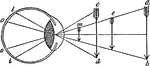
"The angle under which the rays of light, coming from the extremities of an object, cross each other at the eye, bears a proportion directly to the length, and inversely to the distance of the object." -Comstock 1850

Angle of Vision

"The angle under which the rays of light, coming from the extremities of an object, cross each other…
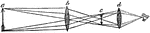
"Suppose a, to be a distinct object, from which pencils of rays flow from every point toward the object lens b. The image of a, in consequence of the refraction of the rays by the object lens, is inverted at c, which is the focus of the eyeglass d, and through which the image is then seen, still inverted." -Comstock 1850

Refracting Telescope

"Suppose a, to be a distinct object, from which pencils of rays flow from every point toward the object…
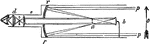
"Suppose the object o to be at such a distance, that the rays of light from it pass in parallel lines, p, p, to the great reflector, r, r. this reflector being concave, the rays are converged by reflection, and cross each other at a, b which the image is inverted. The rays then pass to the small mirror, b, which being also concave, they are thrown back in nearly parallel lines, and having passed the aperture in the centre of the great mirror, fall on the plano-convex lens e." -Comstock 1850

Refracting Telescope

"Suppose the object o to be at such a distance, that the rays of light from it pass in parallel lines,…
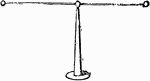
"One of the simplest instruments of this kind consists of a metallic needle, terminated at each end by a light pith-ball, which is covered with gold leaf, and supported horizontally at its centre by a fine point.." -Comstock 1850

Electroscope

"One of the simplest instruments of this kind consists of a metallic needle, terminated at each end…
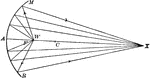
"Hold a lamp reflector or other large concave mirror directly facing the sun, so as to bring the rays of light to a focus...At some point, W, between F and C, the center of curvature of the reflector, hang a loud-ticking watch, and hunt for the point, X, at which the ear can most distinctly hear the ticking. Moving the reflector will render the sound inaudible." -Avery 1895

Reflection of Sound Using a Reflector

"Hold a lamp reflector or other large concave mirror directly facing the sun, so as to bring the rays…
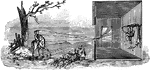
"If light from a highly luminous body is admitted to a darkened room through a small hole in the shutter and ther received upon a white screen, it will form an inverted image of the object." -Avery 1895

Image by Aperature

"If light from a highly luminous body is admitted to a darkened room through a small hole in the shutter…
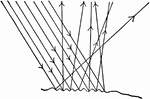
"Irregular reflection or diffusion results from the incidence of radiant energy upon an irregular surface, as is illustrated. Bodies are made visible to the eye mainly by the light that they thus diffuse." -Avery 1895

Irregular Reflection or Diffusion

"Irregular reflection or diffusion results from the incidence of radiant energy upon an irregular surface,…
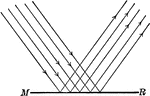
"Regular reflection results from the incidence of radiant energy upon a polished surface. When a beam of light falls upon a mirror, the greater part of it is reflected in a definite direction as is illustrated, and forms an image of the object from which it came. A perfect mirror would be invisible." -Avery 1895

Regular Reflection

"Regular reflection results from the incidence of radiant energy upon a polished surface. When a beam…
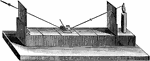
"The apparatus shown is used to prove that incident rays and reflected rays are equal." -Avery 1895
Reflected Light

"The apparatus shown is used to prove that incident rays and reflected rays are equal." -Avery 1895

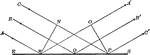
"Consider a beam of light as made up of a number of ehter waves moving forward in air and side by side, as represented by the rays A, B, C. Imagine a plane, MN, normal to these yars, attached to the waves and moving forward in a straight line. As the wave front advances beyond MN, the ray, A, strikes the reflecting surface, RS, and is turned back into the air in accordance with the law just given." -Avery 1895

Explanation of Reflection

"Consider a beam of light as made up of a number of ehter waves moving forward in air and side by side,…