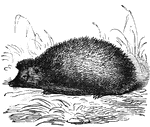
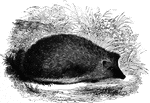
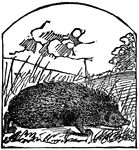
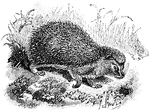
The hedgehog is insectivorous and is in the same family as moles and shrews.

Hedgehog

The hedgehog is insectivorous and is in the same family as moles and shrews.

"The body is short, thick, and stout; the nose pointed, the tail short or entirely wanting, and the upper surface more or less covered with short spines, which when the snimal roll themseles up into a ball, as they always do when alarmed or threatened, present an almsost insuperable obstacle to any predaceous animal that might attack them." —Goodrich, 1885

Hedgehog

"The body is short, thick, and stout; the nose pointed, the tail short or entirely wanting, and the…
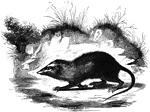
The only species of the Gymnure genus, found in Sumatra. "It is little known, but seems to possess more teeth than the hedgehog, that is, fourty-four in number. It is nearly the same size as that animal, but its body is more elongated. Its fur is soft, and of a grayish color: its tail is long, and nearly naked." —Goodrich, 1885

Raffle's Gymnure

The only species of the Gymnure genus, found in Sumatra. "It is little known, but seems to possess more…
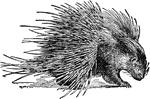
"Hedgehog is a quadruped distinguished by having the body covered with spines instead of hair. The skin of the back is provided with a great orbicular muscle which enables the animal to roll itself up in the form of a ball. The tail is very short. There are several species—some authorities enumerate 14. The best known is the common hedgehog. This species has a long nose, the nostrils bordered on each side by a loose flap; the hind feet have five toes; the ears are short, rounded, naked and dusky; the upper part of the face, sides, and rump covered with strong, coarse hair, of a yellowish ash color, the back with sharp strong spines of a whitish tint with a bar of black through their middle. They are usually abot 10 inches long, the tail about one. Their usual residence is in small thickets, and they feed on fallen fruits, roots, and insects; they are also fond of flesh, either raw or roasted. The hedgehog defends himself from the attacks of other animals by rolling himself up, and thus exposing no part of his body that is not furnished with a defense of spines. It may be rendered domestic to a certain degree, and has been employed to destroy cockroaches which it pursues with avidity. In the winter the hedgehog wraps itself in a warm nest, composed of moss, dried hay and leaves, and remains torpid till spring."—(Charles Leonard-Stuart, 1911)

Hedgehog

"Hedgehog is a quadruped distinguished by having the body covered with spines instead of hair. The skin…
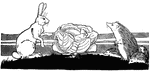
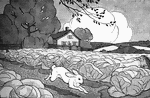
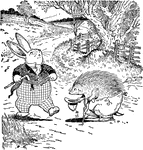
Scene from the story, "The Hare and the Hedgehog."

Hare and Hedgehog

Scene from the story, "The Hare and the Hedgehog."

Scene from the story, "The Hare and the Hedgehog."

Hare

Scene from the story, "The Hare and the Hedgehog."

A small animal having the hair on the upper part of its body mixed with prickles or spines, and endowed with power of rolling itself into a ball.

Hedgehog

A small animal having the hair on the upper part of its body mixed with prickles or spines, and endowed…
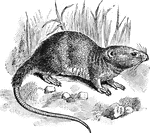
A rat having a long scaly tail, and lacks the spines in the pelage which most of this group of hedgehog rats possess.

Hedgehog Rat

A rat having a long scaly tail, and lacks the spines in the pelage which most of this group of hedgehog…
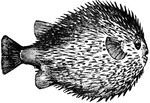
A fish with many small spikes that blows itself into a globular shape by swallowing air.

Sea Porcupine

A fish with many small spikes that blows itself into a globular shape by swallowing air.
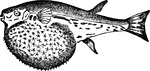
"Tetraodon have a remarkable power of inflating their bodies by filling their stomachs with air, the stomach being extremely dilatable, and assuming a globular form when distended, whence they have received the name Globe Fish, whilst from the spines, which stand out in all directions, like those of a hedgehog when rolled up, as if for defence of the inflated body, some of them have been designated Porcupine Fish." — Chambers' Encyclopedia, 1875

Globefish

"Tetraodon have a remarkable power of inflating their bodies by filling their stomachs with air, the…
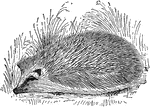
A small European and Asian rodent has quills on his back and can roll up into a ball.

Hedgehog

A small European and Asian rodent has quills on his back and can roll up into a ball.

Two hedgehogs greet each other.

Hedgehog Couple

Two hedgehogs greet each other.

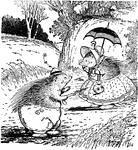
A hedgehog greets a snobby hare.

Hedgehog and Hare

A hedgehog greets a snobby hare.

The West European Hedgehog (Erinaceus europaeus) is a small mammal in the Erinaceidae family of hedgehogs.
West European Hedgehog

The West European Hedgehog (Erinaceus europaeus) is a small mammal in the Erinaceidae family of hedgehogs.

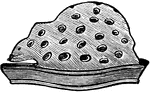
A pot in the shape of a hedgehog that can be used to grow hyacinths in.

Hedgehog Pot

A pot in the shape of a hedgehog that can be used to grow hyacinths in.

Ilex aquifolium ferox is a green leaved variety of holly. The common name is hedgehog holly. The leaves are two inches long with strongly developed marginal spines.

Leaf of Ilex Aquifolium Ferox

Ilex aquifolium ferox is a green leaved variety of holly. The common name is hedgehog holly. The leaves…
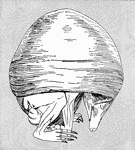
A skinned hedgehog. This image is supposed to show the muscles of the back which contract to make the animal into a "living ball". Notice how close its extremities are to its nose.

Skinned Hedgehog

A skinned hedgehog. This image is supposed to show the muscles of the back which contract to make the…
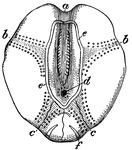
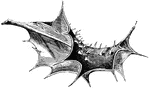
<i>Amphidotus cordatus</i> or <i>Echinocardium cordatum</i>, commonly called a sea urchin, viewed from above. a, anterior ambulacrum, forming with b, b, anterolateral ambulacra, the trivium; c, c, two posterolateral ambulacra, forming the bivium; d, madreporic tubercle surrounded by genital pores; e, intrapetalous semita or fasciole; f, circumanal semita." &mdash;Whitney, 1889

Sea Urchin - View from Above

Amphidotus cordatus or Echinocardium cordatum, commonly called a sea urchin, viewed from above. a, anterior…