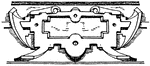
This Renaissance strap-work frame was made between 1576-1577 in Germany. Made out of bronze tablets, the design usually contained foliage, palmettes, festoons and garlands of fruit, fluttering ribbons, cherub-heads are frequently added. Strap-work frame was an invention of the Renaissance.

Renaissance Strap-Work Frame

This Renaissance strap-work frame was made between 1576-1577 in Germany. Made out of bronze tablets,…
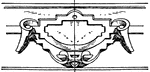
This Renaissance strap-work frame was made between 1576-1577 in Germany. Made out of bronze tablets, the design usually contained foliage, palmettes, festoons and garlands of fruit, fluttering ribbons, cherub-heads are frequently added. Strap-work frame was an invention of the Renaissance.

Renaissance Strap-Work Frame

This Renaissance strap-work frame was made between 1576-1577 in Germany. Made out of bronze tablets,…

This Renaissance strap-work frame was made between 1576-1577 in Germany.

Renaissance Strap-Work Frame

This Renaissance strap-work frame was made between 1576-1577 in Germany.
This Renaissance strap-work frame is French.

Renaissance Strap-Work Frame

This Renaissance strap-work frame is French.

Renaissance strap-work frame.

Renaissance Strap-Work Frame

Renaissance strap-work frame.

This Rococo strap-work frame is French. During this period the strap-work frame was unsymmetrical and picturesque arrangements.

Rococo Strap-Work Frame

This Rococo strap-work frame is French. During this period the strap-work frame was unsymmetrical and…
This Rococo strap-work frame is French, usually placed in a corner of a wall. During this period the strap-work frame was unsymmetrical and picturesque arrangements.

Rococo Strap-Work Frame

This Rococo strap-work frame is French, usually placed in a corner of a wall. During this period the…
This Rococo strap-work frame is French. During this period the strap-work frame was unsymmetrical and picturesque arrangements.

Rococo Strap-Work Frame

This Rococo strap-work frame is French. During this period the strap-work frame was unsymmetrical and…

Modern strap-work frame.

Modern Strap-Work Frame

Modern strap-work frame.

Modern strap-work frame.

Modern Strap-Work Frame

Modern strap-work frame.

This modern strap-work frame was French.

Modern Strap-Work Frame

This modern strap-work frame was French.

Modern strap-work frame.

Modern Strap-Work Frame

Modern strap-work frame.

This border typographical frame was designed during the Renaissance period between 1550-1560. It was of Flemish origin, used as a decoration of books and documents.

Border Typographical Frame

This border typographical frame was designed during the Renaissance period between 1550-1560. It was…
The border typographical frame was used as a decoration for books and documents.

Border Typographical Frame

The border typographical frame was used as a decoration for books and documents.
This Flemish border typographical frame was designed during the Renaissance period in the 16th century.
Border Typographical Frame

This Flemish border typographical frame was designed during the Renaissance period in the 16th century.

This Printer's-mark typographical frame was designed during the Italian Renaissance, 16th century. The head and tail pieces were designed of strap-work.

Printer's-Mark Typographical Frame

This Printer's-mark typographical frame was designed during the Italian Renaissance, 16th century. The…
This Printer's-mark typographical frame was designed during the Italian Renaissance, 16th century. The head and tail pieces were designed of strap-work.

Printer's-Mark Typographical Frame

This Printer's-mark typographical frame was designed during the Italian Renaissance, 16th century. The…
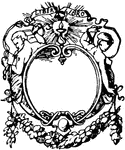
This Printer's-mark typographical frame was designed in Paris during the 19th century. The head and tail pieces were designed of strap-work.

Printer's-Mark Typographical Frame

This Printer's-mark typographical frame was designed in Paris during the 19th century. The head and…
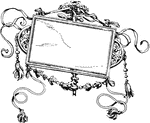
This German Typographical frame is a tablet from the triumphal entry of the Emperor Maximilian. It was designed between 1473-1531.

German Typographical Frame

This German Typographical frame is a tablet from the triumphal entry of the Emperor Maximilian. It was…
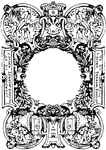
This French typographical frame was designed during the Renaissance in the 16th century.

French Typographical Frame

This French typographical frame was designed during the Renaissance in the 16th century.
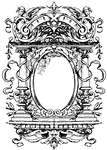
The principles of decoration in the modern typographical frame were very varied, with greater freedom allowed.

Modern Typographical Frame

The principles of decoration in the modern typographical frame were very varied, with greater freedom…
The principles of decoration in the modern typographical frame were very varied, with greater freedom allowed.

Modern Typographical Frame

The principles of decoration in the modern typographical frame were very varied, with greater freedom…
The Decoration of escutcheons strap-work tablet was used as snuff-box lids.

Decoration of Escutcheons Strap-Work Frame

The Decoration of escutcheons strap-work tablet was used as snuff-box lids.
The Decoration of escutcheons strap-work tablet was used as snuff-box lids.

Decoration of Escutcheons Strap-Work Frame

The Decoration of escutcheons strap-work tablet was used as snuff-box lids.
This Modern strap-work border and margin comes from Spain. Made out of metal, it has a rim that is decorated with pierced work and is outlined in richer work in which the framework is free-ending outwards.

Modern Strap-Work Border And Margin

This Modern strap-work border and margin comes from Spain. Made out of metal, it has a rim that is decorated…
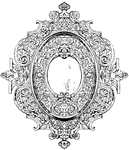
This Modern strap-work border and margin comes from Spain. Made out of metal, it has a rim that is decorated with pierced work and is outlined in richer work in which the framework is free-ending outwards.

Modern Strap-Work Border And Margin

This Modern strap-work border and margin comes from Spain. Made out of metal, it has a rim that is decorated…
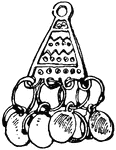
The Old Frankish earring is a pendant that is free-ending with different moveable parts.

Old Frankish Earring

The Old Frankish earring is a pendant that is free-ending with different moveable parts.
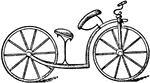
The bicycle, bike, or cycle is a pedal-driven, human-powered vehicle with two wheels attached to a frame, one behind the other.

Bicycle

The bicycle, bike, or cycle is a pedal-driven, human-powered vehicle with two wheels attached to a frame,…
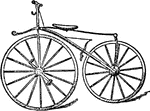
Boneshaker is a name used from about 1869 up to the present time, to refer to the first type of true bicycle with pedals, which was called "velocipede" (from the Latin for "fast foot") by its manufacturers. "Boneshaker" refers to the extremely uncomfortable ride, which was caused by the stiff wrought-iron frame and wooden wheels surrounded by tires made of iron.

Boneshaker Bicycle

Boneshaker is a name used from about 1869 up to the present time, to refer to the first type of true…
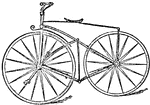
The bicycle, bike, or cycle is a pedal-driven, human-powered vehicle with two wheels attached to a frame, one behind the other.

Bicycle

The bicycle, bike, or cycle is a pedal-driven, human-powered vehicle with two wheels attached to a frame,…
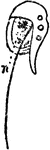
An illustration of the young stages of Noctiluca scintillans. Noctiluca scintillans, also published as Noctiluca miliaris, is a free-living non-parasitic marine-dwelling species of dinoflagellate that exhibits bioluminescence. The bioluminescent characteristic of N. scintillans is produced by a luciferin-luciferase system located in thousands of spherically shaped organelles, or "microsources", located throughout the cytoplasm of this single-celled protist. Nonluminescent populations within the genus Noctiluca lack these microsources.

Young Stage of Noctiluca Scintillans

An illustration of the young stages of Noctiluca scintillans. Noctiluca scintillans, also published…
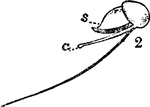
An illustration of the young stages of Noctiluca scintillans. Noctiluca scintillans, also published as Noctiluca miliaris, is a free-living non-parasitic marine-dwelling species of dinoflagellate that exhibits bioluminescence. The bioluminescent characteristic of N. scintillans is produced by a luciferin-luciferase system located in thousands of spherically shaped organelles, or "microsources", located throughout the cytoplasm of this single-celled protist. Nonluminescent populations within the genus Noctiluca lack these microsources.

Young Stage of Noctiluca Scintillans

An illustration of the young stages of Noctiluca scintillans. Noctiluca scintillans, also published…
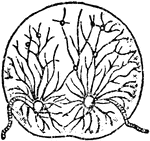
An illustration of the first stage of fission in the Noctiluca scintillans. Noctiluca scintillans, also published as Noctiluca miliaris, is a free-living non-parasitic marine-dwelling species of dinoflagellate that exhibits bioluminescence. The bioluminescent characteristic of N. scintillans is produced by a luciferin-luciferase system located in thousands of spherically shaped organelles, or "microsources", located throughout the cytoplasm of this single-celled protist. Nonluminescent populations within the genus Noctiluca lack these microsources.

Stage One in the Fission of Noctiluca Scintillans

An illustration of the first stage of fission in the Noctiluca scintillans. Noctiluca scintillans, also…
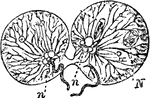
An illustration of the second stage of fission in the Noctiluca scintillans. Noctiluca scintillans, also published as Noctiluca miliaris, is a free-living non-parasitic marine-dwelling species of dinoflagellate that exhibits bioluminescence. The bioluminescent characteristic of N. scintillans is produced by a luciferin-luciferase system located in thousands of spherically shaped organelles, or "microsources", located throughout the cytoplasm of this single-celled protist. Nonluminescent populations within the genus Noctiluca lack these microsources.

Stage Two in the Fission of Noctiluca Scintillans

An illustration of the second stage of fission in the Noctiluca scintillans. Noctiluca scintillans,…
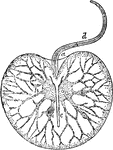
An illustration of the aboral side view of the Noctiluca scintillans. Noctiluca scintillans, also published as Noctiluca miliaris, is a free-living non-parasitic marine-dwelling species of dinoflagellate that exhibits bioluminescence. The bioluminescent characteristic of N. scintillans is produced by a luciferin-luciferase system located in thousands of spherically shaped organelles, or "microsources", located throughout the cytoplasm of this single-celled protist. Nonluminescent populations within the genus Noctiluca lack these microsources.

Aboral Side View of the Noctiluca Scintillans

An illustration of the aboral side view of the Noctiluca scintillans. Noctiluca scintillans, also published…
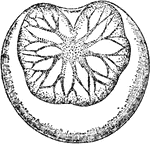
An illustration of the Noctiluca scintillans. Noctiluca scintillans, also published as Noctiluca miliaris, is a free-living non-parasitic marine-dwelling species of dinoflagellate that exhibits bioluminescence. The bioluminescent characteristic of N. scintillans is produced by a luciferin-luciferase system located in thousands of spherically shaped organelles, or "microsources", located throughout the cytoplasm of this single-celled protist. Nonluminescent populations within the genus Noctiluca lack these microsources.

Noctiluca Scintillans

An illustration of the Noctiluca scintillans. Noctiluca scintillans, also published as Noctiluca miliaris,…
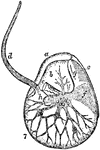
An illustration of the lateral view of the Noctiluca scintillans. Noctiluca scintillans, also published as Noctiluca miliaris, is a free-living non-parasitic marine-dwelling species of dinoflagellate that exhibits bioluminescence. The bioluminescent characteristic of N. scintillans is produced by a luciferin-luciferase system located in thousands of spherically shaped organelles, or "microsources", located throughout the cytoplasm of this single-celled protist. Nonluminescent populations within the genus Noctiluca lack these microsources.

Lateral View of Noctiluca Scintillans

An illustration of the lateral view of the Noctiluca scintillans. Noctiluca scintillans, also published…
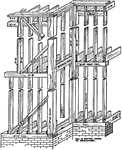
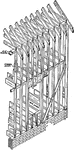
An illustration of a braced frame.

Braced Frame

An illustration of a braced frame.

An illustration of a balloon frame.

Balloon Frame

An illustration of a balloon frame.

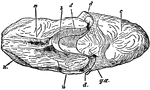
An illustration of a female nautilus without the shell. "m, The dorsal "hood" formed by the enlargement of the outer or annular lobe of the forefoot, and corresponding to the sheaths of two tentacles; n. Tentacular sheaths of lateral portion of the annular lobe; u, The left eye; b, The nuchal plate, continuous at its right and left posterior angles with the root of the mid-foot, and corresponding to the nuchal cartilage of Sepia; c, Visceral hump; d, The free margin of the mantle-skirt,...; g.a, Points to the lateral continuation of the nuchal plate b to join the root of the mid foot of siphon." (Britannica, 1910).

Female Nautilus without Shell

An illustration of a female nautilus without the shell. "m, The dorsal "hood" formed by the enlargement…
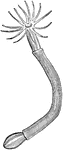
Edwardsia beautempsi is a species of sea anemone that lives freely in tubes in the sand, unattached.

Sea Anemone

Edwardsia beautempsi is a species of sea anemone that lives freely in tubes in the sand, unattached.

"Suppose we have a pipe A B laid in a horizontal position so that the centre line is exactly at the same level all along the pope, and differences of level may be neglected. Let water be delivered b this pipe at a steady from a reservoir provided with a constant supply which keeps the free surface level always the same.  If the pipe A B is of uniform sectional area throughout, and is at all points offers a uniform frictional resistance to the flow of the water, the pressure will gradually become less at points along it more and more distanct from the reservoir. This is no lonfer the case when the pipe is larger at one place than another, as shown in the [figure]." (Britannica, 1891)

Water Flow in Pipes

"Suppose we have a pipe A B laid in a horizontal position so that the centre line is exactly at the…
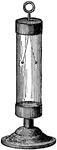
"An instrument for observing or detecting the existence of free electricity, and, in general, for determining its kind. ... The simplest electroscope consists of pith-balls suspended by silk threads." -Whitney, 1911

Pith-Ball Electroscope

"An instrument for observing or detecting the existence of free electricity, and, in general, for determining…
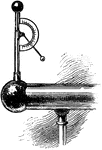
"An instrument for observing or detecting the existence of free electricity, and, in general, for determining its kind. ... Quadrant electroscope, a form of pith-ball electroscope which serves to measure roughly the degree of electrification by the rise of the pith-ball as indicated by the motion of the rod carrying it on a graduated semicircle." -Whitney, 1911

Quadrant Electroscope

"An instrument for observing or detecting the existence of free electricity, and, in general, for determining…
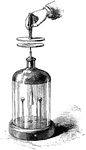
"An instrument for observing or detecting the existence of free electricity, and, in general, for determining its kind. ... In Volta's condensing electroscope, in place of the gilt knob there is a flat metal plate upon which rests another similar plate, which may be removed by an insulating handle." -Whitney, 1911

Condensing Electroscope

"An instrument for observing or detecting the existence of free electricity, and, in general, for determining…
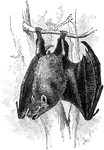
The Egyptian Free-Tailed Bat (Tadarida aegyptiaca) is a species of bat in the Molossidae family of free-tailed bats.

Egyptian Free-Tailed Bat

The Egyptian Free-Tailed Bat (Tadarida aegyptiaca) is a species of bat in the Molossidae family of free-tailed…
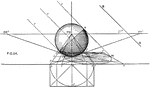
"A globe casts its shadow upon the ground; the sun's rays parallel with the picture at an angle of 45° with the horizon." (Britannica, 1891)

Shadows of Curvilinear Objects

"A globe casts its shadow upon the ground; the sun's rays parallel with the picture at an angle of 45°…
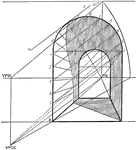
"An archway parallel to the picture. the sun's inclination 40° and elevation 30°." (Britannica, 1891)

Shadows of an Archway

"An archway parallel to the picture. the sun's inclination 40° and elevation 30°." (Britannica,…
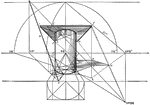
"A column supporting a horizontal square slab at right angles with the picture plane. A pole leans against the wall behind, and cast sit shadow on the column. Sun's inclination 40°, elevation 35°." (Britannica, 1891)

Shadows of an Column Supporting a Horizontal Square

"A column supporting a horizontal square slab at right angles with the picture plane. A pole leans against…
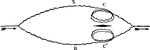
"The galvanometer consists of two distinct coils of wire, each having the same resistance, and having equal magnetic effects upon the needle. These coils C and C' are wound in opposite directions, as shown, and one end of each is joined to the same terminal on the frame of the galvanometer; the other ends are joined to separate terminals also situated on the frame." (Britannica, 1891)

Differential Galvanometer

"The galvanometer consists of two distinct coils of wire, each having the same resistance, and having…
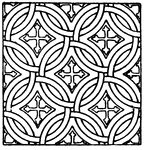
The mosaic circle pattern is inlaid pieces of stone, wood, glass, leather or straw to make a picture or pattern. This design is found in a cathedral in Monreale, Sicily, Italy.

Mosaic Square Pattern

The mosaic circle pattern is inlaid pieces of stone, wood, glass, leather or straw to make a picture…
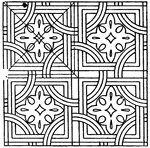
The marble mosaic circle pattern is inlaid pieces of stone, wood, glass, leather or straw to make a picture or pattern. This design is found in the San Vitale church in Ravenna, Italy.

Marble Mosaic Circle Pattern

The marble mosaic circle pattern is inlaid pieces of stone, wood, glass, leather or straw to make a…
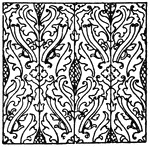
This textile pattern comes from a 1560 Venetian picture.

Textile Pattern

This textile pattern comes from a 1560 Venetian picture.

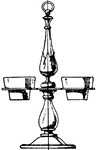
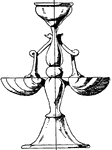
This spice-frame salt-cellar is a 18th century design made out of glass.

Spice-Frame Salt-Cellar

This spice-frame salt-cellar is a 18th century design made out of glass.

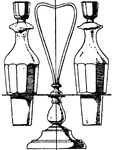
This modern cruet-frame is used to hold oil and vinegar in small bottles with a shoulder.

Modern Cruet-Frame

This modern cruet-frame is used to hold oil and vinegar in small bottles with a shoulder.
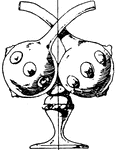
This modern cruet-frame is used to hold oil and vinegar in small bottles with a shoulder. It is made out of colored glass.

Modern Cruet-Frame

This modern cruet-frame is used to hold oil and vinegar in small bottles with a shoulder. It is made…
This modern cruet-frame is used to hold oil and vinegar in small bottles with a shoulder.

Modern Cruet-Frame

This modern cruet-frame is used to hold oil and vinegar in small bottles with a shoulder.
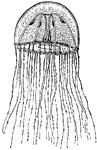
Colonial, plant-like animals closely related to jellyfish, with stinging cells, Any member of the invertebrate order Hydroida (class Hydrozoa, phylum Cnidaria). Hydroids have three basic life-cycle stages: (1) a tiny free-swimming planula larva about 1 mm (0.04 inch) long, which settles and grows into (2) a sessile (attached), usually colonial hydroid stage, which in turn liberates (3) medusa.

Medusa of a Hydroid

Colonial, plant-like animals closely related to jellyfish, with stinging cells, Any member of the invertebrate…
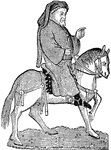
An illustration of Geoffrey Chaucer as a Canterbury pilgrim.  Geoffrey Chaucer (c. 1343 – 25 October 1400?) was an English author, poet, philosopher, bureaucrat, courtier and diplomat. Although he wrote many works, he is best remembered for his unfinished frame narrative The Canterbury Tales. Sometimes called the father of English literature, Chaucer is credited by some scholars as the first author to demonstrate the artistic legitimacy of the vernacular English language, rather than French or Latin.

Geoffrey Chaucer

An illustration of Geoffrey Chaucer as a Canterbury pilgrim. Geoffrey Chaucer (c. 1343 – 25 October…
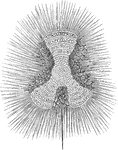
"A pelagic family of radioflagellate infusorians, typified by the genus Euchitonia. The animalcules are free-floating." -Whitney, 1911

Euchitonia

"A pelagic family of radioflagellate infusorians, typified by the genus Euchitonia. The animalcules…