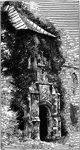
After the Norman conquest in 1066, Lanfranc (1070-1077) became the first Norman archbishop. He thoroughly rebuilt the ruined Saxon cathedral in a Norman design based strong on the Abbey of St. Etienne in Caen, of which he had previously been abbot. The new cathedral was dedicated in 1077.

Norman Door, Canterbury Cathedral

After the Norman conquest in 1066, Lanfranc (1070-1077) became the first Norman archbishop. He thoroughly…
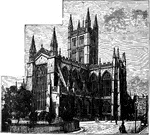
The Abbey Church of Saint Peter, Bath, commonly known as Bath Abbey, is an Anglican parish church and a former Benedictine monastery in Bath, Somerset, England. Founded in the 7th century, reorganized in the 10th century and rebuilt in the 12th and 16th centuries, it is one of the largest examples of Perpendicular Gothic architecture in the West Country.

Bath Abbey (Cathedral) Church

The Abbey Church of Saint Peter, Bath, commonly known as Bath Abbey, is an Anglican parish church and…
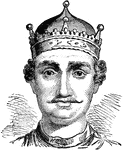
William I of England (1027 – 9 September 1087), better known as William the Conqueror, was Duke of Normandy from 1035 and King of England from 1066 to his death. To claim the English crown, William invaded England in 1066, leading an army of Normans to victory over the Anglo-Saxon forces of Harold Godwinson (who died in the conflict) at the Battle of Hastings, and suppressed subsequent English revolts in what has become known as the Norman Conquest. His reign, which brought Norman culture to England, had an enormous impact on the subsequent course of England in the Middle Ages. In addition to political changes, his reign also saw changes to English law, a programme of building and fortification, changes to the vocabulary of the English language, and the introduction of continental European feudalism into England.

William I of England

William I of England (1027 – 9 September 1087), better known as William the Conqueror, was Duke…
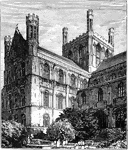
Founded in the Saxon period, the architecture is mainly Norman following a rebuilding in the 12th century. With Durham and Ely Cathedrals, it is one of the most important 12th century buildings in England to have remained largely intact, despite extensions and restoration. Peterborough Cathedral is known for its imposing Early English Gothic West Front (facade) which, with its three enormous arches, is without architectural precedent and with no direct successor.

Peterborough Cathedral

Founded in the Saxon period, the architecture is mainly Norman following a rebuilding in the 12th century.…
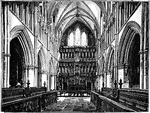
It is the mother church of the Anglican Diocese of Southwark. It has been a place of Christian worship for over 1,000 years, but a cathedral only since 1905. Henry Cardinal Beaufort repaired the church after a 1212 fire. The main structure of the present church was built between 1220 and 1420, making it the first Gothic church in London. Heresy trials occurred in the Galilee chapel in 1555, under Mary I of England.

Choir of St. Saviour's, Southwark

It is the mother church of the Anglican Diocese of Southwark. It has been a place of Christian worship…
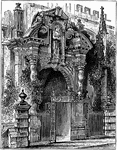
A church was established on this site, at the centre of the old walled city, in Anglo Saxon times. St Mary's has one of the most beautiful spires in England and an eccentric baroque porch, designed by Nicholas Stone, facing High Street. In the early days of Oxford University, the church was adopted as the first building of the university, congregation met there from at least 1252, and by the early 13th century it was the seat of university government and was used for lectures and the award of degrees.

Porch of St. Mary's, Oxford

A church was established on this site, at the centre of the old walled city, in Anglo Saxon times. St…
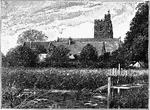
The Church of England parish church of St Michael was built in 1293, supposedly to replace a Saxon church at Water Oakley. It has a number of sculptures which may have come from th earlier church, including a damaged Sheela na Gig. It is best known to brass rubbers for housing the superb memorial brass of 1378 to Sir John Foxley, the Constable of Southampton Castle, and his two wives. One of the local cottages has a tunnel which it is believed leads to the church and served as an escape route for clergymen.

Bray Church, Near Maidenhead, Berks

The Church of England parish church of St Michael was built in 1293, supposedly to replace a Saxon church…
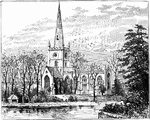
The Collegiate Church of the Holy and Undivided Trinity, Stratford-upon-Avon is a parish church in the Church of England. It is often known simply as Shakespeare's Church, due to its fame as the place of baptism and burial of William Shakespeare. The present building dates from 1210 and is built on the site of a Saxon monastery. It is Stratford's oldest building, in a striking position on the banks of the River Avon, and has long been England's most visited parish church.

Stratford-on-Avon Church

The Collegiate Church of the Holy and Undivided Trinity, Stratford-upon-Avon is a parish church in the…
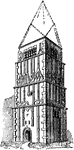
The tower is the only remaining piece of the Earls Barton Church in Northamptonshire, England. It is one of the best examples of Saxon architecture.

Earls Barton Church

The tower is the only remaining piece of the Earls Barton Church in Northamptonshire, England. It is…
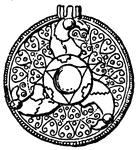
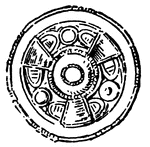
An Anglo-Saxon brooch decorated with cloisonne, an ancient metalworking technique, is a multi-step enamel process used to produce jewelry, vases, and other decorative items.

Anglo-Saxon Brooch

An Anglo-Saxon brooch decorated with cloisonne, an ancient metalworking technique, is a multi-step enamel…
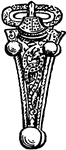
An Anglo-Saxon brooch with hammered work in relief.

Anglo-Saxon Brooch

An Anglo-Saxon brooch with hammered work in relief.

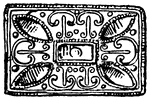
An illustration of an Anglo-Saxon buckle.

Buckle

An illustration of an Anglo-Saxon buckle.

An illustration of a rectangular Anglo-Saxon buckle.

Buckle

An illustration of a rectangular Anglo-Saxon buckle.

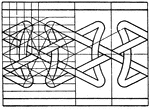
The northern interlacement band is a pattern that is also known as Celtic, Anglo-Saxon, Norman, Scandinavian and Old Frankish. Its is a richly complicated interlacement design. This design comes from a manuscript ornament of the 8th and 9th century.

Northern Interlacement Band

The northern interlacement band is a pattern that is also known as Celtic, Anglo-Saxon, Norman, Scandinavian…
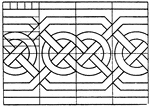
The northern interlacement band is a pattern that is also known as Celtic, Anglo-Saxon, Norman, Scandinavian and Old Frankish. Its is a richly complicated interlacement design. This design comes from a manuscript ornament of the 8th and 9th century.

Northern Interlacement Band

The northern interlacement band is a pattern that is also known as Celtic, Anglo-Saxon, Norman, Scandinavian…
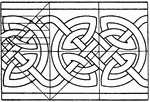
The northern interlacement band is a pattern that is also known as Celtic, Anglo-Saxon, Norman, Scandinavian and Old Frankish. Its is a richly complicated interlacement design. This design comes from a manuscript ornament of the 8th and 9th century.

Northern Interlacement Band

The northern interlacement band is a pattern that is also known as Celtic, Anglo-Saxon, Norman, Scandinavian…
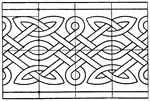
The northern interlacement band is a pattern that is also known as Celtic, Anglo-Saxon, Norman, Scandinavian and Old Frankish. Its is a richly complicated interlacement design. This design comes from a manuscript ornament of the 8th and 9th century.

Northern Interlacement Band

The northern interlacement band is a pattern that is also known as Celtic, Anglo-Saxon, Norman, Scandinavian…
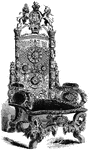
This heraldic chair was used by the royal ancestors of the Saxon line.

Heraldic Chair

This heraldic chair was used by the royal ancestors of the Saxon line.

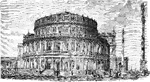
"In Dresden, owing to the method of instruction in the technical schools, as well as to the influence of the buildings, as, for instance, those by Zwinger, and the new theatre by Semper, the Renaissance style is the one preferred by the architects who have been there educated."The Semperoper is the opera house of the Saxon State Opera Dresden (German: Sächsische Staatsoper Dresden) and the concert hall of the Sächsische Staatskapelle Dresden in Dresden, Germany. It was first built in 1841, by architect Gottfried Semper.The building style itself is debated among many, as it has features that appear in the Early Renaissance style, Baroque and even features Corinthian style pillars typical of classical Greece (classical revival). Perhaps the most suitable label for this style would be Eclecticism; where influences from many styles are used- a practice most common during this period.It had to be rebuilt after a fire destroyed it in 1869. The citizenry demanded that Gottfried Semper do the reconstruction, even though he was in exile at the time because of his activities in the May Uprising in Dresden in 1849. So the architect had his son Manfred Semper complete the second opera house with his father's plans. This second one was constructed in Neo-Renaissance style in 1878. During construction, performances were held at the Gewerbehausall, which opened in 1870.The building is considered to be a prime example of "Dresden-Baroque" architecture. It is situated on the Theater Square in central Dresden on the bank of the Elbe River. On top of the portal there is a Panther quadriga with a statue of Dionysos. The interior was created by such famous architects of the time as Johannes Schilling. Monuments on the portal depict famous artists such as Johann Wolfgang von Goethe and Friedrich Schiller, William Shakespeare, Sophocles, Molière and Euripides. The building also features work by Ernst Rietschel and Ernst Julius Hähnel.In the pre-war years, the building premiered many of the works of Richard Strauss.During the last weeks of World War II in 1945 the building was destroyed again - this time by Allied bombing and the subsequent fire storms. Exactly 40 years later, on February 13, 1985 the opera was rebuilt almost the same as it was before the war. It reopened with the same opera that was performed last before the destruction in 1945: Weber's Der Freischütz.During the flood of the Elbe in 2002 the building suffered heavy water damage. With substantial help from around the world, it reopened in December 2002.Today, most operas are accompanied by the Sächsische Staatskapelle Dresden.

Theatre at Dresden

"In Dresden, owing to the method of instruction in the technical schools, as well as to the influence…
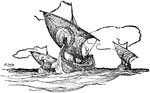
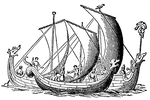
The Saxon ships from ancient Germany.

Saxon Ships

The Saxon ships from ancient Germany.

A fleet of three ancient Anglo-Saxon ships, each with wind filling the lone sail. Each ship has a dragon head at the bow. The front ship has a curled, dragon tail at the stern. Several men occupy the decks of the ships. The ship of the right has a head on a pike displayed at its bow. A crow sits on and pecks at the head. Another crow sits on the mast of that ship.

Anglo-Saxon Ships with Wind in the Sails

A fleet of three ancient Anglo-Saxon ships, each with wind filling the lone sail. Each ship has a dragon…
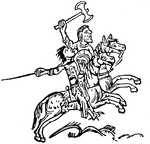
Illustration of a drawing in <I>The Harley Psalter</I>, an illuminated manuscript of the second and third decades of the 11th century. Two Anglo-Saxon warriors ride horseback wielding an axe and long spear or javelin. Both horses are rearing up, their front legs off the ground. Both weapons are raised. The warrior in front has dark hair while the hair of the one behind appears to be lighter-colored.

Two Anglo-Saxon Warriors on Horseback

Illustration of a drawing in The Harley Psalter, an illuminated manuscript of the second and third decades…
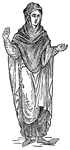
A woman stands in several layers of clothing. The dress usually included a cloak, an overdress, an under-dress, and head-covering. Her arms are bent at the elbow and her hands are raised.

Anglo-Saxon Female Costume from 10th Century England

A woman stands in several layers of clothing. The dress usually included a cloak, an overdress, an under-dress,…
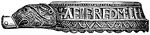
A close-up, side view of the gold Alfred Jewel, which was made in the late 9th century. The inscription reads "aelfred mec heht gewyrcan", which means "Alfred had me wrought". You can clearly see the animal head at the base and the snout, which would have been hollow so that a rod could be fitted onto the jewel.

The Gold Alfred Jewel, Side View

A close-up, side view of the gold Alfred Jewel, which was made in the late 9th century. The inscription…
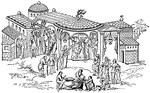
Illustration of an Anglo-Saxon manor house or noble's house from 11th century England. There are several porticoes and entrances to the house. People huddle in the entryways, some have shields and spears. An animal head with antlers is at the pinnacle of one roof. The lord and lady are giving alms to several poor people in the courtyard. There is a line of men with canes, a group filling large pottery jars, and a line of people reaching for alms.

Anglo-Saxon Manor House, Circa 11th Century

Illustration of an Anglo-Saxon manor house or noble's house from 11th century England. There are several…
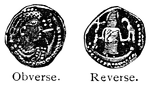
"Specimens occur in gold, but most frequently in silver. Their average weight is 15 grains, and they were probably current from about 600 to 750." &mdash;Whitney, 1889
<p>This image is of a silver sceat currently in the British Museum. The image shows the obverse and reverse of the coin.

Sceat, an Early Anglo Saxon Coin

"Specimens occur in gold, but most frequently in silver. Their average weight is 15 grains, and they…
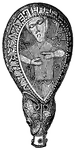
A close-up, front view of the gold Alfred Jewel, which was made in the late 9th century. The inscription reads "aelfred mec heht gewyrcan", which means "Alfred had me wrought". You can clearly see the animal head at the base and the snout, which would have been hollow so that a rod could be fitted onto the jewel.

The Gold Alfred Jewel, Front View

A close-up, front view of the gold Alfred Jewel, which was made in the late 9th century. The inscription…