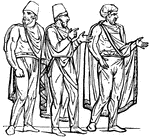
"In 1799, the Rosetta Stone was found and gave the first key to the reading of hieroglyphics. On this stone the same inscription was given in three different sets of characters, -the hieroglyphics, the demotic text (a briefer and more running form of hieroglyphics, commonly used in the papyri or manuscripts), and the Greek. By comparing the letters in certain Greek proper names with the letters of the same words in the Egyptian texts, the sounds for which the Egyptian characters stood were discovered. The Greek text, when translated, showed that the inscription was an ordinance of the priests decreeing certain honors to Ptolemy Epiphanes on the occasion of his coronation, 196 B.C. (Ptolemy Epiphanes was one of a line of Greek sovereigns who ruled over Egypt from the time of its conquest by Alexander in the fourth century, to the first century B.C.) It contains a command that the decree should be inscribed in the sacred letters (hieroglyphics), the letters of the country (demotic), and Greek letters, -and this for the convenience of the mixed population of Egypt under its Greek rulers. It was natural to conclude that the three texts were the same in substance, and accordingly earnest efforts were made to decipher the hieroglyphics by aid of the Greek. The first clew was obtained by noticing that certain groups of the hieroglyphic characters were inclosed in oval rings, and that these groups corresponded in relative position with certain proper names, such as Ptolemy, etc., in the Greek text. The following line presents a few of the characters with a group in the oval ring. (Each word is read from right to left)." —Colby, 1899

Excerpt from the Rosetta Stone

"In 1799, the Rosetta Stone was found and gave the first key to the reading of hieroglyphics. On this…
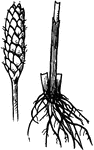
Leaf-sheaths present only at the base of stem; flowers in one group.

Eleocharis

Leaf-sheaths present only at the base of stem; flowers in one group.

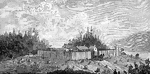
"A stockade. Those settlers who lived outside of Roston and the few seaport villages built palisades about their houses and farm buildings. A group of buildings thus protected was called a stockade."—Scudder, 1897

stockade

"A stockade. Those settlers who lived outside of Roston and the few seaport villages built palisades…

Flowers stalked; fruit a group of several, scarcely angled, small nutlets.

Ranunculus

Flowers stalked; fruit a group of several, scarcely angled, small nutlets.

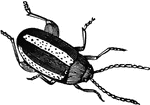
The European Turnip-Fly, <em>Haltica nemorum</em>, one of the most destructive species, belongs to a group in which the posterior thighs are much thickened for jumping." &mdash Goodrich, 1859

Turnip Fly

The European Turnip-Fly, Haltica nemorum, one of the most destructive species, belongs to a…

"Columbia University is a seat of learning in New York city. The charter of King's College, the original name of Columbia, was granted by George II., and finally passed the seals on Oct. 31, 1754, from which day the college dates its existence. The central library building and other costly buildings including St. Paul's Chapel, completed 1907, form a fine group."—(Charles Leonard-Stuart, 1911)

Library of Columbia University

"Columbia University is a seat of learning in New York city. The charter of King's College, the original…

"Eddystone is a group of gneiss rocks, daily submerged by the tide, in the English Channel, 9 miles off the Cornish coast, and 14 S.S.W. of Plymouth Breakwater. The frequent shipwrecks on these rocks led to the erection of a lighthouse on them in 1669-1700, but the great storm of Nov. 20, 1703 completely washed it away. Another lighthouse was built in 1706-1709. This was burned in 1755. The next, noted for its strength and the engineering skill displayed in it, was constructed in 1757-1759. The granite was dovetailed into the solid rock, and each block into its neighbors. As the rock in which this tower was built became undermined and greatly weakened by the action of the waves, the foundation of another was laid on a different part of the reef in 1879. Its light is visible in clear weather at a distance of 17 and one half miles."—(Charles Leonard-Stuart, 1911)

Eddystone Lighthouse

"Eddystone is a group of gneiss rocks, daily submerged by the tide, in the English Channel, 9 miles…
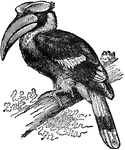
"Hornbills are a remarkable group of birds confined to Southern Asia and Africa, akin to the kingfishers and the toucans, remarkable for the very large size of the bill, and for an extraordinary horny protuberance by which it is surmounted, nearly as large as the bill itself, and of cellular structure within."&mdash;(Charles Leonard-Stuart, 1911)

Hornbill

"Hornbills are a remarkable group of birds confined to Southern Asia and Africa, akin to the kingfishers…
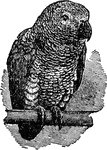
"Parrot is the popular name for any individual of a well-known group of birds from the warmer regions of the globe, remarkable for the brilliant, and in some cases gaudy, coloration of their plumage, and the facility with which many of them acquire and repeat words and phrases."&mdash;(Charles Leonard-Stuart, 1911)

Gray Parrot

"Parrot is the popular name for any individual of a well-known group of birds from the warmer regions…

A group of ancient Greek around a stone table.

Gathering of Greeks

A group of ancient Greek around a stone table.

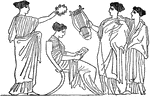
A group of women, with a lyre and wreath.

Sappho

A group of women, with a lyre and wreath.

A group of Greeks rowing a boat.

Greek Boat

A group of Greeks rowing a boat.

"Trowsers, pantaloons, were common to all the nations which encircled the Greek and Roman population, extending from the Indian to the Atlantic ocean, but were not worn by the Greeks and Romans themselves. Accordingly the monuments containing representations of people different from the Greeks and romans exhibit them in trowsers, thus distinguishing them from the latter people. An example is seen in the preceding group of Sarmatians." &mdash; Smith, 1873

Bracae

"Trowsers, pantaloons, were common to all the nations which encircled the Greek and Roman population,…
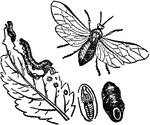
"Sawflies are a group of insects. The turnip fly and the gooseberry fly are examples."&mdash;(Charles Leonard-Stuart, 1911)

Turnip Sawfly

"Sawflies are a group of insects. The turnip fly and the gooseberry fly are examples."—(Charles…

"Shark is an English popular name for any individual of the group Selachoidei. Sharks are scaleless, and the skin usually rough. They are numerous in tropical seas, becoming scarcer as they recede from the warmer regions, a few only reaching the Arctic circle. They are rapid swimmers, with great power of endurance; the larger sharks are exclusively carnivorous, and some of them extremely dangerous to man. They scent their food from a distance, and are readily attracted by the smell of blood or decomposing bodies. The flesh of sharks is coarse, but it is sometimes eaten. Their rough skin is employed by joiners to polish fine-grained wood, and by cutlers to cover the hilts of swords to make them firmer in the grasp. [Pictured] Egg of Scyllium Chilense"&mdash;(Charles Leonard-Stuart, 1911)

Shark Egg

"Shark is an English popular name for any individual of the group Selachoidei. Sharks are scaleless,…
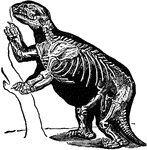
"Sloth is the popular name for any individual of the Edentate group Tardigrada, from their slow and awkward movements on the ground, owing to the peculiar structure of the wrist and ankle joints. The feet are armed with long claws, and turned toward the body, so that the animal is compelled to rest on the side of the hind foot, while the disproportionate length of the fore-limbs causes it to rest also on the elbows. It shuffles forward, alternately stretching the fore legs and hooking the claws into the ground, or grasping some object to draw itself along. Sloths are natives of South America, nocturnal in habit, and are found in the forests of that region, passing their lives among the branches of trees, on the leaves and young shoots of which they feed."&mdash;(Charles Leonard-Stuart, 1911)

Giant Sloth

"Sloth is the popular name for any individual of the Edentate group Tardigrada, from their slow and…
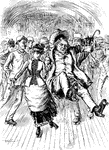
A group of people rollerskating indoors. The man in front is about to fall. All of the people are wearing hats.

Roller Skating

A group of people rollerskating indoors. The man in front is about to fall. All of the people are wearing…
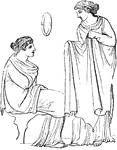
"The <em>peplus</em> was a shawl which commonly formed part of the dress of females. It was often fastened by meeans ofa brooch, but was frequently worn without one, in the manner represented in the annexed cut, which is copied from one of Sir W. Hamilton's vases. Each of the females in this group wears an under garmet falling down to her feet, and over it an ample <em>peplus</em>, or shawl, which she passes entirely round her body, and then throws the loose extremity of it over her left shoulder, and behind her back as distinctly seen in the sitting figure." &mdash; Anthon, 1891

Peplus

"The peplus was a shawl which commonly formed part of the dress of females. It was often fastened…
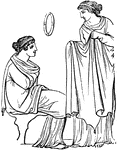
"An outer garment, strictly worn by females, and thus corresponding to the himation or pallium, the outer garment worn by men. Like all other pieces of cloth used for the Amictus, it was often fastened by means of a brooch. It was, however, frequently worn without a brooch, in the manner represented in the annexed cut. Each of the females in this group wears a tunic falling down to her feet, and over it an ample pepius, which she passes entirely round her body and then throws the loose extremity of it over her left shoulder and behind her back, as is distinctly seen in the sitting figure. Of all the productions of the loom, pepli were those on which the greatest skill and labour were bestowed. so various and tasteful were the subjects which they represented, that poets delighted to describe them. The art of weaving them was entirely oriental; and those of the most splendid dyes and curious workmanship were imported from Tyre and Sidon. They often constituted a very important part of the treasures of a temple, having been presented to the divinity by sppliants and devotees." &mdash; Smith, 1873

Peplum

"An outer garment, strictly worn by females, and thus corresponding to the himation or pallium, the…
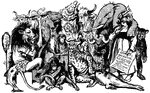
A group of circus animals

Circus Animals

A group of circus animals

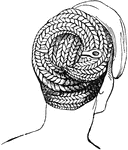
"The mode of platting the hair, and then fastening it with a pin on a needle, is shown in the annexed figure of a female head, taken from a marble group which was found at Apt, in the south of France." &mdash; Anthon, 1891

Platted hair

"The mode of platting the hair, and then fastening it with a pin on a needle, is shown in the annexed…

Leader of the "Oklahoma Boomers," Couch and his group explored the west and Native American territory.
Captain W. L. Couch

Leader of the "Oklahoma Boomers," Couch and his group explored the west and Native American territory.
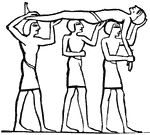
A group of three Egyptians carrying another.

Egyptians

A group of three Egyptians carrying another.

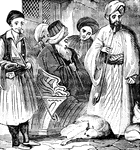
A group of Turks.

Turks

A group of Turks.

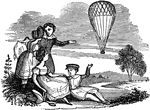
A group of people pointing at a hot air balloon in the distance.

Hot air balloon

A group of people pointing at a hot air balloon in the distance.

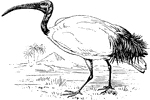
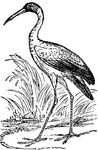
Ibises are a group of long-legged ading birds. They all have long downcurved bills, and usually feed as a group, probing mud for food items.

Ibis

Ibises are a group of long-legged ading birds. They all have long downcurved bills, and usually feed…
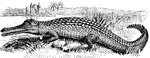
The Gharial is the only surviving member of the family Gavialidae, a long-established group of crocodile-like reptiles with long, narrow jaws. The Gharial is the second-largest of all surviving crocodilians: a large individual can be 6-7 metres long.

Gharial

The Gharial is the only surviving member of the family Gavialidae, a long-established group of crocodile-like…
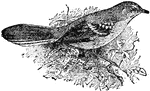
A group of New World passerine birds best known for the habit of some species of mimicking the songs of other birds, often loudly and in rapid succession.

Mockingbird

A group of New World passerine birds best known for the habit of some species of mimicking the songs…
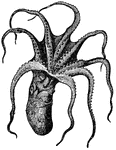
A genus of fishes beloning to the cephalopod group, and also known as cuttlefishes. They have a warty, oval body, eight arms of unequal length, and consist of fourty-six known species.

Octopus

A genus of fishes beloning to the cephalopod group, and also known as cuttlefishes. They have a warty,…
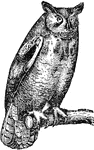
A large group of birds of prey, including fully 150 species, about forty of which inhabit America. They are distinguished chiefly on account of their nocturnl habits. The different species have a short head, a circular or triangular facial disc, large eyes and ears, the outer toe reversible, aand, owing to the soft plumage, a noiseless flight.

Owl

A large group of birds of prey, including fully 150 species, about forty of which inhabit America. They…
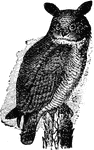
A large group of birds of prey, including fully 150 species, about forty of which inhabit America. They are distinguished chiefly on account of their nocturnl habits. The different species have a short head, a circular or triangular facial disc, large eyes and ears, the outer toe reversible, aand, owing to the soft plumage, a noiseless flight.

Owl

A large group of birds of prey, including fully 150 species, about forty of which inhabit America. They…

"Group from the Eastern frieze of the Parthenon." &mdash;D'Anvers, 1895

Frieze

"Group from the Eastern frieze of the Parthenon." —D'Anvers, 1895

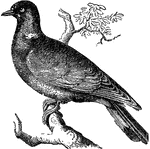
A group of rasorial birds found widely distributed, but most abundant in the tropical countries. They include many varieties, varying greatly in color and habit.

Pigeon

A group of rasorial birds found widely distributed, but most abundant in the tropical countries. They…
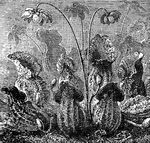
A group of plants remarkable for having leaves or petioles formed like pitchers, and in which more or less fluid is stored. There are two general divisions, known as the American and East Indian pitcher plant families.

Pitcher Plants

A group of plants remarkable for having leaves or petioles formed like pitchers, and in which more or…
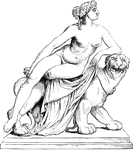
"Johann Heinrich von Dannecker, of Stuttgart, another great sculptor, excelled in portrait-statues, and was also very successful in his treatment of female figures. His busts of Scholler, and Lavater, and of King's Frederick and William of Wurtembery, are very valuable likenessess. His group, Ariadne and the Panther, in a private collection at Frankfort, copies of which abound everywhere, is his most famous work." &mdash;D'Anvers, 1895

Ariadne

"Johann Heinrich von Dannecker, of Stuttgart, another great sculptor, excelled in portrait-statues,…
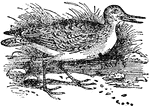
An extensive group of wading birds of the snipe family. They are found in large numbers in swampy regions, on the shores of the sea, and on the banks of rivers, lakes, and ponds.

Sandpiper

An extensive group of wading birds of the snipe family. They are found in large numbers in swampy regions,…
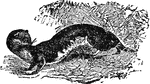
A group of quadruped mammals of the northern hemisphere, which includes a number of widely diffused species. The body is slender, usually about eight inches long and three inches high, and the back generally is much arched.

Weasel

A group of quadruped mammals of the northern hemisphere, which includes a number of widely diffused…
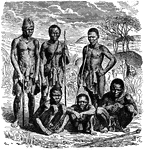
The peoples of South Africa and neighbouring Botswana and Namibia, who live in the Kalahari, are part of the Khoisan group and are related to the Khoikhoi.

Bushmen

The peoples of South Africa and neighbouring Botswana and Namibia, who live in the Kalahari, are part…
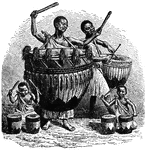
A group of Congo musicians.

Congo

A group of Congo musicians.

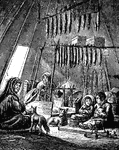
The Ostiaks are a tribe who inhabit the basin of the Ob in western Siberia belonging to the Finno-Ugric group and related to the Voguls.

Ostiak Family

The Ostiaks are a tribe who inhabit the basin of the Ob in western Siberia belonging to the Finno-Ugric…

"A knowledge of even a few words is useful."

Group Chat

"A knowledge of even a few words is useful."

A group of long-legged wading birds. They have long downcurved bills, and usually feed as a group, probing mud for food items, usually crustaceans.

Ibis

A group of long-legged wading birds. They have long downcurved bills, and usually feed as a group, probing…
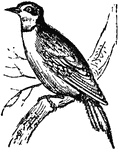
A group of birds with rich colored plumage, slender bodies and usually elongated central tail feathers.
Bee-eater

A group of birds with rich colored plumage, slender bodies and usually elongated central tail feathers.

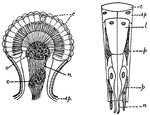
This is a diagram illustrating the compound eye of anthropods. A, the whole eye shown in section; B, one of the eye-elements (ommatidium) more highly magnified. c, cuticular facets; ep, epidermis; l, group of celis forming lens-like body; n, optic nerve fibres; o, optic ganglia; p, pigment celis.

Anthropod

This is a diagram illustrating the compound eye of anthropods. A, the whole eye shown in section; B,…
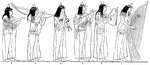
This image shows a group of ancient egyptian street musicians. (1) Woman with a tall light harp with fourteen strings. (2) Cithara. (3) Te-bouni, or banjo. (4) Double flute. (5) Shoulder Harp. (6) Singer, clapping hands.

Ancient Egyptian Music

This image shows a group of ancient egyptian street musicians. (1) Woman with a tall light harp with…

A major group of eukaryotic algae, one of the most common type of phytoplankton. Most diatoms are unicelular, although some form chains or simple colonies.

Diatom

A major group of eukaryotic algae, one of the most common type of phytoplankton. Most diatoms are unicelular,…
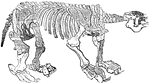
This is a skeleton of the Megatherium. Megatheria were a group of elephant-sized ground sloths that lived from 2 million to 8,000 years ago. Their smaller ground sloth cousins were the Mylodon.

Megatherium

This is a skeleton of the Megatherium. Megatheria were a group of elephant-sized ground sloths that…
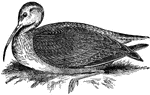
The curlews are a group of eight wader species, characterised by a long slender downcurved bill and mainly brown plumage with little seasonal change.

Curlew

The curlews are a group of eight wader species, characterised by a long slender downcurved bill and…
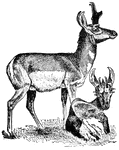
A group of herbivorous African animals of the family Bovidae, distinguished by a pair of hollow horns on their heads.

Antelope

A group of herbivorous African animals of the family Bovidae, distinguished by a pair of hollow horns…
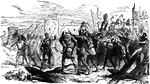
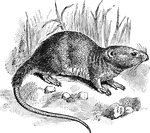
This illustration shows a group of Crusaders gathering for a battle.

Crusaders

This illustration shows a group of Crusaders gathering for a battle.

A rat having a long scaly tail, and lacks the spines in the pelage which most of this group of hedgehog rats possess.

Hedgehog Rat

A rat having a long scaly tail, and lacks the spines in the pelage which most of this group of hedgehog…
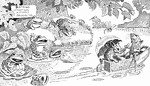
Two mice rowing away from a group of skinny-dipping frogs.

Skinny-dipping Frogs

Two mice rowing away from a group of skinny-dipping frogs.

The Ladrones islands, meaning "Islands of Thieves." Currently they are named the Mariana Islands. Magellan discovered this group of islands.

Ladrones Islands

The Ladrones islands, meaning "Islands of Thieves." Currently they are named the Mariana Islands. Magellan…
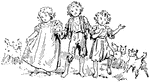
A group of children with dogs.

Children

A group of children with dogs.

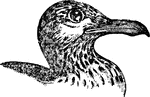
"A long-winged water-bird with webbed feet, inhabiting all parts of the world. The group to which gulls belong embraces also the terns, and these two kinds of birds are closely related." &mdash; Beach, 1909

Great Black Backed Gull

"A long-winged water-bird with webbed feet, inhabiting all parts of the world. The group to which gulls…
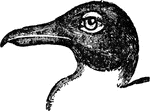
"A long-winged water-bird with webbed feet, inhabiting all parts of the world. The group to which gulls belong embraces also the terns, and these two kinds of birds are closely related." &mdash; Beach, 1909

Black-headed Gull

"A long-winged water-bird with webbed feet, inhabiting all parts of the world. The group to which gulls…
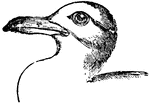
"A long-winged water-bird with webbed feet, inhabiting all parts of the world. The group to which gulls belong embraces also the terns, and these two kinds of birds are closely related." &mdash; Beach, 1909

Killiwake Gull

"A long-winged water-bird with webbed feet, inhabiting all parts of the world. The group to which gulls…
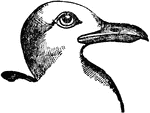
"A long-winged water-bird with webbed feet, inhabiting all parts of the world. The group to which gulls belong embraces also the terns, and these two kinds of birds are closely related." &mdash; Beach, 1909

Small Black-Backed Gull

"A long-winged water-bird with webbed feet, inhabiting all parts of the world. The group to which gulls…
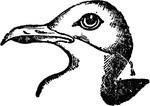
"A long-winged water-bird with webbed feet, inhabiting all parts of the world. The group to which gulls belong embraces also the terns, and these two kinds of birds are closely related." &mdash; Beach, 1909

Herring Gull

"A long-winged water-bird with webbed feet, inhabiting all parts of the world. The group to which gulls…
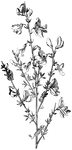
A group of deciduous shrubs that are adapted to dry conditions.

Common Broom

A group of deciduous shrubs that are adapted to dry conditions.