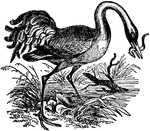
Cranes are large, long-legged and long-necked birds of the order Gruiformes, and family Gruidae. Unlike the similar-looking but unrelated herons, cranes fly with necks outstretched, not pulled back. There are representatives of this group on all the continents except Antarctica and South America. Most species of cranes are at least threatened, if not critically endangered, within their range. The plight of the Whooping Cranes of North America inspired some of the first US legislation to protect endangered species.

Crane

Cranes are large, long-legged and long-necked birds of the order Gruiformes, and family Gruidae. Unlike…
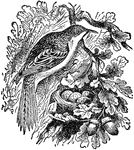
The Brown Creeper (Mohoua novaeseelandiae), also known by its Māori name, Pipipi, is a small passerine bird endemic to the South Island of New Zealand. They are specialist insectivores, gleaning insects from branches and leaves. They have strong legs and toes for hanging upside down while feeding.

Brown Creeper

The Brown Creeper (Mohoua novaeseelandiae), also known by its Māori name, Pipipi, is a small…
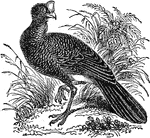
Curassows are one of the three major groups of cracid birds. Three of the four genera are restricted to tropical South America; a single species of Crax ranges north to Mexico. They form a distinct clade which is usually classified as the subfamily Cracinae.

Curassow

Curassows are one of the three major groups of cracid birds. Three of the four genera are restricted…
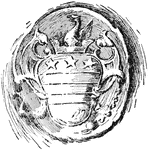
Washington's Seal incorporates the same design which can be found in Washington's Arms. The coat of arms of George Washington, President of the United States of America from 1789 to 1797, were first used to identify the family in the twelfth century, when one of George Washington's ancestors took possession of Washington Old Hall, then in County Durham, in north-east England.

Washington's Seal (From a Letter to Bouquet, 1758)

Washington's Seal incorporates the same design which can be found in Washington's Arms. The coat of…
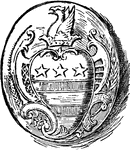
Washington's Private Seal incorporates the same design which can be found in Washington's Arms. The coat of arms of George Washington, President of the United States of America from 1789 to 1797, were first used to identify the family in the twelfth century, when one of George Washington's ancestors took possession of Washington Old Hall, then in County Durham, in north-east England.

Washington's Private Seal, 1783

Washington's Private Seal incorporates the same design which can be found in Washington's Arms. The…
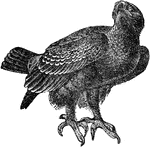
The Screamers are a small family of birds, the Anhimidae.The three species occur only in South America, ranging from Venezuela to northern Argentina. They are large, bulky birds, with a small downy head, long legs and large feet which are only partially webbed. They have large spurs on their wings which are used in fights over mates and territorial disputes, these can break off in the breast of other screamers, and are regularly renewed.

Screamer

The Screamers are a small family of birds, the Anhimidae.The three species occur only in South America,…
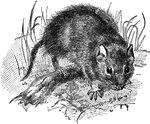
"Schizodon fuscus...A genus of South American octodont rodents, related to Ctenomys" (Tuco-tuco). -Whitney, 1911

Schizodon

"Schizodon fuscus...A genus of South American octodont rodents, related to Ctenomys" (Tuco-tuco). -Whitney,…
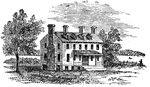
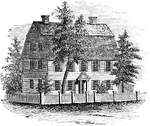
The residence of Francis Marion in Georgetown, South Carolina.

Marion's Residence

The residence of Francis Marion in Georgetown, South Carolina.

Joseph Webb House is a historic Georgian-style house in Wethersfield, Connecticut that was the site of a five day military conference during the American Revolutionary War. General George Washington came to Wethersfield in order to plan with Rochambeau, the French commander. These plans led to the Siege of Yorktown, the last major battle of the war. Washington, in his words, "lodged...at the house of Joseph Webb", on the May 17, 1781. This house is in the central part of Wethersfield, a few rods south of the Congregational Church.

The Webb House

Joseph Webb House is a historic Georgian-style house in Wethersfield, Connecticut that was the site…
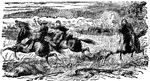
The Battle of Stones River or Second Battle of Murfreesboro (in the South, simply the Battle of Murfreesboro), was fought from December 31, 1862, to January 2, 1863 as the culmination of the Stones River Campaign in the Western Theater of the American Civil War.

Battle of Murfreesboro

The Battle of Stones River or Second Battle of Murfreesboro (in the South, simply the Battle of Murfreesboro),…
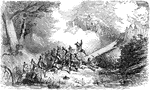
Attack on the Narraganset Indians at South Kingston by the leaders of the Massachusetts Bay Colony.
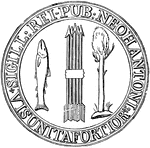
Attack on the Narraganset Indians at South Kingston

Attack on the Narraganset Indians at South Kingston by the leaders of the Massachusetts Bay Colony.

The first seal of New Hampshire.

First Seal of New Hampshire

The first seal of New Hampshire.

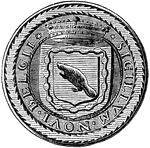
New Netherland, 1614–1674, is the name of the former Dutch territory on the eastern coast of North America in the 17th century.

Seal of New Netherland

New Netherland, 1614–1674, is the name of the former Dutch territory on the eastern coast of North…
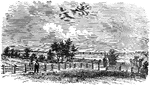
The Battle of New Orleans took place on January 8, 1815, and was the final major battle of the War of 1812. It took place about five miles south of New Orleans on the grounds of Chalmette Plantation.

Chalmette's Plantation

The Battle of New Orleans took place on January 8, 1815, and was the final major battle of the War of…
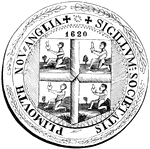
An old colony seal of New Plymouth.

Old Colony Seal

An old colony seal of New Plymouth.

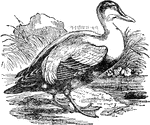
The Common Eider, Somateria mollissima, is a large (50-71cm body length) sea-duck, which is distributed over the northern coasts of Europe, North America and eastern Siberia. It breeds in Arctic and some northern temperate regions, but winters somewhat farther south in temperate zones, when it can form large flocks on coastal waters. The eider's nest is built close to the sea and is lined with the celebrated eiderdown, plucked from the female's breast. This soft and warm lining has long been harvested for filling pillows and quilts, but in more recent years has been largely replaced by down from domestic farm-geese and synthetic alternatives.

Eider Duck

The Common Eider, Somateria mollissima, is a large (50-71cm body length) sea-duck, which is distributed…
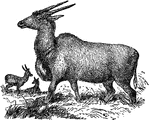
The common eland (Taurotragus oryx, also known as the southern eland) is a savannah and plains antelope found in East and Southern Africa. Common eland live on the open plains of Southern Africa and along the foothills of the great South African plateau. They eat grass, branches and leaves and are diurnal but tend to be inactive during the heat of day. Herds usually have 30 to 80 individuals, but are known to exceed 400. The common eland has an unusual social life, leaving or joining herds as necessary without forming close ties. Predators in the wild are predominantly lions and the endangered African wild dog.

Eland

The common eland (Taurotragus oryx, also known as the southern eland) is a savannah and plains antelope…
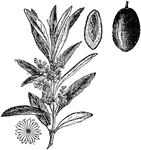
The Olive (Olea europaea) is a species of small tree in the family Oleaceae, native to the coastal areas of the eastern Mediterranean region, from Lebanon, Syria and the maritime parts of Asia Minor and northern Iran at the south end of the Caspian Sea. Its fruit, the olive, is of major agricultural importance in the Mediterranean region as the source of olive oil. The Olive tree is an evergreen tree or shrub native to the Mediterranean, Asia and parts of Africa. It is short and squat, and rarely exceeds 8–15 meters in height. The silvery green leaves are oblong in shape, measuring 4–10 cm long and 1–3 cm wide. The trunk is typically gnarled and twisted.The small white flowers, with four-cleft calyx and corolla, two stamens and bifid stigma, are borne generally on the last year's wood, in racemes springing from the axils of the leaves. The fruit is a small drupe 1–2.5 cm long, thinner-fleshed and smaller in wild plants than in orchard cultivars. Olives are harvested at the green stage or left to ripen to a rich purple colour (black olive). Canned black olives may contain chemicals that turn them black artificially.

Olive Branch

The Olive (Olea europaea) is a species of small tree in the family Oleaceae, native to the coastal areas…
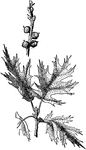
Eastern Black oak (Quercus velutina), or more commonly known as simply Black Oak is an oak in the red oak (Quercus sect. Lobatae) group of oaks. It is native to eastern North America from southern Ontario south to northern Florida and southern Maine west to northeastern Texas. It is a common tree in the Indiana Dunes and other sandy dunal ecosystems along the southern shores of Lake Michigan. It is most often found in dry well draining upland soils which can be clayey or sandy in nature in most of the rest of its range. In the northern part of its range, black oak is a relatively small tree, reaching a height of 20-25 m (65-80 ft) and a diameter of 90 cm (35 in), but it grows larger in the south and center of its range, where heights of up to 42 m (140 ft) are known. Black Oak is well known to readily hybridize with other members of the red oak (Quercus sect. Lobatae) group of oaks being one parent in at least a dozen different named hybrids. he inner bark of the black oak contains a yellow pigment called quercitron, which was sold commercially in Europe until the 1940s.

Eastern Black Oak Branch

Eastern Black oak (Quercus velutina), or more commonly known as simply Black Oak is an oak in the red…
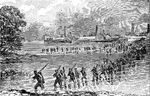
The Battle of New Bern was fought on 14 March 1862, near the city of New Bern, North Carolina, as part of the Burnside Expedition of the American Civil War.

Troops Landing at Newbern

The Battle of New Bern was fought on 14 March 1862, near the city of New Bern, North Carolina, as part…
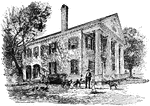

A North Carolina mansion of the old style.

A North Carolina Mansion

A North Carolina mansion of the old style.

The courthouse and City Hall of Wilmington, North Carolina.

Courthouse and City Hall, Wilmington, North Carolina

The courthouse and City Hall of Wilmington, North Carolina.
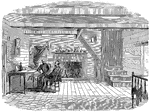
In light of overwhelming enemy strength and the relatively heavy casualties his army suffered in the Battle of Bentonville, Johnston surrendered to Sherman little more than a month later at Bennett Place, near Durham Station.

Johnston's Surrender

In light of overwhelming enemy strength and the relatively heavy casualties his army suffered in the…
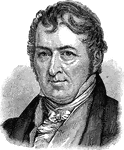
Eli Whitney (December 8, 1765 – January 8, 1825) was an American inventor best known as the inventor of the cotton gin. This was one of the key inventions of the industrial revolution and shaped the economy of the antebellum South. Whitney's invention made short staple cotton into a profitable crop, which strengthened the economic foundation of slavery. Despite the social and economic impact of his invention, Whitney lost his profits in legal battles over patent infringement, closed his business, and nearly filed bankruptcy.

Eli Whitney Jr.

Eli Whitney (December 8, 1765 – January 8, 1825) was an American inventor best known as the inventor…
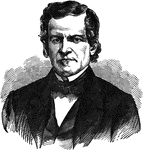
Francis Wilkinson Pickens (April 7, 1805 – January 25, 1869) was an American lawyer and politician who served as Governor of South Carolina when the state seceded from the United States during the American Civil War.

Francis Wilkinson Pickens

Francis Wilkinson Pickens (April 7, 1805 – January 25, 1869) was an American lawyer and politician…
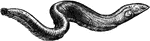
The electric eel, Electrophorus electricus, is a species of fish. It is capable of generating powerful electric shocks, which it uses for both hunting and self-defense. It is an apex predator in its South American range. Despite its name it is not an eel at all but rather a knifefish.

Electric Eel

The electric eel, Electrophorus electricus, is a species of fish. It is capable of generating powerful…
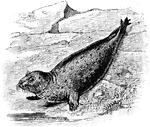
The Gray Seal (Halichoerus grypus) is a large mammal in the Phocidae family of true seals.

Gray Seal

The Gray Seal (Halichoerus grypus) is a large mammal in the Phocidae family of true seals.
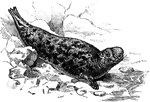
The Hooded Seal (Crystophora cristata) is an arctic seal in the Phocidae family of true seal. It is identified by the large bulge on its head.

Hooded Seal

The Hooded Seal (Crystophora cristata) is an arctic seal in the Phocidae family of true seal. It is…
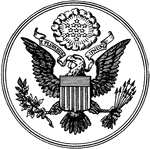
The Great Seal of the United States with "E. Pluribus Unum" and a bald eagle holding thirteen arrows and an olive branch.

Great Seal of the United States

The Great Seal of the United States with "E. Pluribus Unum" and a bald eagle holding thirteen arrows…
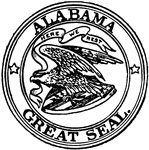
The Great Seal of Alabama, 1911. The image depicts a bald eagle holding a banner that reads "Here we rest." It is holding arrows and standing on a shield decorated with stars and stripes.

Seal of Alabama

The Great Seal of Alabama, 1911. The image depicts a bald eagle holding a banner that reads "Here we…
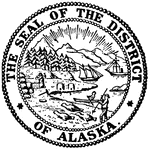
The Seal of the District of Alaska, 1911. The image on the seal shows Alaska's mountains and shore.
Seal of Alaska

The Seal of the District of Alaska, 1911. The image on the seal shows Alaska's mountains and shore.

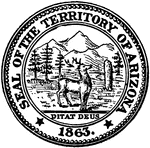
The Seal of the Territory of Arizona, 1863. The image on the seal shows mountains, forests, and a deer. Underneath is Arizona's state motto, 'Ditat Deus,' meaning "God enriches."

Seal of Arizona

The Seal of the Territory of Arizona, 1863. The image on the seal shows mountains, forests, and a deer.…
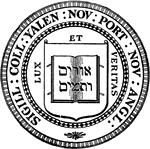
Serious American students of theology and divinity, particularly in New England, regarded Hebrew as a classical language, along with Greek and Latin, and essential for study of the Old Testament in the original words. The Reverend Ezra Stiles, president of the College from 1778 to 1795, brought with him his interest in the Hebrew language as a vehicle for studying ancient Biblical texts in their original language (as was common in other schools), requiring all freshmen to study Hebrew (in contrast to Harvard, where only upperclassmen were required to study the language) and is responsible for the Hebrew words "Urim" and "Thummim" on the Yale seal.

Seal of Yale University

Serious American students of theology and divinity, particularly in New England, regarded Hebrew as…
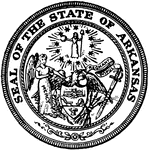
The Seal of the State of Arkansas. The seal shows Mercy, a bald eagle holding a shield, and the sword of justice.

Seal of Arkansas

The Seal of the State of Arkansas. The seal shows Mercy, a bald eagle holding a shield, and the sword…
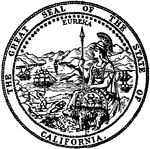
The Great Seal of the State of California. The seal shows Eureka with a bear cub. In the background are mountains and ships.

Seal of California

The Great Seal of the State of California. The seal shows Eureka with a bear cub. In the background…
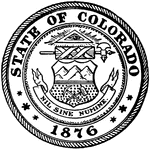
The Seal of Colorado, 1876. The seal shows The Eye of Providence and Colorado's motto 'Nil sine numine' meaning "Nothing without God's will.

Seal of Colorado

The Seal of Colorado, 1876. The seal shows The Eye of Providence and Colorado's motto 'Nil sine numine'…

The Seal of the State of Connecticut (Sigillum reipublicae Connecticutensis). The seal shows three grapevines with their motto underneath, 'Qui transtulit sustinet' meaning "He who transplanted sustains."

Seal of Connecticut

The Seal of the State of Connecticut (Sigillum reipublicae Connecticutensis). The seal shows three grapevines…
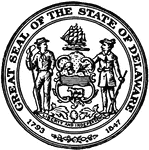
The Seal of the State of Delaware, 1793-1847. The seal shows a farmer, a soldier, Delaware's coat of arms, and their motto "Liberty and Independence."

Seal of Delaware

The Seal of the State of Delaware, 1793-1847. The seal shows a farmer, a soldier, Delaware's coat of…
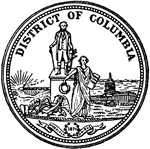
The Great Seal of the District of Columbia. The seal shows Lady justice hanging a wreath on the statue of George Washington. The motto reads 'Justitia omnibus' meaning "Justice for All."

Seal of District of Columbia

The Great Seal of the District of Columbia. The seal shows Lady justice hanging a wreath on the statue…
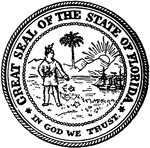
The Great Seal of the State of Florida. The image shows a Seminole Native American sprinkling flowers. There is also a palm tree, a steamboat, and sunshine.

Seal of Florida

The Great Seal of the State of Florida. The image shows a Seminole Native American sprinkling flowers.…
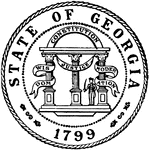
The Seal of the State of Georgia, 1799. The seal shows an arch with three pillars symbolizing the constitution and the three branches of government. Around the pillars are banners which read "Wisdom," "Justice," and "Moderation." There is also a soldier representing protection of the constitution.

Seal of Georgia

The Seal of the State of Georgia, 1799. The seal shows an arch with three pillars symbolizing the constitution…
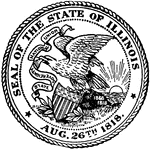
The Seal of the State of Illinois, 1818. The seal shows the bald eagle on a rock carrying a shield. It carries a banner with the state motto, "State Sovereignty, National Union."

Seal of Illinois

The Seal of the State of Illinois, 1818. The seal shows the bald eagle on a rock carrying a shield.…

The Seal of the State of Indiana. The seal shows a sunrise, a woodman, and a buffalo fleeing. This represents civilization, nature fleeing westward, and a bright future.

Seal of Indiana

The Seal of the State of Indiana. The seal shows a sunrise, a woodman, and a buffalo fleeing. This represents…
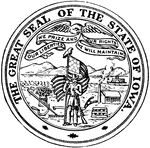
The Great Seal of the State of Iowa. The seal pictures a soldier in wheat field with the American flag and the Mississippi River in the background. The eagle holds the motto, "Our liberties we prize and our rights we will maintain."

Seal of Iowa

The Great Seal of the State of Iowa. The seal pictures a soldier in wheat field with the American flag…
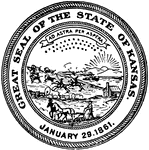
The Great Seal of the State of Kansas, 1861. The seal pictures a sunrise, a steamboat, plowing, a wagon, Native Americans hunting bison, and the state motto, 'Ad Astra per Aspera' meaning "To the Stars through Difficulties."

Seal of Kansas

The Great Seal of the State of Kansas, 1861. The seal pictures a sunrise, a steamboat, plowing, a wagon,…
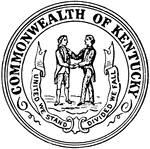
The seal of the Commonwealth of Kentucky. The seal shows a frontiersman and a statesman shaking hands with the state motto, "United we stand, divided we fall."

Seal of Kentucky

The seal of the Commonwealth of Kentucky. The seal shows a frontiersman and a statesman shaking hands…

The seal of the state of Louisiana. The seal shows a pelican in her piety, feeding her young with her own blood. This image is surrounded with the state motto, "Union, justice, and confidence."

Seal of Louisiana

The seal of the state of Louisiana. The seal shows a pelican in her piety, feeding her young with her…
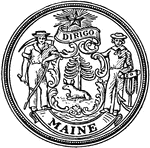
The seal of the state of Maine. The seal has a farmer with his scythe and a sailor with his anchor. Above the shield is the state motto 'Dirigo' meaning "I lead."

Seal of Maine

The seal of the state of Maine. The seal has a farmer with his scythe and a sailor with his anchor.…

The Great Seal of the State of Maryland. The seal is a shield being held by plowman and a fisherman. The motto 'Fatti maschii, parole femine' means "Strong deeds, gentle words."

Seal of Maryland

The Great Seal of the State of Maryland. The seal is a shield being held by plowman and a fisherman.…
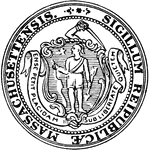
The Seal of the State of Massachusetts. The seal has a shield in the center with a Algonquin Native American holding a bow and arrow. Around the shield, is a blue ribbon with the state motto, 'Ense Petit Placidam Sub Libertate Quietem" which means "By the sword we seek peace, but only under liberty."

Seal of Massachusetts

The Seal of the State of Massachusetts. The seal has a shield in the center with a Algonquin Native…
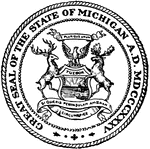
The Great Seal of the State of Michigan. This seal shows the Michigan's coat of arms held by an elk and a moose. The white ribbon holds the state motto, 'Si Quaeris Peninsulam Amoenam Circumspice' which means "If you seek a pleasant peninsula, look about you."

Seal of Michigan

The Great Seal of the State of Michigan. This seal shows the Michigan's coat of arms held by an elk…
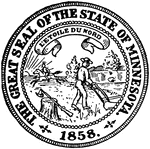
The Great Seal of the State of Minnesota. The seal depicts a farmer plowing as a Native American rides by horseback. Above, the state motto reads, 'L'etoile du nord' meaning "Star of the North."

Seal of Minnesota

The Great Seal of the State of Minnesota. The seal depicts a farmer plowing as a Native American rides…

The Great Seal of the State of Mississippi. The bald eagle wears stars and stripes and holds an olive branch symbolizing peace and arrows representing war.

Seal of Mississippi

The Great Seal of the State of Mississippi. The bald eagle wears stars and stripes and holds an olive…

The Great Seal of the State of Missouri. Two grizzly bears hold a shield with the national seal and icons symbolizing growth and strength. The scroll holds the state motto, 'Salus Populi Suprema Lex Esto' meaning "Let the welfare of the people be the supreme law."

Seal of Missouri

The Great Seal of the State of Missouri. Two grizzly bears hold a shield with the national seal and…
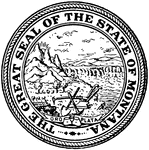
The Great Seal of the State of Montana. The seal shows Montana and a shovel, pick, and plow symbolizing agriculture. The state motto is 'Oro y Plata' meaning "Gold and Silver."

Seal of Montana

The Great Seal of the State of Montana. The seal shows Montana and a shovel, pick, and plow symbolizing…
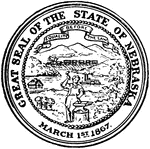
The Great Seal of the State of Nebraska, 1867. The seal shows a steamboat on the Missouri River, a train, a cabin, and a blacksmith. The banner holds the state motto, "Equality Before the Law."

Seal of Nebraska

The Great Seal of the State of Nebraska, 1867. The seal shows a steamboat on the Missouri River, a train,…
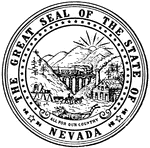
The Great Seal of the State of Nevada. The seal shows wheat, a sickle, and a plow representing agriculture. It also shows sunshine, mountains and the state motto, "All for Our Country."

Seal of Nevada

The Great Seal of the State of Nevada. The seal shows wheat, a sickle, and a plow representing agriculture.…
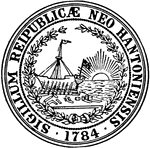
The Great Seal of the State of New Hampshire, 1784. The seal depicts a ship on stocks with a sunrise in the background.

Seal of New Hampshire

The Great Seal of the State of New Hampshire, 1784. The seal depicts a ship on stocks with a sunrise…
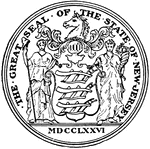
The Great Seal of the State of New Jersey. The seal features Liberty and Ceres holding a shield with three plows representing agriculture. The state motto in the ribbon below reads, "Liberty and Prosperity."

Seal of New Jersey

The Great Seal of the State of New Jersey. The seal features Liberty and Ceres holding a shield with…
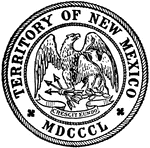
The Great Seal of the State of New Mexico, 1850. The seal pictures the American Bald Eagle and the Mexican Eagle holding a cactus in its talons and a snake in its mouth. Below them is a banner with the state motto, 'Crescit Eundo' meaning "It grows as it goes."

Seal of New Mexico

The Great Seal of the State of New Mexico, 1850. The seal pictures the American Bald Eagle and the Mexican…