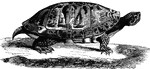
Common around New York and the surrounding regions, the red-bellied terrapin averages ten to seventeen inches in length.

Red-bellied terrapin

Common around New York and the surrounding regions, the red-bellied terrapin averages ten to seventeen…
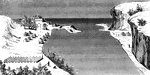
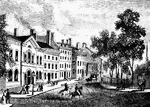
Oswego in 1755. This view is looking north toward the lake. It is a reduced copy of the frontispiece to <em>Smith's History of New York</em>, first ediction, London, 1757, and represents the encampment of Shirley there at that time.

Oswego

Oswego in 1755. This view is looking north toward the lake. It is a reduced copy of the frontispiece…
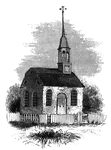
Caughnawaga church. This old church, now (1848) known as the <em>Fonda Academy</em>, under the management of Rev. Douw Van Olinda, is about half a mile east of the court-house, in the village of Fonda. It is a stone edifice, and was erected in 1763 by voluntary contributions. Sir William Johnson contributed liberally. Its first pastor was Thomas Romayne, who was succeeded in 1795 by Abraham Van Horn, one of the earliest graduates of King's (now Columbia) College, in the city of New York. He was from Kingston, Ulster county, and remained its pastor until 1840. During his ministry he united in marriage 1500 couples. The church was without a bell until the confiscated property of Sir John Johnson was sold in the Revolution, when the <em>dinner-bell</em> of his father was purchased and hung in the steeple. The bell weighs a little more than one hundred pounds, and bears the following inscription: "S. R. William Johnson, baronet, 1774. Made by Miller and Ross, in Eliz. Town."

Caughnawaga Church

Caughnawaga church. This old church, now (1848) known as the Fonda Academy, under the management…
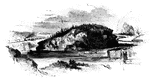
View at Little Falls. This view was taken from the rail-road near the village, looking down the river. On the right is seen the Erie Canal, and on the left, and more in the foreground, the Mohawk, at the foot of the falls, with the rail-road and the magnetic highway. The rugged bluff in the center is Moss Rock, at the lower extremity of which is the gulf, seen in the annexed engraving. This view is from the tow-path, below Moss Rock. On the left is the canal, and on the right are the gulf and a portion of the village in the distance. Moss Rock is an island, formed by the canal and the river. The summit of this amorphous pile has been suggested as an appropriate site for the proposed monument to the memory of Dewitt Clinton. It seems to me that the spot is singularly appropriate for that purpose. The Erie Canal, with its busy commerce, is his perpetual memorial; and here is the point where the most wonderful triumphs were achieved in the construction of that stupendous work. Here, too, pass all travelers to and from Niagara and the great West from the eastward, and the monument would be seen, if erected there, by more persons than at any other locality that may be named, out of the city of New York.

Little Falls

View at Little Falls. This view was taken from the rail-road near the village, looking down the river.…
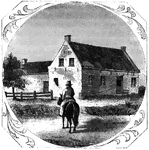
The Vankleek House. It was built by Myndert Vankleek, one of the first settlers in Dutchess county, in 1702, and was the first substantial house erected upon the site of Poughkeepsie. Its walls were very thick, and near the eaves they were pierced with lancet loop-holes for musketry. It was here that Ann Lee, the founder of the sect called Shaking Quakers, in this country, was lodged the night previous to her commitment to the Poughkeepsie jail, in 1776. She was a native of Manchester, England. During her youth she was employed in a cotton factory, and afterward as a cook in the Manchester infirmary. She married a blacksmith named Stanley; became acquainted with James and Jane Wardley, the originators of the sect in England, and in 1758 joined the small society they had formed. In 1770 she pretended to have received a revelation, while confined in prison on account of her religious fanaticism; and so great were the spiritual gifts she was believed to possess, that she was soon acknowledged a spirtual mother in Christ. Hence her name of Mother Ann. She and her husband came to New York in 1774. He soon afterward abandoned her and her faith, and married another woman. She collected a few followers, and in 1776 took up her abode in the woods of Watervliet, near Niskayuna, in the neighborhood of Troy. By some she was charged with witchcraft; and, because she was opposed to war, she was accused of secret correspondence with the British. A charge of high reason was preferred against her, and she was imprisoned in Albany during the summer. In the fall it was concluded to send her to New York, and banish her to the British army, but circumstances prevented the accomplishment of the design, and she was imprisoned in the Poughkeepsie jail until Governor Clinton, in 1777, hearing of her situation, released her. She returned to Watervliet, and her followers greatly increased. She died there in 1784, aged eighty-four years. Her followers sincerely believe that she now occupies that form or figure which John saw in his vision, standing beside the Savior.

Vankleek House

The Vankleek House. It was built by Myndert Vankleek, one of the first settlers in Dutchess county,…

Fitch's Point, the landing-place of the British. This view is from the west side of Gregory's Point, looking north-northwest. The promontory toward the left, covered with dark trees, is called Fort Point. There was an Indian fortification when the first settlers arrived at Norwalk. Further to the left, on the extreme edge of the picture, is seen one end of the rail-road bridge, which crosses Norwalk River. The New York and New Haven Rail-road was then in progress of construction. The point derives its name from its former proprietor, Governor Thomas Fitch, whose residence was Norwalk. He was Governor of the colony of Connecticut, and his name is among the beloved of his generation. He died July 18th, 1774, in the seventy-fifth year of his age.

Fitch's Point

Fitch's Point, the landing-place of the British. This view is from the west side of Gregory's Point,…


The old Colony Seal.

Colony Seal

The old Colony Seal.

The Pine-Tree Shilling. This is a fac-simile of the first money coined in America. The mint-master, who was allowed to take fifteen pence out of every twenty shillings, for his trouble in coining, made a large fortune by it. Henry Sewall, the founder of Newbury, in Massachusetts, married his only daughter, a girl of eighteen years. When the wedding ceremony was ended, a large pair of scales was brought out and suspended. In one disk the blushing bride was placed, and "pine tree shillings," as the coin was called, were poured into the other until there was an equiposie. The money was then handed to Mr. Sewall as his wife's dowry, amounting to one hundred and fifty thousand dollars. There are a few pieces of this money still in existence. One which I saw in the possession of a gentleman in New York was not as much worn as many of the Spanish quarters now in circulation among us. The silver appeared to be very pure.

Pine-Tree Shilling

The Pine-Tree Shilling. This is a fac-simile of the first money coined in America. The mint-master,…
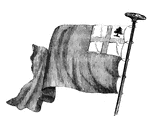
"The New England flag. This is copied from an old Dutch work, preserved in the library of the New York Historical Society, containing pictures of the flags of all nations. In the original, a divided sphere, representing the earth, is in the quarter where I have placed the pine-tree. I have made the alteration in the device, because in the flag raised upon the bastion of the redoubt on Breed's Hill, the pine-tree occupied the place of the sphere, the more ancient device. The question has been unsettled respecting the flag used on that occasion, as contemporary writers are silent on the subject. An intelligent old lady (Mrs. Manning) whom I saw between the Brandywine and Kennet Square, in Pennsylvania, informed me that her father, who was in the battle, assisted in hoisting the standard, and she had heard him speak of it as a 'noble flag.' The ground was blue, and one corner was quartered by the red cross of St. George, in one section of which was the pine-tree. This was the New England flag, as given in the sketch. Doubtless there were many other flags belonging to the several regiments."—Lossing, 1851

New England Flag

"The New England flag. This is copied from an old Dutch work, preserved in the library of the New York…
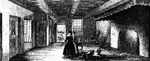
"The dining-hall, or room with seven doors. In the December number of the New York Mirror for 1834, is an interesting account of this old building, by Gulian C. Verplanck, Esq. He relates the following anecdote connected with this room, which he received from Colonel Nicholas Fish, father of the late governor of the State of New York. Just before La Fayette's death, himself and the American minister, with several of his countrymen, were invited to dine at the house of that distinguished Frenchman, Marbois, who was the French secretary of legation here during the Revolution. At the supper hour the company were shown into a room which contrasted quite oddly with the Parisian elegance of the other apartments where they had spent the evening. A low boarded, painted ceiling, with large beams, a single small, uncurtained window, with numerous small doors, as well as the general style of the whole, gave, at first, the idea of the kitchen, or largest room of a dutch or Belgian farm-house. On a long rough table was a repast, just as little in keeping with the refined kitchens of Paris as the room was with its architecture. It consisted of a large dish of meat, uncouth-looking pastry, and wine in decanters and bottles, accompanied by glasses and silver mugs, such as indicated other habits and tastes than those of modern Paris."&mdash;Lossing, 1851

Dining-Hall

"The dining-hall, or room with seven doors. In the December number of the New York Mirror for 1834,…
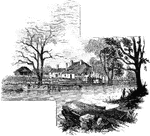
"Head-quarters of Greene and Knox. This view is from the turnpike road, looking southeast. The water in front is a mill-pond over the dam of which passes a foot-bridge. The mill is hidden by the trees in the ravine below. This side was originally the rear of the house, the old Goshen road passing upon the other side. The old front is a story and a half high. Captain Morton, the proprietor, is a son of the late General Jacob Morton, of New York city."—Lossing, 1851

Greene and Knox Head-Quarters

"Head-quarters of Greene and Knox. This view is from the turnpike road, looking southeast. The water…
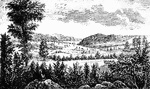
"View of the Camp Ground. This is from a painting by Tice, in my possession. The land on which the encampment on the west side of the meadow was, in now owned chiefly by Gilbert Tompkins and Nathaniel Moore. This view is from the land of Mr. Tompkins, looking east-southeast. On the slopes seen in the foreground, and on the margine of the meadow beyond Van Cortlandt's New York regiment, and the Maryland and Virginia troops were encamped. On the east side of the meadow, upon the most distant elevation in the middle ground, the New England troops were stationed. On the slope toward the right o that elevation stood the <em>Temple</em>. In the distance is seen the upper entrance of the Hudston into the Highlands. The meadow was formerly called Beayer Dam Swamp, from the circumstance that beavers constructed dams at the lower extremity, causing the waters to overflow the low grounds."&mdash;Lossing, 1851

Camp Ground

"View of the Camp Ground. This is from a painting by Tice, in my possession. The land on which the encampment…

"Order of the Cincinnati. This was drawn from an original in the possession of Edward Phalon, Esq., of New York. The engraving is the exact size of the original. The leaves of the sprigs of laurel are of gold, and green enamel; the head and tail of the eagle gold, and white enamel; and the sky in the center device blue enamel. The device and motto are the same as upon the medallion on the right of the certificate."&mdash;Lossing, 1851

Order of the Cincinnati

"Order of the Cincinnati. This was drawn from an original in the possession of Edward Phalon, Esq.,…
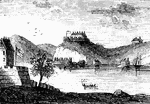
"West Point in 1780. This view is from a print published in the <em>New York Magazine</em> for 1790. It was taken from Constitution Island. On the left is seen a portion of old Fort Constitution. The great chain, four hundred and fifty yards in length, and covered by a strong battery, is seen stretched across the river, immediately below Fort Clinton, the structure on the high point. In the distance, on the left, two mountain summits are seen, crowned with fortifications. These were the North and Middle Redoubts. Upon the range of the Sugar Loaf Mountain, higher than these, and hidden, in the view, by Fort Clinton, was another redoubt, called the South Battery."—Lossing, 1851

West Point

"West Point in 1780. This view is from a print published in the New York Magazine for 1790.…
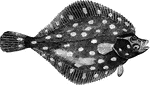
"Weighing six to twelve pounds; it feeds on mollusca, crustacea, and young fish; inhabits sandy banks and muddy grounds in the seal is sometime staken with hooks and sometimes with spears, though more generally with trawl-nets." &mdash; Goodrich, 1859

Plaice

"Weighing six to twelve pounds; it feeds on mollusca, crustacea, and young fish; inhabits sandy banks…
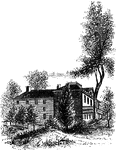
"The Livingston Mansion. This is a view from the lawn on the north side. It is embowerd in trees and shrubbery, and is one of the most pleasantly-located mansions in the country, overlooking interesting portios of the Hudson River. Within its walls many of the leading men of the Revolution were entertained. It was the head-quarters of Washington, when he abandoned an attempt to capture Cornwallis. There, at the close of the war, Washington, Governor Clinton, and General Sir Guy Carleton, and their respective suites, met to make arrangements for the evacuation of the city of New York by the British. Washington and Clinton came down the river from West Point in a barge; Carleton ascended in a frigate. Four companies of American Infantry performed the duty of guards on that occasion."—Lossing, 1851

Livingston Mansion

"The Livingston Mansion. This is a view from the lawn on the north side. It is embowerd in trees and…
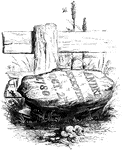
"Place of execution. The place of Andre's execution is now designated by a stone, lying on the right of a lane which runs from the highway from Tappan village to old Tappan, on the westerly side of a large peach orchard owned by Dr. Bartow, about a quarter of a mile from Washington's head-quarters. The stone is a small bowlder, on the upper surface of which is inscribed 'Andre executed Oct. 2d, 1780.' It is about three feet in length. This stone was placed there and inscribed in 1847, by a patriotic merchant of New York. A more elegant and durable monument should be erected upon the spot."&mdash;Lossing, 1851

Andre's Execution

"Place of execution. The place of Andre's execution is now designated by a stone, lying on the right…
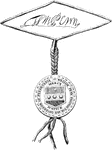
"Penn's Seal and Signature. This is a representation of the seal and signature of William Penn attached to the Pennsylvania charter. The names of the subscribing witnesses to the instrument are James Claypoole, Francis Plumsted, Thomas Barker, Philip Ford, Edward Pritchard, Andrew Soule, Christopher Taylor, Charles Lloyd, William Gibson, U. More, George Rudyard, Harbt. Springett."—Lossing, 1851

Penn's seal and signature

"Penn's Seal and Signature. This is a representation of the seal and signature of William Penn attached…
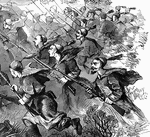
"Battle of Roanoke Island, February 8th, 1862- decisive bayonet charge of the Ninth New York Volunteers (Hawkins's Zouaves), on the three gun battery." —Leslie, 1896

Battle of Roanoke Island

"Battle of Roanoke Island, February 8th, 1862- decisive bayonet charge of the Ninth New York Volunteers…
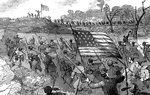
"Battle of Roanoke Island, February 8th, 1862- decisive bayonet charge of the Ninth New York Volunteers (Hawkins's Zouaves), on the three gun battery." —Leslie, 1896

Battle of Roanoke Island

"Battle of Roanoke Island, February 8th, 1862- decisive bayonet charge of the Ninth New York Volunteers…
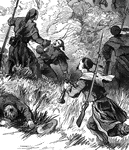
"Battle of Roanoke Island, February 8th, 1862- decisive bayonet charge of the Ninth New York Volunteers (Hawkins's Zouaves), on the three gun battery." —Leslie, 1896

Battle of Roanoke Island

"Battle of Roanoke Island, February 8th, 1862- decisive bayonet charge of the Ninth New York Volunteers…
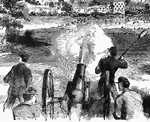
"Battle at Dam No. 4, Potomac River, between Butterfield's brigade and a large Confederate force. A desperate and disastrous action occurred on the banks of the Potomac, at Dam No. 4. General Butterfield's brigade, consisting of the Forty-fourth New York, Seventeenth New York, Eighteenth Massachusetts and One Hundred and Eighteenth Pennsylvania, were ordered to make a reconnoissance on the Virginia side. Crossing over at Dam No. 4, which is about six miles northwest in a straight line from Sharpsburg, and eight south from Williamsport, they had hardly landed when a most murderous fire was opened upon them from an entire division of the Confederate army, every volley of which told, as they had the Federals completely under range. The Federals made a desperate resistance, but they were compelled to retire before superior numbers, and retreated in moderate order across the river." &mdash;Leslie, 1896

Battle at Dam No. 4

"Battle at Dam No. 4, Potomac River, between Butterfield's brigade and a large Confederate force. A…
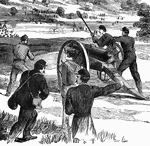
"Battle at Dam No. 4, Potomac River, between Butterfield's brigade and a large Confederate force. A desperate and disastrous action occurred on the banks of the Potomac, at Dam No. 4. General Butterfield's brigade, consisting of the Forty-fourth New York, Seventeenth New York, Eighteenth Massachusetts and One Hundred and Eighteenth Pennsylvania, were ordered to make a reconnoissance on the Virginia side. Crossing over at Dam No. 4, which is about six miles northwest in a straight line from Sharpsburg, and eight south from Williamsport, they had hardly landed when a most murderous fire was opened upon them from an entire division of the Confederate army, every volley of which told, as they had the Federals completely under range. The Federals made a desperate resistance, but they were compelled to retire before superior numbers, and retreated in moderate order across the river." &mdash;Leslie, 1896

Battle at Dam No. 4

"Battle at Dam No. 4, Potomac River, between Butterfield's brigade and a large Confederate force. A…
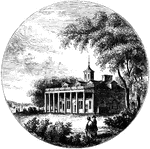
"Mount Vernon. This view is from the lawn in front, looking down the Potomac. The mansion is built of wood, cut so as to resemble stone, like Johnson Hall, at Johnstown, in New York, and is two stories in height. The central part was built by Lawrence Washington, a brother of the chief. The wings were added by the general. Through the center of the building is a spacious passage, level with the portico, and paved with tesselated Italian marble. This hall communicates with three large rooms, and with the main stair-way leading to the second story. The piazza on the eastern or river front is of square paneled pilasters, extending the whole length of the edifice. There is an observatory and cupola in the center of the roof, from whence may be obtained an extensive view of the surrounding country. The Mount Vernon estate was inherited by Lawrence Washington, who named it in honor of Admiral Vernon. He bequeathed it to George, and it passed into his possession on the death of Lawrence, which occurred in the mansion we are now noticing, on the 26th of July, 1752."&mdash;Lossing, 1851

Mount Vernon

"Mount Vernon. This view is from the lawn in front, looking down the Potomac. The mansion is built of…
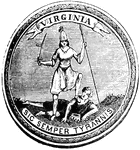
"Great Seal of Virginia."&mdash;Lossing, 1851

Virginia Seal

"Great Seal of Virginia."—Lossing, 1851

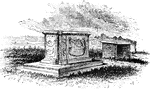
"The Nelson Tombs. This view is from the burial-ground looking down the York River toward Chesapeake Bay. The inscription upon the first monument is in Latin; the following is a translation of it: 'Here lies, in certain hope of a resurrection in Christ, Thomas Nelson, gentleman, son of Hugo and Sarah Nelson, of Penrith, in the county of Cumberland; born February 20th, A. D. 1677, died October 7th, 1745, aged sixty-eight years.' The inscription upon the second monument is much longer, and quite eulogistic. William Nelson was president of his majesty's council in Virginia, and died on the nineteenth of November, 1772, at the age of sixty-one years. No epitaph tells of the many virtues and heroic deeds of him who lies in the obscure vault beyond. History has written them upon the enduring pages of the chronicles of our republic; and in this work his biography and portrait may be found among those of the signers of the Delcaration of Independence."&mdash;Lossing, 1851

Nelson Tombs

"The Nelson Tombs. This view is from the burial-ground looking down the York River toward Chesapeake…
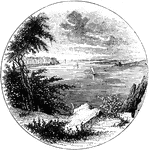
"View from the site of the Redoubt. This view is from the mounds looking northwest, up the York River. The first head-land on the right is Gloucester Point, and upon the high bank on the left is situated the village of Yorktown. The dark spot in the bank indicates the place of the so-called <em>Cornwallis' Cave</em>."&mdash;Lossing, 1851

Redoubt

"View from the site of the Redoubt. This view is from the mounds looking northwest, up the York River.…
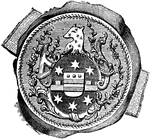
"Seal and signature of Tryon. William Tryon was a native of Ireland, and was educated to the profession of a soldier. He was an officer in the British service. He married Miss Wake, a relative of the Earl of Hillsborough, secretary for the colonies. Thus connected, he was a favorite of government, and was appointed lieutenant governor of North Carolina, in 1765. On the death of Governor Dobbs, he succeeded him in office, and exercised its functions until called to fill the same office in New York, in 1771. The history of his administration in North Carolina is a record of extortion, folly, and crime. During his administration in New York, the Revolution broke out, and he was the last royal governor of that state, though nominally succeeded in office in 1780 by General Robertson, when he was returned to England. His property in North Carolina and in New York was confiscated."—Lossing, 1851

William Tryon Seal

"Seal and signature of Tryon. William Tryon was a native of Ireland, and was educated to the profession…
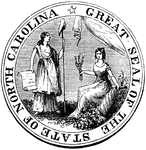
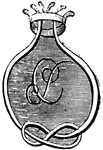
"Great Seal of the State of North Carolina."&mdash;Lossing, 1851

North Carolina Seal

"Great Seal of the State of North Carolina."—Lossing, 1851

"Pulaski's seal."&mdash;Lossing, 1851

Pulaski's Seal

"Pulaski's seal."—Lossing, 1851

"View at the foot of Broadway. General Charles Lee's troops marched to New York."—Lossing, 1851

Broadway

"View at the foot of Broadway. General Charles Lee's troops marched to New York."—Lossing, 1851
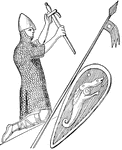
"William the Conqueror (1066-1087), as represented on his seal. Although William really ruled 'as king by the edge of the sword,' he preferred to base his title on the promise of Edward the Confessor rather than on force of arms; and he adhered to far as possible to Anglo-Saxon usages, causing himself to be crowned at Westminster and binding himself to frame good laws and observe justice, as his predecessors had done. In fact he professed to regard himself as the lawful successor of the Anglo-Saxon kings, and not merely as a feudal conqueror. He had great difficulty in making the people recognize him as such, but when this was once done, he was a far more powerful ruler as king of England than he was as Norman duke."&mdash;Colby, 1899

William the Conqueror

"William the Conqueror (1066-1087), as represented on his seal. Although William really ruled 'as king…
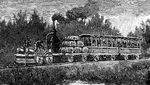
"The first passenger locomotive built in the United States. A year after the Enterprise sailed for India, the first railroad in the United States was opened in Massachusetts, from the Quincy quarries to tide water. It was only two miles long, and was used for hauling granite; the cars were drawn by horses. It was the first use of rails in America. In 1830 the first passenger railway in America was opened. It extended westward from Baltimore about fifteen miles, and now forms a part of the Baltimore and Ohio Railroad. The cars were at first drawn by horses, but a locomotive was used the next year. Its first locomotive was built by Peter Cooper, who made later the generous and useful gift of the Cooper Union to the city of New York. Now began the construction of railroads in various directions; in the next twenty years nearly ten thousand miles of road were built. This mileage has constantly been increased, until in 1895 there were in operation in the United States nearly one hundred and eighty thousand miles of railway."—Scudder, 1897

Passenger Train

"The first passenger locomotive built in the United States. A year after the Enterprise sailed for India,…

"John Ericsson was born in Sweden, July 31, 1803. He early showed great inventive skill and was employed as an engineer in the Swedish service. He resigned in 1826 and went to England to introduce an engine he had invented. In 1829 he won a prize for the best locomotive engine, and invented a hot-air engine. He came to New York in 1839 and built the United States steamer Princeton. He was busily engaged in perfecting his hot-air engine and applying it to the propulsion of vessels, and upon the outbreak of the war he put himself at the service of the United States government. After the war he constantly displayed his inventive genius in various constructions. He died March 8, 1889."—Scudder

John Ericcson

"John Ericsson was born in Sweden, July 31, 1803. He early showed great inventive skill and was employed…
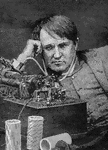
"Thomas Alva Edison was born at Milan, Ohio, February 11, 1847, but the family soon after moved to Port Huron, Michigan. He had to earn his living from early boyhood, and was a train boy on a railroad. A station master, whose child's life Edison had saved, taught the boy telegraphy, and in this art Edison quickly became an expert. In 1868 he chanced to be in New York when the indicator of a gold and stock company was broken, and he not only repaired it, but in doing so struck out a new invention, the printing telegraph. He sold his invention in 1876 and established himself at Menlo Park, New Jersey, where he built workshops for carrying out experiments in the application of electricity. It would take a very long paragraph even to name the devices and inventions which have followed, the most far-reaching being, perhaps, his system of electric lighting, his microphone, and the phonograph."&mdash;Scudder, 1897

Thomas Alva Edison

"Thomas Alva Edison was born at Milan, Ohio, February 11, 1847, but the family soon after moved to Port…

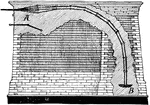
Seal of Massachusetts Bay Company

Massachusetts Seal

Seal of Massachusetts Bay Company

"Anchorage of a cable of the East River Bridge, New York."-Whitney, 1902

Anchorage

"Anchorage of a cable of the East River Bridge, New York."-Whitney, 1902

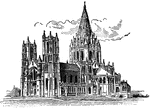
"A Cathedral is the principal church of a diocese, and the Cathedral city is the seat of the bishop of the diocese, and his throne is placed in the Cathedral church, which is the parish church of the whole diocese. The distinction between Cathedral and collegiate churches consists principally in the see of the bishop being at the former. The governing body of a Cathedral is called the dean and chapter. The Cathedral of St. John the Divine (P. E.) in New York, will, when completed, be the most splendid structure of the kind on this continent."—(Charles Leonard-Stuart, 1911)

Cathedral of St. John the Divine

"A Cathedral is the principal church of a diocese, and the Cathedral city is the seat of the bishop…
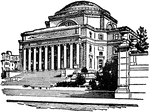
"Columbia University is a seat of learning in New York city. The charter of King's College, the original name of Columbia, was granted by George II., and finally passed the seals on Oct. 31, 1754, from which day the college dates its existence. The central library building and other costly buildings including St. Paul's Chapel, completed 1907, form a fine group."—(Charles Leonard-Stuart, 1911)

Library of Columbia University

"Columbia University is a seat of learning in New York city. The charter of King's College, the original…
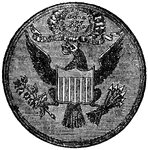
"The Eagle is a gold coin of the United States, value $10; half-eagle, $5; quarter-eagle, $2.50, double eagle, the largest gold coin of this country, $20."&mdash;(Charles Leonard-Stuart, 1911)

Eagle on Seal of United States

"The Eagle is a gold coin of the United States, value $10; half-eagle, $5; quarter-eagle, $2.50, double…
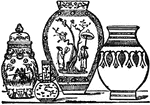
"A Vase is a vessel of various forms and materials, applied to the purposes of domestic life, sacrificial uses, etc. They were often used merely for ornament, or were at least primarily ornamental in character and design. The antique vases found in great numbers in ancient tombs and catacombs in Etruria, Southern Italy, Greece, Sicily, etc., and used to contain the ashes of the dead, were for the most part made of baked clay, painted and glazed. Rare Chinese and Japanese vases are highly prized, and $20,000 has been paid for one vase at auction in New York."&mdash;(Charles Leonard-Stuart, 1911)

Chinese, Japanese and Indian Vases

"A Vase is a vessel of various forms and materials, applied to the purposes of domestic life, sacrificial…
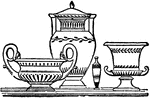
"A Vase is a vessel of various forms and materials, applied to the purposes of domestic life, sacrificial uses, etc. They were often used merely for ornament, or were at least primarily ornamental in character and design. The antique vases found in great numbers in ancient tombs and catacombs in Etruria, Southern Italy, Greece, Sicily, etc., and used to contain the ashes of the dead, were for the most part made of baked clay, painted and glazed. Rare Chinese and Japanese vases are highly prized, and $20,000 has been paid for one vase at auction in New York."&mdash;(Charles Leonard-Stuart, 1911)

Grecian Vases

"A Vase is a vessel of various forms and materials, applied to the purposes of domestic life, sacrificial…
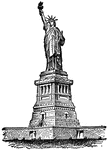
"The Statue of Lberty is a colossal statue on Bedloe's Island, N.Y. On Oct. 28, 1886, after more than 12 years of preparation, the colossal statue of Liberty, given by the people of France to the United States, was dedicated and unveiled in New York harbor. The statue was the conception of M. Bartholdi, who designed it for the Franco-American Union in 1874. It was built by popular subscriptions of the people of France."&mdash;(Charles Leonard-Stuart, 1911)

Statue of Liberty

"The Statue of Lberty is a colossal statue on Bedloe's Island, N.Y. On Oct. 28, 1886, after more than…
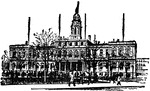
"New York is a city in Southern New York; coextensive with New York, Kings, Queens, and Richmond counties, on New York Bay, the Hudson and East rivers, Long Island Sound and the Atlantic Ocean; the first city in the United States in population and commercial importance, and after London, the largest metropolitan center in the world. Among the public buildings is the City Hall, 216 by 105 feet, and three stories high: completed in 1812 at a cost of $500,000. In the rear of the City Hall is the Court House."—(Charles Leonard-Stuart, 1911)

City Hall of New York

"New York is a city in Southern New York; coextensive with New York, Kings, Queens, and Richmond counties,…
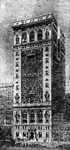
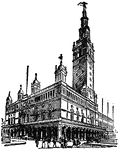
"New York is a city in Southern New York; coextensive with New York, Kings, Queens, and Richmond counties, on New York Bay, the Hudson and East rivers, Long Island Sound and the Atlantic Ocean; the first city in the United States in population and commercial importance, and after London, the largest metropolitan center in the world. New York is noted for the number and height of its office buildings. In 1911 there were 50 such structures in occupancy, ranging from 14 to 50 stories in height, or from 179 to 700 feet above ground level, and 16 more were nearing completion. The tallest building was that of the Metropolitan Life Insurance Company, 700 and one quarter feet to top of lantern on its majestic tower. Other conspicuous ones [include the] Park Row, 382 [feet]."&mdash;(Charles Leonard-Stuart, 1911)

Park Row Building of New York

"New York is a city in Southern New York; coextensive with New York, Kings, Queens, and Richmond counties,…
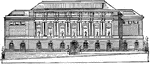
The Masonic Temple in New York City.

Masonic Temple of New York

The Masonic Temple in New York City.

Madison Square Garden in New York City.

Madison Square Garden in New York

Madison Square Garden in New York City.

The National Academy of Design Building in New York City.

National Academy of Design in New York

The National Academy of Design Building in New York City.

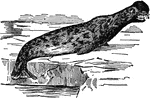
"The Seal, of the family Phocid&aelig;, or seal tribe, are, of all four-limbed mammiferous animals, those which display the most complete adaptation to residence in the water. The seal has considerable resemblance to a quadruped in some respects, and to a fish in others. The head is round, and the nose, which is broad, resembles that of a dog, with the same look of intelligence and mild and expressive physiognomy. It has large whiskers, oblong nostrils, and great black sparkling eyes. It has no external ears, but a valve exists in the orifices, which can be closed at will, so as to keep out the water; the nostrils have a similar valve; and the clothing of the body consists of stiff glossy hairs, very closely set against the skin. The body is elongated and conical, gradually tapering from the shoulders to the tail. The spine is provided with strong muscles, which bend it with considerable force; and this movement is of great assistance to the propulsion of the body."&mdash;(Charles Leonard-Stuart, 1911)

Hooded Seal

"The Seal, of the family Phocidæ, or seal tribe, are, of all four-limbed mammiferous animals,…
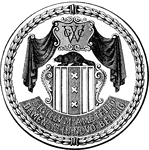
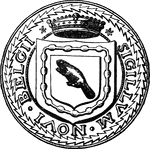
Seal of New Amsterdam

New Amsterdam

Seal of New Amsterdam

Seal of New Netherland

New Netherland

Seal of New Netherland

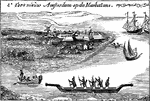
Earliest picture of New Amsterdam

New Amsterdam

Earliest picture of New Amsterdam

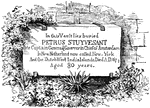
The tomb of Petrus Stuyvesant

Stuyvesant Tomb

The tomb of Petrus Stuyvesant

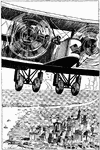
Captain Roy N. Francis, one of the best-known American pilots, flying over New York.

Captain Roy N. Francis over NYC

Captain Roy N. Francis, one of the best-known American pilots, flying over New York.
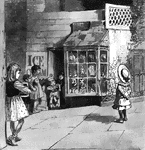
Children in front of a toy shop in New York.

Toy Shop

Children in front of a toy shop in New York.

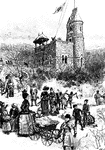
Hoisting the skating flag on the Belvedere in Central Park, New York.

Skating Flag

Hoisting the skating flag on the Belvedere in Central Park, New York.

Seal of East Jersey

East Jersey

Seal of East Jersey

Seal of the proprietors of Carolina.

Carolina

Seal of the proprietors of Carolina.

Founded Tiffany and Co. in New York City in 1837.

Charles Tiffany

Founded Tiffany and Co. in New York City in 1837.

Hewitt was a congressman, major of New York City, teacher, iron manufacturer, and lawyer.

Abram Stevens Hewitt

Hewitt was a congressman, major of New York City, teacher, iron manufacturer, and lawyer.