Euclid's Pythagorean Theorem Proof
To use any of the clipart images above (including the thumbnail image in the top left corner), just click and drag the picture to your desktop. You may also control-click (Mac) or right-click (Windows) and choose "Save file to disk" from the pop-up menu. Click here for help downloading and using clipart files.
* PDF (Portable Document Format) is a file format commonly used to distribute content to a wide audience. An advantage of the PDF is that it can be displayed and printed using any operating system. * A TIFF file is a high-resolution (240 dpi) format. TIFF files should be used only if you are printing the clipart. Do NOT use TIFF files for clipart that will displayed on a computer screen. Click here for help downloading and using TIFF files.* This clipart is also available as an Encapsulated Postscript file. EPS files are scalable and may be used in vector graphics applications such as Freehand or Illustrator and in word processors such as AppleWorks or Word. Click here for help downloading and using EPS files.File Name: pythag-eucl_43498
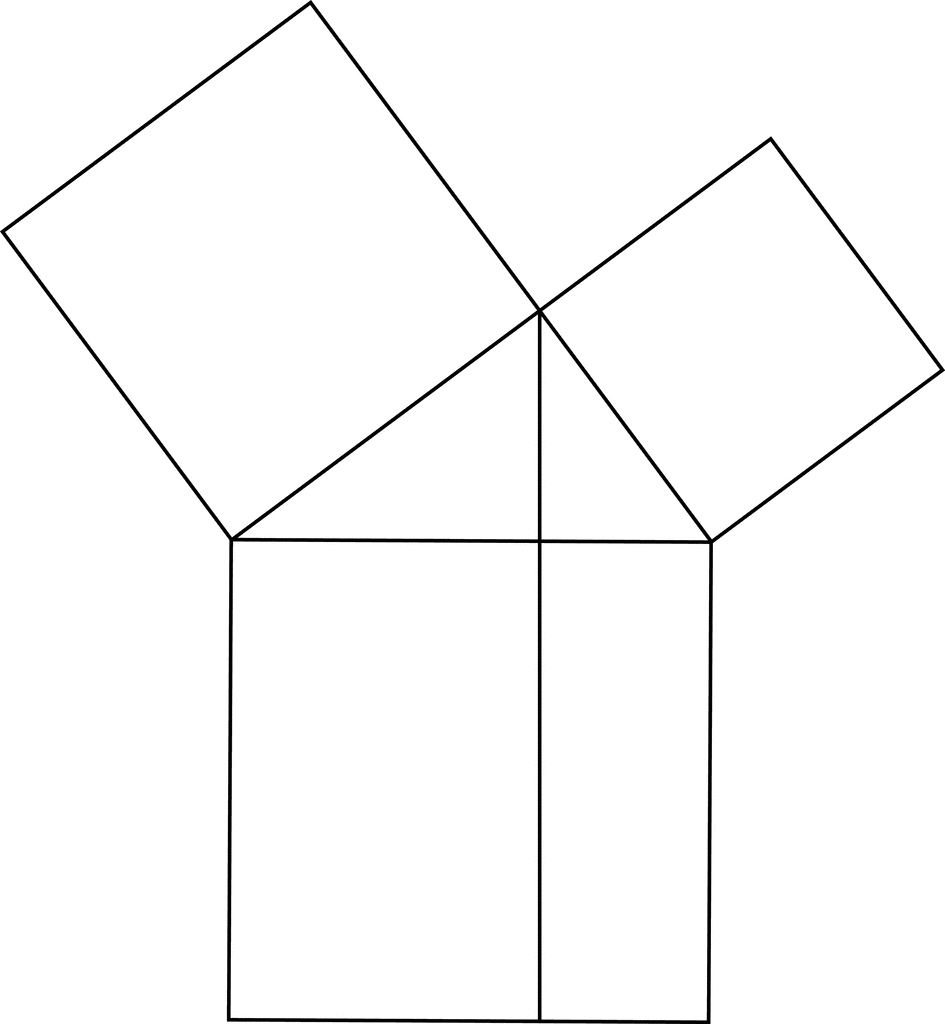
Description: Illustration used to prove the Pythagorean Theorem, according to Euclid. A perpendicular is drawn from the top vertex of the right triangle extended through the bottom square, forming 2 rectangles. Each rectangle has the same area as one of the two legs. This proves that the sum of the squares of the legs is equal to the square of the hypotenuse (Pythagorean Theorem).
Source:
Keywords: right triangle, triangles, Pythagorean Theorem, hypotenuse, proof, Euclid, Euclid's
Copyright: 2008, Florida Center for Instructional Technology. See license.
Main Menu Site Map Search License Clipart Help
Clipart ETC is a part of the Educational Technology Clearinghouse and is funded by various grants. Produced by the Florida Center for Instructional Technology, College of Education, University of South Florida. Email the project manager.