Ancient Roman Baths
![]()
![]()
![]()
To use any of the clipart images above (including the thumbnail image in the top left corner), just click and drag the picture to your desktop. You may also control-click (Mac) or right-click (Windows) and choose "Save file to disk" from the pop-up menu. Click here for help downloading and using clipart files.
* A TIFF file is a high-resolution (240 dpi) format. TIFF files should be used only if you are printing the clipart. Do NOT use TIFF files for clipart that will displayed on a computer screen. Click here for help downloading and using TIFF files.File Name: 63745_roman_baths
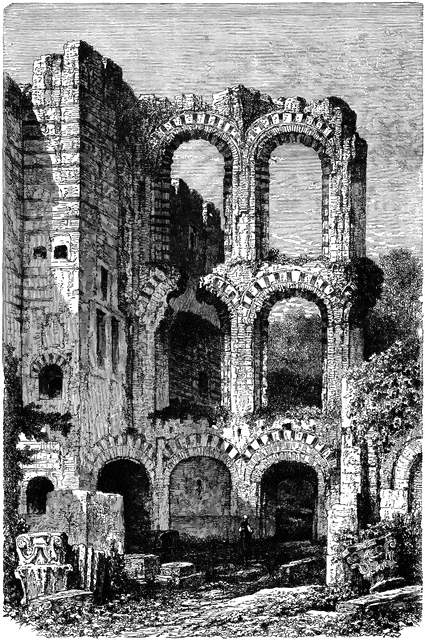
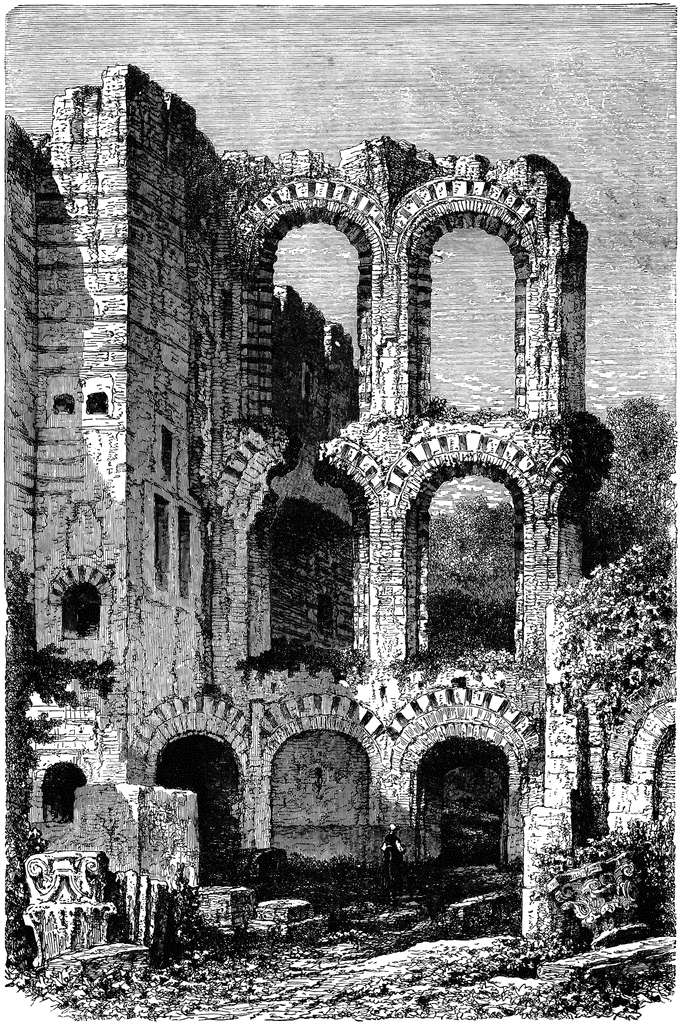
Description: Bathing was an important part in Ancient Roman culture and society. In Germany there are These Roman baths varied from simple to exceedingly elaborate structures. In taking a Roman bath, the bather induced sweating by gradually exposing himself to increasing temperatures. To accommodate this ritual, all Roman bathhouses contained a series of rooms which got progressively hotter. Most contained a room just inside the entrance where the bather stored his clothes. After taking a series of sweat and/or immersion baths, the bather returned to the cooler tepidarium (a warm room) for a massage with oils and final scraping with metal implements. Today ruins of Roman baths remain in three German cities, Trier, Baden-Baden, and Baden-Württemberg.
Source: DeColange, Leo The Heart of Europe from the Rhine to the Danube (Boston: Estes and Lauriat, Publishers, 1883) 6
Keywords: bathing, Roman Baths, baths, spas, massage, history of massage, immersion baths, tepidarium
Copyright: © 2004–2012 Florida Center for Instructional Technology. See license.
Main Menu Site Map Search License Clipart Help
Clipart ETC is a part of the Educational Technology Clearinghouse and is funded by various grants. Produced by the Florida Center for Instructional Technology, College of Education, University of South Florida. Email the project manager.