A capital A, decorated with lines and shading.

Decorative Capital A

A capital A, decorated with lines and shading.

A decorative capital letter A.

Decorative Letter A

A decorative capital letter A.

Capital letter A with a floral decoration.

A, Floral Initial

Capital letter A with a floral decoration.

Ornate capital A.

A, Ornate

Ornate capital A.

Ornate capital A.

A, Ornate

Ornate capital A.

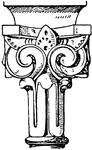
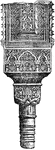
"Capital and Springing of Arch, from the Hall of Abencerrages, Alhambra." — Encyclopedia Britanica, 1893

Abencerrages

"Capital and Springing of Arch, from the Hall of Abencerrages, Alhambra." — Encyclopedia Britanica,…
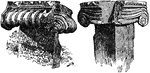
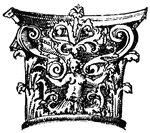
"In Greek Architecture, a capital on the corner column of a portico."-Whitney, 1902

Angle-Capital

"In Greek Architecture, a capital on the corner column of a portico."-Whitney, 1902

Antics are fancies having no foundation in nature, as sphinx, centaurs, etc., different flowers growing on one stem. Grotesque ornaments of all kinds.

Antic

Antics are fancies having no foundation in nature, as sphinx, centaurs, etc., different flowers growing…
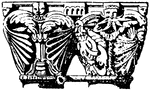
Antics are fancies having no foundation in nature, as sphinx, centaurs, etc., different flowers growing on one stem. Grotesque ornaments of all kinds.

Antic

Antics are fancies having no foundation in nature, as sphinx, centaurs, etc., different flowers growing…
A decorative letter C with curls wrapped around the letter.

Capital Letter C

A decorative letter C with curls wrapped around the letter.

Corinthianesque cap from St. Apollinare Nuovo, Ravenna.

Capital

Corinthianesque cap from St. Apollinare Nuovo, Ravenna.

"The top of a column or pillar." — Williams, 1889

Capital

"The top of a column or pillar." — Williams, 1889

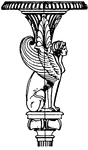
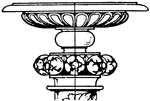
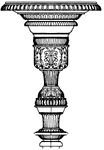
An illustrational of a decorative capital.

Capital

An illustrational of a decorative capital.

An illustration of a decorative capital.

Capital

An illustration of a decorative capital.

"In their private dwellings the Egyptians sometimes used graceful columns and the true arch (both of which forms the Greeks may have learned from them); but for their more important buildings they preferred massive walls and rows of huge, close-set columns, supporting roofs of immense flat slabs of rock." - West, 1904

A Capital from Karnak

"In their private dwellings the Egyptians sometimes used graceful columns and the true arch (both of…
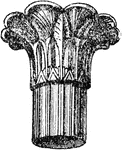
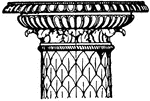
A capital with palm decoration.

Capital with Palm

A capital with palm decoration.

"Basket capital. Fro mthe Cathedral of Gurk." —D'Anvers, 1895

Basket capital

"Basket capital. Fro mthe Cathedral of Gurk." —D'Anvers, 1895

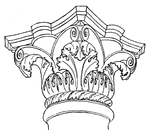
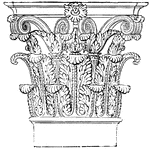
"The Composite or Roman order was the outcome of the attempt to improve the Corinthian, of which it was in fact a somewhat free version." —D'Anvers, 1895

Composite capital

"The Composite or Roman order was the outcome of the attempt to improve the Corinthian, of which it…
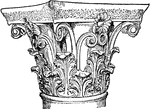
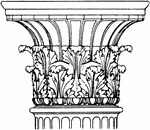
An illustration of a Corithian capital from the Tholos of Epidaurus. In several traditions of architecture including Classical architecture, the capital (from the Latin caput, 'head') forms the crowning member of a column or a pilaster. The capital projects on each side as it rises, in order to support the abacus and unite the form of the latter (normally square) with the circular shaft of the column.

Corinthian Capital

An illustration of a Corithian capital from the Tholos of Epidaurus. In several traditions of architecture…
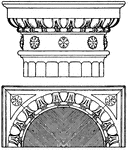
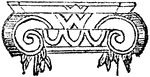
An illustration of an early Greek capital. In several traditions of architecture including Classical architecture, the capital (from the Latin caput, 'head') forms the crowning member of a column or a pilaster. The capital projects on each side as it rises, in order to support the abacus and unite the form of the latter (normally square) with the circular shaft of the column.

Early Greek Capital

An illustration of an early Greek capital. In several traditions of architecture including Classical…
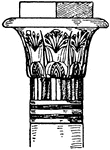
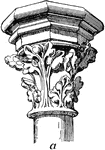
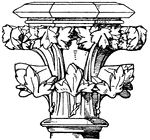
A French Gothic capital from Sainte Chapelle in Paris from the thirteenth century. The capitals were tall and slender, concave in profile, with heavy square or octagonal abaci. After the middle of the thirteenth century the carving became more realistic; the leaves, larger and more mature, were treated as if applied to the capital or moulding, not as if they grew out of it.

French Gothic Capital

A French Gothic capital from Sainte Chapelle in Paris from the thirteenth century. The capitals were…
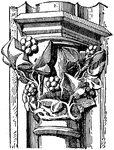
A fourteenth century capital from transept of Notre Dame, Paris. The capitals were tall and slender, concave in profile, with heavy square or octagonal abaci. After the middle of the thirteenth century the carving became more realistic; the leaves, larger and more mature, were treated as if applied to the capital or moulding, not as if they grew out of it.

French Gothic Capital

A fourteenth century capital from transept of Notre Dame, Paris. The capitals were tall and slender,…
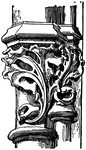
A fifteenth century capital from the north spire of Chartres. The capitals were tall and slender, concave in profile, with heavy square or octagonal abaci. After the middle of the thirteenth century the carving became more realistic; the leaves, larger and more mature, were treated as if applied to the capital or moulding, not as if they grew out of it.

French Gothic Capital

A fifteenth century capital from the north spire of Chartres. The capitals were tall and slender, concave…
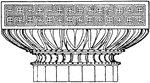
"The Doric Order is, in architecture, the second of the five orders, being that between the Tuscan and Ionic."—(Charles Leonard-Stuart, 1911)

Grecian Doric Capital

"The Doric Order is, in architecture, the second of the five orders, being that between the Tuscan and…
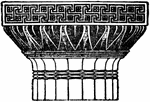
"The Doric Order is, in architecture, the second of the five orders, being that between the Tuscan and Ionic."—(Charles Leonard-Stuart, 1911)

Grecian Doric Capital

"The Doric Order is, in architecture, the second of the five orders, being that between the Tuscan and…
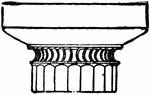
"The Doric Order is, in architecture, the second of the five orders, being that between the Tuscan and Ionic."—(Charles Leonard-Stuart, 1911)

Grecian Doric Capital

"The Doric Order is, in architecture, the second of the five orders, being that between the Tuscan and…
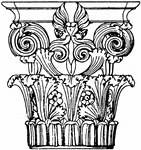
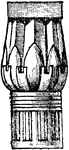
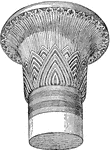
A decorative capital with lotus engraved.

Lotus Capital

A decorative capital with lotus engraved.

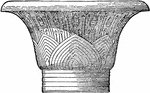
An illustration of a lotus decorated capital. In several traditions of architecture including Classical architecture, the capital (from the Latin caput, 'head') forms the crowning member of a column or a pilaster. The capital projects on each side as it rises, in order to support the abacus and unite the form of the latter (normally square) with the circular shaft of the column.

Lotus Capital

An illustration of a lotus decorated capital. In several traditions of architecture including Classical…
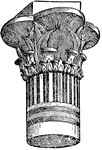
An illustration of a lotus decorated capital. In several traditions of architecture including Classical architecture, the capital (from the Latin caput, 'head') forms the crowning member of a column or a pilaster. The capital projects on each side as it rises, in order to support the abacus and unite the form of the latter (normally square) with the circular shaft of the column.

Lotus Capital

An illustration of a lotus decorated capital. In several traditions of architecture including Classical…
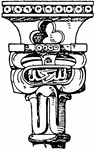
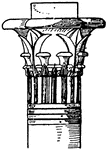
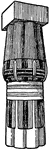
An illustration of a papyrus decorated capital. In several traditions of architecture including Classical architecture, the capital (from the Latin caput, 'head') forms the crowning member of a column or a pilaster. The capital projects on each side as it rises, in order to support the abacus and unite the form of the latter (normally square) with the circular shaft of the column.

Papyrus Capital

An illustration of a papyrus decorated capital. In several traditions of architecture including Classical…
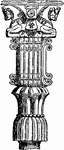
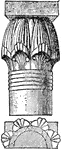
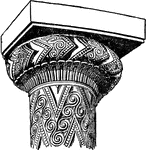
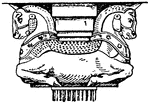
An illustration of a Persian capital. In several traditions of architecture including Classical architecture, the capital (from the Latin caput, 'head') forms the crowning member of a column or a pilaster. The capital projects on each side as it rises, in order to support the abacus and unite the form of the latter (normally square) with the circular shaft of the column.

Persian Capital

An illustration of a Persian capital. In several traditions of architecture including Classical architecture,…
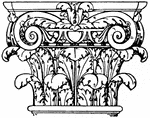
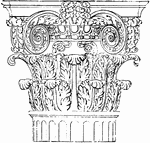
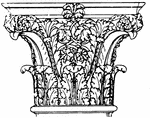
"The favorite order was the richly-decorated Corinthian, the beauty of which the Romans strove to increase by adding to it a fulness and strength such as the Greeks never succeeded in attaining." —D'Anvers, 1895

Roman-Corinthian Capital

"The favorite order was the richly-decorated Corinthian, the beauty of which the Romans strove to increase…
An illustration of the Capital building in Jackson, Mississippi.

The Capital (Jackson, MS)

An illustration of the Capital building in Jackson, Mississippi.

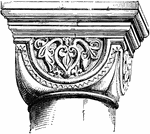
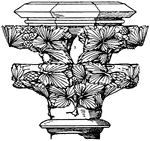
An illustration of a Byzantine capital from the central portal of St. Mark's Venice. In several traditions of architecture including Classical architecture, the capital (from the Latin caput, 'head') forms the crowning member of a column or a pilaster. The capital projects on each side as it rises, in order to support the abacus and unite the form of the latter (normally square) with the circular shaft of the column.

Byzantine Capitals

An illustration of a Byzantine capital from the central portal of St. Mark's Venice. In several traditions…

An illustration of a Byzantine capital from the the Church of St. Vitale, Ravenna. In several traditions of architecture including Classical architecture, the capital (from the Latin caput, 'head') forms the crowning member of a column or a pilaster. The capital projects on each side as it rises, in order to support the abacus and unite the form of the latter (normally square) with the circular shaft of the column.

Byzantine Capitals

An illustration of a Byzantine capital from the the Church of St. Vitale, Ravenna. In several traditions…

An illustration of a Byzantine capital from the the Church of St. Vitale, Ravenna. In several traditions of architecture including Classical architecture, the capital (from the Latin caput, 'head') forms the crowning member of a column or a pilaster. The capital projects on each side as it rises, in order to support the abacus and unite the form of the latter (normally square) with the circular shaft of the column.

Byzantine Capitals

An illustration of a Byzantine capital from the the Church of St. Vitale, Ravenna. In several traditions…

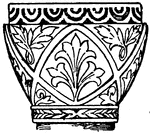
An illustration of a cushion capital. In several traditions of architecture including Classical architecture, the capital (from the Latin caput, 'head') forms the crowning member of a column or a pilaster. The capital projects on each side as it rises, in order to support the abacus and unite the form of the latter (normally square) with the circular shaft of the column.

Cushion Capitals

An illustration of a cushion capital. In several traditions of architecture including Classical architecture,…

An illustration of Italian Renaissance capital from St. Maria dei Miracoli, Venice. In several traditions of architecture including Classical architecture, the capital (from the Latin caput, 'head') forms the crowning member of a column or a pilaster. The capital projects on each side as it rises, in order to support the abacus and unite the form of the latter (normally square) with the circular shaft of the column.

Italian Renaissance Capitals

An illustration of Italian Renaissance capital from St. Maria dei Miracoli, Venice. In several traditions…

An illustration of a Romanesque capitals from the cloister of Monreale near Palermo, Sicily. In several traditions of architecture including Classical architecture, the capital (from the Latin caput, 'head') forms the crowning member of a column or a pilaster. The capital projects on each side as it rises, in order to support the abacus and unite the form of the latter (normally square) with the circular shaft of the column.

Romanesque Capitals

An illustration of a Romanesque capitals from the cloister of Monreale near Palermo, Sicily. In several…

The Capitoline Hill, between the Forum and the Campus Martius, is one of the seven hills of Rome. By the 16th century, Capitolinus had become Campidoglio in the Roman dialect. The English word capitol derives from Capitoline. The Capitoline contains few ancient ground-level ruins, as they are almost entirely covered up by Medieval and Renaissance palaces (now housing the Capitoline Museums) that surround a piazza, a significant urban plan designed by Michelangelo.

Capitoline Hill in Rome

The Capitoline Hill, between the Forum and the Campus Martius, is one of the seven hills of Rome. By…

Chillicothe served as the capital of Ohio from the beginning of statehood in 1803 until 1810 when Zanesville became the capital for two years.

Seat of Government at Chillicothe

Chillicothe served as the capital of Ohio from the beginning of statehood in 1803 until 1810 when Zanesville…

The Trajan's column is a monument in honor of Emperor Trajan located in Rome, Italy. The column is a continuous bas-relief design (raised art) that winds up around the capital from the base to the top of the capital. The relief designs depict Emperor Trajan's two victorious wars against the Dacian's.

Trajan's Column

The Trajan's column is a monument in honor of Emperor Trajan located in Rome, Italy. The column is a…

Arch of Titus.

Composite Order

Arch of Titus.

Composite order

Composite Order

Composite order

Temple of Castor and Pollux.

Corinthian Order

Temple of Castor and Pollux.

Greco-Roman Corinthian order of Temple of Vesta.

Corinthian Order

Greco-Roman Corinthian order of Temple of Vesta.

Corinthian order

Corinthian Order

Corinthian order

"Fig. 24. - Pterylosis of Cyoselus apus, drawn by Coues after Nitzsch; right hand upper, left hand lower, surface. 1 spinal tract; 2. humeral; 3. femoral; 4. capital; 5. alar; 6. caudal; 7. crural; 8. ventral." Elliot Coues, 1884

Pterylosis of Cypselus Apus

"Fig. 24. - Pterylosis of Cyoselus apus, drawn by Coues after Nitzsch; right hand upper, left hand lower,…

Ornate capital D.

D, Ornate

Ornate capital D.

Themoe of Diocletian.

Doric Order

Themoe of Diocletian.

Doric order

Doric Order

Doric order

Florial capital E.

Floral E

Florial capital E.

Floral capital E.

Floral E

Floral capital E.

Ornate capital E.

E, Ornate

Ornate capital E.

Egg-and-dart is an ornamental device often carved in wood, stone, or plaster quarter-round ovolo mouldings, consisting of an egg-shaped object alternating with an element shaped like an arrow, anchor or dart. Egg-and-dart enrichment of the ovolo molding of the Ionic capital is found in Ancient Greek architecture at the Erechtheion and was used by the Romans.

Egg-and-Dart

Egg-and-dart is an ornamental device often carved in wood, stone, or plaster quarter-round ovolo mouldings,…

A diagram showing the titles for different types of architecture.

Elements of an Architectural Order

A diagram showing the titles for different types of architecture.

Ornate capital letter F.

F, Initial

Ornate capital letter F.

Capital letter G with the location of the first Congress meeting.

G, Capital

Capital letter G with the location of the first Congress meeting.

Capital letter G with "The Swamp Fox" General Marion.

G, Capital

Capital letter G with "The Swamp Fox" General Marion.

Capital G decorated with scrollwork used to begin text in a book or as a letterhead.

G, Ornamental Letter

Capital G decorated with scrollwork used to begin text in a book or as a letterhead.