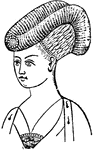
"Drawn from a portrait of Elizabeth of York when young, in stained glass at Little Malvern." — Encyclopedia Britannica, 1893

Elizabeth of York's Mitre Head-Dress

"Drawn from a portrait of Elizabeth of York when young, in stained glass at Little Malvern." — Encyclopedia…
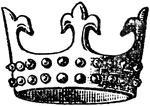
"Henry I enriched the plain circlet with gems, and on his great seal the trefoils of his fathers crown assume a form resembling that of fleurs-de-lys." — Encyclopedia Britannica, 1893

Crown

"Henry I enriched the plain circlet with gems, and on his great seal the trefoils of his fathers crown…
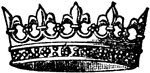
"Upon his seal as earl of Chester, the same sovereign has the circlet of his open crown heightened with fleurs-de-lys only, alternating with small clusters of pearls." — Encyclopedia Britannica, 1893

Crown

"Upon his seal as earl of Chester, the same sovereign has the circlet of his open crown heightened with…
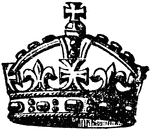
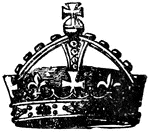
"A crown which appears on the great seal of Henry VIII." — Encyclopedia Britannica, 1893

Crown

"A crown which appears on the great seal of Henry VIII." — Encyclopedia Britannica, 1893

"The form of the arches shown appear for the first time upon the great seal of Edward VI." — Encyclopedia Britannica, 1893

Crown

"The form of the arches shown appear for the first time upon the great seal of Edward VI." — Encyclopedia…
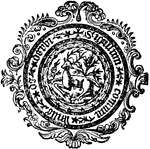
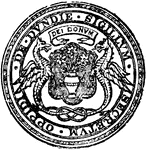
A seal representing the city of Derby, England.

Derby

A seal representing the city of Derby, England.

"A royal and parliamentary burgh and seaport, situated on the east coast of Scotland, in the county of Forfar, on the north bank of the Firth of Tay, twelve miles from the confluence of that estuary with the German Ocean. It is the third town in Scotland as regards to population, and the second in commercial importance." — Encyclopedia Britannica, 1893

Dundee

"A royal and parliamentary burgh and seaport, situated on the east coast of Scotland, in the county…
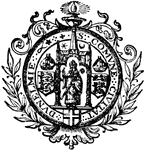
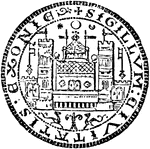
The seal for the civil corporation of Durham and Framwellgate.

Corporation Seal

The seal for the civil corporation of Durham and Framwellgate.

"Corporation Seal." &mdash Encyclopedia Britannica, 1893

Corporation Seal

"Corporation Seal." &mdash Encyclopedia Britannica, 1893

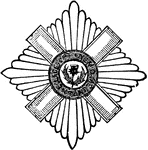
"Star of the order of the Thistle." — Chambers' Encyclopedia, 1875

Order of the Thistle

"Star of the order of the Thistle." — Chambers' Encyclopedia, 1875

"The religious Order of the Heavenly Annunciation, or of the Nuns of the Annunciation of Mary, was instituted by Victoria Fornare at Genoa in 1682, after the rule of St. Augustine. All the convents of the order in France, Germany, and the Netherlands have disappeared since the French Revolution. Some still exist in Italy." — Chambers' Encyclopedia, 1875

Order of the Annunciation

"The religious Order of the Heavenly Annunciation, or of the Nuns of the Annunciation of Mary, was instituted…
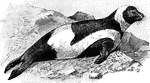
A seal which has many bands of white around black.

Ribbon Seal

A seal which has many bands of white around black.

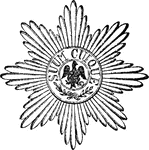
"Star of the Order of the Black Eagle." — Chambers' Encyclopedia, 1875

Black Eagle

"Star of the Order of the Black Eagle." — Chambers' Encyclopedia, 1875

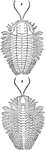
"Restoration of Triarthrus Becki, Green, as determined by Beecher from specimens obtained from the Utica Slates (Ordovician), New York. A, dorsal; B, ventral surface. In the latter the single pair of antennae springing up from each side of the camerostome or hypostome or upper lip-lobe are seen. Four pairs of appendages besides these are seen to belong to the cephalic tergum. All the appendages are pediform and bi-ramose; all have a prominent gnathobase, and in all the exopodite carries a comb-like series of secondary processes." — The Encyclopedia Britannica, 1910

Triarthrus

"Restoration of Triarthrus Becki, Green, as determined by Beecher from specimens obtained from the Utica…
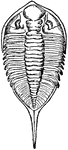
"Dalmanites limulurus, Green. One of the Phacopidae, from the Silurian, New York." — The Encyclopedia Britannica, 1910

Dalmanites

"Dalmanites limulurus, Green. One of the Phacopidae, from the Silurian, New York." — The Encyclopedia…

"Palmer, Erastus Dow, sculptor, born in Onondaga county, New York, in 1817; died in 1904. Among his best works are Indian Girl Contemplating a Crucifix, The White Captive, The Sleeping Peri, and Landing of the Pilgrims." — Winston's Encyclopedia, 1919

Erastus Dow Palmer

"Palmer, Erastus Dow, sculptor, born in Onondaga county, New York, in 1817; died in 1904. Among his…
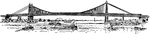
The Williamsburg Bridge in New York

Williamsburg Bridge

The Williamsburg Bridge in New York

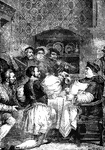
When Henry VIII became king in 1509, Wolsey's affairs prospered. He became Canon of Windsor, Berkshire in 1511, the same year in which he became a member of the Privy Council. His political star was in the ascendant, and he soon became the controlling figure in all matters of state. 1514, he was made Bishop of Lincoln, and then Archbishop of York.

Cardinal Wolsey Served by Noblemen

When Henry VIII became king in 1509, Wolsey's affairs prospered. He became Canon of Windsor, Berkshire…
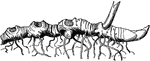
Rootstock of Solomon's Seal, with the bottom of the stalk of the season, and the bud for the next year's growth.

Solomon's Seal

Rootstock of Solomon's Seal, with the bottom of the stalk of the season, and the bud for the next year's…
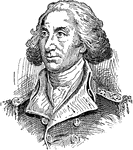
(1733-1804) General Schuyler was in the American Revolution and a United States Senator from New York.
Philip Schuyler

(1733-1804) General Schuyler was in the American Revolution and a United States Senator from New York.

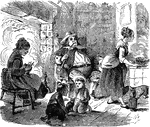
A Dutch colonial family in scene in the colony of New Amsterdam.

Dutch Family

A Dutch colonial family in scene in the colony of New Amsterdam.

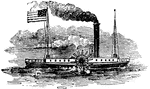
A steamboat constructed by Robert Fulton, which made the passage from New York to Albany in thirty six hours.

Steamboat

A steamboat constructed by Robert Fulton, which made the passage from New York to Albany in thirty six…
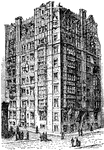
Berkshire Apartment House at New York

Berkshire Apartment House

Berkshire Apartment House at New York

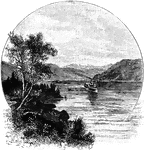
Lake George, also known as <em>Queen of American Lakes</em>, is a long narrow lake at the southeast base of the Adirondack Mountains, northern New York. The lake extends about 32.2 miles on a north-south axis and varies from 1 to 3 miles in width.

View of Lake George, N.Y.

Lake George, also known as Queen of American Lakes, is a long narrow lake at the southeast…
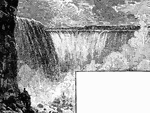
Niagara Falls in New York.

Niagara Falls

Niagara Falls in New York.

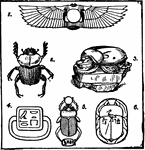
The ancient Egyptians regarded the scarab as a symbol of immortality. 1. Stone scarab with wings, 2. The sacred beetle (<em>Scarabaeus sacer</em>), 3. Scarab from the British Museum, 4. Scarab seal from the tomb of Maket, 5, 6. Scarabs from monuments.

Egyptian scarabs

The ancient Egyptians regarded the scarab as a symbol of immortality. 1. Stone scarab with wings, 2.…
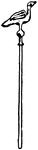
A sceptre from the seal of Edward the Confessor.

Sceptre of Edward the Confessor

A sceptre from the seal of Edward the Confessor.

Torso of the Statue known as Venus of Melos (left) and New York Fashion, 1898 (right). "Since abdomen and chest alternately expand and contract in healthy breathing, anything which impedes their free movement is to be avoided. The tight lacing which is still indulged [in 1900] by those who think a distorted form beautiful, seriously impedes one of the most important functions of the body, and leads not only to shortness of breath and an incapacity for muscular exertion, but in many cases to actual deformity or disease." — Newell, 1900.

Effect of Corset Use on Respiration

Torso of the Statue known as Venus of Melos (left) and New York Fashion, 1898 (right). "Since abdomen…
Torso of the Statue known as Venus of Melos (left) and New York Fashion, 1898 (right). "Since abdomen and chest alternately expand and contract in healthy breathing, anything which impedes their free movement is to be avoided. The tight lacing which is still indulged [in 1900] by those who think a distorted form beautiful, seriously impedes one of the most important functions of the body, and leads not only to shortness of breath and an incapacity for muscular exertion, but in many cases to actual deformity or disease." — Newell, 1900.

Effect of Corset Use on Respiration

Torso of the Statue known as Venus of Melos (left) and New York Fashion, 1898 (right). "Since abdomen…

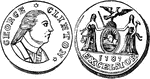
New York Cent (1 cent) New York coin from 1787. Obverse has the right-facing image of a man surrounded with the inscription - GEORGE CLINTON. The reverse shows the state coat of arms with the inscription - 1787 EXCELSIOR below the figure.

Copper Cent Coin, 1787

New York Cent (1 cent) New York coin from 1787. Obverse has the right-facing image of a man surrounded…
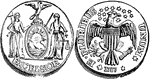
New York Cent (1 cent) New York coin from 1787. Obverse has the state coat of arms with the inscription - EXCELSIOR beneath the figure. Reverse shows a right-facing heraldic eagle with thirteen stars over head, surrounded by the inscription - E PLURIBUS UNUM 1787.

Copper Cent Coin, 1787

New York Cent (1 cent) New York coin from 1787. Obverse has the state coat of arms with the inscription…

Hard Times Token (unknown) US coin from 1834. Obverse has a left-facing sailing ship with the inscription - FOR THE CONSTITUTION HURRA! Reverse is inscribed with WHIGS OF N. YORK VICTORIOUS LES TROIS JOURS APRIL 8, 9, & 10, 1834 surrounded by the inscription - FLOURISH COMMERCE, FLOURISH INDUSTRY

Brass Hard Times Token, 1834

Hard Times Token (unknown) US coin from 1834. Obverse has a left-facing sailing ship with the inscription…

Hard Times Token (unknown) US coin. Obverse has an image of the front of the Merchants Exchange surrounded by the inscription - MERCHANTS EXCHANGE WALL ST N YORK BUILT 1827 BURNT 1835. Reverse shows the center inscription - NOT ONE CENT FOR TRIBUTE surrounded by a wreath with 9 berries - 3 outside and 6 inside the wreath with a surrounding inscription - MILLIONS FOR DEFENCE.

Copper Hard Times Token, ND

Hard Times Token (unknown) US coin. Obverse has an image of the front of the Merchants Exchange surrounded…
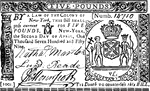
Five Pounds (5 pounds) New York currency from 1759. Image is the New York City Coat of Arms. Beneath the image is the inscription - 'TIS DEATH TO COUNTERFEIT THIS BILL.

Paper Money, Five Pounds Bill, 1759

Five Pounds (5 pounds) New York currency from 1759. Image is the New York City Coat of Arms. Beneath…
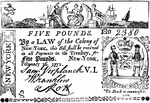
Five Pounds (5 pounds) New York currency from 1771. Image is the Coat of Arms of New York City. Beneath the image is the inscription - 'TIS DEATH TO COUNTERFEIT THIS BILL.

Paper Money, Five Pounds Bill, 1771

Five Pounds (5 pounds) New York currency from 1771. Image is the Coat of Arms of New York City. Beneath…
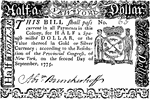
Half Dollar (50 cents) New York currency from 1775. Image is the Coat of Arms of New York City.

Paper Money, Half Dollar Bill, 1775

Half Dollar (50 cents) New York currency from 1775. Image is the Coat of Arms of New York City.
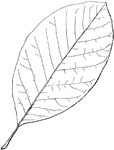
Leaves - simple, alternate, edge entire. Outline - long oval. Apex - pointed. Base - pointed. Leaf - five to ten inches long, thin, dark green above; green beneath and slightly downy; growing along the branch and not simply in a cluster at its end. Bark - dark and rough. Flowers - three to six inches across, bluish or yellowish-white, abundant and fragrant. May, June. Fruit - in a cylinder-shaped bunch, two to three inches long, and somewhat resembling a small cucumber. Found - in rich woods from Western New York to southern Illinois and southward, and in cultivation. Its finest growth is in the southern Alleghany Mountains.  General Information - A tree sixty to ninety feet high, with a straight trunk and rich foliage. The wood is durable, soft, and light. Used for cabinet-work, for flooring, for pump-logs, and water-troughs. As in other magnolias the juice is bitter and aromatic. From "magnol," the name of a botanist of the seventeenth century.

Genus Magnolia, L. (Magnolia)

Leaves - simple, alternate, edge entire. Outline - long oval. Apex - pointed. Base - pointed. Leaf -…
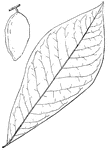
Leaves - simple; alternate; edge entire. Outline - long, reverse egg-shape. Apex - pointed, in small leaves, sometimes rounded. Base - taper-pointed or slightly rounded. Leaf - five to ten inches long, thin, rusty downy with young, soon becoming smooth and polished. Bark - slivery-gray, smooth and polished; young shoots downy. Flowers - one and a half inches wide; dark to light, in drooping clusters, appearing with the leaves. March, April. Fruit - about three inches long by one and a half inches thick, egg-shape, yellow, about ten-seeded, fragrant, sweet, and edible. October. Found - from Western New York to Southern Iowa and southward. General Information - A small tree of unpleasant odor when bruised, ten to twenty feet high (or often only a bush) and densely clothed with its long leaves.<p>General Information - A small tree of unpleasant odor when bruised, ten to twenty feet high (or often only a bush) and densely clothed with its long leaves.

Genus Asimina, Adans (Papaw)

Leaves - simple; alternate; edge entire. Outline - long, reverse egg-shape. Apex - pointed, in small…
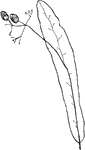
Leaves - simple/alternate; edge somewhat irregularly very sharp-toothed. Outline - rounded, often very one-sided. Apex - pointed. Base - strongly heart-shaped. Leaf - two to three inches long; thinner than the T. Americana, deep green and shining above, beneath somewhat downy. Bark - of the trunk very thick; on the young branches dark brown. Fruit - rounded, about one fourth of an inch in diameter, and with the base of the leaf-like bract to which it is attached usually rounded at the base. Found - in rich woods, from New York to Florida and westward..   General Information - A straight-trunked tree, twenty to thirty feet high (often unbranching to half its height) and two to four feet in diameter. Its very tough inner bark is used for mats and coarse rope. The wood is white and soft and clear of knots. It is much used for wooden ware, in cabinet-work, and for the paneling of carriages, though now less esteemed than the tulip tree for these uses, owing to its liability to crack in bending.

Genus Tilia, L. (Basswood)

Leaves - simple/alternate; edge somewhat irregularly very sharp-toothed. Outline - rounded, often very…
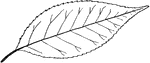
Leaves - simple; alternate; edge with remote, not evergreen; egg-shape or long oval, rather thin with edge finely toothed,  Outline - oval. Apex - taper-pointed. Leaf - about two inches long; dark polished green above; below rather yellowish-green; thick and stiff; smooth throughout; ribs very indistinct below. Bark - light gray and smooth. Fruit - a nearly round, bright-red berry, the size of a pea. It ripens in September and continues upon the branches into the winter. Found - in damp woods in the Catskill and Tahonic Mountains, and in Cattaraugus County, New York; through Pennsylvania as far east as Northampton County, and southward along the Alleghanies.General Information - This is usually regarded as a shrub, "but it not seldom attains the size and exhibits the port of a small tree" -(T. C. Porter).

Genus Ilex, L. (Holly)

Leaves - simple; alternate; edge with remote, not evergreen; egg-shape or long oval, rather thin with…
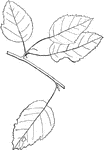
Leaves - simple; alternate; edge distinctly toothed when mature; sometimes near three-lobed Outline - egg-shape or oval Apex - pointed. Base - rounded or somewhat heart-shaped Leaf/Stem - one half to one inch long, very slender, downy Leaf - about two to three inches long, two thirds as wide, smooth. Flowers - large; rose-colored and white, in loose clusters of five to ten blossoms, and very fragrant. May. Fruit - round, one to one and a half inches in diameter; yellowish, fragrant, hard, and sour; fit only for preserving. Found - from Ontario to Western New York, Pennsylvania, and the District of Columbia; long the Alleghany Mountains, and westward. General Information - A small tree, ten to twenty feet high, rarely thirty feet, gaining its finest growth in the valleys of the lower Ohio. Often its presence is recognized before it is seen by means of the delightful fragrance of its blossoms.

Genus Pyrus L. (Apple, Mt. Ash)

Leaves - simple; alternate; edge distinctly toothed when mature; sometimes near three-lobed Outline…
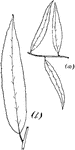
Leaves - simple; alternate; finely and sharply toothed. Outline - long and narrow. Apex - long, taper-pointed. Base - pointed or slightly rounded. Leaf/Stem - short and woolly. Leaf - one and a half to four inches long; commonest length about two inches; downy when young, becoming smooth excepting on the upper side of the mid-rib, which is usually woolly. Bark - of trunk, dark and rough; branches very brittle at the base and yellowish; twigs tough and purplish or yellow. Found - in Southern New Brunswick and Ontario, and from Northern Vermont southward. Common on low ground, especially in New York and Pennsylvania. General Information - A small tree, fifteen to twenty feet high; quite variable in the style of its foliage; the latest to flower, in May.

Genus Salix, L. (Willow)

Leaves - simple; alternate; finely and sharply toothed. Outline - long and narrow. Apex - long, taper-pointed.…
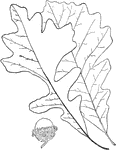
Leaves - simple; alternate; lobed (the edge of the lobes entire, or of the larger ones sometimes wavy). Outline - reverse egg-shape. Apex - of the lobes, rounded. Base - wedge-shape. Leaf - six to fifteen inches long (the longest of the oak-leaves); smooth above, downy beneath; the lobes usually long and rather irregular, the middle ones longest and often extending nearly to the middle rib. Bark - of the young branches always marked with corky wings or ridges. Acorns - large, with short stems. Cup - two thirds to two inches across, roughly covered with pointed scales, and heavily fringed around the nut. Nut - very large (one to one and a half inches long); broad egg-shape; one half to two thirds or often wholly enclosed by the cup. Found - along the coast of Maine southward as far as the Penobscot, in Western New England, in Western New York, in Pennsylvania, and thence westward to the foot-hills of the Rocky Mountains of Montana, and from Central Nebraska and Kansas southwest to the Indian Territory and Texas. It is found farther west and northwest than any other oak of the Atlantic forests. In the prairie region it forms a principal growth of the "Oak Openings." General Information - One of the most valuable and widely distributed oaks in North America, growing sixty to eighty feet in height, or more, with hard, tough wood resembling that of the White Oak. "The most interesting thing about this tree, perhaps is its power, quite unknown in the other White Oaks, of adapting itself to very different climatic conditions, which enables it to live in the humid climate of Maine and Vermont, to flourish in the somewhat drier climate of the Mississippi Valley, and to exist (still farther west) in the driest and most exposed region in habited by any of the Eastern America Oaks." - Sargent. Q. m. olivaformis is a variety found only in a few districts (near Albany and in Pennsylvania), having narrower and rather more deeply lobed leaves. Quercus, possible from a Celtic word meaning to inquire, because it was among the oaks that the Druids oftenest practised their rites.

Genus Quercus, L. (Oak)

Leaves - simple; alternate; lobed (the edge of the lobes entire, or of the larger ones sometimes wavy).…
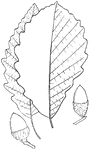
Leaves - simple; alternate; edge coarsely and evenly wavy-toothed. Outline - reverse egg-shape or sometimes oval. Apex - blunt-pointed. Base - rounded or slightly pointed, and often somewhat unequal. Leaf - four to seven inches long, two to four inches wide; smooth above, paler and downy beneath. Teeth - twelve to twenty-six, decreasing evenly and uniformly to the apex. Bark - of trunk, gray; furrowed up and down with continuous and often very deep furrows, with sharp ridges between. Acorns - usually in pairs on a stem about one half of an inch long, or often shorter. Cup - rounded or somewhat top-shaped, with minute scales, or warty. Nut - usually long egg-shape or long oval; one to one and one fourth inches long; brown; about one third covered by the cup; sweet. September, October. Found - from Eastern Massachusetts to New York, southward to Delaware, along the Alleghany Mountains to Alabama and westward to Central Kentucky and Tennessee. General Information - A tree forth to seventy feet in height, with strong, hard wood, largely used in fencing, or railroad ties, etc.; of less value than that of the White Oak. Its bark is very rich in tannin. Quercus, possible from a Celtic word meaning to inquire, because it was among the oaks that the Druids oftenest practised their rites.

Genus Quercus, L. (Oak)

Leaves - simple; alternate; edge coarsely and evenly wavy-toothed. Outline - reverse egg-shape or sometimes…
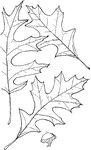
Leaves - simple; alternate; edge lobed (edges of the lobes mostly entire, but notched and toothed towards the ends). Outline - narrow oval or broad oval. Base - from long wedge-shape to squared. Ends of lobes and of the teeth pointed and bristle-tipped. Leaf - three to five inches long; both sides bright green, smooth, and shining; downy in the angles of the ribs below. Lobes - seven to nine, usually seven, with the hollows between them broad and round and usually reaching about three fourths of the way or more to the middle rib. The wide type of leaf closely resembles the leaves of the scarlet oak, but it is smaller and usually the hollows reach nearer to the middle rib. Bark - smoothish (comparatively), inner bark reddish. Acorns - numerous, small, on short stems. Cup - top-shaped, shallow, and nearly smooth. Nut - rounded, one half inch long or less, sometimes broader than long, light brown. October. Found - from the valley of the Connecticut to Central New York, southward to Delaware and the District of Columbia; in Southern Wisconsin and southward; usually along streams and on low, wet land. Most common and reaching its finest growth west of the Alleghany Mountains. General Information - A handsome tree forty to sixty feet high, usually with a pointed top and with light and delicate foliage. The wood is rather coarse and not durable. It takes its name of Pin Oak from the peg-like look of the dead twigs and short branches with which the lower parts of the tree are usually set. Quercus, possible from a Celtic word meaning to inquire, because it was among the oaks that the Druids oftenest practised their rites.

Genus Quercus, L. (Oak)

Leaves - simple; alternate; edge lobed (edges of the lobes mostly entire, but notched and toothed towards…
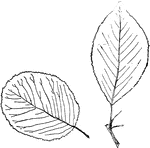
Leaves - simple, opposite; finely and sharply toothed. Outline - broadly oval, or broadly reverse egg-shape. Apex - rounded, sometimes pointed. Base - rounded, sometimes slightly pointed. Quite variable. Leaf/Stem - short and smooth, the edges slightly winged, the wings straight. Leaf - about one and a half to two inches long; smooth; shining above. Flowers - white, in rather large and flat, stemless bunches, at the ends of branches. May. Berries - oval, blackish, sweet and edible. Found - in Connecticut and Southern New York to Michigan and southward. General Information - A small tree fifteen to twenty feet high, or oftenest at the North a low, much-branching shrub. Usually with some of its branches stunted and bare. The tonic bark is sometimes used medicinally.

Genus Viburnum, L. (Haw and Viburnum)

Leaves - simple, opposite; finely and sharply toothed. Outline - broadly oval, or broadly reverse egg-shape.…
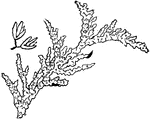
Leaves - simple; indeterminate in position because of their smallness and closeness. They are scale-like, somewhat egg-shape, overlapping each other, and closely pressed in four rows up and down the very flat branchlets. Each leaf has at its centre a raised gland, easily distinguished if held between the eye and the light. Bark - fibrous. The "spray" (formed from the flat branchlets) is itself flat and of rather a bright green. Cones - about five twelfths of an inch in length, long oval or reverse egg-shape, nodding, yellowish-brown as they ripen, dry and opening to the base when ripe. Scales - pointless, oval or egg-shape, smooth (i. e., not pointed on the edge or near the centre.) Seeds - one to two under each scale, long and narrow (like a small caraway seed); broadly winged all around, with the wing notched at one end. Found - along the Alleghany Mountains from the high peaks of North Carolina to Northern Pennsylvania and Central New York, northward into Southern Canada and westward; along rocky banks of streams and in swamps; very common at the North, where it often occupies large areas of swamp land. It is very widely cultivated, especially in hedges. General Information - A tapering evergreen tree, twenty to fifty feet high, with close, dense branches, and a light and durable wood.

Genus Thuya, L. (Arbor Vitae)

Leaves - simple; indeterminate in position because of their smallness and closeness. They are scale-like,…
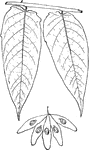
Leaves - compound (odd-feathered, but with the odd leaflet often dwarfed or broken off; leaflets, twenty-one to forty-one); alternate; edge of the leaflets entire, with one or two coarse, blunt teeth at each side of their base. Outline - of leaflet, long egg-shape or lance-shape. Apex - taper-pointed. Base, squared, or heart-shaped. Leaf/Stem - smooth, round, swollen at base. Leaflet/Stems - smooth and short. Leaf - one and a half to six feet long. Leaflets variable, usually about six inches by two and a quarter, rather smooth and thin. Bark - of the trunk, smooth and brown; the new shoots marked with whitish dots. Flowers - in long bunches at the ends of the branches; greenish, and of very disagreeable odor. June, July. Seeds - flat, at the centre of greenish and sometimes pink-tinged wings, in large, loose clusters. October. Found - common in cultivation, and to some extent naturalized. General Information - A large, showy tree (sixty to seventy feet high) of remarkable vigorous and rapid growth. It is a native of China. A Jesuit missionary sent its seeds in 1751 to England. In 1784 it was brought from Europe to the United States, and started near Philadelphia. Also about 1804 it was brought to Rhode Island from South America. But the source of most of the trees now found abundantly in the region of New York is Flushing, Long Island, where it was introduced in 1820. It has been a great favorite, and would deserve to be so still were it not for the peculiar and disagreeable odor of its flowers. Ailanthus, from a Greek word meaning "tree of heaven." Ailanthus - This spelling of the name should rule because so given by its author, although, etymologically, Ailantus would be correct, the native Amboyna name being "Aylanto."

Genus Ailanthus, Desf.

Leaves - compound (odd-feathered, but with the odd leaflet often dwarfed or broken off; leaflets, twenty-one…
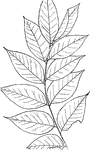
Leaves - unequally twice-compound (odd-feathered; leaflets very numerous - seven to thirteen on the different branches of the main leaf-stem; alternate; edge of leaflets entire. Outline - leaflets, egg-shape or oval. Apex - sharply taper-pointed. Base, slightly heart-shaped or rounded. Leaf-stem - in the autumn takes a violet tinge. Leaf - one and one half to three feet long, about one half as wide. Leaflets, one to two and one half inches long, of a dull green. Bark - of trunk, rough and scaly, separating in small and hard crosswise and backward-curled strips. Branchlets stout and not thorny. Flowers - in white spikes along the branches. May-July. Fruit - in large curved pods (Six to ten inches long, by two inches broad), pulpy within, of a reddish-brown color, flattened and hard. Each pod contains several hard, gray seeds one half of an inch or more in diameter. September, October. Found - in Franklin County, Pennsylvania (Porter), Western New York, westward and southward to Middle Tennessee. Not common. General information - A tree sixty to eighty feet high, or more, with a rather small and regular head. The fewness and the abruptness of its large branches give to it in the winder a dead and stumpy look, whence one of its common names. Its bruised and sweetened leaves are used at the South for poisoning flies. Its seeds were formerly used as a substitute for coffee.

Genus Gymnocladus, Lam. (Coffee Tree)

Leaves - unequally twice-compound (odd-feathered; leaflets very numerous - seven to thirteen on the…
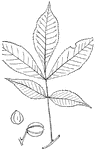
Leaves - compound (odd-feathered; leaflets, five to seven, oftenest five); alternate; edge of leaflets sharp-toothed. Outline - of leaflets, mostly long oval. Apex - pointed. Base - pointed. Leaf/Stem - smooth. Leaflet/Stems - lacking (or scarcely noticeable), excepting the short stem of the end leaflet. Leaflets - mostly four to eight inches long, remarkable smooth, excepting that the under surface is tufted in the angles of the ribs and usually dotted with dark glandular spots. Bark - rough and close. Fruit - broad egg-shape. Husk - thin, splitting part way to the base. Nut - small (three fourths of an inch in diameter), not angled, not sharp-pointed, and with a thin shell.Found - on moist ground, New York to Delaware, west to Michigan and Illinois, rarely, if ever, in New England. General Information - All the Hickories are picturesque trees. Their tendency, even when standing alone, is to grow high, and with heads that, instead of being round, are cylinder-shaped to the very top, with only enough breaks and irregularities to add to the effect. This tendency is more marked in the Hickories than in any other of the leaf-shedding trees of North America. They are worthy of the name sometimes given them of 'the artist's tree." Hicoria, from a Greek word meaning round, in allusion to the shape of the nut.

Genus Hicoria, Raf., Carya, Nutt. (Hickory)

Leaves - compound (odd-feathered; leaflets, five to seven, oftenest five); alternate; edge of leaflets…
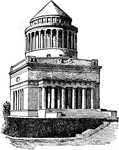

The tomb of Ulysses S. Grant in New York City.

Grant's Tomb

The tomb of Ulysses S. Grant in New York City.

The seal of the United States.

United States Seal

The seal of the United States.

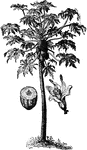
"A native tree of the United States, growing principally in Michigan, New York, New Jersey and Kansas." -Foster, 1921

Papaw

"A native tree of the United States, growing principally in Michigan, New York, New Jersey and Kansas."…
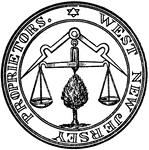
The seal of the western part of the New Jersey colony.

Seal of West Jersey

The seal of the western part of the New Jersey colony.

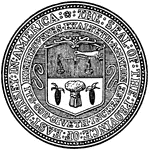
The seal of the eastern part of the New Jersey colony.

Seal of East Jersey

The seal of the eastern part of the New Jersey colony.

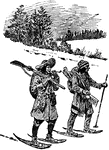
Frenchmen on snowshoes in Schenectady, a northern village of the New York colony.

Frenchmen

Frenchmen on snowshoes in Schenectady, a northern village of the New York colony.

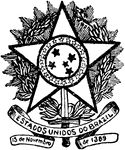
The coat of arms of Brazil.

Brazilian Coat of Arms

The coat of arms of Brazil.

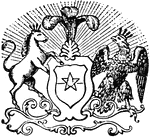
The coat of arms of Chile.

Chilean Coat of Arms

The coat of arms of Chile.

The coat of arms of China.

Chinese Coat of Arms

The coat of arms of China.

The coat of arms of Colombia.

Colombian Coat of Arms

The coat of arms of Colombia.