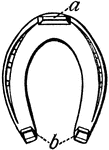
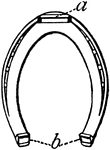
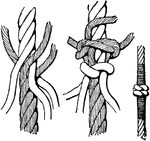
"Horseshoes. A, shoe for fore foot; ... a, toe-calks; b, heel-calks." -Whitney, 1911

Horseshoe

"Horseshoes. A, shoe for fore foot; ... a, toe-calks; b, heel-calks." -Whitney, 1911

"Horseshoes. ... B, shoe for hind foot; a, toe-calks; b, heel-calks." -Whitney, 1911

Horseshoe

"Horseshoes. ... B, shoe for hind foot; a, toe-calks; b, heel-calks." -Whitney, 1911

"A knot by which the two parts of a shroud which has been broken or shot away are reunited." -Whitney, 1911

Shroud Knots

"A knot by which the two parts of a shroud which has been broken or shot away are reunited." -Whitney,…
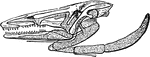
The Common Mudpuppy (Necturus maculosus) is a species of aquatic salamander found throughout the northeastern United States, and parts of Canada. Pictured here is the lateral view of the cranium.

Cranium of the Common Mudpuppy (Lateral View)

The Common Mudpuppy (Necturus maculosus) is a species of aquatic salamander found throughout the northeastern…
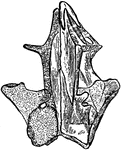
The Common Mudpuppy (Necturus maculosus) is a species of aquatic salamander found throughout the northeastern United States, and parts of Canada. Pictured here is the dorsal view of the cranium.

Cranium of the Common Mudpuppy (Dorsal View)

The Common Mudpuppy (Necturus maculosus) is a species of aquatic salamander found throughout the northeastern…
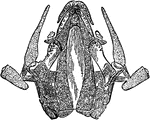
The Common Mudpuppy (Necturus maculosus) is a species of aquatic salamander found throughout the northeastern United States, and parts of Canada. Pictured here is the ventral view of the cranium.

Cranium of the Common Mudpuppy (Ventral View)

The Common Mudpuppy (Necturus maculosus) is a species of aquatic salamander found throughout the northeastern…
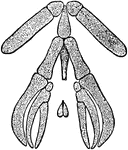
The Common Mudpuppy (Necturus maculosus) is a species of aquatic salamander found throughout the northeastern United States, and parts of Canada. Pictured here is the hyoid and branchial apparatus

Hyoid and Branchial Apparatus of the Common Mudpuppy

The Common Mudpuppy (Necturus maculosus) is a species of aquatic salamander found throughout the northeastern…
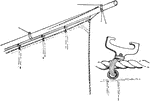
"Railway, with single traveler in detail. Nautical, iron jackstays bolted on the under side of standing gaffs which carry fore-and-aft sails, with or without booms. Small grooved iron shapes called "travelers" are sewed to the head of the sail, and slide along the gaff by means of a whip or outhaul." -Whitney, 1911

Railway

"Railway, with single traveler in detail. Nautical, iron jackstays bolted on the under side of standing…
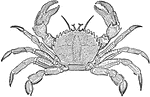
The velvet crab (alternatively velvet swimming crab or devil crab) is the largest swimming crab found in British coastal waters, with a carapace width of up to 100 mm. The body is coated with short hairs, giving the animal a velvety texture, hence the common name. It is one of the major crab species for UK fisheries. The velvet crab lives from southern Norway to Western Sahara in the North Sea and north Atlantic as well as western parts of the Mediterranean Sea, on rocky bottoms from the shoreline to a depth of about 65 m. The last pair of pereiopods are flattened to facilitate swimming.

Velvet Crab

The velvet crab (alternatively velvet swimming crab or devil crab) is the largest swimming crab found…
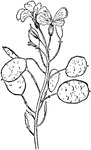
Annual Honesty (Lunaria annua) is a tall (height about 1 m), hairy-stemmed biennial plant found throughout Europe, North America, and parts of Asia. It has large, pointed oval leaves with marked serrations. The common name "Honesty" arose in the 16th century, and it may be due to the translucent seed-pods which are like flattened pea-pods and borne on the plant through winter. In South-East Asia and elsewhere, it is called the Money Plant, because its seed pods have the appearance of silver coins. In the United States it may also be known as "Silver Dollars," also because of the seed pods.

Annual Honesty

Annual Honesty (Lunaria annua) is a tall (height about 1 m), hairy-stemmed biennial plant found throughout…
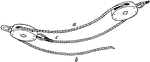
"Running-part. Naut., that part of a rope which is hauled upon is called the hauling-part (b), the part between the blocks is the running-part (a), and the part which is made fast is referred to as the standing-part (c)." -Whitney, 1911

Running Part

"Running-part. Naut., that part of a rope which is hauled upon is called the hauling-part (b), the part…
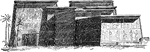
The serious, solemn, and awe-inspiring efect which the general arrangement of the temple produces is maintained by the smaller details, while the slanting form of the outer walls gives the temple an appearance of solidity and isolation. On this account, and especially owing to its simple unbroken lines, the exterior although monotonous and heavy, is still imposing. The chief peculiarity in the construction of these buildings is that they produce the effect of being composed of an agglomeration of separate parts, which resemble on another, but become smaller and smaller towards the rear of the structure.

Back View of the Temple of Philæ

The serious, solemn, and awe-inspiring efect which the general arrangement of the temple produces is…
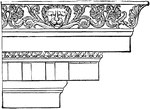
The entablature resting on the columns has three parts: a plain architrave divided into two, or more generally three, bands, with a frieze resting on it that may be richly sculptural, and a cornice built up with dentils, with a corona and cyma molding to support the projecting roof.

Ionic Cornice from the Temple of Minerva Polias at Priene

The entablature resting on the columns has three parts: a plain architrave divided into two, or more…
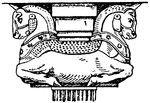
The Ancient Persian capital is a design of the fore-parts of bulls. It is an Old Persian style that is categorized under abnormal capitals.

Ancient Persian Capital

The Ancient Persian capital is a design of the fore-parts of bulls. It is an Old Persian style that…
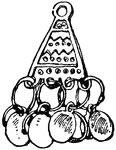
The Old Frankish earring is a pendant that is free-ending with different moveable parts.

Old Frankish Earring

The Old Frankish earring is a pendant that is free-ending with different moveable parts.
An illustration of various parts of the cashew tree. "1, Branch, bearing flowers and fruit. The fruit stales are enlarged in pear like for bearing the nut (the true fruit) at their apex; 2, Flower expanded; Stamen and pistil, with the calyx; 4, Stamen separated; 5, Nut constituting the fruit; 6, Nut opened longitudinally; 7, Seed seprated from the nut; 8, Cotyledons opened to show the radicle a, and the plumule." (Britannica, 1910)

Cashew Tree

An illustration of various parts of the cashew tree. "1, Branch, bearing flowers and fruit. The fruit…

"A valve for opening and closing the induction and eduction passages of a steam-engine cylinder: so called from its plan resembling the letter D. The usual form of the D-valve is shown in fig. 1, where it is seen detached." -Whitney, 1911

D Valve

"A valve for opening and closing the induction and eduction passages of a steam-engine cylinder: so…
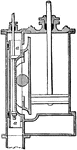
"A valve for opening and closing the induction and eduction passages of a steam-engine cylinder: so called from its plan resembling the letter D. fig. 2 ... represents a section of a steam-cylinder and nozles." -Whitney, 1911

D Valve

"A valve for opening and closing the induction and eduction passages of a steam-engine cylinder: so…
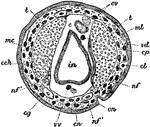
An illustration of a sectional view of a Acanthobdella, a member of the annelid family. "c, Coelom; c.ch, Coelomic epithelium (yellow cells); cg, glandular cells; cl, Muscle cells of lateral line; cp, Pigment cells; ep, Ectoderm; g, Nerve cord; m, Intestine; mc, Circular muscle; ml, Longitudinal muscle; vd, Dorsal vessel; ww, Ventral vessel; cn, nerve cord; nf, parts of nephridium; on, external opening of nephridium; ov, ova; t, testis." (Britannica, 1910)

Sectional View of Acanthobdella

An illustration of a sectional view of a Acanthobdella, a member of the annelid family. "c, Coelom;…
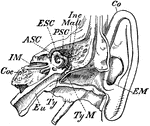
"Transverse Section through Side Walls of Skull, showing the Inner Parts of the Ear. Co, concha or external ear, or pinna; EM, external auditory meatus; TyM, tympanic membrane; Inc, incus; Mall, malleus; ASC, PSC, ESC, anterior, posterior, and external semicircular canals; Coc, cochlea; Eu, Eustachian tube; IM, internal auditory meatus, through which the auditory nerve passes to the organ of hearing." -Whitney, 1911

Inner Ear

"Transverse Section through Side Walls of Skull, showing the Inner Parts of the Ear. Co, concha or external…
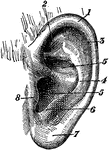
"External Ear, or Pinna. 1, helix; 2, fossa of antihelix, or fossa triangularis; 3, fossa of helix, or fossa scaphoidea; 4, antihelix; 5, 5, concha; 6, antitragus; 7, lobule; 8, tragus." -Whitney, 1911

External Ear

"External Ear, or Pinna. 1, helix; 2, fossa of antihelix, or fossa triangularis; 3, fossa of helix,…
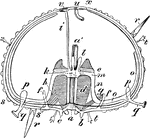
"Diagram of an Echinus (stripped of its spines). a, mouth; a', gullet; b, teeth; c, lips; d, alveoli; e, falces; f, f, auriculariae; g, retractor, and h, protractor, muscles of Aristotle's lantern; i, madreporic canal; k, circular ambulacral vessel; l, Polian pedicels; r, r, spines; s, tubercle; s', tubercle to which a spine is articulated; t, t, pedicellariae; u, anus; v, madreporic tubercle; x, ocular spot." -Whitney, 1911

Sea Urchin Section

"Diagram of an Echinus (stripped of its spines). a, mouth; a', gullet; b, teeth; c, lips; d, alveoli;…
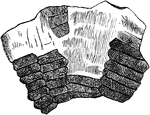
A fossil of Echinothuria floris, a species of sea urchin "having the plates of the shell overlapping or movably connected by soft parts." -Whitney, 1911

Urchin Fossil

A fossil of Echinothuria floris, a species of sea urchin "having the plates of the shell overlapping…
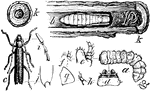
"Elaphidion parallelum ... a, larva; b, twig split open, showing inclosed pupa; k, severed end of twig; c, beetle; i, basal joints of an antenna, showing the characteristic spines at the tip of the third and fourth joints; j, tip of elytron; d, e, f, g, h, head, maxilla, labium, mandible, and antenna of larva." -Whitney, 1911

Long-Horned Beetle

"Elaphidion parallelum ... a, larva; b, twig split open, showing inclosed pupa; k, severed end of twig;…
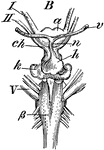
"Brain of Skate (Raia batis), an elasmobranchiate fish. B, from below, in part enlarged: ch, optic chiasm; h, pituitary body; n and v, vessels connected with h; k, saccus vasculosus; ß, pyrimids of medulla oblongata; a, I, II, V, same as in A." -Whitney, 1911

Skate Brain

"Brain of Skate (Raia batis), an elasmobranchiate fish. B, from below, in part enlarged: ch, optic chiasm;…
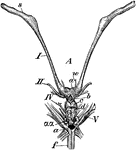
"Brain of Skate (Raia batis), an elasmobranchiate fish. A, from above; s, olfactory bulbs; a, cerebral hemispheres, united in the middle line; b, thalamencephalon; c, mesencephalon; d, cerebellum; aa, plaited bands formed by the restiform bodies; I, II, IV, V, first (olfactory), second (optic), fourth, and fifth pairs of cerebral nerves; f, medulla oblongata; w, a blood-vessel. " -Whitney, 1911

Skate Brain

"Brain of Skate (Raia batis), an elasmobranchiate fish. A, from above; s, olfactory bulbs; a, cerebral…
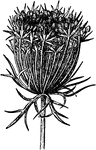
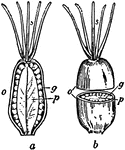
An illustration of fructification of the carrot flower. Fructification is a term used in the plant morphology to denote the generative parts of the plant (flower and fruit) (as opposed to its vegetative parts: trunk, roots and leaves). Sometimes it is applied more broadly to the generative parts of gymnosperms, ferns, horsetails, and lycophytes, though they produce neither fruit nor flower.

Fructification of Carrot Flower

An illustration of fructification of the carrot flower. Fructification is a term used in the plant morphology…
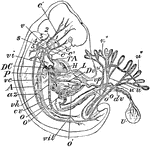
"Early Human Embryo, giving diagrammatically the principal vessels antecedent to the establishment of the regular fetal circulation. H, heart; P, lungs; L, liver; T A, the aortic trunk or cardiac aorta; c, c', c", common, external, and internal carotids; s, subclavian artery; v, vertebral artery; 1, 2, 3, 4, 5, the aortic arches (the persistent left aortic arch hidden); A, subvertebral aorta; o, o', omphalomeseraic artery and vein, to and from U, the umbilical vesicle with its vitelline duct, dv; u, u, the two hypogastric or umbilical arteries, with the ramifications, u", u", in the placenta; u', umbilical vein; vh, hepatic vein; cv, inferior vena cava; vil, iliac veins; az, an azygous vein; vc, a posterior cardinal vein; vi, innominate vein; vp, portal vein; Dv, the ductus venosus; DC, a ductus Cuvieri. The anterior cardinal vein is seen beginning in the head and running down to the ductus Cuvieri, on the under side of the numbers 1, 2, 3, 4, 5." -Whitney, 1911

Human Embryo

"Early Human Embryo, giving diagrammatically the principal vessels antecedent to the establishment of…
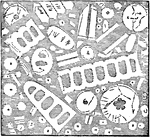
"Encrinite: Any fossil crinoid; a stone-lily: a term especially applied to the ordinary stalked form with a cylindrical stem and well-formed arms. a, a, parts of the stem; b, b, separate joints." -Whitney, 1911

Encrinite

"Encrinite: Any fossil crinoid; a stone-lily: a term especially applied to the ordinary stalked form…
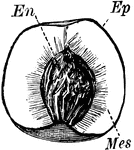
"Fruit of Peach (Prunus persica). En, endocarp; Ep, epicarp; Mes, mesocarp." -Whitney, 1911

Peach

"Fruit of Peach (Prunus persica). En, endocarp; Ep, epicarp; Mes, mesocarp." -Whitney, 1911

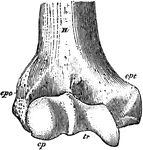
"Anterior View, Distal End, of Right Humerus of a Man. H, humerus; epc, epicondyle, or external supracondyloid protuberance; ept, epitrochlea, or internal supracondyloid protuberance; cp, capitellum, or convex articular suface for head of radius; tr, trochlea, or transversely concave articular surface for the ulna; epc and cp are together the ectocondyle, and ept and tr are together the entocondyle." -Whitney, 1911

Humerus

"Anterior View, Distal End, of Right Humerus of a Man. H, humerus; epc, epicondyle, or external supracondyloid…
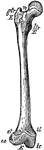
"Right Femur of a Youth. E, E, epiphyses; gtr, ltr, greater and lesser trochanter; h, head; et, it, external and internal tuberosity; ec, ic, external and internal condyle; n, neck." -Whitney, 1911

Youth Femur

"Right Femur of a Youth. E, E, epiphyses; gtr, ltr, greater and lesser trochanter; h, head; et, it,…
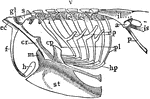
"Epipleurae.-- Thorax, scapular arch, and part of pelvic arch of a bobolink (Dolichonyx oryzivorus). ep, four epipleurae or uncinate processes of as many ribs; pl, pleurapophysial parts of seven ribs; hp, hemapopysial parts of six ribs; v, dorsolumbar vertebrae; st, sternum (the letters are on the carina or keel); m, manubrium sterni; cp, costal process of sternum, bearing f, furcula; ec, epiclidium of furcula; h, hypoclidium of fucula; gl, glenoid fossa, formed by coracoid and scapula; il, ilium; is, ischium; p, pubis; a, acetabulum." -Whitney, 1911

Bobolink Epipleurae

"Epipleurae.-- Thorax, scapular arch, and part of pelvic arch of a bobolink (Dolichonyx oryzivorus).…

"A Lion's Head Erased. In heraldry, represented as having been forcibly torn off, the separated parts being left jagged, as opposed to couped." -Whitney, 1911

Erased

"A Lion's Head Erased. In heraldry, represented as having been forcibly torn off, the separated parts…
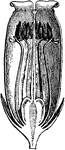
The magnified flower of the Bell Heather (Erica cinerea) is a plant in the Ericaceae family of heaths.
Bell Heather

The magnified flower of the Bell Heather (Erica cinerea) is a plant in the Ericaceae family of heaths.

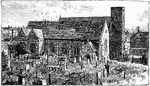
Monkwearmouth is an area of Sunderland located at the north side of the mouth of the River Wear. It was one of the three original settlements on the banks of the River Wear along with Bishopwearmouth and Sunderland, the area now known as the East End. It includes the area around St. Peter's Church and was once the main centre of Wearside shipbuilding and coalmining in the town. It is now host to a campus of the University of Sunderland and the National Glass Centre. It is served by the three Church of England churches of the Parish of Monkwearmouth. The locals of the area were called "Barbary Coasters". The borough stretches from Wearmouth Bridge to the harbour mouth on the north side of the river and is one of the oldest parts of Sunderland.

Monkwearmouth Church

Monkwearmouth is an area of Sunderland located at the north side of the mouth of the River Wear. It…
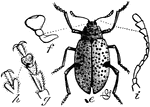
Erotylus boisduvali, a fungus beetle. "e, beetle; f, palpus; g, tarsus, from below; h, terminal joint of tarsus, from above; i, antenna." -Whitney, 1911

Fungus Beetle

Erotylus boisduvali, a fungus beetle. "e, beetle; f, palpus; g, tarsus, from below; h, terminal joint…
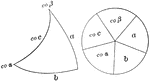
Illustration of a right spherical triangle and the five circular parts placed in the sectors of a circle in the order in which they occur in the triangle. "The ten formulas used in the solution of spherical right triangles can be expressed by means of two rules, known as Napier's rules of circular parts."

Napier's Right Spherical Triangle

Illustration of a right spherical triangle and the five circular parts placed in the sectors of a circle…
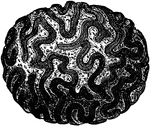
Head of brain coral with soft parts.

Brain Coral

Head of brain coral with soft parts.

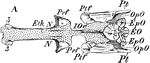
"Cartilaginous Cranium of the Pike (Esox lucius), with its intrinsic ossifications. A, top view; 3, small ossifications in the rostrum; N, N, nasal fossae; I Or, interorbital septum; Eth, ethmoid; Prf, Ptf, prefrontal and postfrontal; EpO, epiotic; OpO, opisthotic; Pt, pteriotic; EO, exoccipital." -Whitney, 1911

Pike Cranium

"Cartilaginous Cranium of the Pike (Esox lucius), with its intrinsic ossifications. A, top view; 3,…
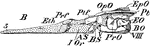
"Cartilaginous Cranium of the Pike (Esox lucius), with its intrinsic ossifications. B, side view: V, VII, exits of trigeminal and of pneumogastric nerves; 3, small ossifications in the rostrum; I Or, interorbital septum; Eth, ethmoid; Prf, Ptf, prefrontal and postfrontal; PrO, proötic; EpO, epiotic; OpO, opisthotic; Pt, pteriotic; EO, exoccipital; BO, basioccipital; BS, basisphenoid; AS, alisphenoid." -Whitney, 1911

Pike Cranium

"Cartilaginous Cranium of the Pike (Esox lucius), with its intrinsic ossifications. B, side view: V,…
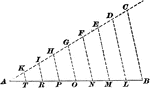
Illustration used to show how to divide a given straight line into required number of equal parts.
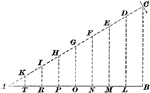
Construction Of Dividing A Line

Illustration used to show how to divide a given straight line into required number of equal parts.
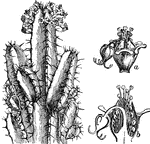
Illustration used to show how to divide a given straight line into required number of equal parts.

Construction Of Dividing A Line

Illustration used to show how to divide a given straight line into required number of equal parts.

The Resin Spurge (Euphorbia resinifera) is a flowering plant that superficially resembles a cactus. "Top of Stem of Euphorbia resinifera. a, involucre with inclosed flowers; b, section of same." -Whitney, 1911

Resin Spurge

The Resin Spurge (Euphorbia resinifera) is a flowering plant that superficially resembles a cactus.…
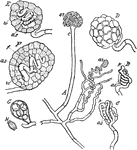
"Eurotium repens. A, a small portion of the mycelium with a conidiophore (c), terminated by the sterigmata (st), from which the spores have fallen, also with the spiral female organ, the ascogonium (as). B the spiral ascogonium (as) with antheridium (p). C, the same beginning to be surrounded by threads, out of which the wall of the perithecium is formed. D, a perithecium. E, F, sections of young perithecia: w, cells composing the wall; f, false parenchyma underneath the wall; as ascogonium. G, ascus. H, an ascopore." -Whitney, 1911

Eurotium Fungus

"Eurotium repens. A, a small portion of the mycelium with a conidiophore (c), terminated by the sterigmata…
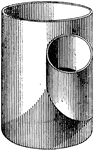
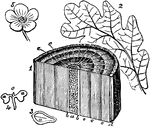
Illustration of the intersection of 2 cylinders of unequal diameter.

Intersecting Cylinders

Illustration of the intersection of 2 cylinders of unequal diameter.

"Exogen. 1. Section of a branch of three years' growth: a, medulla or pith; b b, medullary sheath; e e, medullary rays; c c c, circles of annual growth; d, bark. 2. Netted veined leaf (oak). 3. Dicotyledonous seed: a, cotyledon. 4. Germination of dicotyledonous seed: a a, seed-leaves or cotyledons; o, plumula. 5. Exogenous flower (crowfoot)." -Whitney, 1911

Section of Branch Showing Exogen

"Exogen. 1. Section of a branch of three years' growth: a, medulla or pith; b b, medullary sheath; e…
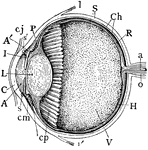
"Human Eye, in Median Vertical Anteroposterior Section. (Ciliary processes shown, through not all lying in this section.) A, anterior, and A', posterior chambers of aqueous humor; a, central artery of retina; C, cornea; Ch, choroid; cj, conjunctiva; cm, ciliary muscle; cp, ciliary processs; H, hyaloid; I, iris; L, crystalline lens in its capsule (the reference-line passes through the pupil); l, l', insertion of tendon of superior and inferior rectus muscles; o, optic nerve; P, canal of Petit; R, retina; S, sclerotic; s, s', circular sinus or canal of Schlemm; V, vitreous body filling back part of the eye." -Whitney, 1911

Median Vertical Anteroposterior Section of Eye

"Human Eye, in Median Vertical Anteroposterior Section. (Ciliary processes shown, through not all lying…
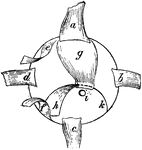
"Right Eyeball of Bird, seen from behind, showing the following muscles; a, rectus superior; b, rectus externus; c, rectus inferior; d, rectus internus; e, obliquus superior; f, obliquus inferior; g, quadratus; h, pyramidalis, with its tendon, k, passing through a pulley in the quadratus (as shown by dotted line) to keep it off the optic nerve, i, then passing around the edge of the ball to its insertion in the nictitating membrane." -Whitney, 1911

Right Eyeball of Bird

"Right Eyeball of Bird, seen from behind, showing the following muscles; a, rectus superior; b, rectus…
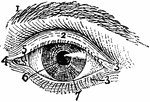
"Exterior of Left Human Eye. 1, supercilium, or eyebrow; 2, palpebra superior, or upper eyelid; 3, 3, cilia, or eyelashes; 4, caruncula lacrymalis; 5, plica semilunaris; 6, pupil; 7, iris." -Whitney, 1911

Exterior of Left Human Eye

"Exterior of Left Human Eye. 1, supercilium, or eyebrow; 2, palpebra superior, or upper eyelid; 3, 3,…
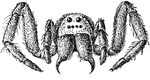
The Tarantula Wolf Spider (Lycosa tarantula) is an arachnid in the Lycosidae family of wolf spiders. f, falces.

Tarantula Wolf Spider

The Tarantula Wolf Spider (Lycosa tarantula) is an arachnid in the Lycosidae family of wolf spiders.…
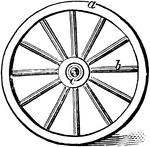
"Wheel. a, felly; b, spoke; c, hub." -Whitney, 1911

Wheel Showing Parts

"Wheel. a, felly; b, spoke; c, hub." -Whitney, 1911

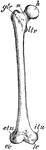
"Anterior View of Human Right Femur. ec, external condyle; etu, external tuberosity; ic, internal condyle; itu, internal tuberosity; ltr, lesser trochanter; gtr, great trochanter; h, head; n, neck." -Whitney, 1911

Anterior View of Human Right Femur

"Anterior View of Human Right Femur. ec, external condyle; etu, external tuberosity; ic, internal condyle;…
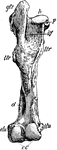
"Posterior View of Left Femur of a Horse. h, head; gtr, great trochanter; ttr, third trochanter; ltr, lesser trochanter; p, pit for round ligament; itf, intertrochanteric fossa; d, a depression or fossa; etu, itu, external and internal tuberosities; cc, the two condyles." -Whitney, 1911

Posterior View of Left Femur of Horse

"Posterior View of Left Femur of a Horse. h, head; gtr, great trochanter; ttr, third trochanter; ltr,…
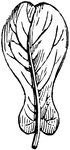
A leaf which has "the form of a fiddle or violin; pandurate or panduriform: applied in botany to an obovate leaf which is contracted above the base." -Whitney, 1911

Fiddle-Shaped Leaf

A leaf which has "the form of a fiddle or violin; pandurate or panduriform: applied in botany to an…
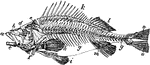
"Skeleton of Fish (Perch). a, intermaxillaries; b, nasal region; c, dentary bone of mandible; d, orbit of eye; e, supraoccipital crest; f, preoperculum; g, g', vertebral column; h, pectoral fin; i, ventral fin; k, first dorsal fin; l, second dorsal fin; m, anal fin; n, n, caudal fin, making a homocercal tail." -Whitney, 1911

Skeleton of Perch

"Skeleton of Fish (Perch). a, intermaxillaries; b, nasal region; c, dentary bone of mandible; d, orbit…
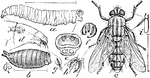
"Sarracenia Flesh-fly (Sarcophaga sarraceniae). a, larva; b, pupa; c, fly; d, head and prothoracic joints of larva, showing curved hooks, lower lip, and prothoracic spiracles; e, end of body of larva, showing stigmata, prolegs, and vent; h, tarsal claws of fly with protecting pads; i, antenna of fly." -Whitney, 1911

Sarracenia Flesh Fly

"Sarracenia Flesh-fly (Sarcophaga sarraceniae). a, larva; b, pupa; c, fly; d, head and prothoracic joints…
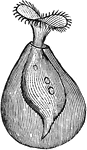
"They are trumpet-animalcules of the family Stentoridae, with the peristome divided into two lappet-like parts. Folliculina ampulla is an example." -Whitney, 1911

Trumpet Animalcule

"They are trumpet-animalcules of the family Stentoridae, with the peristome divided into two lappet-like…
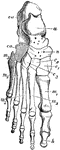
"Bones of Human Foot, or Pes, the third principal segment of the hind limb, consisting of tarsus, metatarsus, and phalanges. a, astralagus; ca, calcaneum; n, navicular, or scaphoid; co, cuboid; c1, c2, c3, entocuneiform, mesocuneiform, and ectocuneiform, or inner, middle, and outer cuneiform bones. The foregoing seven bones constitute the tarsus, and m1 to m5, first to the fifth metatarsal, constitue the metatarsus. The remaining fourteen bones are the phalanges, three to each digit excepting the great toe; h, distal phalanx of the hallux or great toe." -Whitney, 1911

Bones of Human Foot

"Bones of Human Foot, or Pes, the third principal segment of the hind limb, consisting of tarsus, metatarsus,…