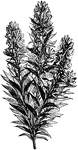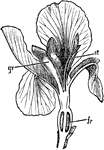
Iris is a genus of between 200-300 species of flowering plants with showy flowers. It takes its name from the Greek word for a rainbow, referring to the wide variety of flower colors found among the many species. As well as being the scientific name, iris is also very widely used as a common name; for one thing, it refers to all Iris species, but some plants called thus belong to closely related genera. In North America, a common name for irises is flags, while the subgenus Scorpiris is widely known as junos, particularly in horticulture.

Iris

Iris is a genus of between 200-300 species of flowering plants with showy flowers. It takes its name…
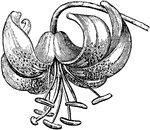
Lilium martagon (Martagon or Turk's cap lily) is a species of lily. It has a widespread native region extending from central Europe east through northern Asia to Mongolia and Korea. Several subspecies have been named. The plant is stem-rooting, growing between 1 m and 2 m tall. The flower colour is typically a pink-purple, with dark spots, but is quite variable, extending from near white to near black. The flowers are scented. Numerous flowers are borne on each plant, and up to 50 can be found on vigorous plants.

Turk's Cap Lily

Lilium martagon (Martagon or Turk's cap lily) is a species of lily. It has a widespread native region…
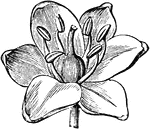
Scilla (squill) is a genus of bulb-forming perennial herbs in the Hyacinthaceae. The 90-odd species are found in woodlands, subalpine meadows, and seashores across the Old World. Their flowers are usually blue, but white, pink, and purple types are known; most flower in early spring, but a few are autumn-flowering.

Scilla

Scilla (squill) is a genus of bulb-forming perennial herbs in the Hyacinthaceae. The 90-odd species…
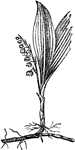
Convallaria majalis, commonly known as the Lily of the Valley or Lily-of-the-Valley, is the only species in the genus Convallaria in the flowering plant family Ruscaceae, formerly placed in the lily family Liliaceae or in its own family called Convallariaceae. This woodland plant is native throughout the cool temperate Northern Hemisphere in Asia and Europe and a limited native population in Eastern USA.

Lily of the Valley

Convallaria majalis, commonly known as the Lily of the Valley or Lily-of-the-Valley, is the only species…
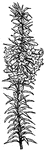
The flowering branch of the Common Heath (Epacris impressa), a plant in the Ericaceae family of heaths.
Common Heath

The flowering branch of the Common Heath (Epacris impressa), a plant in the Ericaceae family of heaths.

The flower of Eperua grandiflora, a legume in the Fabaceae family.

Legume

The flower of Eperua grandiflora, a legume in the Fabaceae family.

The Trailing Arbutus (Epigaea repens) is a spreading shrub in Ericaceae family of heaths.

Trailing Arbutus

The Trailing Arbutus (Epigaea repens) is a spreading shrub in Ericaceae family of heaths.

The Bell Heather (Erica cinerea) is a plant in the Ericaceae family of heaths.

Bell Heather

The Bell Heather (Erica cinerea) is a plant in the Ericaceae family of heaths.

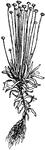
Eriocaulon setaceum is a plant species in the Eriocaulaceae family of pipeworts.

Pipewort

Eriocaulon setaceum is a plant species in the Eriocaulaceae family of pipeworts.

An illustration of liverwort (Hepatica): a, Thalloid stem with female branches; b, Thalloid stem with male branches. Hepatica is a genus of herbaceous perennial plants belonging to the buttercup family, Ranunculaceae. A native of central and northern Europe, Asia and northeastern North America, Hepatica is sometimes called liverleaf or "liverwort". It should not be confused with liverworts, which may also be called "Hepaticae". A few botanists include Hepatica within a wider interpretation of Anemone, as Anemone hepatica.

Hepatica

An illustration of liverwort (Hepatica): a, Thalloid stem with female branches; b, Thalloid stem with…
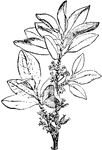
The flowering branch of the coca plant (Erythroxylon coca) best known for its use in the drug cocaine.
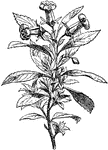
Coca

The flowering branch of the coca plant (Erythroxylon coca) best known for its use in the drug cocaine.

"Escallonia macrantha. Escallonia is a South American genus of trees or shrubs, of the natural order Saxifragaceae, allied to the Itea of the United States." -Whitney, 1911

Escallonia

"Escallonia macrantha. Escallonia is a South American genus of trees or shrubs, of the natural order…
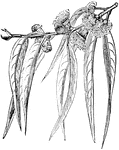
A flowering branch of the Blue Gum Tree (Eucalyptus globulus), a tree in the Myrtaceae family of evergreen plants.

Blue Gum

A flowering branch of the Blue Gum Tree (Eucalyptus globulus), a tree in the Myrtaceae family of evergreen…
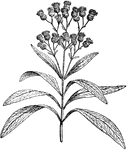
The Ayapana (Ayapana triplinervis) is a flowering shrub in the Asteraceae family of daisies.

Ayapana

The Ayapana (Ayapana triplinervis) is a flowering shrub in the Asteraceae family of daisies.
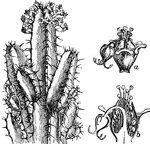
The Resin Spurge (Euphorbia resinifera) is a flowering plant that superficially resembles a cactus. "Top of Stem of Euphorbia resinifera. a, involucre with inclosed flowers; b, section of same." -Whitney, 1911

Resin Spurge

The Resin Spurge (Euphorbia resinifera) is a flowering plant that superficially resembles a cactus.…

Common duckweed, <em>Lemna</em>. The entire plant is reduced to a leaf-like expansion which bears a long slender root and small flowers; forms green floating scum on ponds and stagnant pools.

Duckweed

Common duckweed, Lemna. The entire plant is reduced to a leaf-like expansion which bears a…

A page divider illustrated with a lyre and foral designs.

Floral and Lyre Divider

A page divider illustrated with a lyre and foral designs.

The jaguarundi (Puma yagouaroundi) is a medium-sized wild cat closely related to the puma but has a distinct appearance. It was also known as the eyra with the synonym Felis eyra.

Jaguarundi

The jaguarundi (Puma yagouaroundi) is a medium-sized wild cat closely related to the puma but has a…
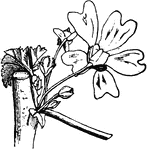
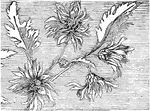
The image shows a fascicle (bundle or cluster) of flowers of a mallow plant (Malvaceae).

Fascicle of Mallow Flowers

The image shows a fascicle (bundle or cluster) of flowers of a mallow plant (Malvaceae).
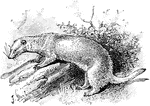
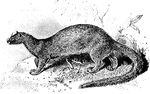
The ferret (Mustela putorius furo) is a carnivorous mammal in the Mustelidae family of weasels.

Ferret in the Wild

The ferret (Mustela putorius furo) is a carnivorous mammal in the Mustelidae family of weasels.
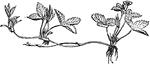
"In botany, a runner; a weak, creeping shoot sent out from the bottom of the stem, and rooting and forming new plants at the nodes, as in the strawberry." -Whitney, 1911

Strawberry Flagellum

"In botany, a runner; a weak, creeping shoot sent out from the bottom of the stem, and rooting and forming…
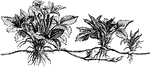
The Woodland Strawberry (Fragaria vesca) is a flowering plant in Rosaceae, the rose family.

Woodland Strawberry

The Woodland Strawberry (Fragaria vesca) is a flowering plant in Rosaceae, the rose family.

Decorative floral tailpiece with a cherub and birds, used as an ornamental footer.

Footer with Cherub

Decorative floral tailpiece with a cherub and birds, used as an ornamental footer.

An illustration of a young girl watering a field of tulips.

Girl Watering Field of Tulips

An illustration of a young girl watering a field of tulips.

An illustration of decorative flowers.

Flowers

An illustration of decorative flowers.

An illustration of decorative flowers.

Flowers

An illustration of decorative flowers.

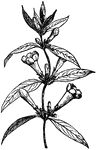
The Yellow Jasmine (Gelsemium sempervirens) is a vine in the Gelsemiaceae family.

Yellow Jasmine

The Yellow Jasmine (Gelsemium sempervirens) is a vine in the Gelsemiaceae family.

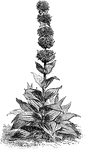
The Woodwaxen or Dyer's Greenweed (Genista tinctoria) is a flowering plant in the legume family, Fabaceae.
Woodwaxen

The Woodwaxen or Dyer's Greenweed (Genista tinctoria) is a flowering plant in the legume family, Fabaceae.

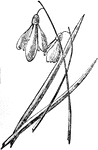
The Great Yellow Gentian (Gentian lutea) is a flowering plant in the Gentian family, Gentianaceae.
Great Yellow Gentian

The Great Yellow Gentian (Gentian lutea) is a flowering plant in the Gentian family, Gentianaceae.

Epigaea repens (Mayflower or Trailing Arbutus) is a low, spreading shrub in the Ericaceae family. It is found from Newfoundland to Florida, west to Kentucky and the Northwest Territory. It can also be found in parts of Central Europe and Western Africa.

Mayflower

Epigaea repens (Mayflower or Trailing Arbutus) is a low, spreading shrub in the Ericaceae family. It…

Epigaea repens (Mayflower or Trailing Arbutus) is a low, spreading shrub in the Ericaceae family. It is found from Newfoundland to Florida, west to Kentucky and the Northwest Territory. It can also be found in parts of Central Europe and Western Africa.

Mayflower

Epigaea repens (Mayflower or Trailing Arbutus) is a low, spreading shrub in the Ericaceae family. It…


An illustration of a young girl selling flowers.

Girl Selling Flowers

An illustration of a young girl selling flowers.

An illustration of a man shooting a wild dog.

Man Shooting Wild Dog

An illustration of a man shooting a wild dog.

An illustration of a woman feeding two squirrels.

Woman Feeding Squirrels

An illustration of a woman feeding two squirrels.

An illustration of a of an M decorated with flowers.

Decorative Letter M

An illustration of a of an M decorated with flowers.

An illustration of the letter C decorated with tall stems.

Decorative Letter C

An illustration of the letter C decorated with tall stems.

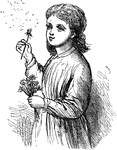
An illustration of a girl blowing dandelions.

Girl Blowing Dandelions

An illustration of a girl blowing dandelions.

An illustration of a bunch of wildflowers.

Wildflowers

An illustration of a bunch of wildflowers.

An illustration of a group of decorative plants.

Decorative Plants

An illustration of a group of decorative plants.

An illustration of flowers in the shape of a face.

Flower Face

An illustration of flowers in the shape of a face.

"Time bears for youth a muffled bell, And hides his face in flowers." -Trowbridge, 1866

Time Rebus

"Time bears for youth a muffled bell, And hides his face in flowers." -Trowbridge, 1866

An illustration of a watering can.

Watering Can

An illustration of a watering can.

An illustration of a lion.

Lion

An illustration of a lion.

An illustration of a man surrounded by decorative vines and flowers.

Man Surrounded by Vines & Flowers

An illustration of a man surrounded by decorative vines and flowers.
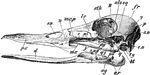
"Skull of a Wild Duck (Anus boscas), from the side. ag, Angular; als, alisphenoid; ar, articular; bt, basitemporal; d, dentaryl en, external nostrils, e.o, exoccipital; eth, ethmoid; fr, frontal; j, jugal; lc, lacrymal; mx, maxilla; mx.p, maxillopalatine process; n, nasal, parietal; pg, pterygoid; pl, palatine; ps, presphenoid; px, premaxilla; q, quadrate; q.j, quadratojugal; s.ag, supra-angular; s.o, supraoccipital; sq, squamosal; ty, tympanic cavity; v, vomer; II, foramen for optic nerve; V, for trigeminal." (From Wiedersheim.)" A. H. Evans, 1900

Diagram of the Skull of a Wild Duck

"Skull of a Wild Duck (Anus boscas), from the side. ag, Angular; als, alisphenoid; ar, articular; bt,…

"On the morrow, as they went on their journey, and drew nigh unto the city, Peter went up upon the housetop to pray about the sixth hour: And he became very hungry, and would have eaten: but while they made ready, he fell into a trance, And saw heaven opened, and a certain vessel descending unto him, as it had been a great sheet knit at the four corners, and let down to the earth: Wherein were all manner of fourfooted beasts of the earth, and wild beasts, and creeping things, and fowls of the air. And there came a voice to him, Rise, Peter; kill, and eat. But Peter said, Not so, Lord; for I have never eaten any thing that is common or unclean. And the voice spake unto him again the second time, What God hath cleansed, that call not thou common." Acts 10:9-15 KJV

Peter's Vision on the Housetop

"On the morrow, as they went on their journey, and drew nigh unto the city, Peter went up upon the housetop…

Capital letter D designed and accented with a floral motif including flowers, leaves, lines, and shapes inside and outside the letter

Capital Letter D with Floral Motif

Capital letter D designed and accented with a floral motif including flowers, leaves, lines, and shapes…
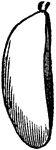
Indian Rice Grass (Zizania aquatica), also known as Wild Rice, or Water Oats, is found in swampy borders of streams, and is common in shallow water. It grows from three to nine feet in height, with flat, long, lanceolate leaves. It has a large, pyramidal panicle with spreading, sterile lower branches.

Virginia Cut Grass

Indian Rice Grass (Zizania aquatica), also known as Wild Rice, or Water Oats, is found in swampy borders…
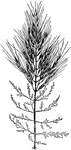
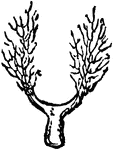
Indian Rice Grass (Zizania aquatica), also known as Wild Rice, or Water Oats, is found in swampy borders of streams, and is common in shallow water. It grows from three to nine feet in height, with flat, long, lanceolate leaves. It has a large, pyramidal panicle with spreading, sterile lower branches. The staminate flowers are seen as they appear at the the end of a branch of the natural size.

Indian Rice Grass

Indian Rice Grass (Zizania aquatica), also known as Wild Rice, or Water Oats, is found in swampy borders…
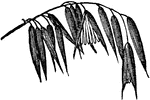
Indian Rice Grass (Zizania aquatica), also known as Wild Rice, or Water Oats, is found in swampy borders of streams, and is common in shallow water. It grows from three to nine feet in height, with flat, long, lanceolate leaves. It has a large, pyramidal panicle with spreading, sterile lower branches. The staminate flowers are seen as they appear when magnified.

Indian Rice Grass

Indian Rice Grass (Zizania aquatica), also known as Wild Rice, or Water Oats, is found in swampy borders…
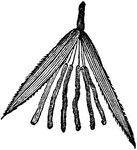
Indian Rice Grass (Zizania aquatica), also known as Wild Rice, or Water Oats, is found in swampy borders of streams, and is common in shallow water. It grows from three to nine feet in height, with flat, long, lanceolate leaves. It has a large, pyramidal panicle with spreading, sterile lower branches. The germ and stigmas are shown here.

Indian Rice Grass

Indian Rice Grass (Zizania aquatica), also known as Wild Rice, or Water Oats, is found in swampy borders…
Indian Rice Grass (Zizania aquatica), also known as Wild Rice, or Water Oats, is found in swampy borders of streams, and is common in shallow water. It grows from three to nine feet in height, with flat, long, lanceolate leaves. It has a large, pyramidal panicle with spreading, sterile lower branches. Here we see a fertile or pistillate flower.

Indian Rice Grass

Indian Rice Grass (Zizania aquatica), also known as Wild Rice, or Water Oats, is found in swampy borders…

Indian Rice Grass (Zizania aquatica), also known as Wild Rice, or Water Oats, is found in swampy borders of streams, and is common in shallow water. It grows from three to nine feet in height, with flat, long, lanceolate leaves. It has a large, pyramidal panicle with spreading, sterile lower branches. Here we see a fertile or pistillate flower.

Indian Rice Grass

Indian Rice Grass (Zizania aquatica), also known as Wild Rice, or Water Oats, is found in swampy borders…

Indian Rice Grass (Zizania aquatica), also known as Wild Rice, or Water Oats, is found in swampy borders of streams, and is common in shallow water. It grows from three to nine feet in height, with flat, long, lanceolate leaves. It has a large, pyramidal panicle with spreading, sterile lower branches. Here we see a ripe fertile or pistillate flower.

Indian Rice Grass

Indian Rice Grass (Zizania aquatica), also known as Wild Rice, or Water Oats, is found in swampy borders…

Indian Rice Grass (Zizania aquatica), also known as Wild Rice, or Water Oats, is found in swampy borders of streams, and is common in shallow water. It grows from three to nine feet in height, with flat, long, lanceolate leaves. It has a large, pyramidal panicle with spreading, sterile lower branches. Here we see a narrow thin seed for this grass.

Indian Rice Grass

Indian Rice Grass (Zizania aquatica), also known as Wild Rice, or Water Oats, is found in swampy borders…
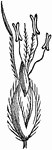
The Meadow Foxtail (Alopecurus pratensis)has an erect, smooth stem, two or three feet high with swelling sheaths. The spikes are cylindrical and obtuse. The awn is twisted and twice the length of the blossom. It has only one palea. The spike or head of the Meadow Foxtail is soft. There are few light stems and leaves. It thrives best in rich, moist strong soil, and flowers from late spring to early summer.

Meadow Foxtail Grass

The Meadow Foxtail (Alopecurus pratensis)has an erect, smooth stem, two or three feet high with swelling…
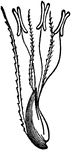
The Slender Foxtail (Alopecurus agretis) is distinguished from the meadow foxtail by its slender panicle, larger spikelets and ligule, and the roughness of the stem and leaves. It flowers in July and is of no agricultural value.

Slender Foxtail Grass

The Slender Foxtail (Alopecurus agretis) is distinguished from the meadow foxtail by its slender panicle,…
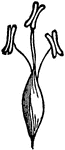
The Slender Foxtail is distinguished from the meadow foxtail by its slender panicle, larger spikelets and ligule, and the roughness of the stem and leaves. It flowers in July and is of no agricultural value.

Slender Foxtail Grass

The Slender Foxtail is distinguished from the meadow foxtail by its slender panicle, larger spikelets…
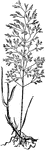
The Redtop Grass (Agrostis vulgaris), also known as Burden's Grass, is a perennial grass with smooth, erect stems. The roots are creeping and the panicle is oblong. The leaves are linear and the lower palea is moslty awnless and three-nerved. The Redtop flowers in July. It is also known as Finetop, Burden's Grass, and Herd's grass.

Redtop Grass

The Redtop Grass (Agrostis vulgaris), also known as Burden's Grass, is a perennial grass with smooth,…
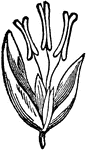
The Redtop Grass (Agrostis vulgaris), also known as Burden's Grass, is a perennial grass with smooth, erect stems. The roots are creeping and the panicle is oblong. The leaves are linear and the lower palea is moslty awnless and three-nerved. The Redtop flowers in July. It is also known as Finetop, Burden's Grass, and Herd's grass. A magnified flower is shown here.

Redtop Grass

The Redtop Grass (Agrostis vulgaris), also known as Burden's Grass, is a perennial grass with smooth,…