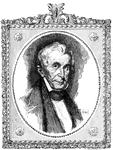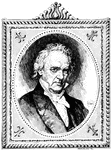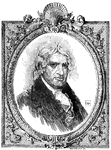
(1739-1812) George Clinton, was governor of New York (1777-1795} and fourth vice president of the United States under Thomas Jefferson and James Madison.

George Clinton

(1739-1812) George Clinton, was governor of New York (1777-1795} and fourth vice president of the United…
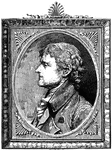
"Thomas Jefferson was president of the United States."—E. Benjamin Andrews, 1895

Thomas Jefferson

"Thomas Jefferson was president of the United States."—E. Benjamin Andrews, 1895

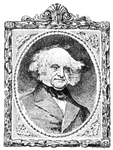
"Martin van Buren, president of the United States."—E. Benjamin Andrews, 1895

Martin van Buren

"Martin van Buren, president of the United States."—E. Benjamin Andrews, 1895

"William Henry Harrison, former president of the United States."—E. Benjamin Andrews, 1895

William Henry Harrison

"William Henry Harrison, former president of the United States."—E. Benjamin Andrews, 1895
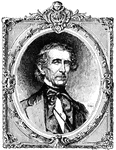
"John Tyler, former president of the United States."—E. Benjamin Andrews, 1895
John Tyler

"John Tyler, former president of the United States."—E. Benjamin Andrews, 1895

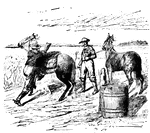
The Pony Express was a mail service operating between St. Joseph, Missouri, and Sacramento, California. From April 3, 1860 to October 1861, it became the West's most direct means of east–west communication before the telegraph was established and was vital for tying the new state of California with the rest of the United States.

Pony Express

The Pony Express was a mail service operating between St. Joseph, Missouri, and Sacramento, California.…
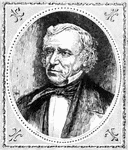
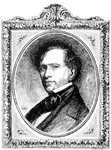
"Zachary Taylor, president of the United States."—E. Benjamin Andrews 1895

Zachary Taylor

"Zachary Taylor, president of the United States."—E. Benjamin Andrews 1895

"Franklin Pierce, president of the United States and involved in the fight for Kansas."—E. Benjamin Andrews 1895

Franklin Pierce

"Franklin Pierce, president of the United States and involved in the fight for Kansas."—E. Benjamin…
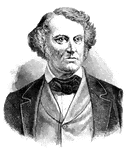
"Charles Sumner was a United States Senator from Massachusetts involved in the fight for Kansas."—E. Benjamin Andrews 1895

Charles Sumner

"Charles Sumner was a United States Senator from Massachusetts involved in the fight for Kansas."—E.…
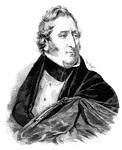
"Thomas H. Benton, former United States Senator from Missouri whom was involved in the years of slavery."—E. Benjamin Andrews 1895

Thomas H. Benton

"Thomas H. Benton, former United States Senator from Missouri whom was involved in the years of slavery."—E.…
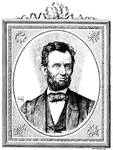
"Abraham Lincoln, former United States President, involved in slavery issues and the Civil War."—E. Benjamin Andrews 1895

Abraham Lincoln

"Abraham Lincoln, former United States President, involved in slavery issues and the Civil War."—E.…
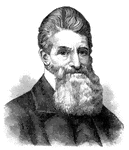
"John Brown was an anti-slavery abolitionist, known for the John Brown raid on October 16th, 1858, when he and others seized the United States Armory at Harper's Ferry."—E. Benjamin Andrews 1895

John Brown

"John Brown was an anti-slavery abolitionist, known for the John Brown raid on October 16th, 1858, when…
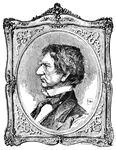
"William H. Seward, former United States Senator from New York involved in slavery issues."—E. Benjamin Andrews 1895

William H. Seward

"William H. Seward, former United States Senator from New York involved in slavery issues."—E. Benjamin…
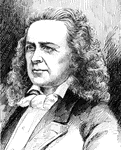
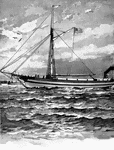
"Elias Howe, invented the sewing machine."—E. Benjamin Andrews 1895

Elias Howe

"Elias Howe, invented the sewing machine."—E. Benjamin Andrews 1895

"The <em>Vandalia</em>, the pioneer propeller on the lakes."&mdash;E. Benjamin Andrews 1895

Vandalia

"The Vandalia, the pioneer propeller on the lakes."—E. Benjamin Andrews 1895

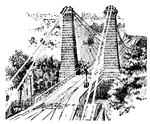
"Old stone towers of the Niagra Suspension Bridge."&mdash;E. Benjamin Andrews 1895

Niagra bridge

"Old stone towers of the Niagra Suspension Bridge."—E. Benjamin Andrews 1895

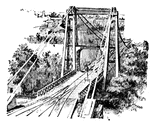
"The new iron towers of the Niagra Bridge."&mdash;E. Benjamin Andrews 1895

Niagra bridge

"The new iron towers of the Niagra Bridge."—E. Benjamin Andrews 1895

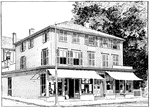
"Birthplace of S. F. B. Morse, at Charlestown, Mass., built 1775."&mdash;E. Benjamin Andrews 1895

Morse birthplace

"Birthplace of S. F. B. Morse, at Charlestown, Mass., built 1775."—E. Benjamin Andrews 1895
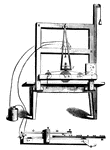
"The first telegraphic instrument, as exhibited in 1837 by Morse."—E. Benjamin Andrews 1895

Telegraph Instrument

"The first telegraphic instrument, as exhibited in 1837 by Morse."—E. Benjamin Andrews 1895
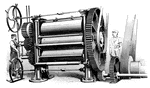
"Calenders heated internally by steam, for spreading India Rubber into sheets or upon cloth, called the 'Chaffee Machine.'"—E. Benjamin Andrews 1895

Chaffee Machine

"Calenders heated internally by steam, for spreading India Rubber into sheets or upon cloth, called…
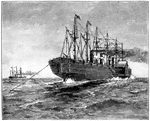
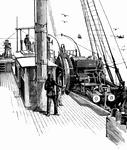
"The Great Eastern laying the Atlantic Cable."&mdash;E. Benjamin Andrews 1895

Great Eastern

"The Great Eastern laying the Atlantic Cable."—E. Benjamin Andrews 1895

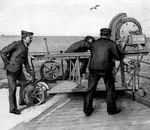
"Sounding Machine used by a cable expedition."&mdash;E. Benjamin Andrews 1895

Sounding Machine

"Sounding Machine used by a cable expedition."—E. Benjamin Andrews 1895

"Paying out cable gear, from Chart House."&mdash;E. Benjamin Andrews 1895

Chart House

"Paying out cable gear, from Chart House."—E. Benjamin Andrews 1895

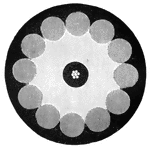
"Shore end of cable, exact size, from a Sounding Machine."&mdash;E. Benjamin Andrews 1895

cable

"Shore end of cable, exact size, from a Sounding Machine."—E. Benjamin Andrews 1895

"Barnacles on cable of a Sounding Machine"&mdash;E. Benjamin Andrews 1895

barnacles

"Barnacles on cable of a Sounding Machine"—E. Benjamin Andrews 1895

"James Buchanan, fifteenth president of the United States and involved in the pre-Civil War era."&mdash;E. Benjamin Andrews 1895

James Buchanan

"James Buchanan, fifteenth president of the United States and involved in the pre-Civil War era."—E.…
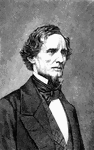
"Jeffeson Davis, president of the Confederate States of America."&mdash;E. Benjamin Andrews 1895

Jefferson Davis

"Jeffeson Davis, president of the Confederate States of America."—E. Benjamin Andrews 1895
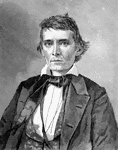
"Alexander H. Stephens, Vice-President of the Confederate States of America."&mdash;E. Benjamin Andrews 1895

Alexander H. Stephens

"Alexander H. Stephens, Vice-President of the Confederate States of America."—E. Benjamin Andrews…
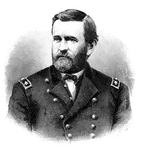
"Ulysses S. Grant, president of the United States after the Civil War."&mdash;E. Benjamin Andrews 1895

Ulysses S. Grant

"Ulysses S. Grant, president of the United States after the Civil War."—E. Benjamin Andrews 1895

Military establishment at St. John's. This view is taken from the eastern side of the river, near the remains of a block-house erected by Montgomery when he besieged the fort in 1775. On the right is seen the fort, which incloses the magazine; in the center is the building occupied by the officers, on either side of which are the barracks of the soldiers. The large building on the left is the hospital, and the smaller one still further left is the dead-house. The river here is about a quarter of a mile wide. The present military works are upon the site of those of the Revolution.

St. John's

Military establishment at St. John's. This view is taken from the eastern side of the river, near the…
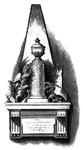
Richard Montgomery's Monument, states: "This monument is erected by order of Congress, 25th of January, 1776, to transmit to posterity a grateful remembrance of the patriotic conduct, enterprise, and preseverance of Major-general Richard Montgomery, who, after a series of success amid the most discouraging difficulties, fell in the attack on Quebec, 31st December, 1775, aged 37 yeras.

Richard Montgomery's Monument

Richard Montgomery's Monument, states: "This monument is erected by order of Congress, 25th of January,…
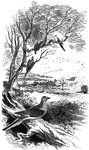
Once one of the most numerous bird species in the world, the common wild pigeon of the United States is now extinct.

Wild Pigeons

Once one of the most numerous bird species in the world, the common wild pigeon of the United States…
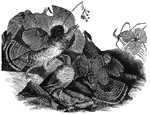
Known as the <em>partridge</em> in the Eastern States and as the <em>pheasant</em> in the South, the ruffled grouse is found throughout the United States, where it prefers to make its home at higher elevations.

Ruffled Grouse

Known as the partridge in the Eastern States and as the pheasant in the South, the…

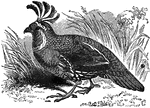
Found in California, the California partridge averages aproximately nine and a quarter inches in length, with a crest of six long feathers on its head.

California Partridge

Found in California, the California partridge averages aproximately nine and a quarter inches in length,…
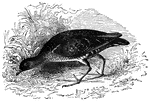
Also known as the Carolina rail, soree rail, and the English rail, the common American rail is found in the temperate wetlands of the United States.

Common American Carolina Rail

Also known as the Carolina rail, soree rail, and the English rail, the common American rail is found…
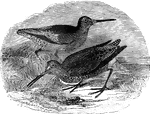
The gray snipe is a migratory bird, found in the United States. It is also known as the brown snipe, red-breasted snipe, quail snipe, and as the dowitchee.

Gray Snipe

The gray snipe is a migratory bird, found in the United States. It is also known as the brown snipe,…
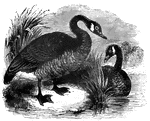
Also known as the wild goose of America, the Canada goose averages about forty inches in length fully-grown, and is known for its yearly migration between Canada and the United States.

Canada Goose

Also known as the wild goose of America, the Canada goose averages about forty inches in length fully-grown,…
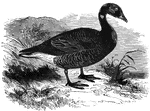
A small species of goose common in both Europe and America, known in the United States as the brant.
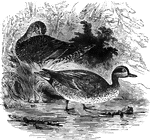
Brent Goose

A small species of goose common in both Europe and America, known in the United States as the brant.

Common throughout Europe, the English teal is accidental to the East coast of the United States.

English Teal

Common throughout Europe, the English teal is accidental to the East coast of the United States.
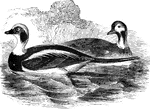
Also known as the old-wife, the long-tailed duck measures about seventeen inches, not including its characteristically long tail-feathers. It is common in both Europe and the United States.

Long-Tailed Duck

Also known as the old-wife, the long-tailed duck measures about seventeen inches, not including its…
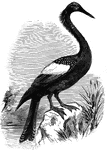
Also known as the snake-bird, the anhinga inhabits the freshwater areas of the South Atlantic States; also in South America as far south as Brazil.

Anhinga

Also known as the snake-bird, the anhinga inhabits the freshwater areas of the South Atlantic States;…
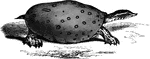
Found in the rivers and lakes of the western and southern United States, the soft-shelled tortoise feeds on fish and small aquatic reptiles.

Soft-shelled tortoise

Found in the rivers and lakes of the western and southern United States, the soft-shelled tortoise feeds…
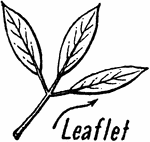
Composed of two or more similar parts united to form one whole; for instance, a leaf.

Compound

Composed of two or more similar parts united to form one whole; for instance, a leaf.

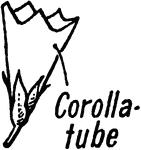
Tubular structure formed by united petals.

Corolla-Tube

Tubular structure formed by united petals.

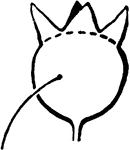
Portion of the united calyx investing the fruit.

Hypanthium

Portion of the united calyx investing the fruit.

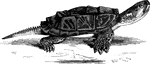
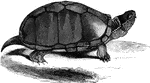
Inhabiting freshwater areas of the United States, the snapping turtle feeds on frogs and fishes.

Snapping turtle

Inhabiting freshwater areas of the United States, the snapping turtle feeds on frogs and fishes.
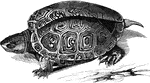
The smooth terrapin is found from Rhode island southward along the eastern coast of the United States.
Smooth terrapin

The smooth terrapin is found from Rhode island southward along the eastern coast of the United States.

Averaging six inches in length, the mud-tortoise is evenly distributed throughout the United States.
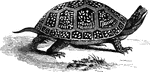
Mud-tortoise

Averaging six inches in length, the mud-tortoise is evenly distributed throughout the United States.

Ranging throughout the Northern and Middle States, Blanding's box-tortoise measures seven to inches in length at the shell.

Blanding's box-tortoise

Ranging throughout the Northern and Middle States, Blanding's box-tortoise measures seven to inches…
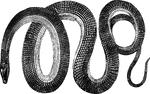
Found in the woods of the Southern States, the glass-snake has the head of a lizard, but the body resembles that of a snake.

Glass-snake

Found in the woods of the Southern States, the glass-snake has the head of a lizard, but the body resembles…
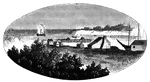
View of Oswego and the Fort in 1798. This view is from the west side of the river, near the site of the present United States Hotel.

Fort Oswego

View of Oswego and the Fort in 1798. This view is from the west side of the river, near the site of…
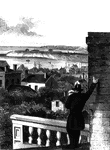
View of Oswego Harbor, 1848. This view is from the top of the United States Hotel, looking east-northeast. It was hastily sketched during the approach of a thunder-storm, and the "huge herald drops" came down just as I traced the distant water-line of the lake. The objects by the figure in the foreground are the balustrade and chimney of the hotel, now (1848) a summer boarding-house for strangers. The first height beyond the water on the right is the point on which stands Fort Oswego. The land in the far distance, on the same side, is Four-mile point, behind which Montcalm landed his forces. On the left is seen the light-house upon one of the stone piers, and beyond it spread out the waters of Lake Ontario.

Oswego Harbor

View of Oswego Harbor, 1848. This view is from the top of the United States Hotel, looking east-northeast.…
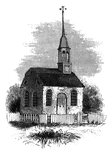
Caughnawaga church. This old church, now (1848) known as the <em>Fonda Academy</em>, under the management of Rev. Douw Van Olinda, is about half a mile east of the court-house, in the village of Fonda. It is a stone edifice, and was erected in 1763 by voluntary contributions. Sir William Johnson contributed liberally. Its first pastor was Thomas Romayne, who was succeeded in 1795 by Abraham Van Horn, one of the earliest graduates of King's (now Columbia) College, in the city of New York. He was from Kingston, Ulster county, and remained its pastor until 1840. During his ministry he united in marriage 1500 couples. The church was without a bell until the confiscated property of Sir John Johnson was sold in the Revolution, when the <em>dinner-bell</em> of his father was purchased and hung in the steeple. The bell weighs a little more than one hundred pounds, and bears the following inscription: "S. R. William Johnson, baronet, 1774. Made by Miller and Ross, in Eliz. Town."

Caughnawaga Church

Caughnawaga church. This old church, now (1848) known as the Fonda Academy, under the management…
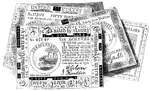
Fac-simile of the Continental Bills. The paper on which these bills were printed was quite thick, and the enemy called it "the <em>pasteboard</em> money of the rebels." The vignettes were generally, both in device and motto, significant. The one most prominent in the engraving represents a beaver in the slow but sure process of cutting down a tree with its teeth. The motto, "Preseverando- by Preseverance," said to the colonists, "Persist, and you will be successful." I will notice a few other devices and mottoes of bills which I have seen. A globe, with the motto, in Latin, "The Lord reigns; let the earth rejoice." A candlestick with thirteen branches and burners, denoting the number of states; motto, "One fire, and to the same purpose." A thorn-bush with a hand grasping it; motto, "Sustain or abstain." A circular chain bearing on each link the name of a state, an emblem of union; motto, "We are one."

Continental Bills

Fac-simile of the Continental Bills. The paper on which these bills were printed was quite thick, and…
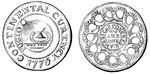
Fac-simile of the first money coined by the United States.

First Money

Fac-simile of the first money coined by the United States.

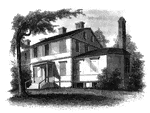
Liberty Hall. Some time after the death of Governor Livingston this property was purchased by Lord Blingbroke, who, under the assumed name of John Belesis, ran away from England with a daughter of Baron Hompasch, a German general. She was at a boarding school there, and Bolingbroke had a wife living. He married the girl here. She died in England in 1848. The grandmother of the present proprietor, Susan, the daughter of Peter Van Burgh Livingston, bought the farm of Lord Bolingbroke, and it has been in possession of the family ever since. Her first husband was John Kean, a member of Congress from South Carolina from 1785 to 1787, and was first cashier of the first United States Bank, chartered by an act of Congress passed February 8th, 1791. Her second husband was Count Niemcewicz, a Polish nobleman.

Liberty Hall

Liberty Hall. Some time after the death of Governor Livingston this property was purchased by Lord Blingbroke,…
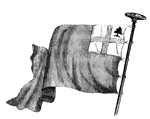
"The New England flag. This is copied from an old Dutch work, preserved in the library of the New York Historical Society, containing pictures of the flags of all nations. In the original, a divided sphere, representing the earth, is in the quarter where I have placed the pine-tree. I have made the alteration in the device, because in the flag raised upon the bastion of the redoubt on Breed's Hill, the pine-tree occupied the place of the sphere, the more ancient device. The question has been unsettled respecting the flag used on that occasion, as contemporary writers are silent on the subject. An intelligent old lady (Mrs. Manning) whom I saw between the Brandywine and Kennet Square, in Pennsylvania, informed me that her father, who was in the battle, assisted in hoisting the standard, and she had heard him speak of it as a 'noble flag.' The ground was blue, and one corner was quartered by the red cross of St. George, in one section of which was the pine-tree. This was the New England flag, as given in the sketch. Doubtless there were many other flags belonging to the several regiments."—Lossing, 1851

New England Flag

"The New England flag. This is copied from an old Dutch work, preserved in the library of the New York…
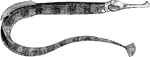
"Have a long, eel-like body, with the jaws united forming a tube nearly cylindrical. The eggs of the female are cast by her into a sort of false belly belonging to the male, and situated near the tial; here they are hatched, and here they occaisionally take refuge like young opossums!" &mdash; Goodrich, 1859

Pipefish

"Have a long, eel-like body, with the jaws united forming a tube nearly cylindrical. The eggs of the…
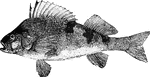
"One of the best and handsomest of the freshwater fishes of that quarter of the globe." &mdash; Goodrich, 1859

European Perch

"One of the best and handsomest of the freshwater fishes of that quarter of the globe." — Goodrich,…
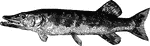
"Is from one to three feet long, and is found in most of the lakes, ponds, and rivers of the Middle and Eastern States." &mdash; Goodrich, 1859

Pickerel

"Is from one to three feet long, and is found in most of the lakes, ponds, and rivers of the Middle…