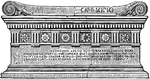
"Sarcophagus, plural Sarcophagi, is a kind of stone used among the Greeks for making coffins, and so called because it was believed to have the property of consuming the flesh of dead bodies deposited in it within a few weeks. Hence a coffin or tomb of stone; a kind of stone chest used for containing a dead body. In modern times stone coffins are occasionally used for royal or distinguished persons."—(Charles Leonard-Stuart, 1911)

Sarcophagus of Scipio

"Sarcophagus, plural Sarcophagi, is a kind of stone used among the Greeks for making coffins, and so…
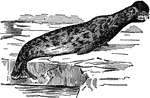
"The Seal, of the family Phocidæ, or seal tribe, are, of all four-limbed mammiferous animals, those which display the most complete adaptation to residence in the water. The seal has considerable resemblance to a quadruped in some respects, and to a fish in others. The head is round, and the nose, which is broad, resembles that of a dog, with the same look of intelligence and mild and expressive physiognomy. It has large whiskers, oblong nostrils, and great black sparkling eyes. It has no external ears, but a valve exists in the orifices, which can be closed at will, so as to keep out the water; the nostrils have a similar valve; and the clothing of the body consists of stiff glossy hairs, very closely set against the skin. The body is elongated and conical, gradually tapering from the shoulders to the tail. The spine is provided with strong muscles, which bend it with considerable force; and this movement is of great assistance to the propulsion of the body."—(Charles Leonard-Stuart, 1911)

Hooded Seal

"The Seal, of the family Phocidæ, or seal tribe, are, of all four-limbed mammiferous animals,…
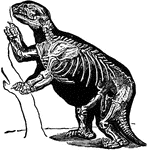
"Sloth is the popular name for any individual of the Edentate group Tardigrada, from their slow and awkward movements on the ground, owing to the peculiar structure of the wrist and ankle joints. The feet are armed with long claws, and turned toward the body, so that the animal is compelled to rest on the side of the hind foot, while the disproportionate length of the fore-limbs causes it to rest also on the elbows. It shuffles forward, alternately stretching the fore legs and hooking the claws into the ground, or grasping some object to draw itself along. Sloths are natives of South America, nocturnal in habit, and are found in the forests of that region, passing their lives among the branches of trees, on the leaves and young shoots of which they feed."—(Charles Leonard-Stuart, 1911)

Giant Sloth

"Sloth is the popular name for any individual of the Edentate group Tardigrada, from their slow and…
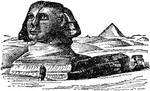
"Sphinx is a Greek word signifying 'strangler,' applied to certain symbolical forms of Egyptian origin, having the body of a lion, a human or an animal head, and two wings. Various other combinations of animal forms have been called by this name, though they are rather griffins or chimæras. Human-headed sphinxes have been called andro-sphinxes; that with the head of a ram, a criosphinx; and that with a hawk's head, a hieracosphinx. The form when complete had the wings added at the sides; but these are of a later period and seem to have originated with the Babylonians or Assyrians. In Egypt the sphinx also occurs as the symbolical form of the monarch considered as a conqueror, the head of the reigning king being placed on a loin's body, the face bearded, and the usual head dress. Thus used, the sphinx was generally male; but in the case of female rulers that figure has a female head and the body of a lioness. The most remarkable sphinx is the Great Sphinx at Gizeh (Giza), a colossal form hewn out of the natural rock, and lying about a quarter of a mile S.E. of the Great Pyramid. It is sculptured out of a spur of the rock itself, to which masonry has been added in certain places to complete the shape, and it measures 172 feet 6 inches long by 56 feet high."—(Charles Leonard-Stuart, 1911)

Sphinx

"Sphinx is a Greek word signifying 'strangler,' applied to certain symbolical forms of Egyptian origin,…
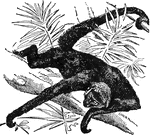
"Spider Monkey is a general name applied to many species of platyrhine or New World monkeys, distinguished by the great relative length, slender-ness, and flexibility of their limbs, and by the prehensile power of their tails. A familiar species is the chameck, which occurs abundantly in Brazil. The body is about 20 inches, the tail 2 feet long, and the color is a general black. The coaita, another typical species, has an average length of 12 inches; the tail measures over 2 feet long, and the fur is of a glossy black hue."—(Charles Leonard-Stuart, 1911)

Spider Monkey

"Spider Monkey is a general name applied to many species of platyrhine or New World monkeys, distinguished…

"Starfish is a popular name for any individual of the family Asteridæ, a familiar object on the Atlantic coasts. The body is more or less star shaped, and consists of a central portion, or disk, surrounded by five or more lobes, or arms, radiating from the body and containing prolongations of the viscera. The mouth is situated in the center of the lower surface of the body, and the anus is either absent or on the upper surface. Locomotion is effected by means of peculiar tube-like processes, which are protruded from the under surface of the arms. They possess in a high degree the power of reproducing lost members and abound in all seas. [Pictured] Lesser Sand-star (Ophiura albida)"—(Charles Leonard-Stuart, 1911)

Lesser Sand-Star Starfish

"Starfish is a popular name for any individual of the family Asteridæ, a familiar object on the…
"Starfish is a popular name for any individual of the family Asteridæ, a familiar object on the Atlantic coasts. The body is more or less star shaped, and consists of a central portion, or disk, surrounded by five or more lobes, or arms, radiating from the body and containing prolongations of the viscera. The mouth is situated in the center of the lower surface of the body, and the anus is either absent or on the upper surface. Locomotion is effected by means of peculiar tube-like processes, which are protruded from the under surface of the arms. They possess in a high degree the power of reproducing lost members and abound in all seas. [Pictured]Common Starfish, reproducing rays"—(Charles Leonard-Stuart, 1911)

Common Starfish

"Starfish is a popular name for any individual of the family Asteridæ, a familiar object on the…

"Starfish is a popular name for any individual of the family Asteridæ, a familiar object on the Atlantic coasts. The body is more or less star shaped, and consists of a central portion, or disk, surrounded by five or more lobes, or arms, radiating from the body and containing prolongations of the viscera. The mouth is situated in the center of the lower surface of the body, and the anus is either absent or on the upper surface. Locomotion is effected by means of peculiar tube-like processes, which are protruded from the under surface of the arms. They possess in a high degree the power of reproducing lost members and abound in all seas. [Pictured]Common Starfish (Asterias rubens)"—(Charles Leonard-Stuart, 1911)

Common Starfish

"Starfish is a popular name for any individual of the family Asteridæ, a familiar object on the…

"Starfish is a popular name for any individual of the family Asteridæ, a familiar object on the Atlantic coasts. The body is more or less star shaped, and consists of a central portion, or disk, surrounded by five or more lobes, or arms, radiating from the body and containing prolongations of the viscera. The mouth is situated in the center of the lower surface of the body, and the anus is either absent or on the upper surface. Locomotion is effected by means of peculiar tube-like processes, which are protruded from the under surface of the arms. They possess in a high degree the power of reproducing lost members and abound in all seas. [Pictured]Eyed Cribella (Cribella oculata)"—(Charles Leonard-Stuart, 1911)

Eyed Cribella Starfish

"Starfish is a popular name for any individual of the family Asteridæ, a familiar object on the…

"Starfish is a popular name for any individual of the family Asteridæ, a familiar object on the Atlantic coasts. The body is more or less star shaped, and consists of a central portion, or disk, surrounded by five or more lobes, or arms, radiating from the body and containing prolongations of the viscera. The mouth is situated in the center of the lower surface of the body, and the anus is either absent or on the upper surface. Locomotion is effected by means of peculiar tube-like processes, which are protruded from the under surface of the arms. They possess in a high degree the power of reproducing lost members and abound in all seas. [Pictured]Gibbous Starlet (Asterina gibbosa)"—(Charles Leonard-Stuart, 1911)

Lesser Sand-star Starfish

"Starfish is a popular name for any individual of the family Asteridæ, a familiar object on the…

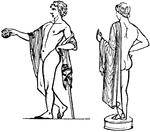
"A scarf, denoted an article of the amictus, or outer raiment of the Greeks. It was for the most part woollen; and it differed from the himation or cloak, the usual amictus of the male sex, in being smaller, finer, and oblong instead of square, its length being generally about twice its breadth. The scarf does not appear to have been much worn by children. It was generally assumed on reaching adolescence, and was worn by the ephebi from about seventeen to twenty years of age. It was also worn by the military, especially of high rank, over their body armour, and by hunters and travellers, more particularly on horseback. The usual mode of wearing the scarf was to pass one of its shorter sides round the neck, and to fasten it by means of a brooch, either over the breast, in which case it hung down the back, or over the right shoulder, so as to cover the left arm. In the following cut it is worn again in another way." — Smith, 1873

Chlamys

"A scarf, denoted an article of the amictus, or outer raiment of the Greeks. It was for the most part…
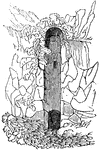
"An artificial channel formed to carry off any stagnany body of water, like the sluices in modern use. Some works of this kind are among the most remarkable efforts of Roman ingenuity. That through which the waters of the lake Fucinus discharged themselves into the Liris, is represented in the preceding woodcut." — Smith, 1873.

Emissarium

"An artificial channel formed to carry off any stagnany body of water, like the sluices in modern use.…
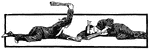
"Here is a new game, which is causing a great deal of amusement at social gatherings in Europe. Two boys, or young men, are blindfolded, and in the right hand of each is placed a stout roll of paper in the form of a club or cudgel. The players then have to lie down on the carpet and to grasp each other by the left hand. Thereupon the fun begins. One of the players asks the other, 'Are you there?' When the answer, 'Yes' comes he raises his right hand and strives to hit with his cudgel the spot where, from the sound of the voice, he supposes the other player's head to be. The other player, however, is at perfect liberty to move his head after he has answered 'Yes,' and the result is that in nine cases out of ten the blow misses his head and falls on his shoulders or some other part of his body. In that case it is his turn to retaliate, and so the game goes on indefinitely, the sole object of the player who asks the question being to strike the other player's head, and that of the player who answers to save his head from being struck."— Thomas Sheppard Meek

Cudgel Game

"Here is a new game, which is causing a great deal of amusement at social gatherings in Europe. Two…
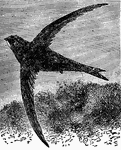
"The Swift, like swallows in many respects, their structure is almost entirely different, and some naturalists rather class them with the humming birds or the goat suckers. The swift has all four toes directed forward; it is larger than the swallow; its flight is more rapid and steady; and its scream is very different from the twittering of the swallow. Its weight is most disproportionately small to its extent of wing, the former being scarcely an ounce, the latter 18 inches, the length of the body beinig about 8 inches. Its color is a somber or sooty black, a whitish patch appearing beneath the chin. It builds in holes in the roofs of houses, in towers, or in hollow trees. A common North American swift is the so-called chimney swallow, which builds its nest in chimneys."—(Charles Leonard-Stuart, 1911)

Common Swift

"The Swift, like swallows in many respects, their structure is almost entirely different, and some naturalists…
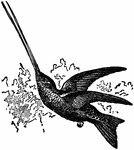
"Swordbill is a popular name for any individual of the humming bird genus, Docimastes. The bill which exceeds in length the body of the bird, is a character by which this humming bird may be distinguished at the first glance. Its use is to reach the insects on which the bird feeds at the bottom of long tubular flowers. On species is known, an inhabitant of Colombia, Ecuador, and Peru."—(Charles Leonard-Stuart, 1911)

Swordbill

"Swordbill is a popular name for any individual of the humming bird genus, Docimastes. The bill which…
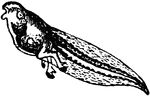
"The Tadpole is the larva of the anurous amphibia, sometimes so far extended as to include larvaæ of the urodela, which undergo a much less complete metamorphosis. At first the young have no respiratory organs or limbs. They are all head and tail with simple entire gills which soon disappear, to be followed by others of more complicated structure, situated within the cavity of the body as in fishes. After a certain length of time the hind legs begin to appear, the head becomes more developed, and the body assumes a more compact form. Still later the forelegs are found to exist fully formed beneath the skin and ready ultimately to burst forth. The tadpole at first seems to derive its subsistence from the fluid absorbed within its body and on the surface, but soon begins to seek its food amidst softened or decomposing vegetable matter. From that period the tadpole begins to assume more and more the appearance of a frog. Toes appear on its hind legs, the tail very rapidly disappears by absorption, and finally the fore-legs become fully developed and the metamorphosis of the tadpole is completed."—(Charles Leonard-Stuart, 1911)

Tadpole

"The Tadpole is the larva of the anurous amphibia, sometimes so far extended as to include larvaæ…
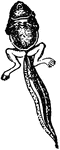
"The Tadpole is the larva of the anurous amphibia, sometimes so far extended as to include larvaæ of the urodela, which undergo a much less complete metamorphosis. At first the young have no respiratory organs or limbs. They are all head and tail with simple entire gills which soon disappear, to be followed by others of more complicated structure, situated within the cavity of the body as in fishes. After a certain length of time the hind legs begin to appear, the head becomes more developed, and the body assumes a more compact form. Still later the forelegs are found to exist fully formed beneath the skin and ready ultimately to burst forth. The tadpole at first seems to derive its subsistence from the fluid absorbed within its body and on the surface, but soon begins to seek its food amidst softened or decomposing vegetable matter. From that period the tadpole begins to assume more and more the appearance of a frog. Toes appear on its hind legs, the tail very rapidly disappears by absorption, and finally the fore-legs become fully developed and the metamorphosis of the tadpole is completed."—(Charles Leonard-Stuart, 1911)

Tadpole

"The Tadpole is the larva of the anurous amphibia, sometimes so far extended as to include larvaæ…
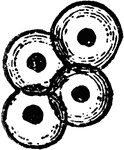
"The Tadpole is the larva of the anurous amphibia, sometimes so far extended as to include larvaæ of the urodela, which undergo a much less complete metamorphosis. At first the young have no respiratory organs or limbs. They are all head and tail with simple entire gills which soon disappear, to be followed by others of more complicated structure, situated within the cavity of the body as in fishes. After a certain length of time the hind legs begin to appear, the head becomes more developed, and the body assumes a more compact form. Still later the forelegs are found to exist fully formed beneath the skin and ready ultimately to burst forth. The tadpole at first seems to derive its subsistence from the fluid absorbed within its body and on the surface, but soon begins to seek its food amidst softened or decomposing vegetable matter. From that period the tadpole begins to assume more and more the appearance of a frog. Toes appear on its hind legs, the tail very rapidly disappears by absorption, and finally the fore-legs become fully developed and the metamorphosis of the tadpole is completed."—(Charles Leonard-Stuart, 1911)

Frog Eggs

"The Tadpole is the larva of the anurous amphibia, sometimes so far extended as to include larvaæ…

"The Tadpole is the larva of the anurous amphibia, sometimes so far extended as to include larvaæ of the urodela, which undergo a much less complete metamorphosis. At first the young have no respiratory organs or limbs. They are all head and tail with simple entire gills which soon disappear, to be followed by others of more complicated structure, situated within the cavity of the body as in fishes. After a certain length of time the hind legs begin to appear, the head becomes more developed, and the body assumes a more compact form. Still later the forelegs are found to exist fully formed beneath the skin and ready ultimately to burst forth. The tadpole at first seems to derive its subsistence from the fluid absorbed within its body and on the surface, but soon begins to seek its food amidst softened or decomposing vegetable matter. From that period the tadpole begins to assume more and more the appearance of a frog. Toes appear on its hind legs, the tail very rapidly disappears by absorption, and finally the fore-legs become fully developed and the metamorphosis of the tadpole is completed."—(Charles Leonard-Stuart, 1911)

Frog Egg

"The Tadpole is the larva of the anurous amphibia, sometimes so far extended as to include larvaæ…

"The Tapeworm is an intestinal worm, Tænia solium, in form somewhat resembling tape. Its length is from 5 to 15 yards, and its breadth from two lines at the narrowest part to four or five at the other or broader extremity. At the narrow end is the head, which is terminated anteriorly by a central rostellum, surrounded by a crown of small recurved hooks, and behind them four suctorial depressions; then follow an immense number of segments, each full of microscopic ova. The segments are capable of being detached when mature, and reproducing the parasite. There is no mouth; but nutrition appears to take place through the tissues of the animal, as algæ derive nourishment from the sea water in which they float. The digestive system consists of two tubes or lateral canals, extending from the anterior to the posterior end of the body, and a transverse canal at the summit of each joint. [Pictured] Portion of tapeworm, natural size, showing the alternating arrangement of the generative pores."—(Charles Leonard-Stuart, 1911)

Tapeworm

"The Tapeworm is an intestinal worm, Tænia solium, in form somewhat resembling tape. Its length…
"The Tapeworm is an intestinal worm, Tænia solium, in form somewhat resembling tape. Its length is from 5 to 15 yards, and its breadth from two lines at the narrowest part to four or five at the other or broader extremity. At the narrow end is the head, which is terminated anteriorly by a central rostellum, surrounded by a crown of small recurved hooks, and behind them four suctorial depressions; then follow an immense number of segments, each full of microscopic ova. The segments are capable of being detached when mature, and reproducing the parasite. There is no mouth; but nutrition appears to take place through the tissues of the animal, as algæ derive nourishment from the sea water in which they float. The digestive system consists of two tubes or lateral canals, extending from the anterior to the posterior end of the body, and a transverse canal at the summit of each joint. [Pictured] A single segment or proglottis magnified; 1, generating pore; 2, water vessels; 3, dendritic ovary."—(Charles Leonard-Stuart, 1911)

Tapeworm

"The Tapeworm is an intestinal worm, Tænia solium, in form somewhat resembling tape. Its length…

"The Tapeworm is an intestinal worm, Tænia solium, in form somewhat resembling tape. Its length is from 5 to 15 yards, and its breadth from two lines at the narrowest part to four or five at the other or broader extremity. At the narrow end is the head, which is terminated anteriorly by a central rostellum, surrounded by a crown of small recurved hooks, and behind them four suctorial depressions; then follow an immense number of segments, each full of microscopic ova. The segments are capable of being detached when mature, and reproducing the parasite. There is no mouth; but nutrition appears to take place through the tissues of the animal, as algæ derive nourishment from the sea water in which they float. The digestive system consists of two tubes or lateral canals, extending from the anterior to the posterior end of the body, and a transverse canal at the summit of each joint. [Pictured] Head of tænia solium (enlarged)."—(Charles Leonard-Stuart, 1911)

Tapeworm

"The Tapeworm is an intestinal worm, Tænia solium, in form somewhat resembling tape. Its length…

"The Tapeworm is an intestinal worm, Tænia solium, in form somewhat resembling tape. Its length is from 5 to 15 yards, and its breadth from two lines at the narrowest part to four or five at the other or broader extremity. At the narrow end is the head, which is terminated anteriorly by a central rostellum, surrounded by a crown of small recurved hooks, and behind them four suctorial depressions; then follow an immense number of segments, each full of microscopic ova. The segments are capable of being detached when mature, and reproducing the parasite. There is no mouth; but nutrition appears to take place through the tissues of the animal, as algæ derive nourishment from the sea water in which they float. The digestive system consists of two tubes or lateral canals, extending from the anterior to the posterior end of the body, and a transverse canal at the summit of each joint. [Pictured] A, ovum with contained embryo, B, Cystericus longicollis."—(Charles Leonard-Stuart, 1911)

Tapeworm

"The Tapeworm is an intestinal worm, Tænia solium, in form somewhat resembling tape. Its length…

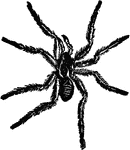
"The Tarantula is a large spider, with a body about an inch in length; its bite was formerly supposed to produce Tarantism, and doubtless in some cases, produces disagreeable symptoms. It is a native of Italy, but varieties, or closely allied species, are found throughout the S. of Europe. The tarantulas of Texas and adjacent countries are large species of Mygale."—(Charles Leonard-Stuart, 1911)

Tarantula

"The Tarantula is a large spider, with a body about an inch in length; its bite was formerly supposed…
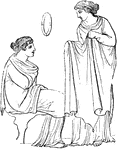
"The <em>peplus</em> was a shawl which commonly formed part of the dress of females. It was often fastened by meeans ofa brooch, but was frequently worn without one, in the manner represented in the annexed cut, which is copied from one of Sir W. Hamilton's vases. Each of the females in this group wears an under garmet falling down to her feet, and over it an ample <em>peplus</em>, or shawl, which she passes entirely round her body, and then throws the loose extremity of it over her left shoulder, and behind her back as distinctly seen in the sitting figure." &mdash; Anthon, 1891

Peplus

"The peplus was a shawl which commonly formed part of the dress of females. It was often fastened…
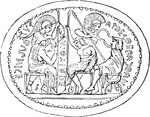
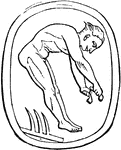
"The <em>palla</em>, as well as the <em>pallium</em> and <em>palliolum</em>, was always a rectangular piece of cloth, exactly, or, at least, nearly square. It was, indeed, used in the very form in which it was taken from the loom, being made entirely by the weaver. Among the Greeks and Romans the most common material for the <em>palla</em> was wool. It was often folded about the body simply with a view to defend it from cold, and without any regard to gracefulness of appearance, as in the following cut, taken from an ancient intaglio." &mdash; Anthon, 1891

Palla

"The palla, as well as the pallium and palliolum, was always a rectangular…

"Halteres were certain masses of stone or metal, which were used in the gymnastic exercises of the Greeks and Romans. Persons who practised leaping frequently performed their exercises with halteres in both hands; but they were also frequently used merely to exercise the body in somewhat the same manner as out dumb-bells." &mdash; Smith, 1873

Halteres

"Halteres were certain masses of stone or metal, which were used in the gymnastic exercises of the Greeks…
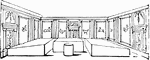
"The Roman people reclined at their meals. On each couch there were commonly three persons. They lay with the upper part of the body reclined on the left arm, the head a little raised, the back supported by cushions and the limbs stretched out at full length, or a little bent; the feet of the first behind the back of the second, and his feet behind the back of the third, with a pillow between each. When they ate, they raised themselves on their elbow, and made use of the right hand. A banqueting-room generally contained three couches, holding nine guests, and, from the number of couches, was called <em>riclinium</em>. The following representation of such a room is from one at Pomopeii. In the centre is a pedestal to receive the table." &mdash; Anthon, 1891

Banqueting room

"The Roman people reclined at their meals. On each couch there were commonly three persons. They lay…
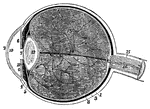
1, the sclerotic thicker behind than in front; 2, the cornea; 3, the choriod; 6, the iris; 7, the pupil; 8, the retina; 10, the anterior chamber of the eye; 11, the posterior chamber; 12, the crystalline lens, enclosed in its capsule; 13, the vitreous humour, enclosed in the hyaloid membrane and in cells formed in its interior by that membrae; 15, the sheath; and 16, the interior of the optic nerve, in the centre of which is a small artery.

Human Eye

1, the sclerotic thicker behind than in front; 2, the cornea; 3, the choriod; 6, the iris; 7, the pupil;…
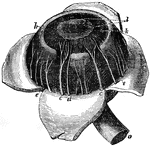
c, ciliary nerves going to be distributed in iris; d, smaller ciliary nerve; e, veins known as vasa vorticosa; h, ciliary ligament and muscle; k,l, converging fibres of iris; o, optic nerve.

Human Eye

c, ciliary nerves going to be distributed in iris; d, smaller ciliary nerve; e, veins known as vasa…
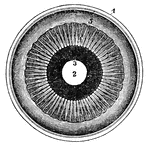
The iris and adjacent structures seen from behind. 1, the divided edge of the three coats, the choroid being the dark intermediate one; 2, the pupil; 3, the posterior surface of the iris; 4, the ciliary processes; 5, the scalloped anterior border of the retina.

Human Eye

The iris and adjacent structures seen from behind. 1, the divided edge of the three coats, the choroid…
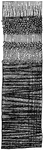
The retina of a human eye stretched out vertical.

Eye Retina

The retina of a human eye stretched out vertical.

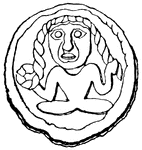
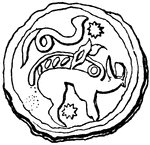
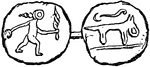
Coin of the Gauls picturing human figure on front and figure of animal on back.

Gallic Coin

Coin of the Gauls picturing human figure on front and figure of animal on back.

A Gallic coin with a human figure on the front. Front.

Gallic Coin

A Gallic coin with a human figure on the front. Front.

A Gallic coin with a human figure on the front. Back.

Gallic Coin

A Gallic coin with a human figure on the front. Back.

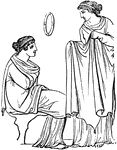
"An outer garment, strictly worn by females, and thus corresponding to the himation or pallium, the outer garment worn by men. Like all other pieces of cloth used for the Amictus, it was often fastened by means of a brooch. It was, however, frequently worn without a brooch, in the manner represented in the annexed cut. Each of the females in this group wears a tunic falling down to her feet, and over it an ample pepius, which she passes entirely round her body and then throws the loose extremity of it over her left shoulder and behind her back, as is distinctly seen in the sitting figure. Of all the productions of the loom, pepli were those on which the greatest skill and labour were bestowed. so various and tasteful were the subjects which they represented, that poets delighted to describe them. The art of weaving them was entirely oriental; and those of the most splendid dyes and curious workmanship were imported from Tyre and Sidon. They often constituted a very important part of the treasures of a temple, having been presented to the divinity by sppliants and devotees." &mdash; Smith, 1873

Peplum

"An outer garment, strictly worn by females, and thus corresponding to the himation or pallium, the…
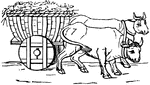
"A cart or wagon. It had commonly two wheels, but sometimes four, and it was then called the plaustrum majus. Besides the wheels and axle the plaustrum consisted of a strong pole (temo), to the hinder part of which was fastened a table of wooden planks. The blocks of stone, or other things to be carried, were either laid upon this table without any other support, or an additional security was obtained by the use either of boards at the sides, or of a large wicker basket tied upon the cart. The annexed cut exhibits a cart, the body of which is supplied by a basket. The commonest kind of cart-wheel was that called tympanum, the "drum," from its resemblance to the musical instrument of the same name. It was nearly a foot in thickness, and was made either by sawing the trunk of a tree across in a horizontal direction, or by nailing together boards of the requisite shape and size. These wheels advanced slowly, and made a loud creaking, which was heard to a great distance." &mdash; Smith, 1873

Plaustrum

"A cart or wagon. It had commonly two wheels, but sometimes four, and it was then called the plaustrum…
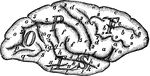
Part of a human brain.

Cerebellum

Part of a human brain.

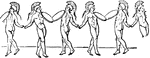
"Dancing. The dancing of the Greeks as well as of the Romans had very little in common with the exercise which goes by that name in modern times. It may be divided into two kinds, gymnastic and mimetic; that is, it was intended either to represent bodily activity, or to express by gestures, movements, and attitudes, certain ideas or feelings, and also single events or a series of events, as in the modern ballet. All these movements, however, were accompanied by music; but the term saltatio was used in a so much wider sense than our word dancing, that they applied to disignate gestures, even when the body did not move at all. We find dancing prevalent among the Greeks from the earliest times. It was originally closely connected with religion. In all the public festivals, which were so numerous among the Greeks, dancing formed a very prominent part. We find from the earliest times that the worship of Apollo was connected with a religious dance, called Hyporchema. All the religious dances, with the exception of the bacchic and the Corybantian, were very simple, and consisted of gentle movements of the body, with various turnings and windings around the altar; such a dance was the Geranus, which Theseus is said to have performed at Delos on his return from Crete." &mdash; Smith, 1873

Salatio

"Dancing. The dancing of the Greeks as well as of the Romans had very little in common with the exercise…
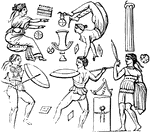
"Dancing. The dancing of the Greeks as well as of the Romans had very little in common with the exercise which goes by that name in modern times. It may be divided into two kinds, gymnastic and mimetic; that is, it was intended either to represent bodily activity, or to express by gestures, movements, and attitudes, certain ideas or feelings, and also single events or a series of events, as in the modern ballet. All these movements, however, were accompanied by music; but the term saltatio was used in a so much wider sense than our word dancing, that they applied to disignate gestures, even when the body did not move at all. We find dancing prevalent among the Greeks from the earliest times. It was originally closely connected with religion. In all the public festivals, which were so numerous among the Greeks, dancing formed a very prominent part. We find from the earliest times that the worship of Apollo was connected with a religious dance, called Hyporchema. All the religious dances, with the exception of the bacchic and the Corybantian, were very simple, and consisted of gentle movements of the body, with various turnings and windings around the altar; such a dance was the Geranus, which Theseus is said to have performed at Delos on his return from Crete." &mdash; Smith, 1873

Salatio

"Dancing. The dancing of the Greeks as well as of the Romans had very little in common with the exercise…
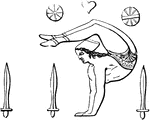
"Dancing. The dancing of the Greeks as well as of the Romans had very little in common with the exercise which goes by that name in modern times. It may be divided into two kinds, gymnastic and mimetic; that is, it was intended either to represent bodily activity, or to express by gestures, movements, and attitudes, certain ideas or feelings, and also single events or a series of events, as in the modern ballet. All these movements, however, were accompanied by music; but the term saltatio was used in a so much wider sense than our word dancing, that they applied to disignate gestures, even when the body did not move at all. We find dancing prevalent among the Greeks from the earliest times. It was originally closely connected with religion. In all the public festivals, which were so numerous among the Greeks, dancing formed a very prominent part. We find from the earliest times that the worship of Apollo was connected with a religious dance, called Hyporchema. All the religious dances, with the exception of the bacchic and the Corybantian, were very simple, and consisted of gentle movements of the body, with various turnings and windings around the altar; such a dance was the Geranus, which Theseus is said to have performed at Delos on his return from Crete." &mdash; Smith, 1873

Salatio

"Dancing. The dancing of the Greeks as well as of the Romans had very little in common with the exercise…
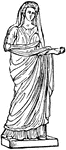
"A female dress worn over the tunic; it came as low as the ankles or feet, and was fastened round the body by a girdle, leaving above the breast broad folds. The tunic did not reach much below the knee, but the essential distinction between the tunic and stole seems to have been, that the latter always had an institia or flounce sewed to the bottom and reaching to the instep. Over the stole the palla or pallium was worn, as we see in the cut annexed." &mdash; Smith, 1873

Stola

"A female dress worn over the tunic; it came as low as the ankles or feet, and was fastened round the…
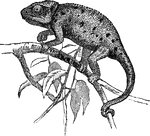
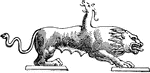
There are about 59 known species, <em>Cham&aelig;leon vulgaris</em> being the most famous. its body is 6 to 7 inches long, tail about 5 inches. The skin is cool to the touch and contains small grains or einences which are of a bluish-gray color in the shade. The extraordinary faculty which the chameleon possesses of changing its color, in accordance with that of the objects by which it is surrounded or its temper.

Chameleon

There are about 59 known species, Chamæleon vulgaris being the most famous. its body…

A fire breathing monster, the fore part of whose body, according to the Iliad, was that of a lion, the middle that of a goat, and the hinder that of a dragon, or which, according to Hesiod, had three heads.

Chimera

A fire breathing monster, the fore part of whose body, according to the Iliad, was that of a lion, the…
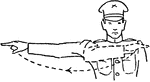
"The hand on the side toward which the change of direction is to be made is carried across the body to the opposite shoulder, forearm horizontal; then swing in a horizontal plane, arm extended, pointing in the new direction." — Moss, 1914

Change Direction Signal

"The hand on the side toward which the change of direction is to be made is carried across the body…
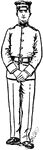
"Carry the right foot 6 inches straight to the rear, left knee slightly bent; clasp the hands, without constriant, in front of the center of the body, fingers joined, left hand uppermost, left thumb clasped by the thumb and forefinger of the right hand, preserve silence and steadiness of position." — Moss, 1914

Parade Rest

"Carry the right foot 6 inches straight to the rear, left knee slightly bent; clasp the hands, without…
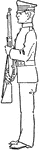
"With the right hand carry the piece in front of the center of the body, barrel to the rear and vertical, grasp it with the left hand at the balance, forearm horizontal and resting against the body. Grasp the small of the stock with the right hand." — Moss, 1914

Present Arms

"With the right hand carry the piece in front of the center of the body, barrel to the rear and vertical,…
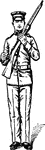
"With the right hand raise and throw the piece diagonally across the body, grasp it smartly with both hands, the right, palm down, at the small of the stock, the left, palm up, at the balance; barrel up, sloping to the left and crossing opposite the junction of the neck with the left shoulder." — Moss, 1914

Port Arms

"With the right hand raise and throw the piece diagonally across the body, grasp it smartly with both…
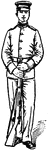
"Carry the right foot 6 inches straight to the rear, left knee slightly bent; carry the muzzle in front of the center of the body, barrel to the left; grasp the piece with the left hand just below the stacking swivel, and with the right hand below and against the left." — Moss, 1914

Parade Rest with Rifle

"Carry the right foot 6 inches straight to the rear, left knee slightly bent; carry the muzzle in front…
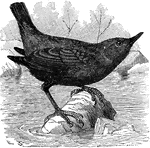
A bird that spends most of its time in the water. It has a thick body; very short tail of 12 rectrices and short rounded wings consisting of 10 primaries.

American Dipper

A bird that spends most of its time in the water. It has a thick body; very short tail of 12 rectrices…
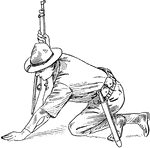
"Carry back the left foot and lie flat on the belly, inclining the body about 35 degree to the right." — Moss, 1914

Lie Down

"Carry back the left foot and lie flat on the belly, inclining the body about 35 degree to the right."…
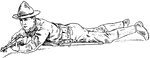
"Carry back the left foot and lie flat on the belly, inclining the body about 35 degree to the right." — Moss, 1914

Lie Down

"Carry back the left foot and lie flat on the belly, inclining the body about 35 degree to the right."…

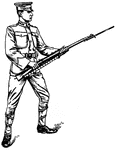
The collar bone of a human.

Clavicle

The collar bone of a human.

"At the second command sake the position of guard; at the same time throw the rifle smartly to the front, grasp the rifle with the left hand just below the lower band, fingers between the stock and gun sling, barrel turned slightly to the left, the right hand grasping the small of the stock about 6 inches in front of the right hip, elbows free from the body, bayonet point at the height of the chin." — Moss, 1914

Bayonet Guard

"At the second command sake the position of guard; at the same time throw the rifle smartly to the front,…
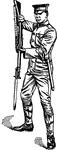
"Carry the point of the bayonet down until it is at the height of the knee, moving the point of the bayonet sufficiently to the right (left) to keep the opponent's attacks clear of the point threatened. These parries are rarely used, as an attack below the waist leaves the head and body exposed." — Moss, 1914

Low Parry

"Carry the point of the bayonet down until it is at the height of the knee, moving the point of the…
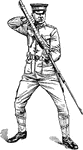
"These parries are rarely used, as an attack below the waist leaves the head and body exposed." — Moss, 1914

Low Parry

"These parries are rarely used, as an attack below the waist leaves the head and body exposed." —…
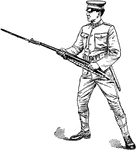
"As additional instruction, the men may be permitted to wield the rifle left handed, that is on the left side of the body, left hand at the small of the stock. Many men will be able to use this method to advantage. It is also of value in case the left hand is wounded." — Moss, 1914

Left-Handed Rifle

"As additional instruction, the men may be permitted to wield the rifle left handed, that is on the…
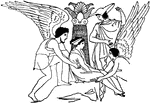
"Death, Sleep, and Hermes laying a Body in the Tomb" &mdash; Gayley, 1893

Death

"Death, Sleep, and Hermes laying a Body in the Tomb" — Gayley, 1893

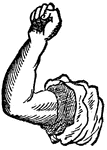
The limb of the human body which extends from the shoulder to the hand.

Arm

The limb of the human body which extends from the shoulder to the hand.

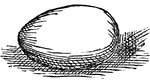
A body formed in the females of birds, and some other animals, from which their young is produced.

Egg

A body formed in the females of birds, and some other animals, from which their young is produced.