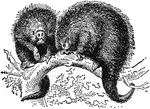
"The Porcupine is a rodent quadruped. The North American porcupine is about two feet long, and of sluggish habits. The quills are short, and concealed among the fur, and the tail is short. The 'tree porcupine' of South America has a prehensile tail, about 10 inches long. The porcupine of Southern Europe and Africa is about 28 inches long, exclusive of the tail. The head, fore quarters, and under surface are clothed with short spines, intermixed with hairs, crest on head and neck, hind quarters covered with long sharp spines, ringed with black and white, and erectile at will. They are but loosely attached to the skin and readily fall out, a circumstance which probably gave rise to the belief that the animal was able to project them at an enemy."—(Charles Leonard-Stuart, 1911)

Prehensile Tailed Porcupine

"The Porcupine is a rodent quadruped. The North American porcupine is about two feet long, and of sluggish…
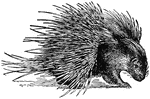
"The Porcupine is a rodent quadruped. The North American porcupine is about two feet long, and of sluggish habits. The quills are short, and concealed among the fur, and the tail is short. The 'tree porcupine' of South America has a prehensile tail, about 10 inches long. The porcupine of Southern Europe and Africa is about 28 inches long, exclusive of the tail. The head, fore quarters, and under surface are clothed with short spines, intermixed with hairs, crest on head and neck, hind quarters covered with long sharp spines, ringed with black and white, and erectile at will. They are but loosely attached to the skin and readily fall out, a circumstance which probably gave rise to the belief that the animal was able to project them at an enemy."—(Charles Leonard-Stuart, 1911)

Hystrix Crystata Porcupine

"The Porcupine is a rodent quadruped. The North American porcupine is about two feet long, and of sluggish…
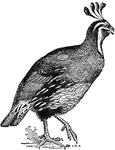
"The Quail is a small game bird; the Virginia species is common in North America, and so far south as Honduras. It is larger than the European quail, and is better eating. The California crested quail is another American species. THe quail, genus Coturnix, is widely distributed over the Eastern Hemisphere, visiting Europe in early summer and returning S. in the autumn, when immense numbers are caught and fattened for the market. Length about seven inches, general color reddish-brown, with buff streaks on the upper surface; throat rufous; head, dark brown above, striped with ocherous white, sides reddish-brown, lower parts pale buff, fading into white on belly. Color less bright in the hen bird, and the rufous tinge absent from the throat. They nest on the ground, laying from 9 to 15 pyriform, yellowish-white eggs, blotched with dark-brown. The males are polygamous and extremely pugnacious."—(Charles Leonard-Stuart, 1911)

Lophortyx Californicus Quail

"The Quail is a small game bird; the Virginia species is common in North America, and so far south as…
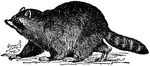
"The Raccoon, or Racoon, is a handsome animal, about the size of a large cat, brown furry hair, tail bushy and ringed; body large and unwieldy, legs short, feet with strong fossorial claws. It is omnivorous and ranges over a large part of North America, where it is hunted for its fur. The crab-eating raccoon of South America, ranging as far N. as Panama, differs chiefly from the former in the shortness of its fur, and consequent slender shape."—(Charles Leonard-Stuart, 1911)

Procyon Lotor Raccoon

"The Raccoon, or Racoon, is a handsome animal, about the size of a large cat, brown furry hair, tail…
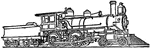
"Three locomotives were imported from England in 1829, and the first trial in America took place Aug. 8, 1829, at Honesdale, Pa. The first railway constructed to be worked by locomotives was the South Carolina railroad (1826–1830), though trials of an experimental locomotive had been made before on the Baltimaore and Ohio railroad, which continued to be worked by horsepower till 1832. "—(Charles Leonard-Stuart, 1911)

American Locomotive

"Three locomotives were imported from England in 1829, and the first trial in America took place Aug.…

"Three locomotives were imported from England in 1829, and the first trial in America took place Aug. 8, 1829, at Honesdale, Pa. The first railway constructed to be worked by locomotives was the South Carolina railroad (1826–1830), though trials of an experimental locomotive had been made before on the Baltimaore and Ohio railroad, which continued to be worked by horsepower till 1832. "—(Charles Leonard-Stuart, 1911)

Early Locomotive

"Three locomotives were imported from England in 1829, and the first trial in America took place Aug.…
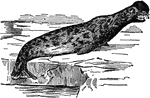
"The Seal, of the family Phocidæ, or seal tribe, are, of all four-limbed mammiferous animals, those which display the most complete adaptation to residence in the water. The seal has considerable resemblance to a quadruped in some respects, and to a fish in others. The head is round, and the nose, which is broad, resembles that of a dog, with the same look of intelligence and mild and expressive physiognomy. It has large whiskers, oblong nostrils, and great black sparkling eyes. It has no external ears, but a valve exists in the orifices, which can be closed at will, so as to keep out the water; the nostrils have a similar valve; and the clothing of the body consists of stiff glossy hairs, very closely set against the skin. The body is elongated and conical, gradually tapering from the shoulders to the tail. The spine is provided with strong muscles, which bend it with considerable force; and this movement is of great assistance to the propulsion of the body."—(Charles Leonard-Stuart, 1911)

Hooded Seal

"The Seal, of the family Phocidæ, or seal tribe, are, of all four-limbed mammiferous animals,…
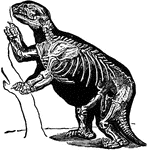
"Sloth is the popular name for any individual of the Edentate group Tardigrada, from their slow and awkward movements on the ground, owing to the peculiar structure of the wrist and ankle joints. The feet are armed with long claws, and turned toward the body, so that the animal is compelled to rest on the side of the hind foot, while the disproportionate length of the fore-limbs causes it to rest also on the elbows. It shuffles forward, alternately stretching the fore legs and hooking the claws into the ground, or grasping some object to draw itself along. Sloths are natives of South America, nocturnal in habit, and are found in the forests of that region, passing their lives among the branches of trees, on the leaves and young shoots of which they feed."—(Charles Leonard-Stuart, 1911)

Giant Sloth

"Sloth is the popular name for any individual of the Edentate group Tardigrada, from their slow and…
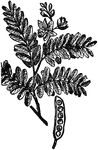
"The Tamarind is an evergreen tree, 80 feet high by 25 in circumference, cultivated in India as far N. as the Jhelum, and very largely planted in avenues and 'topes.' The wood, which is yellowish-white, sometimes with red streaks, is hard and close-grained. It weighs about 83 pounds per cubic foot, is highly prized, but is very difficult to work, and is used in India for turning wheels, mallets, planes, furniture, rice-pounders, oil and sugar mills, etc. The West Indian and South American variety has legumes only three times as long as the broad, whereas the Indian tree has them six times as long. The tamarinds sold in the United States are chiefly West Indian tamarinds. They differ from the Black or East Indian tamarinds, of which the preserved pulp is black."—(Charles Leonard-Stuart, 1911)

Tamarind

"The Tamarind is an evergreen tree, 80 feet high by 25 in circumference, cultivated in India as far…
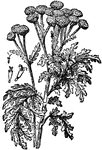
"Tansy is a genus of Compositæ, numbering about 50 species of strong-scented herbs, often shrubby below, with alternate usually much-divided leaves, and solitary or corymbose heads of rayless yellow flowers. The genus is represented in North America, Europe, North and South Africa, temperate and cold Asia. Common tansy has long had a reputation as a medicinal herb, causing it to be much grown in gardens in the past."—(Charles Leonard-Stuart, 1911)

Tansy

"Tansy is a genus of Compositæ, numbering about 50 species of strong-scented herbs, often shrubby…


Seal of New Amsterdam

New Amsterdam

Seal of New Amsterdam

Seal of New Netherland

New Netherland

Seal of New Netherland

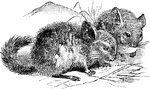
A small south American rodent quadruped of the genus Chinchilla, especially C. lanigera; a pika-squirrel. Usually about 10 inches long, with large rounded ears, long hind legs, 5 toes on the fore feet, a long bushy tail, and beautifully fine pearly-gray pelage, in great repute in furriery.

Chinchilla

A small south American rodent quadruped of the genus Chinchilla, especially C. lanigera; a pika-squirrel.…
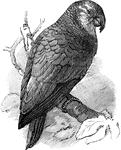
A south American parrot.

Amazon Parrot

A south American parrot.

Seal of East Jersey

East Jersey

Seal of East Jersey

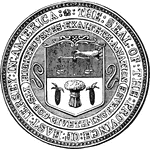
Seal of the proprietors of Carolina.

Carolina

Seal of the proprietors of Carolina.

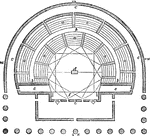
"Theatrum, a theatre. The Athenians before the time of Aeschylus had only a wooden scaffolding on which their dramas were performed. Such a wooden theatre was only erected for the time of the Dionysiac festivals, and was afterwards pulled down. The first drama that Aeschylus brought upon the stage was performed upon such a wooden scaffold, and it is recorded as a singular and ominous coincidence that on that occasion (500 b.c.) the scaffolding broke down. To prevent the recurrence of such an accident, the building of a stone theatre was forthwith commenced on the south-eastern descent of the Acropolis, in the Lenaea; for it should be observed, that throughout Greece theatres were always built upon eminences, or on the sloping side of a hill." &mdash Smith; 1873

Theatrum

"Theatrum, a theatre. The Athenians before the time of Aeschylus had only a wooden scaffolding on which…
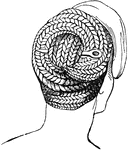
"The mode of platting the hair, and then fastening it with a pin on a needle, is shown in the annexed figure of a female head, taken from a marble group which was found at Apt, in the south of France." — Anthon, 1891

Platted hair

"The mode of platting the hair, and then fastening it with a pin on a needle, is shown in the annexed…

Writer who fought in the Civil War that wrote <em>Silent South</em> and fought for equal rights for African Americans.

George W. Cable

Writer who fought in the Civil War that wrote Silent South and fought for equal rights for…
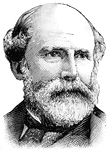
Democratic U.S. Senator from North Carolina in 1872.

Matt W. Ransom

Democratic U.S. Senator from North Carolina in 1872.

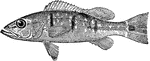
A genus of fishes inhabiting the fresh waters of South America, and typical of the family Cichlid&aelig;.

Cichla

A genus of fishes inhabiting the fresh waters of South America, and typical of the family Cichlidæ.
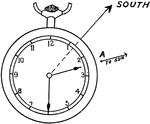
"The position of the true meridian may be found as follows: Point the hour hand of a watch towards the sun; the line joining the pivot and the point midway between the hour hand and XIII on the dial will point towards the south; that is to say if the observer stands so as to face the sun and the XII on the dial, he will be looking south. To point the hour hand exactly at the sun, stick a pin and bring the hour hand into the shadow. At night a line drawn toward the north star from the observer's position is approximately a true meridian." &mdash; Moss, 1914

True meridian

"The position of the true meridian may be found as follows: Point the hour hand of a watch towards the…
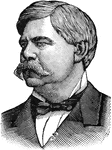
Hero of the Civil War and Governor of North Carolina.

Hon. Zebulon B. Vance

Hero of the Civil War and Governor of North Carolina.

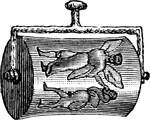
"A Cylinder Seal" &mdash; Morey, 1903

Cylinder Seal

"A Cylinder Seal" — Morey, 1903

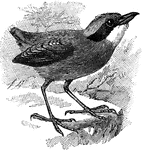
A bird of South America.

Black Cheeked Ant Thrush

A bird of South America.

"Bring the two ends of the wire into contact, and thus close the circuit. The needle instantly flies around as though it was trying to place itself at right angles to the wire. Break the circuit, and the needle swings back to its north and south position. Twist the wires together, and bend the conductor into a loop so that the current passes above the needle in one direction and beneath the needle in the other direction. The deflection of the needle will be greater than before." &mdash; Avery, 1895

Needle, compass

"Bring the two ends of the wire into contact, and thus close the circuit. The needle instantly flies…
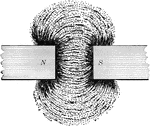
A pair of opposite poles attracting, the magnetic force shown by iron filings.

Attractive poles

A pair of opposite poles attracting, the magnetic force shown by iron filings.

A carolina parakeet perched on a branch.

Carolina Parakeet

A carolina parakeet perched on a branch.

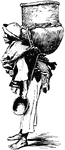
An Equadorian water-carrier.

Water carrier

An Equadorian water-carrier.

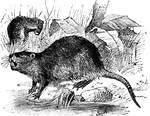
A rodent of South America. Its head is large and depressed, its neck short and stout, its limbs short, its tail long and round. Swims with great ease. Grows up to two and a half feet in length.

Coypu

A rodent of South America. Its head is large and depressed, its neck short and stout, its limbs short,…
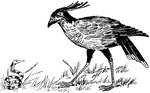
A bird of prey located in South Africa and the Philippine Islands.

Secretary Bird

A bird of prey located in South Africa and the Philippine Islands.

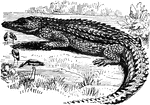
The Nile crocodile is the largest African crocodile and the top predator in its range, which covers most of Africa south of the Sahara.

Nile Crocodile

The Nile crocodile is the largest African crocodile and the top predator in its range, which covers…

The Anglo-Zulu War was fought between Britain and the Zulus. Scene of the British defeat at Majuba Hill.
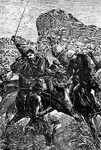
Anglo-Zulu War

The Anglo-Zulu War was fought between Britain and the Zulus. Scene of the British defeat at Majuba Hill.

The Anglo-Zulu War was fought between Britain and the Zulus. Scene of Battle of Isandhlwana, the dash with the colors.

Anglo-Zulu War

The Anglo-Zulu War was fought between Britain and the Zulus. Scene of Battle of Isandhlwana, the dash…
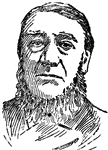
A prominent Boer resistance leader against British rule and the president of the Transvaal Republic in South Africa.

Paul Kruger

A prominent Boer resistance leader against British rule and the president of the Transvaal Republic…
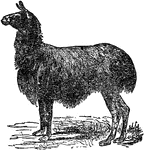
A ruminating quadruped closely allied to the camel, and native to the southern parts of Peru and other sections of South America.

Llama

A ruminating quadruped closely allied to the camel, and native to the southern parts of Peru and other…
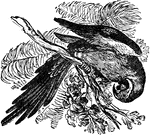
A genus of birds native to tropical South America, remarkable for their size and beauty of their plumage. They range as far north as Mexico.

Macaw

A genus of birds native to tropical South America, remarkable for their size and beauty of their plumage.…
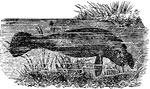
An animal native to the waters of South America, Australia, and West Africa. It is herbivorous, subsisting especially on sea moss and plants in shallow water.

Manatee

An animal native to the waters of South America, Australia, and West Africa. It is herbivorous, subsisting…
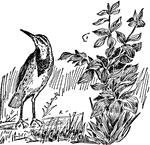
A bird of North america, and common in the United States as far south as the Mexican boundary.

Meadowlark

A bird of North america, and common in the United States as far south as the Mexican boundary.
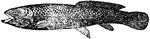
The common name of several species of fishes. They are found in freshwater bodies, in the lakes and rivers between the rocky Mountains and the Alleghanies, and also in several sections of South America, Africa, and Australia.

Mudfish

The common name of several species of fishes. They are found in freshwater bodies, in the lakes and…
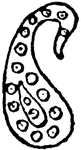
"Also known as the cone, the palm leaf, the river loop, the crown jewel, the seal, the almond, the feather, the boquet, and the flame. There is a vast difference of opinion as to the origin and meaning of this motif. Some authorities claim it was intended for the fir cone, which served as an emblem of immortality and was revered by the ancients; some say it was intended for the palm leaf, which has been handed down by the Greeks as a symbol of victory; others say it was intended to represent a loop which the river Indus makes on a vast plain in upper Cashmere as seen from the Mosque. By some it is said to represent the crown jewels or chief ornament in the old Iranian crown, which is a composite jewel of pear shape. Tradition tells us that the signing of documents in such a manner was a custom well known in the East. This design has also been called the almond, the feather, the bouquet, and the flame on account of its fancied resemblance to these objects. We have selected the name "pear" because the image it conveys is more clearly recognized by the western mind. It is that which its shape most suggests. The Pear design is common in many kinds of rugs, especially in those of Persia and Kurdistan, but it varies greatly in varieties of form and size. The large size is usually employed in the Caucasus and Southern Persia, while the small size is used more frequently in Central and Western Persia. In the Saraband, Shiraz, Herat, Khorasan, and Senna, it frequently covers the whole field. In the two former alternate rows usually have the stems of the pears turned in opposite directions, while in the three latter the stems are usually turned in the same direction."

Pear Design

"Also known as the cone, the palm leaf, the river loop, the crown jewel, the seal, the almond, the feather,…
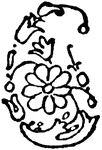
"Also known as the cone, the palm leaf, the river loop, the crown jewel, the seal, the almond, the feather, the boquet, and the flame. There is a vast difference of opinion as to the origin and meaning of this motif. Some authorities claim it was intended for the fir cone, which served as an emblem of immortality and was revered by the ancients; some say it was intended for the palm leaf, which has been handed down by the Greeks as a symbol of victory; others say it was intended to represent a loop which the river Indus makes on a vast plain in upper Cashmere as seen from the Mosque. By some it is said to represent the crown jewels or chief ornament in the old Iranian crown, which is a composite jewel of pear shape. Tradition tells us that the signing of documents in such a manner was a custom well known in the East. This design has also been called the almond, the feather, the bouquet, and the flame on account of its fancied resemblance to these objects. We have selected the name "pear" because the image it conveys is more clearly recognized by the western mind. It is that which its shape most suggests. The Pear design is common in many kinds of rugs, especially in those of Persia and Kurdistan, but it varies greatly in varieties of form and size. The large size is usually employed in the Caucasus and Southern Persia, while the small size is used more frequently in Central and Western Persia. In the Saraband, Shiraz, Herat, Khorasan, and Senna, it frequently covers the whole field. In the two former alternate rows usually have the stems of the pears turned in opposite directions, while in the three latter the stems are usually turned in the same direction."

Pear Design

"Also known as the cone, the palm leaf, the river loop, the crown jewel, the seal, the almond, the feather,…
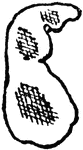
"Also known as the cone, the palm leaf, the river loop, the crown jewel, the seal, the almond, the feather, the boquet, and the flame. There is a vast difference of opinion as to the origin and meaning of this motif. Some authorities claim it was intended for the fir cone, which served as an emblem of immortality and was revered by the ancients; some say it was intended for the palm leaf, which has been handed down by the Greeks as a symbol of victory; others say it was intended to represent a loop which the river Indus makes on a vast plain in upper Cashmere as seen from the Mosque. By some it is said to represent the crown jewels or chief ornament in the old Iranian crown, which is a composite jewel of pear shape. Tradition tells us that the signing of documents in such a manner was a custom well known in the East. This design has also been called the almond, the feather, the bouquet, and the flame on account of its fancied resemblance to these objects. We have selected the name "pear" because the image it conveys is more clearly recognized by the western mind. It is that which its shape most suggests. The Pear design is common in many kinds of rugs, especially in those of Persia and Kurdistan, but it varies greatly in varieties of form and size. The large size is usually employed in the Caucasus and Southern Persia, while the small size is used more frequently in Central and Western Persia. In the Saraband, Shiraz, Herat, Khorasan, and Senna, it frequently covers the whole field. In the two former alternate rows usually have the stems of the pears turned in opposite directions, while in the three latter the stems are usually turned in the same direction."

Pear Design

"Also known as the cone, the palm leaf, the river loop, the crown jewel, the seal, the almond, the feather,…
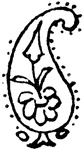
"Also known as the cone, the palm leaf, the river loop, the crown jewel, the seal, the almond, the feather, the boquet, and the flame. There is a vast difference of opinion as to the origin and meaning of this motif. Some authorities claim it was intended for the fir cone, which served as an emblem of immortality and was revered by the ancients; some say it was intended for the palm leaf, which has been handed down by the Greeks as a symbol of victory; others say it was intended to represent a loop which the river Indus makes on a vast plain in upper Cashmere as seen from the Mosque. By some it is said to represent the crown jewels or chief ornament in the old Iranian crown, which is a composite jewel of pear shape. Tradition tells us that the signing of documents in such a manner was a custom well known in the East. This design has also been called the almond, the feather, the bouquet, and the flame on account of its fancied resemblance to these objects. We have selected the name "pear" because the image it conveys is more clearly recognized by the western mind. It is that which its shape most suggests. The Pear design is common in many kinds of rugs, especially in those of Persia and Kurdistan, but it varies greatly in varieties of form and size. The large size is usually employed in the Caucasus and Southern Persia, while the small size is used more frequently in Central and Western Persia. In the Saraband, Shiraz, Herat, Khorasan, and Senna, it frequently covers the whole field. In the two former alternate rows usually have the stems of the pears turned in opposite directions, while in the three latter the stems are usually turned in the same direction."

Pear Design

"Also known as the cone, the palm leaf, the river loop, the crown jewel, the seal, the almond, the feather,…
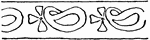
"Also known as the cone, the palm leaf, the river loop, the crown jewel, the seal, the almond, the feather, the boquet, and the flame. There is a vast difference of opinion as to the origin and meaning of this motif. Some authorities claim it was intended for the fir cone, which served as an emblem of immortality and was revered by the ancients; some say it was intended for the palm leaf, which has been handed down by the Greeks as a symbol of victory; others say it was intended to represent a loop which the river Indus makes on a vast plain in upper Cashmere as seen from the Mosque. By some it is said to represent the crown jewels or chief ornament in the old Iranian crown, which is a composite jewel of pear shape. Tradition tells us that the signing of documents in such a manner was a custom well known in the East. This design has also been called the almond, the feather, the bouquet, and the flame on account of its fancied resemblance to these objects. We have selected the name "pear" because the image it conveys is more clearly recognized by the western mind. It is that which its shape most suggests. The Pear design is common in many kinds of rugs, especially in those of Persia and Kurdistan, but it varies greatly in varieties of form and size. The large size is usually employed in the Caucasus and Southern Persia, while the small size is used more frequently in Central and Western Persia. In the Saraband, Shiraz, Herat, Khorasan, and Senna, it frequently covers the whole field. In the two former alternate rows usually have the stems of the pears turned in opposite directions, while in the three latter the stems are usually turned in the same direction."

Pear Design

"Also known as the cone, the palm leaf, the river loop, the crown jewel, the seal, the almond, the feather,…
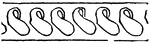
"Also known as the cone, the palm leaf, the river loop, the crown jewel, the seal, the almond, the feather, the boquet, and the flame. There is a vast difference of opinion as to the origin and meaning of this motif. Some authorities claim it was intended for the fir cone, which served as an emblem of immortality and was revered by the ancients; some say it was intended for the palm leaf, which has been handed down by the Greeks as a symbol of victory; others say it was intended to represent a loop which the river Indus makes on a vast plain in upper Cashmere as seen from the Mosque. By some it is said to represent the crown jewels or chief ornament in the old Iranian crown, which is a composite jewel of pear shape. Tradition tells us that the signing of documents in such a manner was a custom well known in the East. This design has also been called the almond, the feather, the bouquet, and the flame on account of its fancied resemblance to these objects. We have selected the name "pear" because the image it conveys is more clearly recognized by the western mind. It is that which its shape most suggests. The Pear design is common in many kinds of rugs, especially in those of Persia and Kurdistan, but it varies greatly in varieties of form and size. The large size is usually employed in the Caucasus and Southern Persia, while the small size is used more frequently in Central and Western Persia. In the Saraband, Shiraz, Herat, Khorasan, and Senna, it frequently covers the whole field. In the two former alternate rows usually have the stems of the pears turned in opposite directions, while in the three latter the stems are usually turned in the same direction."

Pear Design

"Also known as the cone, the palm leaf, the river loop, the crown jewel, the seal, the almond, the feather,…
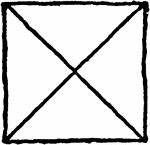
Built on the right angle triangle and, like the Signet of David, it is found in many of the Turkish and Caucasian fabrics and to it scores of patterns may be traced.

Solomon's Seal

Built on the right angle triangle and, like the Signet of David, it is found in many of the Turkish…
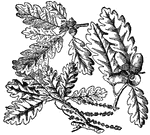
A genus of trees and shrubs widely distributed in the temperate zones of all the continents, but most abundant in North America. They are not common to the tropical regions of South America, Africa, or Australia.

Oak

A genus of trees and shrubs widely distributed in the temperate zones of all the continents, but most…
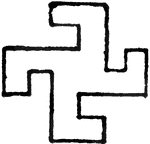
"Derived from the Sanscrit word Svasti, which means good pretence. It dates bck three or four thousand years B.C. and has been found in nearly all excavations of prehistoric times and among the relics of primitive people all over the world. It has been known alike to Ancient Greeks, Egyptians, Chinese, Japanese, East Indians, Aztecs, mound builders, and the North and South American Indians, with all of whom it has a similar meaning, viz., good luck and happiness. In Indian it is drawn below the seats intended for bridegrooms, below the plates containing food to be offered to gods and is tattooed on the arms. It is drawn on the scalp at the thread ceremony and on the dorsum of the feet on all auspicious ceremonies, such as mariages, etc. The usual figure consists of four arms with the cross at right angles and the arms pointing in the direction of motion of a clock's hand, although it has been given different forms, as shown by the accompanying illustrations. It is very commonly used as a rug design, especially in the Chinese, Caucasian, Turkish, and Turkoman products."

Swastika Design

"Derived from the Sanscrit word Svasti, which means good pretence. It dates bck three or four thousand…
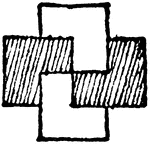
"Derived from the Sanscrit word Svasti, which means good pretence. It dates bck three or four thousand years B.C. and has been found in nearly all excavations of prehistoric times and among the relics of primitive people all over the world. It has been known alike to Ancient Greeks, Egyptians, Chinese, Japanese, East Indians, Aztecs, mound builders, and the North and South American Indians, with all of whom it has a similar meaning, viz., good luck and happiness. In Indian it is drawn below the seats intended for bridegrooms, below the plates containing food to be offered to gods and is tattooed on the arms. It is drawn on the scalp at the thread ceremony and on the dorsum of the feet on all auspicious ceremonies, such as mariages, etc. The usual figure consists of four arms with the cross at right angles and the arms pointing in the direction of motion of a clock's hand, although it has been given different forms, as shown by the accompanying illustrations. It is very commonly used as a rug design, especially in the Chinese, Caucasian, Turkish, and Turkoman products."

Swastika Design

"Derived from the Sanscrit word Svasti, which means good pretence. It dates bck three or four thousand…
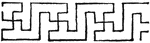
"Derived from the Sanscrit word Svasti, which means good pretence. It dates bck three or four thousand years B.C. and has been found in nearly all excavations of prehistoric times and among the relics of primitive people all over the world. It has been known alike to Ancient Greeks, Egyptians, Chinese, Japanese, East Indians, Aztecs, mound builders, and the North and South American Indians, with all of whom it has a similar meaning, viz., good luck and happiness. In Indian it is drawn below the seats intended for bridegrooms, below the plates containing food to be offered to gods and is tattooed on the arms. It is drawn on the scalp at the thread ceremony and on the dorsum of the feet on all auspicious ceremonies, such as mariages, etc. The usual figure consists of four arms with the cross at right angles and the arms pointing in the direction of motion of a clock's hand, although it has been given different forms, as shown by the accompanying illustrations. It is very commonly used as a rug design, especially in the Chinese, Caucasian, Turkish, and Turkoman products."

Swastika Design

"Derived from the Sanscrit word Svasti, which means good pretence. It dates bck three or four thousand…
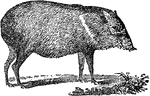
A genus of animals allied to the swine, and found extensively in South America and the southern parts of North America. There are two well known species, the white-lipped

Peccary

A genus of animals allied to the swine, and found extensively in South America and the southern parts…
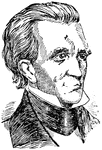
The eleventh President of the United States, serving from March 4, 1845 to March 3, 1849. Polk was born in Mecklenburg county, North Carolina, but mostly lived in and represented state of Tennessee.

James Polk

The eleventh President of the United States, serving from March 4, 1845 to March 3, 1849. Polk was born…
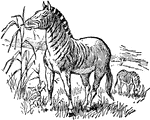
The quagga is an extinct subspecies of the plains zebra, which was once found in great numbers in south Africa's Cape Province and the southern part of the Orange Free State.

Quagga

The quagga is an extinct subspecies of the plains zebra, which was once found in great numbers in south…
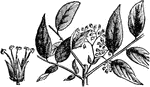
A genus in the family Simaroubaceae. Its size is disputed; some botanists treat it as consisting of only one species, Quassia amara from tropical South America, while others treat it in a wide circumscription as a pantropical genus containing up to 40 species of trees and shrubs.

Quassia

A genus in the family Simaroubaceae. Its size is disputed; some botanists treat it as consisting of…
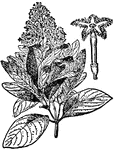
Cinchona is a genus of about 40 species in the family Rubiaceae, native to tropical South America. They are large shrubs or small trees growing 5-15 metres tall with evergreen foliage.

Cinchona

Cinchona is a genus of about 40 species in the family Rubiaceae, native to tropical South America. They…
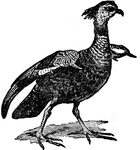
A class of wading birds native to South America. In habits they resemble somewhat the duck, but do not have webbed feet.

Screamer

A class of wading birds native to South America. In habits they resemble somewhat the duck, but do not…
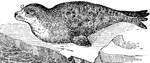
The general name of certain genera of carnivorous mammals, havin feet adapted for swimming, and being able to live both in and out of water.

Seal

The general name of certain genera of carnivorous mammals, havin feet adapted for swimming, and being…
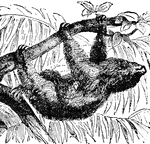
A genus of mammals belonging to the bear family. They are native to Central and South America. These animals are peculiar for their long claws, which turn toward the body, thus making it difficult to move on the ground, but they pass to and fro with remarkable favility on the limbs of trees.

Sloth

A genus of mammals belonging to the bear family. They are native to Central and South America. These…
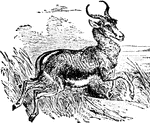
A species of antelope which resembles the gazelles in size and habits. It is native to the open plains of South Africa.

Springbok

A species of antelope which resembles the gazelles in size and habits. It is native to the open plains…