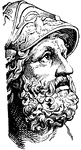
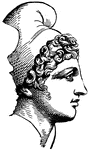
Ancient Greek Mythology. King of Troy that fought to win his wife Helen back.

Menelaus

Ancient Greek Mythology. King of Troy that fought to win his wife Helen back.

Ancient Greek Mythology. Paris begins the Trojan War by kidnapping Helen of Troy, the most beautiful woman in the world.

Paris

Ancient Greek Mythology. Paris begins the Trojan War by kidnapping Helen of Troy, the most beautiful…
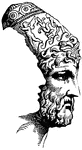
Greek Mythology

Achilles

Greek Mythology

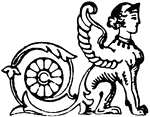
Sphinx

Sphinx

Sphinx

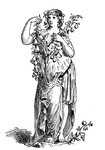
Roman goddess of fruit trees.

Pomona

Roman goddess of fruit trees.

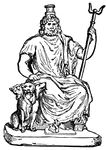
Roman goddess of the underworld.

Pluto

Roman goddess of the underworld.

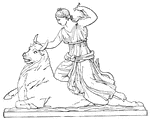
Europa and Zeus in the form of a bull.

Europa

Europa and Zeus in the form of a bull.

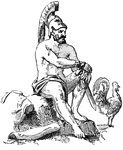
God of War

Mars

God of War

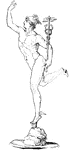
God of trade and profit.

Mercury

God of trade and profit.

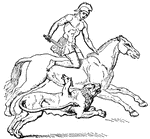
Bellerophon and the Chimera

Bellerophon and the Chimera

Bellerophon and the Chimera

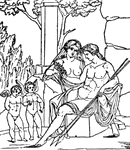
Adonis was loved by Venus. When he was killed by a wild boar while hunting, Venus changed his blood into flowers.

Adonis and Venus

Adonis was loved by Venus. When he was killed by a wild boar while hunting, Venus changed his blood…
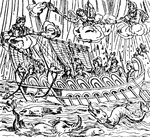
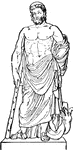
Trojan prince, son of Anchises and the goddess Venus.

Aeneas in a storm.

Trojan prince, son of Anchises and the goddess Venus.

Greek god of medicine, the son of Apollo and the nymph Coronis.

Aesculapius

Greek god of medicine, the son of Apollo and the nymph Coronis.

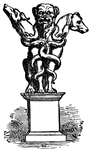
Bronze statue of the three-headed dog of ancient mythology.

Cerebrus

Bronze statue of the three-headed dog of ancient mythology.

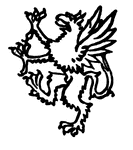
The griffon is a mythological creature with a lions body and head and wings of an eagle.

Griffon

The griffon is a mythological creature with a lions body and head and wings of an eagle.

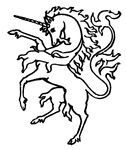
The unicorn is a mythological creature usually depicted as a white horse with a slender horn atop its head.

Unicorn

The unicorn is a mythological creature usually depicted as a white horse with a slender horn atop its…
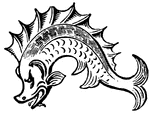
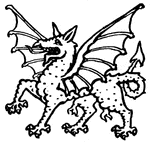
Dolphin borrowed from mythology.

Dolphin

Dolphin borrowed from mythology.

The mythological Dragon.

Dragon

The mythological Dragon.

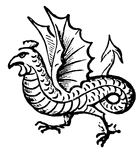
The mythological cockatrice.

Cockatrice

The mythological cockatrice.

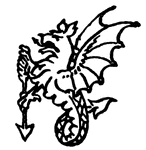
The mythological wyvern.

Wyvern

The mythological wyvern.

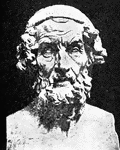
"Homer. Of all the writings that describe this Heroic Age, the most important are the two great narrative poems,- the <em>Illiad</em> and the <em>Odyssey</em>, -attributed to Homer."&mdash;Colby, 1899

Homer

"Homer. Of all the writings that describe this Heroic Age, the most important are the two great narrative…
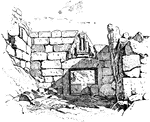
"Gate of Mycenae, the City of Agamemnon."—Colby, 1899

Gate of Mycenae

"Gate of Mycenae, the City of Agamemnon."—Colby, 1899

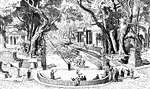
"The race course at Sparta."&mdash;Colby, 1899

Race Course

"The race course at Sparta."—Colby, 1899

"The chief credit of the battle of Marathon belongs to Miltiades. But for his courage, the Athenians would have shut themselves up in their city and stood a siege; and it was the stimulus of his heroism that nerved his little army to the victory of Marathon. And the people of Athens fully appreciated what he had done. No man was more popular in the city and none had more honors bestowed upon him. His greatness, however, was of the sort that only great crises call forth. When peace returned, he showed himself selfish and even dishonorable. Securing an armament from the city under false representations, he used it to gratify a private grudge against the people of Paros. He laid siege to their capital, was unsuccessful, and returned in disgrace. He was put on trial, convicted, and fined, but died a few days afterwards."&mdash;Colby, 1899

Miltiades

"The chief credit of the battle of Marathon belongs to Miltiades. But for his courage, the Athenians…
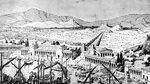
"The Piraeus or Harbor of Athens."&mdash;Colby, 1899

Athens Harbor

"The Piraeus or Harbor of Athens."—Colby, 1899

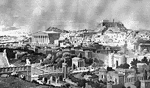
"Athens, in the time of Pericles."&mdash;Colby, 1899

Athens

"Athens, in the time of Pericles."—Colby, 1899

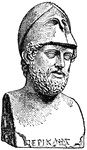
"The Age of Pericles. The interval of about fifty years between the close of the Persian and the beginning of the Peloponnesian war has been called the Age of Pericles, -a somewhat misleading term, as Pericles was at the head of Athenian affairs for only twenty years (449-429 B.C.). But he was the most brilliant statesman that Athens produced during that period, and his work is so closely indentified with the greatness of the city that it is not strange that his name has been given to the period."&mdash;Colby, 1899

Pericles

"The Age of Pericles. The interval of about fifty years between the close of the Persian and the beginning…
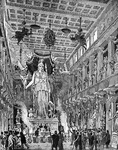
Inside of the Parthenon

Parthenon

Inside of the Parthenon

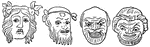
Comic Masks

Masks

Comic Masks

Alcibiades was one of the political leaders in Athens during the Peloponnesian War.

Alcibiades

Alcibiades was one of the political leaders in Athens during the Peloponnesian War.

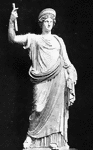
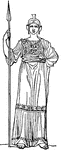
Hera (Juno), a greek goddess.

Hera

Hera (Juno), a greek goddess.

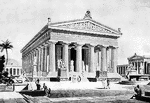
A Grecian Temple

Grecian Temple

A Grecian Temple

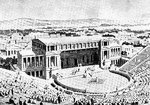
A Greek Theater, Athens.

Greek Theatre

A Greek Theater, Athens.

"signifies, literally, a goat skin. According to ancient mythology, the aegis worn by Jupiter was the hide of the goat Amaltheia, which had suckled him in his infancy. Homer always represents it as part of the armour of Jupiter, whom on this account he distinguishes by the epithet aegis-bearing. He, however, asserts, that it was borrowed on different occasions, both by Apollo and Minerva. The aegis was connected with the shield of Jupiter, either serving as a covering over it, or as a belt by which it was suspended from the right shoulder. Homer accordingly uses the word to denote not only the goat-skin, which it properly signified, but also the shield to which it belonged. The aegis was aorned in a style corresponding to the might and majesty of the father of the gods. In the middle of it was fixed the appalling Gorgon's head, and its border was surrounded with golden tassels, each of which was worth a hecatomb. The aegis is usually seen on the statues of Minerva, in which it is a sort of scarf falling obliquely over the right shoulder, so as to pass round the body under the left arm. The serpents of the Gorgon's head are transferred to the border of the skin. The later poets and artists represent the aegis as breastplate covered with metal in the form of scales." &mdash; Smith, 1873

Aegis

"signifies, literally, a goat skin. According to ancient mythology, the aegis worn by Jupiter was the…
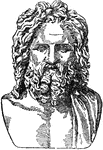
"Zeus of Otricoli. (Marble bust in the Vatican.)" &mdash; The Delphian Society, 1913

Zeus

"Zeus of Otricoli. (Marble bust in the Vatican.)" — The Delphian Society, 1913

"The enrollment of a mortal among the gods. The mythology of Greece contains numerous instances of the deification of mortals; but in the republican times of Greece we find few examples of such deification. The inhabitants of Amphipolis, however, offered sacrifices to Brasidas after his death. In the Greek kingdoms, which arose in the East of the dismemberment of the empire of Alexander, it appears to have been not uncommon for the successor to the throne to offer divine honours to the former sovereign. Such an apotheosis of Ptolemy, king of Egypt, is described by Theocritus in his 17th Idyl" &mdash; Smith, 1873

Apotheosis

"The enrollment of a mortal among the gods. The mythology of Greece contains numerous instances of the…
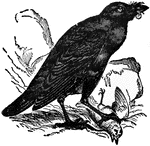
"The Raven is a large bird of the crow family. The raven has played an important part in mythology and folk-lore. It is the first bird mentioned by name in the Old Testament; by the ministry of ravens Elijah was fed, and they were to be the ministers of vengeance on unruly children. The raven was the bird of Odin, and in classic mythology was of ill-omen, a character often attributed to it by the early English dramatists. Marlowe calls it the 'sad presageful raven.' and Shakespeare repeatedly refers to the belief that its appearance foreboded misfortune. This belief, which is widespread, probably arose from the preternaturally grave manner of the bird, its sable plumage, and the readiness with which it learns to imitate human speech."&mdash;(Charles Leonard-Stuart, 1911)

Raven

"The Raven is a large bird of the crow family. The raven has played an important part in mythology and…
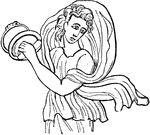
"A musical instrument, in the shape of two half globes, which were held one in each hand of the performer, and played by being struck against each other. The cymbal was a very ancient instrument, being used in the worship of Cybele, Bacchus, Juno, and all the earlier deities of the Grecian and Roman mythology. It probably came from the east. for sistrum, which some have regerred to the class of cymbala." &mdash; Smith, 1873.

Cymbalum

"A musical instrument, in the shape of two half globes, which were held one in each hand of the performer,…
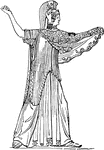
"According to ancient mythology, the aegis worn by Jupiter was the hide of the goat Amalthea, which has suckled him in his infancy. The following represents Minerva with the aegis." &mdash; Anthon, 1891

Minerva with aegis

"According to ancient mythology, the aegis worn by Jupiter was the hide of the goat Amalthea, which…
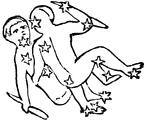
"The third sign of the zodiac, so named from its 2 brightest stars, Castor, of the 1st magnitude, farthest to the west, and Pollux of the 2d, farthest to the east. Its constitutent stars form a binary system revolving in about 250 years. The sun is in G. from about May 21st, till about June 21st." &mdash; Williams, 1889

Gemini

"The third sign of the zodiac, so named from its 2 brightest stars, Castor, of the 1st magnitude, farthest…
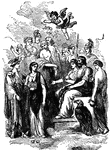
"Epimetheus had in his house a jar in which were kept certain noxious articles, for which, in fitting man for his new abode, he had had no occaision. Pandora was seized with an eager curiosity to know what this jar contained; and one day she slipped off the cover and looked in." &mdash;Bulfinch, 1897

Pandora

"Epimetheus had in his house a jar in which were kept certain noxious articles, for which, in fitting…
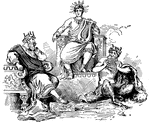
"Bacchus offered Midas his choice of a reward, whatever he might wish. He asked that whatever he might touch should be changed into gold." &mdash;Bulfinch, 1897

Midas

"Bacchus offered Midas his choice of a reward, whatever he might wish. He asked that whatever he might…
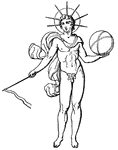
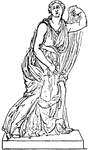
"Helios the Sun-God." &mdash;Bulfinch, 1897

Helios

"Helios the Sun-God." —Bulfinch, 1897

A personage mentioned in Greek mythology as the daughter of Tantalus and the wife of Amphion, king of Thebes, and that she incurred the displeasure of Apollo.

Niobe

A personage mentioned in Greek mythology as the daughter of Tantalus and the wife of Amphion, king of…
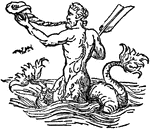
In Greek mythology, the only son of Poseidon, who is described as one of the minor sea gods. He was represented as an attendant of his father, usually mounted on a sea monster, and holding in his hand a conch-shell trumpet.

Triton

In Greek mythology, the only son of Poseidon, who is described as one of the minor sea gods. He was…
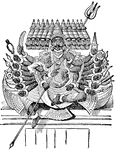
In Hindu mythology, Ravana is the principal antagonist of the Hindu epic, the Ramayan. According to Ramayana, he was a king of Lanka many thousands of years ago.

Ravana

In Hindu mythology, Ravana is the principal antagonist of the Hindu epic, the Ramayan. According to…
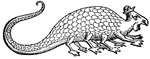
A legendary reptile reputed to be king of serpents and said to have power of causing death by a single glance.

Basilisk

A legendary reptile reputed to be king of serpents and said to have power of causing death by a single…
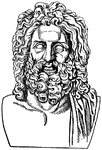
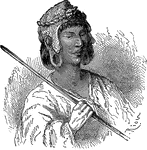
The leader of all the other gods in Greek mythology. He is the god of the sky and thunder.

Zeus

The leader of all the other gods in Greek mythology. He is the god of the sky and thunder.

An Inca Manco Capac, the first king of the Kingdom of Cuzco, according to Inca mythology.

Manco Capac

An Inca Manco Capac, the first king of the Kingdom of Cuzco, according to Inca mythology.
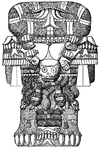
Stone statue of Teoyaomiqui, a god of the Aztec mythology.

Teoyaomiqui

Stone statue of Teoyaomiqui, a god of the Aztec mythology.

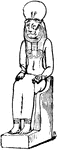
The feline war gods in Egyptian mythology.

Pakhet

The feline war gods in Egyptian mythology.

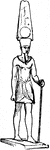
A diety in Egyptian mythology.

Amen Ra

A diety in Egyptian mythology.

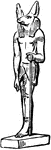
The god of the underworld in ancient Egyptian mythology.

Anubis

The god of the underworld in ancient Egyptian mythology.

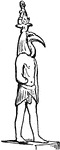
The god of the moon in ancient Egyptian mythology.

Thoth

The god of the moon in ancient Egyptian mythology.

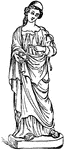
"In the classical mythology, the goddess of Health- the daughter of Aesculapius. She was worshipped at Athens, Corinth, Argos, and other important cities, and in works of art is usually represented as a blooming virgin, with a snake, the symbol of health, which drinks from a cup held in her hand." &mdash; Chambers, 1881

Hygieia

"In the classical mythology, the goddess of Health- the daughter of Aesculapius. She was worshipped…
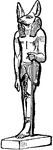
"An Egyptian deity, styled Anepu on hieroglyphic monuments, was, according to mythology, the son of Osiris and Nephthys. By the Greeks, he was frequently styled Hermes or Hermanubis, combining the Egyptian with the Grecian name. He is represented on monuments as having the head of a jackal, with pointed ears and snout, which the Greeks frequently changed to those of a dog." &mdash; Chambers' Encyclopedia, 1875

Anubus

"An Egyptian deity, styled Anepu on hieroglyphic monuments, was, according to mythology, the son of…
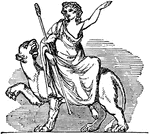
"The god of wine, was the son of Zeus and Semele, the daughter of Cadmus. Before his birth, Semele fell a victim to the insidious counsels of the jealous Here, who induced her to petition Zeus to visit her in his proper form and majesty." &mdash; Chambers' Encyclopedia, 1875

Bacchus

"The god of wine, was the son of Zeus and Semele, the daughter of Cadmus. Before his birth, Semele fell…
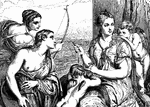
This painting, by Tistian, is of a Roman story. The painting can now be found hanging in the Borghese Palace in Rome, Italy.

Cupid Equipped by Venus

This painting, by Tistian, is of a Roman story. The painting can now be found hanging in the Borghese…
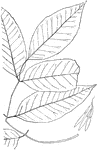
Leaves - compound (odd-feathered; leaflets, seven to nine); opposite; edge of leaflets slightly toothed or entire; entire at base. Outline - of leaflet, long oval or long egg-shape. Apex - taper-pointed. Base - somewhat pointed. Leaf/Stem - smooth. Leaflet/Stem - about one fourth of an inch long, or more; smooth. Leaf/Bud - rusty-colored and smooth. Leaflet - two to six inches long; pale beneath; downy when young, but becoming nearly smooth, except on the ribs. Bark - of the trunk, light gray. In very young trees it is nearly smooth, but it soon becomes deeply furrowed - the furrows crossing each other, and so breaking the bark into irregular, somewhat square or lozenge-shaped plates. Then in very old trees it becomes smooth again, from the scaling off of the plates. The branches are smooth and grayish-green. The young shoots have a polished, deep-green bark, marked with white lines or dots. Winged seeds - one and a half to two inches long, with the "wing" about one fourth of an inch wide, hanging in loose clusters from slender stems. The base of the seed it pointed and not winged. Found - in rich woods, from Southern Canada to Northern Florida and westward. It is most common in the Northern States. The finest specimens are seen in the bottom lands of the lower Ohio River basin. General Information - a tree forty to eighty feet high. Often the trunk rises forty feet without branching. Its tough and elastic timer is of very great value, being widely used in the manufacture of agricultural implements, for oars, and the shafts of carriages, and in cabinet-work. Fraxinus from a Greek word meaning "separation," because of the ease with which the wood of the Ash can be split. I find in the notes of an old copy of White's "Natural History of Selborne" this comment: "The Ash, I think, has been termed by Gilpin the Venus of British trees." Gerardes' "Herbal" comments: "The leaves of the Ash are of so great a vertue against serpents, as that the serpents dare not be so bolde as to touch the morning and evening shadowes of the tree, but shunneth them afarre off, as Pliny reporteth in his 16 book, 13 chap. He also affirmeth that the serpent being penned in with boughes laide rounde about, will sooner run into the fire, if any be there, than come neere to the boughes of the Ash."In Scandinavian mythology the great and sacred tree, Yggdrasil, the greatest and most sacred of all trees, which binds together heaven and earth and hell, is an Ash. Its roots spread over the whole earth. Its branches reach above the heavens. Underneath lies a serpent; above is an eagle; a squirrel runs up and down the trunk, trying to breed strife between them.

Genus Fraxinus, L. (Ash)

Leaves - compound (odd-feathered; leaflets, seven to nine); opposite; edge of leaflets slightly toothed…
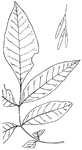
Leaves - compound (odd-feathered; leaflets, seven to nine); edge of leaflets nearly entire or slightly toothed. Outline - of leaflet, long oval or egg-shape. Apex - taper-pointed. Base - somewhat pointed. Leaf/Stem - velvety-downy. Leaflet/Stem - about one fourth of an inch long, or somewhat less, and velvety-downy. Leaf/Bud - rounded, nearly concealed by the leaf-stem, downy, and of a dark, rusty brown. Leaflet - two to six inches long, downy beneath, and pale, becoming reddish. Bark - of the trunk, dark ashy or granite-gray, or of a deep brown. It is slightly furrowed up and does, the furrows seldom joining or crossing. The branches are grayish. The young shoots are velvety, with a grayish or rusty down. Winged seeds - resembling those of the White Ash, but usually with the end of the wing more rounded. Found - along borders of streams and in low and swampy ground - New Brunswick to Minnesota, and southward to Northern Florida and Alabama; but rare west of the Alleghany Mountains. Its finest growth is in the Northern Atlantic States. General Information - A medium-sized tree, usually thirty to fifty feet high, of less value than the White Ash. Fraxinus from a Greek word meaning "separation," because of the ease with which the wood of the Ash can be split. I find in the notes of an old copy of White's "Natural History of Selborne" this comment: "The Ash, I think, has been termed by Gilpin the Venus of British trees." Gerardes' "Herbal" comments: "The leaves of the Ash are of so great a vertue against serpents, as that the serpents dare not be so bolde as to touch the morning and evening shadowes of the tree, but shunneth them afarre off, as Pliny reporteth in his 16 book, 13 chap. He also affirmeth that the serpent being penned in with boughes laide rounde about, will sooner run into the fire, if any be there, than come neere to the boughes of the Ash."In Scandinavian mythology the great and sacred tree, Yggdrasil, the greatest and most sacred of all trees, which binds together heaven and earth and hell, is an Ash. Its roots spread over the whole earth. Its branches reach above the heavens. Underneath lies a serpent; above is an eagle; a squirrel runs up and down the trunk, trying to breed strife between them.

Genus Fraxinus, L. (Ash)

Leaves - compound (odd-feathered; leaflets, seven to nine); edge of leaflets nearly entire or slightly…