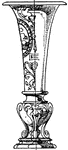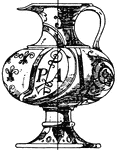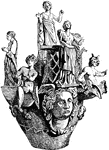
"Italo-Greek vase in the Campana Collection, Louvre Museum."-Whitney, 1902

Affixes

"Italo-Greek vase in the Campana Collection, Louvre Museum."-Whitney, 1902

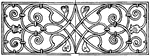
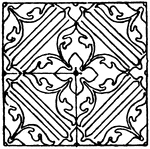
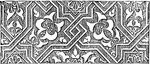
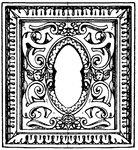
A decorative implement for flat surfaces

Arabesque

A decorative implement for flat surfaces

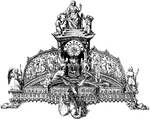
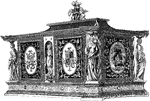
This jewelry box is designed in a Cinquecento (Italian 16th century) style in bronze, gilt and silver. At the top of the box are two cupids bearing the royal crown which is surmounted by the British Lion. The box is designed with medallions of the royal coat of arms, surrounded by wreaths of laurel. The angles of the box are figures of caryatides which are sculpted female figures serving as pillars or supports.

Jewelry Box

This jewelry box is designed in a Cinquecento (Italian 16th century) style in bronze, gilt and silver.…

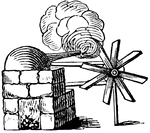
"In 1629 Giovanni Branca, an Italian, contrived a machine which was employed for the various purposes of raising water, of sawing timber and pounding materials. His machine consisted of a wheel furnished with flat vanes around its circumference, like the boards of a paddle-wheel. Upon these vanes, steam was propelled from a close vessel, called an eolipile. A rotary motion was produced, and communicated to appropriate machinery. The results, however, of these and other discoveries made about this period, have never been rendered applicable to the purposes for which the modern steam engine is adapted." —Comstock, 1850

Brancas Engine

"In 1629 Giovanni Branca, an Italian, contrived a machine which was employed for the various purposes…

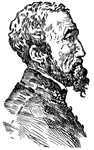
Distinguished Italian painter, sculptor, architect, and poet.

Michael Angelo Buonarroti

Distinguished Italian painter, sculptor, architect, and poet.

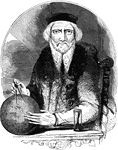
Sebastian Cabot (c. 1484 - c. 1557) was an Italian explorer, probably born in Venice.

Sebastian Cabot

Sebastian Cabot (c. 1484 - c. 1557) was an Italian explorer, probably born in Venice.

An Italian explorer.

Sebastian Cabot

An Italian explorer.

A leading figure in the movement toward Italian unification. He was also the first Prime Minister of Italy.

Count Cavour

A leading figure in the movement toward Italian unification. He was also the first Prime Minister of…

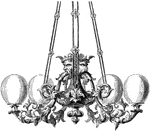
This gas chandelier is an Italian design with scrolls and grotesque marks (strange design).

Gas Chandelier

This gas chandelier is an Italian design with scrolls and grotesque marks (strange design).

A famous Italian painter and creator of mosaics in the 13th century.

Cimabue

A famous Italian painter and creator of mosaics in the 13th century.

Italian painter, from Florence.

Giovanni Cimabue

Italian painter, from Florence.

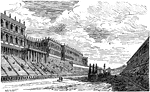
"Chariot-racing was a favorite amusement, and the great circuses were arranged especially for such contests. The space was broad enough to accommodate three of four chariots side by side, each with four horses abreast."—Ridpath, 1885

Circus Maximus

"Chariot-racing was a favorite amusement, and the great circuses were arranged especially for such contests.…

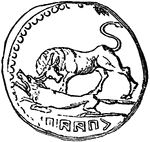
An illustration of a coin from the Italian Confederacy.

Coin of the Italian Confederacy

An illustration of a coin from the Italian Confederacy.

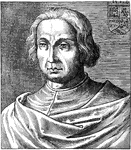
An Italian explorer whose voyages across the Atlantic Ocean led to general European awareness of the American continents.

Christopher Columbus

An Italian explorer whose voyages across the Atlantic Ocean led to general European awareness of the…

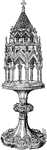
"Monstrance of Copper Gilt; Italian work of the 15th century." —The Encyclopedia Britannica, 1903

Copper Gilt

"Monstrance of Copper Gilt; Italian work of the 15th century." —The Encyclopedia Britannica, 1903

An Italian politician who was instrumental in the formation of the united country.

Francesco Crispi

An Italian politician who was instrumental in the formation of the united country.

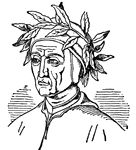
Famous Italian poet

Alighieri Dante

Famous Italian poet

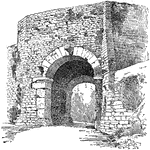
"The Italian city of Volterra still preserves in the Porta dell' Arco an interesting relic of Ertuscan times. The archway, one of the original gates of the ancient town, is about twenty feet in height and twelve feet in width. On the keystone and imposts are three curious heads, probably representing the guardian deities of the place."—Webster, 1913

An Ertuscan Arch

"The Italian city of Volterra still preserves in the Porta dell' Arco an interesting relic of Ertuscan…

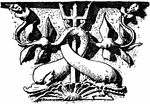
The Dolphin Frieze was found in St. Maria dell Anima, Rome from 1500 to 1514.

Dolphin Frieze

The Dolphin Frieze was found in St. Maria dell Anima, Rome from 1500 to 1514.

An Italian military and political figure.

Garibaldi

An Italian military and political figure.

(1807-1882) Italian Patriot that helped reinstate the kingdom of Italy

Giuseppe Garibaldi

(1807-1882) Italian Patriot that helped reinstate the kingdom of Italy

This inkstand is designed in a Cinquecento (Italian 16th century) style. It is made of part gold, part silver, gilt and enamel. There is a bird in the front that is attacking a dragon. The groups of figures in the back signify moral Christian Virtues and domestic scenes.

Inkstand

This inkstand is designed in a Cinquecento (Italian 16th century) style. It is made of part gold, part…

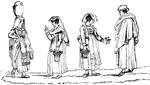
Four people in Italian costume of the 1800's.

Italian

Four people in Italian costume of the 1800's.

Italian girl doll in traditional national costume.

Italian doll

Italian girl doll in traditional national costume.

Mark Twain reading the daily Italian newspaper to learn how to speak Italian.

Italian Without a Master

Mark Twain reading the daily Italian newspaper to learn how to speak Italian.

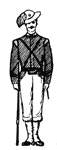
Italian soldier, 1901

Italy: soldier 1901

Italian soldier, 1901

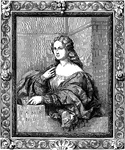
The portait is of a woman that the artist, Tiziano was in love with. It can now be found in the Sciarra Palace in Rome, Italy.

La Bella Di Tiziano

The portait is of a woman that the artist, Tiziano was in love with. It can now be found in the Sciarra…

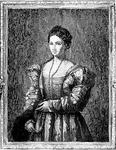
This painting, by Titian, is of the Dutches of Urbino. The painting can now be found hanging in the Pitti Palace in Florence, Italy.

La Donna

This painting, by Titian, is of the Dutches of Urbino. The painting can now be found hanging in the…

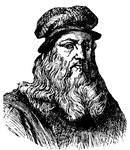
(1452-1519) Italian painter

Leonardo Da Vinci

(1452-1519) Italian painter

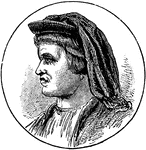
Lorenzo de' Medici (January 1, 1449 – 9 April 1492) was an Italian statesman and de facto ruler of the Florentine Republic during the Italian Renaissance. Known as Lorenzo the Magnificent by contemporary Florentines, he was a diplomat, politician and patron of scholars, artists, and poets. His life coincided with the high point of the early Italian Renaissance; his death marked the end of the Golden Age of Florence. The fragile peace he helped maintain between the various Italian states collapsed with his death; two years later the French invasion of 1494 began and led to nearly 400 years of foreign occupation of the Italian peninsula.

Lorenzo de' Medici

Lorenzo de' Medici (January 1, 1449 – 9 April 1492) was an Italian statesman and de facto ruler of…

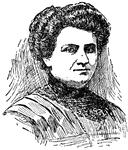
(1870-1952) Italian doctor and educator best known for the development of the Montessori method of education.

Maria Montessorri

(1870-1952) Italian doctor and educator best known for the development of the Montessori method of education.

Maiolica designates Italian tin-glazed pottery dating from the Renaissance.The name is thought to come from the medieval Italian word for Majorca, an island on the route for ships bringing Hispano-Moresque wares from Valencia to Italy. Moorish potters from Majorca are reputed to have worked in Sicily and it has been suggested that their wares reached the Italian mainland from Caltagirone.

Maiolica Pottery

Maiolica designates Italian tin-glazed pottery dating from the Renaissance. The name is thought to come…

(1483-1520) Italian painter

Raphael Sanzio

(1483-1520) Italian painter

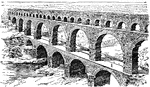
"The Pont du Gard near Nimes (ancient Nemausus) in southern France. Built by the emperor Antoninus Pius. The bridge spans two hilltops nearly a thousand feet apart. It carries an aqueduct with three tiers of massive stone arches at a height of 160 feet above the stream. This is the finest and best preserved aqueduct in existence."—Webster, 1913

A Roman Aqueduct

"The Pont du Gard near Nimes (ancient Nemausus) in southern France. Built by the emperor Antoninus Pius.…

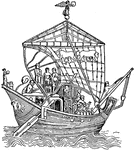
"This ship lies besides the wharf at Ostia. In the afterpart of the vessel is a cabin with two windows. Notice the figure of Victory on the top of the single mast and the decoration of the mainsail with the wolf and twins. The ship is steered by a pair of huge paddles."—Webster, 1913

A Roman Freight Ship

"This ship lies besides the wharf at Ostia. In the afterpart of the vessel is a cabin with two windows.…

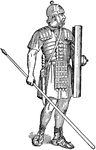
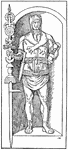
"From a monument of the imperial age. The soldier wears a metal helmet, a leather doublet with shoulder-pieces, a metal-plated belt, and a sword hanging from a strap thrown over the left shoulder. His left hand holds a large shield, his right, a heavy javelin."—Webster, 1913

A Roman Legionary

"From a monument of the imperial age. The soldier wears a metal helmet, a leather doublet with shoulder-pieces,…

"From a gravestone of the first century A.D. The standard consists of a spear crowned with a wreath, below which is a crossbar bearing pendant acorns. Then follow, in order, a metal disk. Jupiter's eagle standing on a thunderbolt, a crescent moon, an amulet, and a large tassel."—Webster, 1913

A Roman Standard Bearer

"From a gravestone of the first century A.D. The standard consists of a spear crowned with a wreath,…

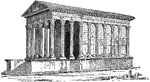
"The best preserved of Roman temples. Located at Nimes in southern France, where it is known as La Maison Carree ("the square house"). The structure is now used as a museum of antiquities."—Webster, 1913

A Roman Temple

"The best preserved of Roman temples. Located at Nimes in southern France, where it is known as La Maison…

The Italian rosette is a renaissance design made of five divisions. It is found on the door of the baptistery in Parma, Italy.

Italian Rosette

The Italian rosette is a renaissance design made of five divisions. It is found on the door of the baptistery…

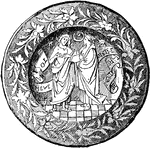
This piece, by Donatello, is a Bas-relief or sculpture of Saint Cecilia. It is now in he posession of Lord Elcho.

Saint Cecilia

This piece, by Donatello, is a Bas-relief or sculpture of Saint Cecilia. It is now in he posession of…

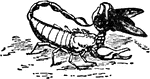
"Drawing from tlife of the Italian scorpion Euscorpius italicus, Herbst, holding a blue-bottle fly with its left chela, and carefully piercing it between head and thorax with its string. Two insertions of the string are effected and the fly is instantly paralysed by the poison so introduced into its body." — The Encyclopedia Britannica, 1910

Scorpion

"Drawing from tlife of the Italian scorpion Euscorpius italicus, Herbst, holding a blue-bottle fly with…

This female sculpture represents a soul ascending to heaven. It was sculpted by Milanese sculptor Sangiorgio.

Female Sculpture

This female sculpture represents a soul ascending to heaven. It was sculpted by Milanese sculptor Sangiorgio.

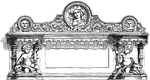
This side-board is made out of mahogany, traditionally used in the dining room for serving food. It has an Italian design that shows a young Bacchus (Greek God of wine) with a lion on each side. In the center of the back piece is a medallion of a Bacchante (female follower of Bacchus), and at each corner is one of a Bacchanal (festivities). The remainder of this piece is filled with wreaths of the grape-vine and its fruit.

Side-Board

This side-board is made out of mahogany, traditionally used in the dining room for serving food. It…

"A runaway slave, if recaptured, was sometimes compelled to wear a metal collar riveted about his neck."—Webster, 1913

A Slave's Collar

"A runaway slave, if recaptured, was sometimes compelled to wear a metal collar riveted about his neck."—Webster,…

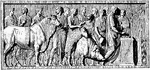
"The relief pictures an ancient Italian sacrifice of a bull, a ram, and a boar, offered to Mars to secure purification from sin. Note the sacred laurel trees, the two altars, and the officiating magistrate, whose head is covered with the toga. He is sprinkling incense from a box held by an attendant. Another attendant carries a ewer with the libation. In the rear is the sacrificer with his ax."—Webster, 1913

Suovetaurilia

"The relief pictures an ancient Italian sacrifice of a bull, a ram, and a boar, offered to Mars to secure…

The Lion supporting shield is also called "il Marzocco" in Italian. It is a sculpture designed by Donatello in Florence, Italy during the 15th century.

Lion Supporting Shield

The Lion supporting shield is also called "il Marzocco" in Italian. It is a sculpture designed by Donatello…

"A relief from the Column of Trajan, Rome. The name testudo, a tortoise (shell), was applied to the covering made by a body of soldiers who placed their shields over their heads. The shields fitted so closely together that men could walk on them and even horses and chariots could be driven over them."—Webster, 1913

A Testudo

"A relief from the Column of Trajan, Rome. The name testudo, a tortoise (shell), was applied to the…

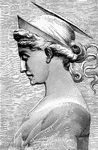
Emperor of Rome from 14 to 37 A.D.

Tiberius

Emperor of Rome from 14 to 37 A.D.

(1512-1574) Italian painter and architect. Wrote <I>Lives of the Most Excellent Painters, Sculptors, and Architects.</em>

Sir Henry (Harry) VaneGiorgio Vasari

(1512-1574) Italian painter and architect. Wrote Lives of the Most Excellent Painters, Sculptors, and…

An illustration for a 17th century Italian vase decorated with a floral pattern.

17th Century Italian Floral Vase

An illustration for a 17th century Italian vase decorated with a floral pattern.

Venice: House of Gold

Venice: House of Gold

Venice: House of Gold

Italian composer

Giuseppe Verdi

Italian composer

(1528-1588) Italian painter of the Venitian school

Paul (Paulo) Veronese

(1528-1588) Italian painter of the Venitian school

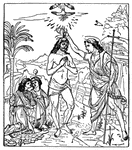
<em>Baptism of Christ</em> by Andrea del Verrocchio, Italian painter (1435-1488)

Verrocchio, Baptism of Christ

Baptism of Christ by Andrea del Verrocchio, Italian painter (1435-1488)
Italian painter (1435-1488)

Andrea del Verrocchio

Italian painter (1435-1488)

An Italian explorer and cartographer.

Americus Vespicius

An Italian explorer and cartographer.

(1451-1512) Italian explorer, explored the coast of Venezuela

Amerigo Vespucci

(1451-1512) Italian explorer, explored the coast of Venezuela

(1451-1512) Italian explorer, explored the coast of Venezuela

Amerigo Vespucci

(1451-1512) Italian explorer, explored the coast of Venezuela

The King of Italy from 1861 to 1878.

Victor Emmanuel II

The King of Italy from 1861 to 1878.

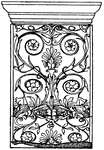
The Renaissance Ornament Vine was used as a design on an Italian pilaster.

Renaissance Ornament Vine

The Renaissance Ornament Vine was used as a design on an Italian pilaster.