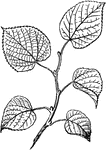

Apex of Leaves
From left to right: Acuminate, Acute, Obtuse, Truncate, Retuse, Emarginate, Obcordate, Cuspidate, Mucronate.
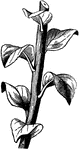
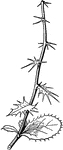
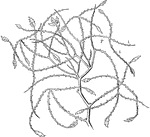
Australian Blackberry Leaves
"Xerophytic leaves of the Australian blackberry. l, leaflets reduced in many cases to bare midrobs,…

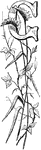
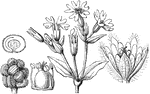
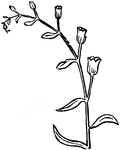
Red Campion
Silene dioica or the red campion was once known as Lychnis diurna and is a member of the Caryophyllaceae…
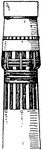
Egyptian Capital
This Egyptian capital is the upper termination of the column with cinctured bundles of papyrus stems.
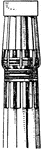
Egyptian Capital
This Egyptian capital is the upper termination of the column with cinctured bundles of papyrus stems.…
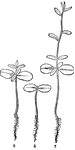
Early Flax Seedling
Growth of Flax seedling from a stem with two leaves and a bud, to a stem with several leaves and stem…
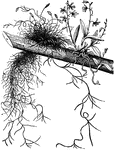
Epiphytes of Florida and Georgia
Epidendrum conopseum, a small Orchid, and Tillandsia usneoides, the so-called Long Moss or Black Moss,…
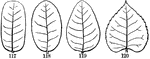
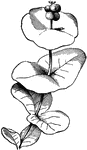
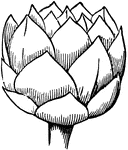
Houseleek
A young plant of the Houseleek, with the leaves (not yet expanded) numbered, and exhibiting the 13-ranked…
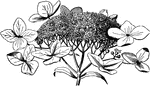
Hydrangea arborscens
Compound cyme of Hydrangea arborescens, with neutral enlarged flowers round the circumference.


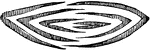
Juncus Conglomeratus
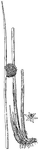
Juncus conglomeratus, also known as the common rush, belongs to a genus of grass-like herbs (Juncus)…
Low Sweet Buckeye
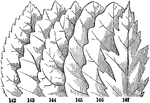
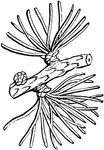
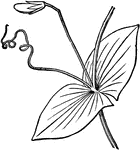
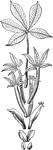
Series of bud-scales and foliage-leaves from a developing bud of the Low Sweet Buckeye, showing nearly…
End of Maple Root
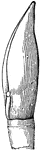
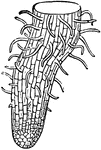
Lower end of Maple root magnified, the root seen just as root-hairs are beginning to for a little behind…
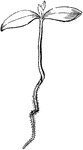
Maple Seedling
Seedling Maple, of the natural size; the root well supplied with root hairs, here large enough to be…
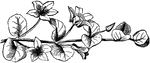
Moneywort
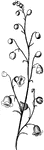
Piece of a flowering-stem of Moneywort with single flower successively produced in the axils of the…
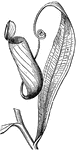
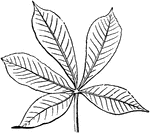
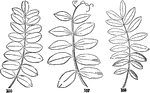
Pinnate Leaves
From left to right: Pinnate with odd leaflet, Pinnate with a tendril in place, Pinnate with even pairs.
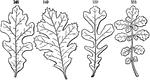
Pinnately Leaves
From left to right: pinnately lobed, pinnately cleft, pinnately parted, pinnately divided.

Pitch Pine
Piece of a branch of Pitch Pine, with three leaves in a fascicle or bundle, in the axial of a thin scale,…
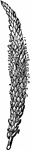
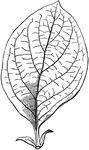
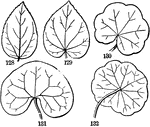
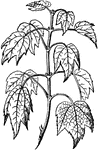

Red-Maple branch
Red-Maple branch, with accessory buds placed side by side. The annular lines toward the base are scars…
Scammony
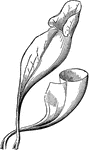
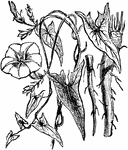
The scammony (Convolvulus scammonia) is a flowering plant of the bindweed family. R, the root.

Shoot of Lilac
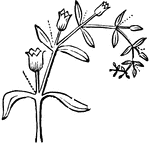
Shoot of Lilac, with winter buds; the two uppermost auxiliary ones strong; the terminal not developed.
Simple cyme
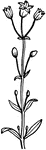
Diagram of a simple cyme in which the axis lengthens, so as to take the form of a raceme.
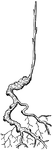
Seneca Snakeroot - Roots and Base of the Stem
"Polygala senega of eastern North America. It sends up several stems from hard knotty root-stocks, bearing…