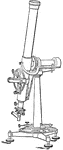
"The instrument is supported on a strong tripod, fitted with levelling screws; to this tripod is fixed the azimuth circle and a long vertical steel axis. Fitting on this axis is a hollow axis which carries on its uper end a short transverse horizontal axis. This latter carries the telescope, which, supported at the center of its length, is free to rotate in a vertical plane. The telescope is thus mounted excentrically with respect to the vertical axis around which it revolves." — Encyclopedia Britannica, 1893

Zenith Telescope

"The instrument is supported on a strong tripod, fitted with levelling screws; to this tripod is fixed…
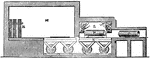
"In the arrangement of the flattening and annealing ovens numerous improvements have been effected, which have resulted in greatly increased smoothness and uniformity of the glass, and in considerable economy of time and labor in the operations. This shows a section of a flattening (L) and annealing kiln (M) in common use. The split cylinder O is introduced and gradually pushed forward so as to be uniformly heated till it reaches P, the flattening stone or table, mounted on a movable waggon N. On this waggon after it has been flattened it is carried into the annealing arch M, as shown by the dotted outline. Here in a less heat is graually stiffens, till it is ready to be moved by a forked tool to a horizontal position on the bed of the annealing oven." — Encyclopedia Britannica, 1893

Glass Cutter

"In the arrangement of the flattening and annealing ovens numerous improvements have been effected,…
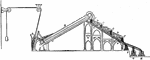
"Granulating machine. A, hopper, with raising arrangement; B, endless band; C, C, C, C, four pairs of rollers; D, D, D, short screens; E, E, long screens; F, box for dust; G, box for grain; H, box for chucks; K, bottom board." — Encyclopedia Britannica, 1893

Granulating Machine

"Granulating machine. A, hopper, with raising arrangement; B, endless band; C, C, C, C, four pairs of…
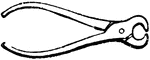
"Cutting pliers and cutting nippers have a pair of knife edges so arranged as to work exactly opposite to one another, the handles, on being tightly grasped, affording sufficient leverage for these edges to be forced to a short distance into the two opposite sides of a nail or wire, which, if of small diameter or of soft metal, can thus be cut asunder." — Encyclopedia Britannica, 1893

Cutting Pliers

"Cutting pliers and cutting nippers have a pair of knife edges so arranged as to work exactly opposite…
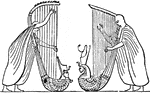
"This primitive-looking instrument was played horizontally, being born upon the performer's shoulder. between it and the grand vertical harps in the frescos of the time of Rameses III, More than 3000 years old, paintings discovered by the Laveller Bruce, there are varieties that permit us to bind the whole, from the simplest bow-form to the almost triangular harp, in to one family." — Encyclopediia Britannica, 1893

Harp

"This primitive-looking instrument was played horizontally, being born upon the performer's shoulder.…
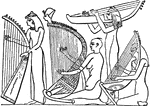
"This primitive-looking instrument was played horizontally, being born upon the performer's shoulder. between it and the grand vertical harps in the frescos of the time of Rameses III, More than 3000 years old, paintings discovered by the Laveller Bruce, there are varieties that permit us to bind the whole, from the simplest bow-form to the almost triangular harp, in to one family." — Encyclopediia Britannica, 1893

Harp

"This primitive-looking instrument was played horizontally, being born upon the performer's shoulder.…
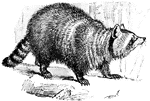
An animal about two feet long, stout body, bushy ringed tail, short limbs, pointed ears, broad face, and sharp snout. Usually washes its food before eating it.

Racoon

An animal about two feet long, stout body, bushy ringed tail, short limbs, pointed ears, broad face,…
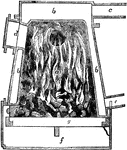
"Rogers's Conical Boiler, which has long been in use, is very suitable for heating pits and small houses, since it is economical of fuel, and gives out a steady heat for a long time, 15 to 20 hours." — Encyclopedia Britannica, 1893

Conical Boiler

"Rogers's Conical Boiler, which has long been in use, is very suitable for heating pits and small houses,…
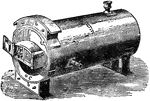
"A very powerful and economical one, for large establishments especially. It is a modification of the well-known Cornish boiler, and consists of two wrought-iron cylinders substantially rivetted together, and having a water space of about 2 inches between them. The frame for the furnace doors d is attached to the front. It is supported by two cast-iron chairs a, a, the front chair forming the frame for the lower flue doors b, which fasten by a simple catch, and can readily be lifted off for cleaning the flues. The plug c, opened by unscrewing it, is for the purpose of clearing out all interior accumulation of dirt, which should be done thoroughly at short intervals. The flow pipe is at e, the return at f." — Encyclopedia Britannica, 1893

Trentham Boiler

"A very powerful and economical one, for large establishments especially. It is a modification of the…
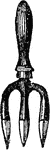
"The hand-fork, a short-handled three-tined implement, is extremely handy for many purposes, such as loosening weeds for hand-weeding, or for planting or transplanting small subjects; it is also very handy for plunging pots, either indoors or out, in tan-beds, ash-beds or common soil." — Encyclopedia Britannica, 1893

Hand-fork

"The hand-fork, a short-handled three-tined implement, is extremely handy for many purposes, such as…
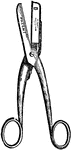
"Selby's Flower Gatherer which cuts and holds the flower at the same time." — Encyclopedia Britannica, 1893

Flower Gatherer

"Selby's Flower Gatherer which cuts and holds the flower at the same time." — Encyclopedia Britannica,…
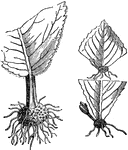
"Many plans may be propagated by planting their leaves or portions of their leaves as cuttings, as, for example, the herbaceous Gloxinia (a) and Gesnera, the succulent Sempervivum, Echeveria, Pachyphytum, and their allies and such hard-leaved plants as Theophrasta (b). The leaves are best taken off with the base whole, and should be planted in well-drained sandy soil; in due time they form roots, and ultimately from some latent bud a little shoot which forms the young plant. The treatment is precisely like that of branch cuttings. Gloxinias, begonias, etc., grow readily from fragments of the leaves cut clean through the thick veins and ribs, and planted edgewise like cuttings. This class of subjects may also be fixed flat on the surface of the cutting pot, by means of little pegs or hooks, the main ribs being cut across at intervals, and from these points roots, and eventually young tubers, will be produced." — Encyclopedia Britannica, 1893

Leaf Cuttings

"Many plans may be propagated by planting their leaves or portions of their leaves as cuttings, as,…
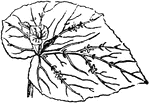
"Many plans may be propagated by planting their leaves or portions of their leaves as cuttings, as, for example, the herbaceous Gloxinia (a) and Gesnera, the succulent Sempervivum, Echeveria, Pachyphytum, and their allies and such hard-leaved plants as Theophrasta (b). The leaves are best taken off with the base whole, and should be planted in well-drained sandy soil; in due time they form roots, and ultimately from some latent bud a little shoot which forms the young plant. The treatment is precisely like that of branch cuttings. Gloxinias, begonias, etc., grow readily from fragments of the leaves cut clean through the thick veins and ribs, and planted edgewise like cuttings. This class of subjects may also be fixed flat on the surface of the cutting pot, by means of little pegs or hooks, the main ribs being cut across at intervals, and from these points roots, and eventually young tubers, will be produced." — Encyclopedia Britannica, 1893

Leaf Cuttings

"Many plans may be propagated by planting their leaves or portions of their leaves as cuttings, as,…
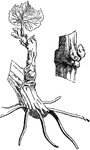
"This mode of propagation is performed by cutting the branches into short lengths, each containing one well-matured bud or eye, with a short portion of the stem above and below. It is a common mode of propagating vines, the eyes being in this case cut from the ripened leafless wood. The eyes (a) are planted just below the surface in pots of light soil, which are placed in a hot bed or propagating pit, and in due time each pushed up a young shoot which forms the future stem, while convert it into an independent plant." — Encyclopedia Britannica, 1893

Single Eye

"This mode of propagation is performed by cutting the branches into short lengths, each containing one…
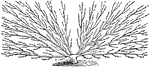
"The form of Dumoutier is merely a refinement on the Montreuil method. The formation of the tree commences with the inferior limbs and proceeds towards the center, he branches being lowered from time to time as the tree acquires strength. What is most worthy of notice in this method is the management of the subordinates in the pruning for fruit." — Encyclopedia Britannica, 1893

Dumontier's Fan

"The form of Dumoutier is merely a refinement on the Montreuil method. The formation of the tree commences…
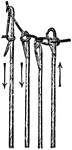
"An improvement of great importance in the hosiery trade was effected through the invention of the tumbler needle, patented by Mr. M. Townsend in 1858. The tumbler needle consists of a stem somewhat bulged near the point. The bulged part contains a groove in which there is hinged a short pin. The pin is so placed that, when turned to the hooked or curved point, its own point falls into a spoon-like indent, thus forming a smooth metal loop." — Encyclopedia Britannica, 1893

Tumbler Needle

"An improvement of great importance in the hosiery trade was effected through the invention of the tumbler…
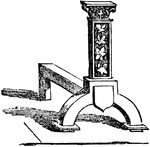
"Andirons were used for burning wood on an open hearth, and consisted of a horizontal bar raised on short supports, with an upright standard at one end." — Chambers' Encyclopedia, 1875

Andiron

"Andirons were used for burning wood on an open hearth, and consisted of a horizontal bar raised on…

"An ancient English gold coin, varying in value. It was so called from the figure of the archangel Michael piercing the gradon upon its obverse. angels continued to be coined down to the time of the Commonwealth." — Chambers' Encyclopedia, 1875

Angel

"An ancient English gold coin, varying in value. It was so called from the figure of the archangel Michael…
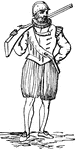
"The first form of hand-gun which could fairly be compared with the modern musket. those of earlier date were fired by applying a match by hand to the touch-hole; but about the time of the battle of Morat, in 1476, guns were used having a contrivance suggested by the trigger of the arbalest or cross-bow, by which the burning match could be applied with more quickness and certainty." — Chambers' Encyclopedia, 1875

Arquebus

"The first form of hand-gun which could fairly be compared with the modern musket. those of earlier…

"After appropriating to national purposes the land belonging to the church, the French National Assembly, instead of bringing it into the market at a time of insecurity, when its value was depreciated, issued bonds on the security of it, which were called assignats, as representing land assigned to the holder. This paper money consisted chiefly of notes for 100 francs each, though many of them were for sums as low as ten or five francs, and even lower; and the first issue amounted to 400 million francs." — Chambers' Encyclopedia, 1875

Assignat

"After appropriating to national purposes the land belonging to the church, the French National Assembly,…
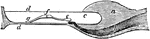
"a, the osseous septum grooved for the passage of the cochlear nerve b, which terminates by a free end inside the chamber c, along the floor of which it lies for a short distance; d, d are the two layers of the membranous septum. Lying in contact with the end of the nerve is the enlarged extremity of a rod e, which is connected in a flail-like manner by the hinge f to another rod, which is fixed at g." — Chambers' Encyclopedia, 1875

Auditory Nerve

"a, the osseous septum grooved for the passage of the cochlear nerve b, which terminates by a free end…
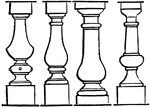
"Popularly, banister or ballaster, the name given to small shafts or pillars set in a line at short equal distances, and supporting a cornice or coping. These miniature pillars have generally either a pear-shaped swelling at the lower end, or consist of two pear-shaped pieces, places above each other, a ring of moulding being set between them." — Chambers' Encyclopedia, 1875

Baluster

"Popularly, banister or ballaster, the name given to small shafts or pillars set in a line at short…
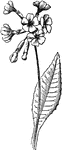
"A common native of pastures in England and many other parts of Europe, although rare in Scotland, a delicate and modest little flower, a universal favorite, both for its beauty and its fragrance. The flowers are small, in an umbel at the top of the scape, the limb of the corolla short and concave." — Chambers' Encyclopedia, 1875

Cowslip

"A common native of pastures in England and many other parts of Europe, although rare in Scotland, a…
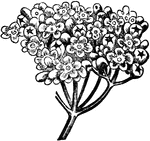
"Cyme, in Botany, a common form of Centrifugal inflorescence, in which the rachis or floral axis disappears by separating into irregular branches, and these are short and corymbose." — Chambers' Encyclopedia, 1875

Cyme

"Cyme, in Botany, a common form of Centrifugal inflorescence, in which the rachis or floral axis disappears…
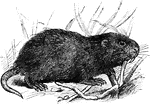
A mole—rat having the eyes open, though very small, ears naked and very short, thumb rudimentary, tail short and hartially haired, and general fom robust.

Bamboo Rat

A mole—rat having the eyes open, though very small, ears naked and very short, thumb rudimentary,…
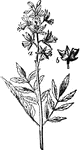
"A genus of plants of the natural order Rutaceae, having a short 5-partite calx, five some-what unequal petals, ten stamens, and five 1—3 seeded follicular capsules cohering at the base." — Chambers' Encyclopedia, 1875

Dittany

"A genus of plants of the natural order Rutaceae, having a short 5-partite calx, five some-what unequal…
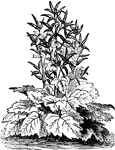
A perennial plant with many short red stems and green leaves. Commonly used in cooking.

Medicinal Rhubarb

A perennial plant with many short red stems and green leaves. Commonly used in cooking.
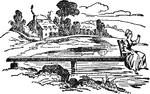
"An apparatus at one time in use in Britain for the punishment of wives. The ducking-stool grew out of the cucking-stool, which was not, as many have supposed, a mere difference of name for the same thing. The cucking-stool of itself did not admit of the ducking of its occupants. It was a simple chair in which the offender was placed, usually before her or his (for the cucking-stool was not so specially for women as the ducking-stool) own door, to be pelted and insulted by the mob." — Chambers' Encyclopedia, 1875

Ducking-Stool

"An apparatus at one time in use in Britain for the punishment of wives. The ducking-stool grew out…
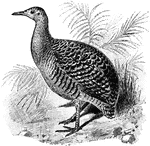
A large bird with varigated plumage, short soft tail feathers, well developed hind toe and long bill.
Tinamou

A large bird with varigated plumage, short soft tail feathers, well developed hind toe and long bill.

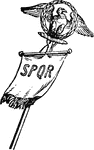
"Eagle, as a military standard, was adopted by the Romans, and even by nations preceding them in history. The Persians, in the time of Cyrus the Younger, bore an eagle on a spear as a standard. The Romans for some time used the eagle, the wolf, the boar, the horse, and the minotaur for standards, but afterwards abandoned the last four, and confined themselves to the first." — Chambers' Encyclopedia, 1875

Roman Eagle

"Eagle, as a military standard, was adopted by the Romans, and even by nations preceding them in history.…
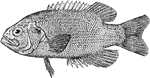
It is found from the Great Lake region to Louisiana. Can attain length of a foot and is usually an olive green with brassy tints and dark mottling.

Redeye

It is found from the Great Lake region to Louisiana. Can attain length of a foot and is usually an olive…
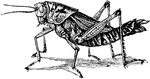
A large bodied, short winged locust. Sometimes called the short horned grasshopper.

Lubber Grasshopper

A large bodied, short winged locust. Sometimes called the short horned grasshopper.
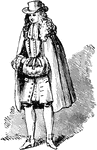
A form of a short cloak much worn in the earlier part of the eighteenth century.

Roquelaure

A form of a short cloak much worn in the earlier part of the eighteenth century.

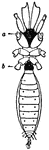
"Schizomus crassicaudaius, one of the Tartarid Pedipalpi. Ventral view of a female with the appendages cut short near the base. a, Prosternum of prosoma. b, Metasternum of prosoma. prae-gen, The prae-genital somite. I opisth, First somite of the opisthosoma. II opisth, Eleventh somite of the opisthosoma. pa, Post-anal lobe of the female." — The Encyclopedia Britannica, 1910

Schizomus

"Schizomus crassicaudaius, one of the Tartarid Pedipalpi. Ventral view of a female with the appendages…
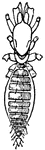
"Schizomus crassicaudatus, a Tartarid Pedipalp. Dorsal view of a male with the appendages cut short. I to VI. The prosomatic appendages. a, Anterior plate. b, Posterior plate of the prosomatic carapace. prae-gen, Tergum of the praegenital somite. II, The eleventh somite of the opisthosoma. pa, Post-anal lobe of the male—a conical body with narrow basal stalk." — The Encyclopedia Britannica, 1910

Schizomus

"Schizomus crassicaudatus, a Tartarid Pedipalp. Dorsal view of a male with the appendages cut short.…
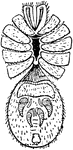
"Liphistus desultor, Ventral view with the prosomatic appendages cut short expecting the chelicerae (1) whose sharp retroverts are seen. Between the bases of the prosomatic limbs an anterior and a posterior sternal plate (black) are seen. I, The sternum of the first opisthosomatic or genital somite covering the genital aperture and the first pair of lungsacs. In front of it the narrow waist is formed by the soft sternal area of the praegenital somite. 2, the sternite of the second opisthosomatic somite covering the posterior pair of lung-sacs; 3 and 4, the spinning appendages (limbs) of the opisthosoma; a, inner, b, outer ramus of the appendage; II, sternite of the eleventh somite of the opisthosoma: in front of it other rudimentary sternites; an, anus." — The Encyclopedia Britannica, 1910

Liphistius Desultor

"Liphistus desultor, Ventral view with the prosomatic appendages cut short expecting the chelicerae…

"Galeodes sp., one of the Solifugae. I to VI, The six prosomatic limbs cut short. o, The eyes. b, c, Demarcated areae of the cephalic or first prosomatic plate corresponding respectively to appendages I, II, III, and to appendage IV. d, Second plate of the prosoma-carrying appendage V. e, Third plate of the prosoma-carrying appendage VI. The prae-genital somite is absent. 1, First somite of the opisthosoma. 2, Second do. S, Prosomatic tracheal aperture between legs IV and V. S' and S'', Opisthosomatic tracheal apertures. 10, Tenth opisthosomatic somite. an, Anus." — The Encyclopedia Britannica, 1910

Galeodes

"Galeodes sp., one of the Solifugae. I to VI, The six prosomatic limbs cut short. o, The eyes. b, c,…
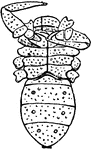
"Cryptostemma Karschii, one of the Podogona. Vental view. I to VI, The six pairs of appendages of the prosoma, the last three cut short. 1, 2, 3, 4, The four somites of the opisthosoma. a, Visible hood overhanding the first pair of appendages. b, Position of the genital orifice. c, Part of 3rd appendage. d, Fourth segment of 2nd appendage Observe that the basal segment of appendage III does not meet its fellow in the middle line." — The Encyclopedia Britannica, 1910

Cryptostemma Karschii

"Cryptostemma Karschii, one of the Podogona. Vental view. I to VI, The six pairs of appendages of the…
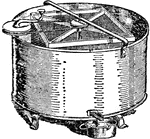
"Hruschka's extractor, first brough to public notice in 1865, may be said to have revolutionized the bee-industry as a business. It enabled the honey producer to increase his output considerably by extracting honey from the cells in most cleanly fashion without damaging the combs, and in a fraction of the time previously occupied in the draining." — The Encyclopedia Britannica, 1910

Hruschka Extractor

"Hruschka's extractor, first brough to public notice in 1865, may be said to have revolutionized the…
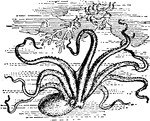
"A genus of dimiliarly known as cuttle-fishes. They have eight arms, each with two rows of suckers, which are sessile or unstalked. The prominent head is joined to the body by a distinct neck, and the body itself is short, generally more or less rounded in shape, and unprovided with side or lateral fins. They have attained a notoriety from tales circulated concerning their ferocity and the existence of gigantic members of the genus, though the largest cuttle-fishes that have been met with have belonged to other genera." — Winston's Encyclopedia, 1919

Octopus

"A genus of dimiliarly known as cuttle-fishes. They have eight arms, each with two rows of suckers,…
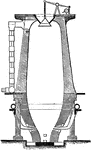
"The more modern furnaces are constructed like this, but the masonry at the base is still less massive, so that, instead of there being four distinct tuyere houses, the separating walls of the houses are wholly cut away and replaced by a number of stout iron pillars on which rests the greater portion of the weight of the superstructure; through the walls of the hearth are pierced conical arched openings for the tuyeres; the throat is fitted with a valve for introducing materials from time to time, such as the cup and cone arrangement." — The Encyclopedia Britannica, 1893

Furnace

"The more modern furnaces are constructed like this, but the masonry at the base is still less massive,…
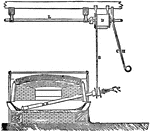
"Dormoy's rabble differs from others of this class in being worked by rotation like a hair-brushing machine; the tool being made to revolve very rapidly (300 to 500 turns per minute for white iron and 800 to 1000 for grey pig) gives the metal such an impulse that it gyrates horizontally round the bed, continually renewing the surface in contact with the atmosphere; this is further aided, by making the end of the rabble to carry a disk, which is replaced by a short twisted point when the metal comes to nature." — The Encyclopedia Britannica, 1893

Dormoy's Rabble

"Dormoy's rabble differs from others of this class in being worked by rotation like a hair-brushing…
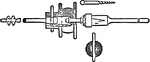
"Dormoy's rabble differs from others of this class in being worked by rotation like a hair-brushing machine; the tool being made to revolve very rapidly (300 to 500 turns per minute for white iron and 800 to 1000 for grey pig) gives the metal such an impulse that it gyrates horizontally round the bed, continually renewing the surface in contact with the atmosphere; this is further aided, by making the end of the rabble to carry a disk, which is replaced by a short twisted point when the metal comes to nature." — The Encyclopedia Britannica, 1893

Dormoy's Rabble

"Dormoy's rabble differs from others of this class in being worked by rotation like a hair-brushing…
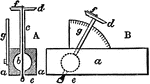
"Lapidary's Dial. A, section; B, side elevation; a, a, jaws; b, ball; c, tube; d, dial; e, cement rod; f, index; g, quadrant." —The Encyclopedia Britannica, 1910

Lapidary's Dial

"Lapidary's Dial. A, section; B, side elevation; a, a, jaws; b, ball; c, tube; d, dial; e, cement rod;…
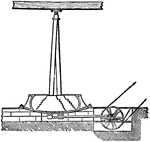
"The softening of leather is helped and rendered thorough by working them for some time in the stocks after they have been well soaked." —The Encyclopedia Britannica, 1910

Double-Acting Stock

"The softening of leather is helped and rendered thorough by working them for some time in the stocks…
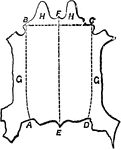
"The hides now come to be trimmed and prepared for tanning in the shape in which they are intended ultimately to be sent into the market. An entire untrimmed hide is termed a crop; a side is half a crop, the dividing line of the two sides being shown at EF; a butt is the back portion ABCD, and a bend is half a butt ABFE. G, G are belly pieces, and H, H the cheeks, both together being the offal. When the shoulder (the upper part of the butt) is removed, what remains is the short butt." —The Encyclopedia Britannica, 1910

Hide Divisions

"The hides now come to be trimmed and prepared for tanning in the shape in which they are intended ultimately…
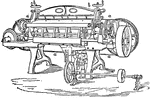
"In this machine the knife or cutter a is an endless band of steel which revolves at considerable speed with its cutting edges close to the sides of a pair of rollers through which the leather is fed and pressed against the knife. The lower of these rollers is made of short segments or rings, each separately capable of yielding to some extent so as to accommodate itself to the inequal thickness of various parts of a hide." —The Encyclopedia Britannica, 1910

Splitting Machine

"In this machine the knife or cutter a is an endless band of steel which revolves at considerable speed…
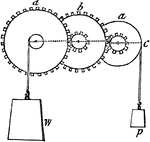
"System of Wheels.—As the wheel and axle is only a modification of the simple lever, so a system of wheels acting on each other, and transmitting the power to the resistance, is only another form of the compound lever. The first wheel a, by means of the teeth, or cogs, around its axle, moved the second wheel, b, with a force equal to that of a lever, the long arm of which extends from the center to the circumference of the wheel, where the power p is suspended, and the short arm from the same center to the ends of the cogs. The dotted line c, passing through the center of the wheel a, shows the position of the lever, as the wheel now stands." —Comstock, 1850

System of Wheels

"System of Wheels.—As the wheel and axle is only a modification of the simple lever, so a system…
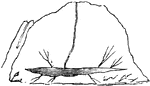
"Rupture of a Mountain.—There is no doubt, but in the operations of nature, great effects are sometimes produced among mountains, by a small quantity of water finding its way to a reservoir in the crevices of the rocks far beneath. Suppose, in the interior of a mountain, there should be a space of ten yards square, and an inch deep, filled with water, and closed up on all sides; and suppose that, in the course of time, a small fissure, no more than an inch in diameter, should be openeing by the water, from the height of two hundred feet above, down to this little reservoir. The consequence might be, that the side of the mountain would burst asunder, for the pressure, under the circumstances supposed, would be equal to the weight of five thousand tons." —Comstock, 1850

Mountain Rupture

"Rupture of a Mountain.—There is no doubt, but in the operations of nature, great effects are…
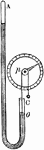
"The whole length of the tube of the wheel barometer, from C to A, is 34 or 35 inches, and it is filled with mercury, as usual. The mercury rises in the short leg to the point a, where there is a small piece of glass floating on its surface, to which there is attached a silk string, passing over the pulley p. To the axis of the pulley is fixed an index, or hand, and behind this is a graduated circle, as seen in the figure. It is obvious, that a very slight variation in the height of the mercury at o, will be indicated by a considerable motion of the index, and thus changes in the weight of the atmosphere, hardly perceptible by the common barometer, will become quite apparent by this." —Comstock, 1850

Wheel Barometer

"The whole length of the tube of the wheel barometer, from C to A, is 34 or 35 inches, and it is filled…
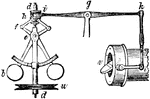
"Of all the contrivances for regulating the motion of machinery, this is said to be the most effectual. It will be readily understood by the following description. It consists of two heavy iron balls b, attached to the extremities of the two rods, b, e. These rods play on a joint at e, passing through a mortice in the vertical stem d, d. At f, these pieces are united, by joints to two short rods, f, h, which, at their upper ends, are again connected by joints at h, to a ring which slides upon the vertical stem d d." —Comstock, 1850

Governor

"Of all the contrivances for regulating the motion of machinery, this is said to be the most effectual.…
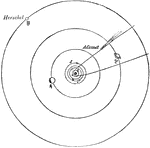
"Relative distance of the Planets. Having now given a short account of each planet composing the solar system, the relative situation of their several orbits, with the exception of those of the Asteroids, are shown in this figure. The orbits are marked by the signs of each planet, of which the first, or that nearest the Sun, is Mercury, the next Venus, the third the Earth, the fourth Mars then come those of the Asteroids, then Jupiter, then Saturn and lastly Herschel." —Comstock, 1850

Planet Distance

"Relative distance of the Planets. Having now given a short account of each planet composing the solar…
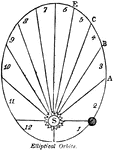
"The elliptical circle being supposed to be the Earth's orbit, with the Sun, S, in one of the foci. Now the spaces, 1, 2, 3, etc., though of different shapes, are of the same dimensions, or contain the same quantity of surface. The Earth, we have already seen, in its journey round the Sun, describes an ellipse, and moves more rapidly in one part of its orbit than in another. But whatever may be its actual velocity, its comparative motion is through equal areas in equal times. Thus its center passes from E to C, and from C to A, in the same period of time, and so of all the other divisions marked in the figure." —Comstock, 1850

Elliptical Orbit

"The elliptical circle being supposed to be the Earth's orbit, with the Sun, S, in one of the foci.…
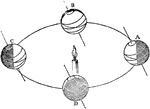
"Now it is the inclination of the Earth's axis, as above described, which causes the lengths of the days and nights to differ at the same place at different seasons of the year, for on reviewing the positions of the globe at A, it will be observed that the line formed by the enlightened and dark hemispheres, does not coincide with the line of the axis and the pole, but that the line formed by the darkness and the light, extends obliquely across the line of the Earth's axis, so that the north pole is in the light while the south is in the dark. In the position A, therefore, an observer at the north pole would see the sun constantly, while another at the south pole would not see it at all. Hence those living in the north temperate zone, at the season of the year when the earth is at A, or in the Summer, would have long days and short nights, in proportion as they approached the polar circle; while those who live in the south temperate zone, at the same time, and when it would be Winter there, would have long nights and short days in the same proportion." —Comstock, 1850

Earth Axis

"Now it is the inclination of the Earth's axis, as above described, which causes the lengths of the…
"Now it is the inclination of the Earth's axis, as above described, which causes the lengths of the days and nights to differ at the same place at different seasons of the year, for on reviewing the positions of the globe at A, it will be observed that the line formed by the enlightened and dark hemispheres, does not coincide with the line of the axis and the pole, but that the line formed by the darkness and the light, extends obliquely across the line of the Earth's axis, so that the north pole is in the light while the south is in the dark. In the position A, therefore, an observer at the north pole would see the sun constantly, while another at the south pole would not see it at all. Hence those living in the north temperate zone, at the season of the year when the earth is at A, or in the Summer, would have long days and short nights, in proportion as they approached the polar circle; while those who live in the south temperate zone, at the same time, and when it would be Winter there, would have long nights and short days in the same proportion." —Comstock, 1850

Earth Axis

"Now it is the inclination of the Earth's axis, as above described, which causes the lengths of the…
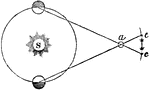
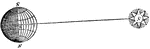
"Suppose a to be a stationary celestial object, then as the Earth makes her annual revolution around the Sun S, this object at one time will appear among the stars at e, but six months after, when the Earth comes to the opposite point in her orbit, the same object will be seen at c, the space from c to e being the annual parallax of the object a. But the distances of the stars are so great that the diameter of the Earth's orbit, or 190,000,000 of miles make no difference in their apparent places. Were the fixed stars within 19 trillions of miles, their distance could be told by their parallaxes." —Comstock, 1850

Annual Parallax

"Suppose a to be a stationary celestial object, then as the Earth makes her annual revolution around…
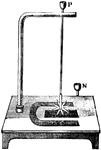
"Rotation of a Wheel. The same force which throws the wire away from the mercury, will cause the rotation of a spur-wheel. For this purpose the conducting wire, instead of being suspended, as in the former experiment, must be fixed firmly to the arm. A support for the axis of the wheel may be made by soldering a short piece to the side of the conducting wire, so as to make the form of a fork, the lower end of which must be flattened with a hammer, and pierced with fine orifices, o recieve the ends of the axis." —Comstock, 1850

Wheel Rotation

"Rotation of a Wheel. The same force which throws the wire away from the mercury, will cause the rotation…
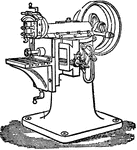
"For work of moderate size shaping machines, which are more recent indroduction than either slotting or planning machines, both of which they resemble in theiraction, are in some respects more convenient. The slide which carries the tool is in their case horizontal, and its short but variable strokes are in a direction transverse to the bed, along which it can travel, just as a slide-rest travels along a lathe bed." —The Encyclopedia Britannica, 1903

Shaping Machine

"For work of moderate size shaping machines, which are more recent indroduction than either slotting…
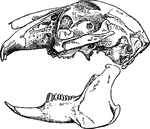
"Terrestril Rodents, with imperfect clavicles, elongated hind limbs, short recurved tail, and long ears. Skull compressed, frontals with large wing-shaped post-orbital processes; molars as in Lagomyidae." —The Encyclopedia Britannica, 1903

Lepus Timidus

"Terrestril Rodents, with imperfect clavicles, elongated hind limbs, short recurved tail, and long ears.…
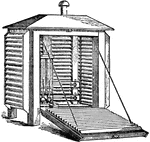
"Stevenson's louvre-boarded box for the thermometers, which is now very widely used for temperature observations. The box is made of wood, and louvred all round so as to protect the thermometers inside from radiation, and at the same time secure as free a circulation of air as is consistent with a satisfactory protection from radiation. The box is painted white, both inside and outside, and screwed to four stout wooden posts, also painted white, firmly fixed in the ground. The posts are of such a length that when the thermometers are hung in position the bulbs of the minimum thermometer and hygrometer are exactly at the same height of 4 feet above the ground, the maximum thermometer being hung immediately above the minimum thermometer." —The Encyclopedia Britannica, 1903

Thermometer Box

"Stevenson's louvre-boarded box for the thermometers, which is now very widely used for temperature…