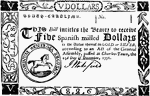
Five Dollars ($5) South Carolina currency from 1776. Image of a horse surrounded by the inscription - DOMINUM GENEROSA RECUSAT. Wood engraving, rough brown paper.

Paper Money, Five Dollars Bill, 1776

Five Dollars ($5) South Carolina currency from 1776. Image of a horse surrounded by the inscription…
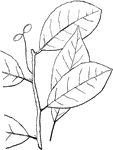
Leaves - simple; alternate; edge entire. Outline - oval or reverse egg-shape. Apex - pointed. Base - pointed. Leaf/Stem - slightly hairy when young. Leaf - two to five inches long; usually about half as broad; dark green and very shining above, especially when old; light green and shining below; thick, tough, and firm. Middle rib slightly hairy when young; side ribs rather indistinct and curved. Bark - grayish and often broken into short sections. Fertile Flowers - small, in clusters of three to eight on slender stems. April, May. Fruit - nearly one half inch long; bluish-black when ripe; egg-shape or oval; acid and rather bitter until "frosted." Stone - oval, somewhat pointed at each end, slightly flattened, and with three or four blunt ridges on each side. September. Found - from Southern Maine to Michigan, and southward to Florida and Texas. General Information - A tree twenty to forty feet high (larger southward), with flat, horizontal branches. The wood, even in short lengths, is very difficult of cleavage, and so is well fitted for beetles, hubs of wheels, pulleys, etc. Its leaves are the first to ripen in the fall, changing (sometimes as early as August) to a bright crimson. In the South, opossums climb the tree in search of its fruit and are immortalized in stories.

Genus Nyssa, L. (Sour Gum)

Leaves - simple; alternate; edge entire. Outline - oval or reverse egg-shape. Apex - pointed. Base -…
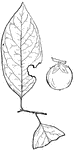
Leaves - simple; alternate, edge entire. Outline - long oval or long egg-shape. Apex - pointed. Base - pointed or rounded. Leaf - three to five inches long, thickish; dark and smooth, usually shining, above; below dull, with ribs curved and irregular and minutely downy. On the upper surface the ribs are quite indistinct, except as the lea is held toward the light when they appear almost transparent. In the same position the left is seen also to be edged with a slight delicate fringe (appearing in the dried leaf like a line of yellow light). Bark - of trunk dark and rough. Flowers - greenish-yellow and small, at the base of the leaf-stems. June. Fruit - about one inch in diameter, rounded, nearly stemless, orange-red when ripe, with about eight large flat seeds. After frost it is of very pleasant flavor, before, exceedingly "puckery." Found - from Connecticut southward to Florida and westward to Southeastern Iowa. General Information - A tree twenty to sixty feet high; sometimes, at the South, more than one hundred feet high. The wood is hard and close-grained; the bark tonic and astringent. From two Greek words meaning fruit of Jove.

Genus Diospyros, L. (Persimmon)

Leaves - simple; alternate, edge entire. Outline - long oval or long egg-shape. Apex - pointed. Base…
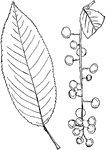
Leaves - simple; alternate; edge toothed (with the points of the teeth so incurved as to appear blunt), and often finely "crinkled." Outline - usually long oval or long egg-shape. Apex - pointed. Base - rounded or slightly pointed. Leaf/Stem - usually with two to five tooth-like glands near the base of the leaf. Leaf - two to five inches long; thickish; polished, and of a deep shining green above; beneath, lighter and smooth, with the middle rib sometimes downy toward the base. In the autumn the leaves turn to orange and later to pale yellow. Bark - of old trunks, blackish and rough; of young trunks and on the larger branches, reddish or purplish brown; marked with scattered lines; on young shoots, at first green or olive brown, gradually becoming darker, and sprinkled (sic) with small orange dots. Flowers - white, with short stems, closely set in a long, cylinder-shaped cluster. May, June. Fruit - about one and a quarter inches in diameter; with short stems (one and a quarter to one and a third inches ) hanging in long, close clusters from the ends of the twigs. It is nearly black when ripe, and of a pleasant flavor though somewhat bitter; it is eagerly eaten by birds. August. Found - very widely distributed north, south, and west. It reaches its finest growth on the western slopes of the Alleghany Mountains. General Information - A tree fifty to eighty feet high. The wood is light and hard, of a brown or reddish tinge, becoming darker with exposure, and of very great value in cabinet work and interior finish. It is now becoming scarce, so that stained birch is often used as a substitute. The bitter aromatic bark is used as a valuable tonic; "cherry brandy" is made from the fruit.

Genus Prunus L. (Cherry, Plum)

Leaves - simple; alternate; edge toothed (with the points of the teeth so incurved as to appear blunt),…
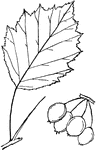
Leaves - simple; alternate (and in alternate bunches); edge unevenly sharp-toothed (with five to nine deep cuts almost forming small lobes). Outline - rounded egg-shape Apex - pointed Base - usually slightly pointed, but often blunt or slightly heart-shape. Leaf/Stem - slender and often with small wart-like glands. Leaf - usually one and a half to two and a half inches long, but of variable size on the same tree; thin; smooth; shining. Branchlets - greenish, or whitish and shining, as though washed with silver. Thorns - one to two inches long, stout, often whitish, usually slightly curved. Flowers - about two thirds of an inch across; white (often with a rosy tinge); twelve or so in a bunch; with a strong and rather disagreeable odor. May. Fruit - nearly one half inch in diameter; rounded or egg-shape; bright red; with thin pulp and one to five stones; somewhat edible. September Found - through the Atlantic forests southward to Northern Florida and Eastern Texas. General Information - A low tree (or often a bush), ten to twenty feet high, with crooked, spreading branches; very common at the North; rare in the South. From a Greek word meaning strength.

Genus Crataegus, L. (Thorn)

Leaves - simple; alternate (and in alternate bunches); edge unevenly sharp-toothed (with five to nine…
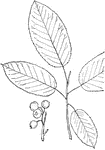
Leaves - simple; alternate; edge very sharply and finely toothed. Outline - long oval, long egg-shape, or reverse egg-shape. Apex - sometimes bristle-pointed. Base - slightly heart-shaped or rounded. Leaf - usually two to three inches long, somewhat downy when young, afterward very smooth above and below. Bark - of branches and twigs usually purplish-brown and very smooth. Flowers - large, white, in long and loose clusters at the ends of the branchlets; appearing before the leaves. April, May. Fruit - berry-like, round, purplish, sweet, and edible. June. Found - in woods and along streams; common at the North; rare in the South. General Information - A small tree, ten to thirty feet high, or in some of its numerous forms reduced to a low shrub; noticeable and showy in early spring because of its flowers. The variety A. C. oblongifolia, T. and G., differs somewhat from the above in the dimensions of the flowers and flower clusters, etc. The name "shad-bush" is given because the trees blossom about the time that the shad "run".

Genus Amelanchier, Medik (June-berry)

Leaves - simple; alternate; edge very sharply and finely toothed. Outline - long oval, long egg-shape,…
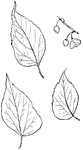
Leaves - simple; alternate; edge sharp-toothed, but entire at the base. Outline - obliquely egg-shaped, very one-sided. Apex - taper-pointed. Base - usually somewhat heart-shaped, or slightly pointed or rounded. Leaf - two to three inches long, one to two inches wide; rough. Bark - of the trunk, rough; sometimes much crumpled. Fruit - about the size of a pea; solitary; drooping from the bases of the leaf-stems, on stems once or twice as long as the leaf-stems; rounded; pulp thin, sweet, and edible; purplish red; ripe in September. Found - from the valley of the St. Lawrence westward and southward. General Information - A tree fifteen to thirty feet high (but much larger at the South), most common, and reaching its finest growth in the basin of the Mississippi. It is very variable in size and in the shape and texture of its leaves. Variety crassifolia is sometimes found, in which the leaves are thicker and usually toothed all around. Hackberry is an ancient name for lotus.

Genus Celtis, L. (Hackberry)

Leaves - simple; alternate; edge sharp-toothed, but entire at the base. Outline - obliquely egg-shaped,…
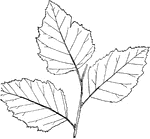
Leaves - simple; alternate; edge unequally double-toothed, entire at base. Outline - egg-shape, often approaching diamond-shape. Apex - pointed. Base - somewhat pointed, often rather blunt wedge-shaped. Leaf/Stem - short (about one half to three fourths of an inch) and downy. Leaf - about three inches long by two inches wide, or often less; whitish and (until old) downy beneath; dotted; in autumn turning to a bright yellow. Bark - of the trunk reddish-brown. As the tree grows the bark becomes torn and loose, hanging in thin shreds of varying shades. The young twigs are downy.  Found - on low grounds, especially along river banks, from Massachusetts westward and southward. It becomes common only in the lower part of New Jersey. Its finest growth is in the South. It is the only birch which grows in a warm climate. General Information - A tree usually thirty to fifty feet high, with the branches long and slender, arched and heavily drooping. Often the branches cover the trunk nearly to the ground. "Birch brooms" are made from the twigs.

Genus Betula, L. (Birch)

Leaves - simple; alternate; edge unequally double-toothed, entire at base. Outline - egg-shape, often…
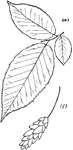
Leaves - simple; alternate; edge very sharply and slightly irregularly and unequally toothed. Outline - long oval or long egg-shape. Apex - taper-pointed. Base - slightly heart-shaped. Leaf/Stem - about one fourth inch long, and often rough. Leaf - usually three to four inches long, and about half as wide, but with many smaller leaves of varying size on the same branch; smoothish above, paler and somewhat downy below. Ribs - The straight ribs and their angles hairy. Bark - of trunk, brownish or dark gray, and remarkable for being finely furrowed up and down, with the ridges broken into three - to four-inch lengths. These divisions are narrower than on any other rough-barked tree, and they become narrower and finer as the tree grows older. The new shoots are reddish green and dotted with brown; the younger branches purplish-brown and dotted with white or gray. When the branch is two to three inches thick, its bark becomes grayish and begins to crack. Fruit - in long oval, drooping clusters, resembling those of the hop-vine, with long, unlobed scales that lap each other like shingles. August, September. Found - oftenest on dry hill-sides. Common North, South, and West, especially in Southern Arkansas. General Information - A tree twenty to thirty feet high, with white, very strong, and compact wood. It would be very valuable, if it were more abundant and of larger growth.

Genus ostrya, Scop. (Hop-Hornbeam)

Leaves - simple; alternate; edge very sharply and slightly irregularly and unequally toothed. Outline…
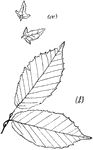
Leaves - simple; alternate; edge very sharply and quite irregularly and unevenly toothed. Outline - long egg-shape, or reverse long egg-shape. Apex - taper-pointed. Base - rounded or slightly heart-shaped. Leaf/Stem - about one half inch long, slender and smooth, or slightly hairy. Leaf - usually three to four inches long, and about half as wide, but with many smaller leaves of varying size on the same branch; nearly smooth, slightly hairy on the straight and distinct ribs and in their angles. Bark - of trunk, a deep bluish-gray or slate; smooth, but often marked up and down with irregular ridges, which run from each side of the lower branches. The new shoots are somewhat hairy, and brownish or purple; the older branchlets, an ashy-gray color, with a pearly luster. Fruit - in loose drooping cluster, with leaf-like scales that are strongly three-lobed and placed in pairs base to base. October. Found - along streams and in swamps. Quite common North, South, and West; northward often only as a low shrub. General Information - A small tree or shrub, usually ten to twenty feet high, but in the southern Alleghany Mountains sometimes reaching a height of fifty feet. Its wood is white and very compact and strong.

Genus Carpinus, L. (Hornbeam)

Leaves - simple; alternate; edge very sharply and quite irregularly and unevenly toothed. Outline -…
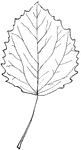
Leaves - simple; alternate; edge large-toothed, with the hollows rounded. Outline - wide egg-shape. Apex - sharp-pointed. Base - squared, or slightly rounded. Leaf/Stem - long and slender, and flattened sidewise. Leaf - three to five inches long, smooth on both sides when mature; white, and covered thickly with silky wool when young. Ribs, whitish and distinct above. Bark - of the trunk, smooth, and of a soft, light greenish-gray; when old, becoming somewhat cracked. On the young branches the bark is dark. Found - in Nova Scotia and New Brunswick, through the Northern States, along the Alleghany Mountains to North Carolina, and west to Wisconsin and Iowa. Rare at the South. common at the North. General Information - A tree forth to eight feet high, with open, crooked branches. Large quantities of the soft, white wood are ground into pulp for making paper. "In both this and the P. tremuloides, Michx., the leaves of young sprouts are often differently shaped and toothed, and much enlarged." -- (Porter.) Poplar wood, like other soft woods, is not usually esteemed for durability' but an old couplet, said to have been found inscribed on a poplar plank, teaches differently: "Though 'heart of Oak' be e'er so stout, Keep me dry, and I'll see him out."

Genus Populus, L. (Aspen, Poplar)

Leaves - simple; alternate; edge large-toothed, with the hollows rounded. Outline - wide egg-shape.…
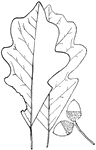
Leaves - simple; alternate; edge quite deeply wavy-toothed. Outline - reverse egg-shape or oval. Apex - blunt-pointed. Base - pointed. Leaf - five to eight inches long; smooth, and rather bright green above; whitish-downy beneath, becoming almost silvery-white; often with a rather deep hollow just below the middle, and usually abruptly spreading above; the teeth unequal, longest toward the middle of the leaf, sometimes almost long enough to be called lobes; mostly rounded at the apex, but sometimes ending in a hard point; the main ribs prominent and rust-colored. Bark - of trunk, grayish-white, dividing into large, flat scales. Acorns - usually in pairs on a stem one and a quarter to three inches long. Cup - rounded, rather thin, rough, with sharp scales; the upper scales bristle-tipped, forming a border, or sometimes a fringe, along the edge; slightly downy within. Nut - one inch or less in length, egg-shape; sweet. October. Found - from Southern Maine and the Upper St. Lawrence to Southeastern Iowa and Western Missouri, south to Delaware and along the Alleghany Mountains to Northern Georgia; along borders of streams and in swamps, in deep, rich soil. Its finest growth is in the region of the Great Lakes. General Information - A tree thirty to sixty feet high or more, with wood similar in value to that of the White Oak. Quercus, possible from a Celtic word meaning to inquire, because it was among the oaks that the Druids oftenest practised their rites.

Genus Quercus, L. (Oak)

Leaves - simple; alternate; edge quite deeply wavy-toothed. Outline - reverse egg-shape or oval. Apex…
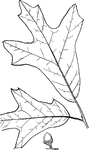
Leaves - simple; alternate; edge lobed (the edges of the lobes mostly entire, but often with one to three teeth toward the ends). Outline - abruptly spreading above the middle. Base - rounded, sometimes slightly unequal. Ends of the lobes and of the few teeth, when present, sharp and bristle-tipped. Leaf - about three to six inches long; dark, dull green, and rough above; below, grayish and downy. Lobes, usually three, sometimes four or five, mostly long and narrow, especially the end one. Bark - of trunk, blackish and deeply grooved. Acorns - nearly stemless. Cup - shallow, somewhat top-shaped. Nut, about one third to one half inch long, rounded, sometimes slightly hollowed at the apex, bitter. October. Found - in sandy soils and barrens, from Long Island southward; in the Northern States, only near the coat and rare. General Information - A tree about twenty to thirty feet high in New Jersey; in the South, seventy to eighty feet; with wood of slight value except for fuel. Quercus, possible from a Celtic word meaning to inquire, because it was among the oaks that the Druids oftenest practised their rites.

Genus Quercus, L. (Oak)

Leaves - simple; alternate; edge lobed (the edges of the lobes mostly entire, but often with one to…
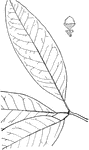
Leaves - simple; alternate; edge entire. Outline - long and narrow. Apex - pointed and bristle-tipped. Base - pointed. Leaf - three to six inches long; one to two inches wide; smooth and shining above; somewhat downy beneath; thick and stiff. Bark - smooth and unbroken. Acorns - small, nearly stemless. Cup - shallow. Nuts - rounded; about one half inch in diameter; bitter. October. Found - in Lehigh County, Pennsylvania (Porter), westward to Southeastern Iowa, and southward. Most common west of the Alleghany Mountains.  General Information - A tree thirty to fifty feet high, with poor wood, that is used at the West for shingles and clapboards.  Note: Of the nine hybrids that have been recognized, most are outside of our limits or entirely local. Mention need be made only of tow: Q. heterophylla, Michaux ("Bartram's Oak"). Staten Island and New Jersey to Delaware and North Carolina; Q. Rudkini, Britt., New Jersey. Quercus, possible from a Celtic word meaning to inquire, because it was among the oaks that the Druids oftenest practised their rites.   The Oak "Live thy Life, Young and old, Like yon oak, Bright in spring, Living gold; Summer-rich, Then; and then Autumn-changed, Sober-hued Gold again. All his leaves fall'n at length, Look, he stands, Trunk and bough, Naked strength.: Alfred (Lord) Tennyson, 1889.

Genus Quercus, L. (Oak)

Leaves - simple; alternate; edge entire. Outline - long and narrow. Apex - pointed and bristle-tipped.…
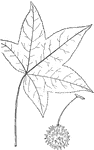
Leaves - simple; alternate; edge deeply lobed (lobes finely and sharply toothed throughout). Outline - rounded. The lobes are five to seven, radiating from the base. Apex - of the lobes, pointed. Base - of the leaf heart-shape. Leaf - three to seven inches in diameter, smooth and shining with a pleasant odor when bruised. Ribs tufted at their angles. Bark - gray; usually strongly winged with corky ridges along the branchlets. In the South, a spicy gum, from which the tree takes its name, oozes from the bark. Fruit - small woody pods are collected into a round ball. These usually contain a few good seeds and a large number of others that resemble saw-dust. September. Found - from Connecticut to Illinois, and southward. It reaches its finest growth and is very common in the bottom lands of the Mississippi basin. General Information - A fine tree sixty to seventy feel high, or southward one hundred feet and more. The wood is valuable, and would be better appreciated except for the difficulty of seasoning it. It is sometimes used as a substitute for Black Walnut, Its gum is used medicinally.

Genus Liquidamber, L. (Sweet Bum)

Leaves - simple; alternate; edge deeply lobed (lobes finely and sharply toothed throughout). Outline…
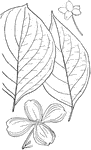
Leaves - simple; opposite; edge entire. Outline - egg-shape, or often broad oval, or reverse egg-shape. Apex - pointed, often taper-pointed. Base - pointed and usually slightly unequal. Leaf/Stem - short (about one half inch). Leaf - three to five inches long; smooth above; pale and nearly smooth beneath; with the whitish ribs very distinct and curved. Bark - of trunk, blackish and rough, with short, broken ridges. The bark, especially of the roots, is very bitter and is used as a tonic. Flowers - The real flowers are greenish-yellow, in a small rounded bunch; but this bunch is surrounded by four large, petal-like leaves, white and often tinged with pink, more than an inch in length, reverse egg-shaped, and ending in a hard, abruptly turned point. The appearance is of a single large flower. The tree blossoms in May before the leaves are fully set. Fruit - The "Flower" is succeeded by a bunch of oval berries that turn bright red as they ripen, making the tree in the autumn, with its richly changing foliage, nearly as attractive as in the spring. Found - in rich woods, from New England to Minnesota, and southward to Florida and Texas. It is very common, especially at the South. General Information - A finely shaped, rather flat-branching tree, usually twelve to thirty feet high, but dwindling, northward, to the dimensions of a shrub; one of the most ornamental of all our native flowering trees. Its character throughout the extent of its range would seem to warrant the recognition of its blossom as the "national flower." Cornus, from a Greek word meaning horn, because of the hardness of the wood.

Flowering Dogwood

Leaves - simple; opposite; edge entire. Outline - egg-shape, or often broad oval, or reverse egg-shape.…
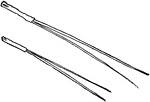
Leaves - simple; indeterminate in position because of their closeness, but arrange along the branches in two-leaved sheathed bunches. Leaf - needle-shape, one and three fourths to two and three fourths inches long, stiff, bluntish; on the outer side smooth and rounded; on the inner side flat, and rough downwards. Cones - one and three fourths to three inches long, usually single and pointing downward. Scales - tipped with a stiff, straight prickle. Bark - of the trunk, rough and blackish. Young branches smooth (in other pines scaly). Twigs - purplish. Found - from Long Island along the coast to South Carolina, and through eastern and Middle Kentucky to Southeastern Indiana; in sandy and generally barren soil. General Information - An evergreen tree fifteen to forty feet high, irregular in shape and with straggling, spreading, or drooping branches. The timber is very "pitchy," soft, and durable, but poor even for fuel. "Next to the Gray Pine, the Jersey Pine is the most uninteresting species of the United States." - Michaux, f.

Genus Pinus, L. (Pine)

Leaves - simple; indeterminate in position because of their closeness, but arrange along the branches…
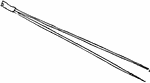
Leaves - simple; indeterminate in position because of their closeness, but arranged along the branches in two-leaved sheathed bunches. Leaf - needle-shape, about two and one half inches long, stiff; outer side smooth and rounded; inner side hollowed. Cones - about three and one half inches long, of a light yellow color, stemless, often united in clusters of fours. Scales - with a stout spine, widening at its base, one sixth of an inch in length. Found - within narrower limits than any other American Pine; along the Alleghany Mountains from Pennsylvania to Tennessee, especially upon Table Mountain in North Carolina, one of the highest peaks of the range. General Information - A tree ten to fifty feet high, with light and soft wood, largely used for charcoal.

Genus Pinus, L. (Pine)

Leaves - simple; indeterminate in position because of their closeness, but arranged along the branches…
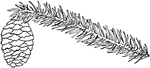
Leaves - simple; indeterminate in position because of their closeness; arranged singly and thickly all around the branchlets. Leaf - needle-shape, five twelfths to two thirds of an inch long, four-sided, mostly straight, stiff, and sharp; dark green. Cones - three fourths to one and one half inches long, drooping at the ends of the branchlets; broad oval; dark purple when young, becoming reddish-brown as they ripen. Scales - long reverse egg-shape, thin, with a wavy or toothed edge toward their apex. Found - along the Alleghany Mountains from the high peaks of North Carolina to Pennsylvania, through the Northern States, andGeneral Information - An evergreen tree thirty to sixty feet high, with straight, tapering trunk. The wood is light and straight-grained and is used for lumber, for the masts and spars of ships, in building, etc. From its twigs is prepared the "essence of spruce."

Genus Picea, Link. (Spruce)

Leaves - simple; indeterminate in position because of their closeness; arranged singly and thickly all…
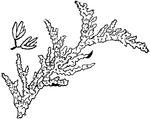
Leaves - simple; indeterminate in position because of their smallness and closeness. They are scale-like, somewhat egg-shape, overlapping each other, and closely pressed in four rows up and down the very flat branchlets. Each leaf has at its centre a raised gland, easily distinguished if held between the eye and the light. Bark - fibrous. The "spray" (formed from the flat branchlets) is itself flat and of rather a bright green. Cones - about five twelfths of an inch in length, long oval or reverse egg-shape, nodding, yellowish-brown as they ripen, dry and opening to the base when ripe. Scales - pointless, oval or egg-shape, smooth (i. e., not pointed on the edge or near the centre.) Seeds - one to two under each scale, long and narrow (like a small caraway seed); broadly winged all around, with the wing notched at one end. Found - along the Alleghany Mountains from the high peaks of North Carolina to Northern Pennsylvania and Central New York, northward into Southern Canada and westward; along rocky banks of streams and in swamps; very common at the North, where it often occupies large areas of swamp land. It is very widely cultivated, especially in hedges. General Information - A tapering evergreen tree, twenty to fifty feet high, with close, dense branches, and a light and durable wood.

Genus Thuya, L. (Arbor Vitae)

Leaves - simple; indeterminate in position because of their smallness and closeness. They are scale-like,…
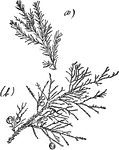
Leaves - simple; indeterminate in position because of their smallness and closeness. They are arranged in four rows up and down the branchlets. In younger or rapidly growing sprouts the leaves are awl-shaped or needle-shaped, somewhat spreading from the branch, very sharp and stiff, placed in pairs (or sometimes in threes), usually about one fourth of an inch long, and with the fine branchlets, which they cover, rounded. In the older and slower-growing trees the leaves are scale-like and overlapping, egg-shape, closely pressed to the branchlets which they cover, and with the branchlets square. As the branchlets grow, the lower scales sometimes lengthen and become dry and chaffy and slightly spreading. Bark - brown and sometimes purplish-tinged, often shredding off with age and leaving the trunk smooth and polished. Berries - about the size of a small pea, closely placed along the branchlets, bluish, and covered with a whitish powder. Found - in Southern Canada, and distributed nearly throughout the United States - more widely than any other of the cone-bearing trees. General information - An evergreen tree, fifteen to thirty feet high (much larger at the South), usually pyramid-shaped, with a rounded base, but varying very greatly, especially near the coast, where it is often twisted and flattened into angular and weird forms. The wood is very valuable, light, straight-grained, durable, fragrant. It is largely used for posts, for cabinet-work, for interior finish, and almost exclusively in the making of lead pencils. The heart-wood is usually a dull red (whence the name), the sap-wood white.  Among the most picturesque objects in the Turkish landscape, standing like sentinels, singly or in groups, and slender and upright as a Lombardy Poplar, are the black cypress trees (C. sempervirens). They mark the sites of graves, often of those which have long since disappeared. In America, more than any other northern tree, the red cedar gives the same sombre effect, whether growing wild or planted in cemeteries. The Common Juniper (J. communis, L.), common as a shrub, is occasionally found in tree form, low, with spreading or drooping branches, and with leaves resembling those of a young Red Cedar, awl-shaped and spreading, but arranged in threes instead of opposite.

Genus Juniperus, L. (Red Cedar)

Leaves - simple; indeterminate in position because of their smallness and closeness. They are arranged…
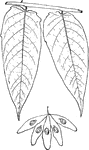
Leaves - compound (odd-feathered, but with the odd leaflet often dwarfed or broken off; leaflets, twenty-one to forty-one); alternate; edge of the leaflets entire, with one or two coarse, blunt teeth at each side of their base. Outline - of leaflet, long egg-shape or lance-shape. Apex - taper-pointed. Base, squared, or heart-shaped. Leaf/Stem - smooth, round, swollen at base. Leaflet/Stems - smooth and short. Leaf - one and a half to six feet long. Leaflets variable, usually about six inches by two and a quarter, rather smooth and thin. Bark - of the trunk, smooth and brown; the new shoots marked with whitish dots. Flowers - in long bunches at the ends of the branches; greenish, and of very disagreeable odor. June, July. Seeds - flat, at the centre of greenish and sometimes pink-tinged wings, in large, loose clusters. October. Found - common in cultivation, and to some extent naturalized. General Information - A large, showy tree (sixty to seventy feet high) of remarkable vigorous and rapid growth. It is a native of China. A Jesuit missionary sent its seeds in 1751 to England. In 1784 it was brought from Europe to the United States, and started near Philadelphia. Also about 1804 it was brought to Rhode Island from South America. But the source of most of the trees now found abundantly in the region of New York is Flushing, Long Island, where it was introduced in 1820. It has been a great favorite, and would deserve to be so still were it not for the peculiar and disagreeable odor of its flowers. Ailanthus, from a Greek word meaning "tree of heaven." Ailanthus - This spelling of the name should rule because so given by its author, although, etymologically, Ailantus would be correct, the native Amboyna name being "Aylanto."

Genus Ailanthus, Desf.

Leaves - compound (odd-feathered, but with the odd leaflet often dwarfed or broken off; leaflets, twenty-one…
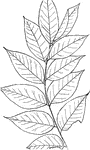
Leaves - unequally twice-compound (odd-feathered; leaflets very numerous - seven to thirteen on the different branches of the main leaf-stem; alternate; edge of leaflets entire. Outline - leaflets, egg-shape or oval. Apex - sharply taper-pointed. Base, slightly heart-shaped or rounded. Leaf-stem - in the autumn takes a violet tinge. Leaf - one and one half to three feet long, about one half as wide. Leaflets, one to two and one half inches long, of a dull green. Bark - of trunk, rough and scaly, separating in small and hard crosswise and backward-curled strips. Branchlets stout and not thorny. Flowers - in white spikes along the branches. May-July. Fruit - in large curved pods (Six to ten inches long, by two inches broad), pulpy within, of a reddish-brown color, flattened and hard. Each pod contains several hard, gray seeds one half of an inch or more in diameter. September, October. Found - in Franklin County, Pennsylvania (Porter), Western New York, westward and southward to Middle Tennessee. Not common. General information - A tree sixty to eighty feet high, or more, with a rather small and regular head. The fewness and the abruptness of its large branches give to it in the winder a dead and stumpy look, whence one of its common names. Its bruised and sweetened leaves are used at the South for poisoning flies. Its seeds were formerly used as a substitute for coffee.

Genus Gymnocladus, Lam. (Coffee Tree)

Leaves - unequally twice-compound (odd-feathered; leaflets very numerous - seven to thirteen on the…
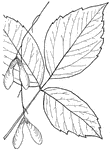
Leaves - compound (odd-feathered; leaflets, three, sometimes five, rarely seven); opposite; edge of leaflet remotely and unequally coarse-toothed. Outline - of leaflets, egg-shape or oval. Apex - taper-pointed. Base - variable and often uneven. Leaflets - slightly rough; the ribs very marked. Bark - of young trunks, smoothish and yellowish-green; twigs, light green. Flowers - small and greenish, in delicate, drooping clusters from the sides of the branches. Fruit - large, yellowish-green, smooth, in long, loose, late-hanging clusters. Found - North, South, and West. One of the most widely distributed of the North American trees, with its finest growth in the region of the Wabash and Cumberland rivers. General Information - A tree twenty to thirty feet high, with spreading branches. Its wood is light and of slight value.

Genus Negundo, Moench

Leaves - compound (odd-feathered; leaflets, three, sometimes five, rarely seven); opposite; edge of…
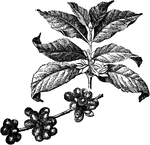
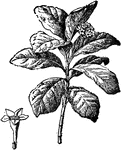
Paraguay tea leaves of South America.

Tea Plant

Paraguay tea leaves of South America.

Coffee beans of South America.

Coffee Plant

Coffee beans of South America.

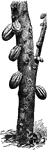
Cacao tree of South America where chocolate is made from.

Cacao

Cacao tree of South America where chocolate is made from.

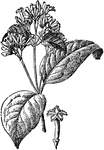
The Ipecac plant of South America.

Ipecac

The Ipecac plant of South America.

The Cinchona plant of South America.

Cinchona

The Cinchona plant of South America.

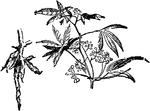
The Cassava plant of South America.

Cassava

The Cassava plant of South America.

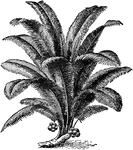
The Vegetable Ivory plant of South America.

Vegetable Ivory

The Vegetable Ivory plant of South America.

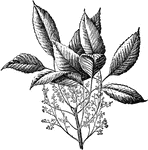
The India Rubber plant of South America.

India Rubber

The India Rubber plant of South America.

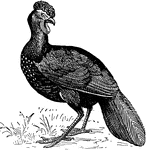
South American bird related to the partridge.

Guan

South American bird related to the partridge.

The seal of the United States.

United States Seal

The seal of the United States.

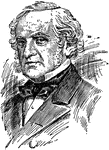
(1795-1869) American merchant and philanthropist, most noted for his donations to education in the South and to promote arts and sciences.

George Peabody

(1795-1869) American merchant and philanthropist, most noted for his donations to education in the South…
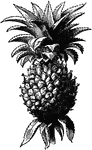
The popular fruit which is native to South America.

Pineapple

The popular fruit which is native to South America.

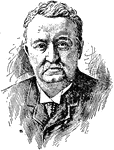
(1853-1902) "A South African statesman, known as the Empire Builder." -Foster, 1921

Cecil Rhodes

(1853-1902) "A South African statesman, known as the Empire Builder." -Foster, 1921

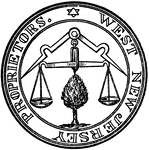
The seal of the western part of the New Jersey colony.

Seal of West Jersey

The seal of the western part of the New Jersey colony.

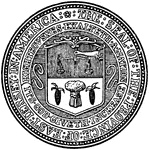
The seal of the eastern part of the New Jersey colony.

Seal of East Jersey

The seal of the eastern part of the New Jersey colony.

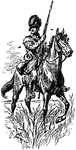
An American soldier fighting the English for the south in the Revolutionary War.

Revolutionary Soldier

An American soldier fighting the English for the south in the Revolutionary War.
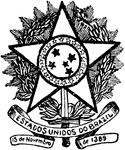
The coat of arms of Brazil.

Brazilian Coat of Arms

The coat of arms of Brazil.

The coat of arms of Chile.

Chilean Coat of Arms

The coat of arms of Chile.

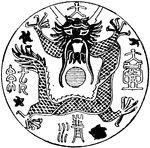
The coat of arms of China.

Chinese Coat of Arms

The coat of arms of China.

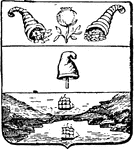
The coat of arms of Colombia.

Colombian Coat of Arms

The coat of arms of Colombia.

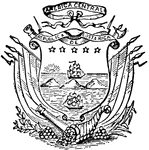
The coat of arms of Costa Rica.

Costa Rican Coat of Arms

The coat of arms of Costa Rica.

The coat of arms of Dominican Republic.

Dominican Republic Coat of Arms

The coat of arms of Dominican Republic.

The Coat of Arms of Ecuador.

Ecuador Coat of Arms

The Coat of Arms of Ecuador.

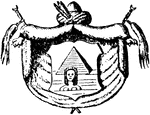
The Coat of Arms of Egypt.

Egyptian Coat of Arms

The Coat of Arms of Egypt.

The Coat of Arms of France.

French Coat of Arms

The Coat of Arms of France.

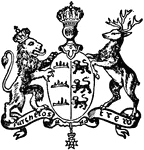
The Coat of Arms of Wurtemberg.

Wurtemberg Coat of Arms

The Coat of Arms of Wurtemberg.

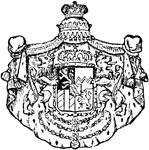
The Coat of Arms of Bavaria.

Bavarian Coat of Arms

The Coat of Arms of Bavaria.

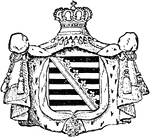
The Coat of Arms of Saxony.

Saxony Coat of Arms

The Coat of Arms of Saxony.

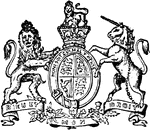
The Coat of Arms of Great Britain.

Great Britain Coat of Arms

The Coat of Arms of Great Britain.

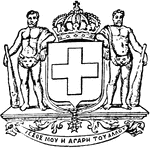
The Coat of Arms of Greece.

Greek Coat of Arms

The Coat of Arms of Greece.

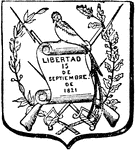
The Coat of Arms of Guatemala.

Guatemalan Coat of Arms

The Coat of Arms of Guatemala.

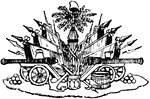
The Coat of Arms of Haiti.

Haitian Coat of Arms

The Coat of Arms of Haiti.

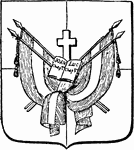
The Coat of Arms of Honduras.

Honduran Coat of Arms

The Coat of Arms of Honduras.

The seal of the Seminole Nation.

Seminole Seal

The seal of the Seminole Nation.

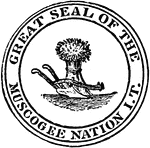
The seal of the Muscogee Nation.

Muscogee Seal

The seal of the Muscogee Nation.

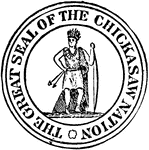
The seal of the Chickasaw Nation.

Chickasaw Seal

The seal of the Chickasaw Nation.