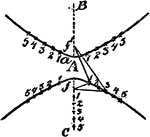
An illustration showing how to construct a hyperbola by plotting. "Having given the transverse axis BC, vertexes Aa, and foci ff'. Set off any desired number of parts on the axis below the focus, and number them 1,2,3,4,,5,etc. Take the distance a1 as radius, and, with f' as center, strike the cross 1 with f'1=a1. With the distance A1, and the focus f as center, strike the cross 1 with the radius F1=A1, and the cross 1 is a point in the hyperbola."

Construction Of A Hyperbola

An illustration showing how to construct a hyperbola by plotting. "Having given the transverse axis…
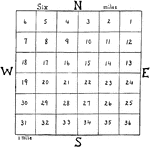
"A regular township, according to United States surveys, is 6 miles square and is divided into 36 equal parts or sections, each section containing 640 acres and measuring one mile square...How many acres or land in 4.75 sections? How many more acres in 7.5 sections than there are in 3 sections? How many acres of land in .5 section?, 2.5 sections?, 5 sections? How many more acres in 3.5 sections than in 2 sections?" -Foster, 1921

Land Measurement

"A regular township, according to United States surveys, is 6 miles square and is divided into 36 equal…
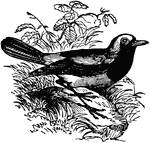
A bird belonging to the family Sylviadae, nearly allied to the nearest, but having a more slender form and a more slender bill. It is found in almost all parts of Britain as a summer bird of passage, and has a soft sweet song.

Redstart Bird

A bird belonging to the family Sylviadae, nearly allied to the nearest, but having a more slender form…
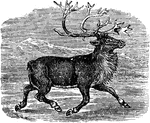
A species of deer found in the northern parts of Europe and Asia. It has branched, recurved, round antlers, the summits of which are palmated; the antlers of the male are much larger than those of the females.

Reindeer

A species of deer found in the northern parts of Europe and Asia. It has branched, recurved, round antlers,…
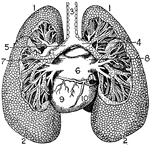
"The Lungs. 1, Summit of lungs. 2, Base of lungs. 3, Trachea. 4, Right bronchus. 5, Left bronchus. 6, Left aurical of heart. 7, Left superior pulmonary vein. 8, Right superior pulmonary vein. 9, Left ventricle of heart. 10, Right ventricle of heart." -Foster, 1921

Lungs

"The Lungs. 1, Summit of lungs. 2, Base of lungs. 3, Trachea. 4, Right bronchus. 5, Left bronchus. 6,…
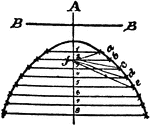
An illustration showing how to construct a parabola by plotting. "Having given the axis, vertex, and focus of the parabola. Divide the transverse axis into any desired number of parts 1, 2, 3, etc., and draw ordinates through the divisions; take the distance A1, and set it off on the 1st ordinate from the focus f to a, so that A1 = fa. Repeat the same operation with the other ordinates - that is, set off the distance A5 from f to e, so that A5 = fe; and so the parabola is constructed."

Construction Of A Parabola

An illustration showing how to construct a parabola by plotting. "Having given the axis, vertex, and…
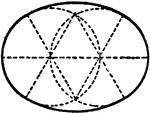
An illustration showing how to construct an ellipse using circle arcs. "Divide the long axis into three equal parts, draw the two circles, and where they intersect one another are the centers for the tangent arcs of the ellipses as shown by the figure."

Construction Of An Ellipse

An illustration showing how to construct an ellipse using circle arcs. "Divide the long axis into three…
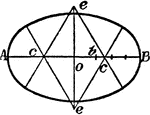
An illustration showing how to construct an ellipse using circle arcs. "Given the two axes, set off the short axis from A to b, divide b into three equal parts, set off two of these parts from o towards c and c which are the centers for the ends of the ellipse. Make equilateral triangles on cc, when ee will be the centers for the sides of the ellipse. If the long axis is more than twice the short one, this construction will not make a good ellipse."

Construction Of An Ellipse

An illustration showing how to construct an ellipse using circle arcs. "Given the two axes, set off…
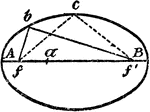
An illustration showing how to construct an ellipse. Given the two axes, set off half the long axis from c to ff, which will be the two focuses in the ellipse. Divide the long axis into any number of parts, say a to be a division point. Take Aa as radius and f as center and describe a circle arc about b, take aB as radius and f as center describe another circle arc about b, then the intersection b is a point in the ellipse, and so the whole ellipse can be constructed."

Construction Of An Ellipse

An illustration showing how to construct an ellipse. Given the two axes, set off half the long axis…
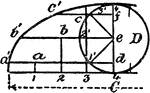
An illustration showing how to construct a cycloid. "The circumference C=3.14D. Divide the rolling circle and base line C into a number of equal parts, draw through the division point the ordinates and abscissas, make aa' = 1d, bb' = 2'e, cc = 3f, then ab' and c' are points in the cycloid. In the Epicycloid and Hypocycloid the abscissas are circles and the ordinates are radii to one common center."

Construction Of A Cycloid

An illustration showing how to construct a cycloid. "The circumference C=3.14D. Divide the rolling circle…
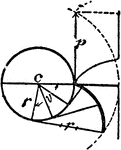
An illustration showing how to construct an evolute of a circle. "Given the pitch p, the angle v, and radius r. Divide the angle v into a number of equal parts, draw the radii and tangents for each part, divide the pitch p into an equal number of equal parts, then the first tangent will be one part, second two parts, third three parts, etc., and so the Evolute is traced."

Construction Of An Evolute Of A Circle

An illustration showing how to construct an evolute of a circle. "Given the pitch p, the angle v, and…
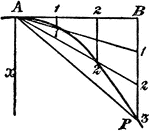
An illustration showing how to construct a parabola. "Given the vertex A, axis x, and a point P. Draw AB at right angle to x, and BP parallel to x, divide AB and BP into an equal number of equal parts. From the vertex A draw lines to the divisions on BP, from the divisions on AB draw the ordinates parallel to x, the corresponding intersections are points in the parabola."

Construction Of A Parabola

An illustration showing how to construct a parabola. "Given the vertex A, axis x, and a point P. Draw…
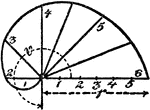
An illustration showing how to construct an arithmetic spiral. "Given the pitch p and angle v, divide them into an equal number of equal parts, say 6; make 01 = 01, 02 = 02, 03 = 03, 04 = 04, 05 = 05, and 06 = the pitch p; then join the points 1, 2, 3, 4, 5 and 6, which will form the spiral required."

Construction Of An Arithmetic Spiral

An illustration showing how to construct an arithmetic spiral. "Given the pitch p and angle v, divide…
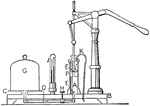
"A pump for exhausting air and other gases from a closed space, or for compressing air within an enclosed space." -Foster, 1921

Air Pump

"A pump for exhausting air and other gases from a closed space, or for compressing air within an enclosed…
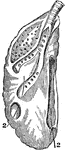
In birds the lungs are confined to the back wall of the chest. They are not separated into lobes, but are oblong and flattened in shape, and connected with a series of air-receptacles scattered through various parts of the body. Shown is the right lung of a goose. Labels: 1, A bronchial tube which divides into two tubes that open into the abdominal air-receptacles (2).

The Right Lung of a Goose

In birds the lungs are confined to the back wall of the chest. They are not separated into lobes, but…
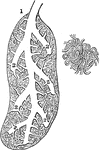
In birds the lungs are confined to the back wall of the chest. They are not separated into lobes, but are oblong and flattened in shape, and connected with a series of air-receptacles scattered through various parts of the body. Shown is a section of a bird lung, magnified. Labels: 1, A bronchial tube that ends in a sac (caeca). 2, Division of the bronchial tubes that branch out among lobules. B, A plexus of capillary vessels.

Section of the Lung of a Bird

In birds the lungs are confined to the back wall of the chest. They are not separated into lobes, but…
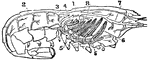
In the class of Crustacea there is a single ventricle, which receives the blood from the gills and propels it to other parts of the body. Shown is the heart and arteries of a lobster. Labels: 1, The heart. 2, The abdominal artery. 5, Venous sinuses. 6, The branchia from which the blood returns to the hear.

The Heart and Arteries of a Lobster

In the class of Crustacea there is a single ventricle, which receives the blood from the gills and propels…
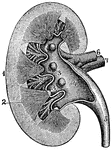
A longitudinal section of a kidney. Labels: 1, 2, 3, Parts of the Kidney. 4, Pelvis. 5, Ureter. 6, Renal artery. 7, Renal vein. 8, Branches of the latter vessels in the kidney.

Longitudinal Section of a Kidney

A longitudinal section of a kidney. Labels: 1, 2, 3, Parts of the Kidney. 4, Pelvis. 5, Ureter. 6, Renal…
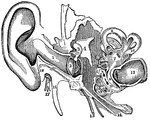
A view of all the parts of the ear, Labels: 1, The tube that leads to the internal ear. 2, The membrana tympani. 3, 4, 5, The bones of the ear. 7, The central part of the labyrinth, names the vestibule. 8, 9, 10, The semicircular canals. 11, 12, The channels of the cochlea. 13, The auditory nerve. 14, The channel from the middle ear to the throat (Eustachian tube). 15, A nerve. 16, A process. 17, The seventh pair of nerves (facial). 18, A process of the temporal bone.

Parts of the Ear

A view of all the parts of the ear, Labels: 1, The tube that leads to the internal ear. 2, The membrana…
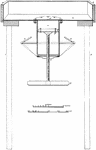
"The principal working parts of the apparatus are the sheet of boiler plate a (fig. 100), the cylinder c, the piston head p, the screw s, and conduit plate d...f, frame." -Walcott, 1901

Intrusion Machine

"The principal working parts of the apparatus are the sheet of boiler plate a (fig. 100), the cylinder…
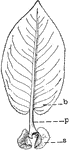
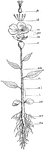
"Leaf of a willow (Salix sp.). b, blade; p, petiole; s, stipules." -Gager, 1916

Willow Leaf

"Leaf of a willow (Salix sp.). b, blade; p, petiole; s, stipules." -Gager, 1916

"Diagram to show the essential parts of a "flowering" plant. t.r., tap-root; cot. seed-leaf (cotyledon); i, internode; a.l, leaf-axil; n, node; a.b, axillary buud; r, receptacle of floral organs; ca, calyx; per, perianth; co, corolla; st, stamens (androecium); pi, pistil (gynoecium)." -Gager, 1916

Flower Parts

"Diagram to show the essential parts of a "flowering" plant. t.r., tap-root; cot. seed-leaf (cotyledon);…
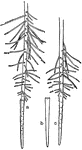
"Roots of the water-hyacinth (Eichornia crassipes Solms), showing removable root-caps; b, root-cap removed from c." -Gager, 1916

Water Hyacinth Roots

"Roots of the water-hyacinth (Eichornia crassipes Solms), showing removable root-caps; b, root-cap removed…
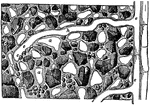
"Diagram to illustrate a root-hair (h) in the soil, and its relation to the soil-particles, the capillary film of water (w), and the air spaces (a); e, epidermal cell of the root, of which the root-hair is an out-growth, or branch." -Gager, 1916

Roots in Soil

"Diagram to illustrate a root-hair (h) in the soil, and its relation to the soil-particles, the capillary…
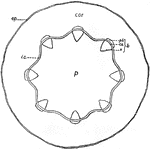
"Diagram showing tissue-systems in young stem of castor-oil plant (Ricinus communis), as seen in cross-section. ep, epidermis; cor, cortex; p, pith or medulla; b, fibro-vascular bundle; ph, phloem; ca, cambium; x, xylem; ic, interfascicular cambium." -Gager, 1916

Castor-Oil Plant Stem

"Diagram showing tissue-systems in young stem of castor-oil plant (Ricinus communis), as seen in cross-section.…
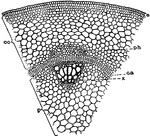
"The castor-oil plant (Ricinus communis). Portion of cross-section of young stem. co, Cortex; p, pith or medulla; e, epidermis; ph, phloem; ca, cambium; x, xylem. The last three elements compose the fibro-vascular bundle, the cambium being continuous from bundle to bundle; the portion between the bundles is called interfascicular cambium." -Gager, 1916

Castor-Oil Plant Stem

"The castor-oil plant (Ricinus communis). Portion of cross-section of young stem. co, Cortex; p, pith…
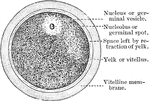
The diagram of a human ovum, showing the parts of an animal cell.

A Diagram of the Human Ovum

The diagram of a human ovum, showing the parts of an animal cell.

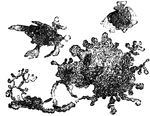
Flat, pigmented, branched connective tissue cells from the sheath of a large blood vessel of a frog's mesentery. The pigment is not distributed uniformly throughout the substance of the larger cell, consequently some parts of it look blacker than others (uncontracted state). In the two smaller cells most of the pigment is withdrawn into the cell body, so that they appear smaller, blacker, and less branched.

Connective Tissue Cells from a Frog

Flat, pigmented, branched connective tissue cells from the sheath of a large blood vessel of a frog's…
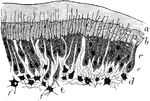
Part of section of developing tooth of a young rat, showing the mode of deposition of the dentine. Labels: a, outer layer of fully formed dentine; b, uncalcified matrix with one or two nodules of calcareous matter near the calcified parts; c, odontoblasts sending processes into the dentine; d, pulp; e, fusiform or wedge-shape cells found between odontoblasts; f, stellate cells of pulp in fibrous connective tissue. The section is stained in carmine, which colors the uncalcified matrix, but not the calcified part.

Deposition of Dentine

Part of section of developing tooth of a young rat, showing the mode of deposition of the dentine. Labels:…
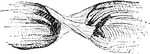
Muscular fiber torn across; the sarcolemma still connecting the two parts of the fiber.

Torn Muscular Fiber

Muscular fiber torn across; the sarcolemma still connecting the two parts of the fiber.
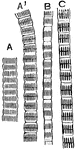
Sarcostyles from the wing muscle of a wasp. A, A'. A sarcostyles showing degrees of retraction. B. A sarcostyle extended with the sarcous element separated into two parts. C. Sarcostyles moderately extended.

Sarcostyles from Wasp

Sarcostyles from the wing muscle of a wasp. A, A'. A sarcostyles showing degrees of retraction. B. A…
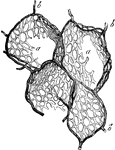
The form of the capillary network presents considerable variety in the different textures of the body: the varieties consists principally of modifications of two chief kind of mesh, the rounded and the elongated. The kind in which the meshes or interspaces have a roundish form is the most common, and prevails in those parts which the capillary network is most dense, such as the lungs. Shown is the network of capillary vessels of the air cells of the horse's lung magnified. Labels: a, capillaries proceeding from b, terminal branched of the pulmonary artery.

Capillary Vessels of Air Cells

The form of the capillary network presents considerable variety in the different textures of the body:…
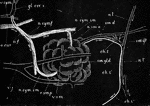
Diagrammatic representation of the submaxillary gland of the dog with its nerves and blood vessels. Labels: sm. gld., the submaxillary gland into the duct (sm. d.) of which a cannula has been tied. The sublingual gland and duct are not proceeding from the facial nerve, becoming conjoined with the lingual at n.l'., and afterwards diverging and passing to the gland along the duct; sm. gl., submaxillary ganglion with its roots; n. l., the lingual nerve proceeding to the tongue; a. car., the carotid artery. two branches of which, a. sm. a. and r. sm. p. pass to the anterior and posterior parts of the gland; v. sym., the conjoined vagus and sympathetic trunks; gl. cer. s., the superior cervical ganglion, two branches of which forming a plexus, a.f., over the facial artery are distributed (n.sym.sm.) along the two glandular arteries to the anterior and posterior portion of the gland. The arrows indicate the direction taken by the nervous impulses; during reflex stimulations of the gland they ascend to the brain by the lingual and descend by the chorda tympani.

Submaxillary Gland of Dog with Nerves and Blood Vessels

Diagrammatic representation of the submaxillary gland of the dog with its nerves and blood vessels.…
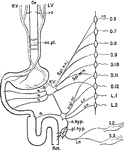
Diagrammatic representation of the nerves of the alimentary canal. Oe to Rct, the various parts of the alimentary canal from esophagus to rectum: L.V, left vagus, ending in front of stomach; rl, recurrent laryngeal nerve, supplying upper part of esophagus; R.V, right vagus, joining left vagus in esophageal plexus; oe.pl., supplying the posterior part of the stomach , and continues at R'V' to join the solar plexus, here represented by a single ganglion, and connected with the inferior mesenteric ganglion m.gl.: a, branches from the solar plexus to stomach and small intestine , and from the mesenteric ganglia and rami communicantes; r.c., belonging to dorsal nerves from the 6th to the 9th (or 10th); Spl.min., small splanchnic nerve similarly from the 10th and 11th dorsal nerves. These both join the solar plexus, and thence make their way to the alimentary canal; c.r., nerves from the ganglia, &c., belonging to 11th and 12th dorsal and 1st and 2nd lumbar nerves, proceeding to the inferior mesenteric ganglia (or plexus), m.gl., and thence by the hypogastic nerve, n.hyp., and the hypogastric nerve, n.hyp., and the hypogastric plexus, pl.hyp., to the circular muscles of the rectum; 1.r., nerves from the 2nd and 3rd sacral nerves, S.2, S.3 (nervi erigentes) proceeding by the hypogastric plexus to the longitudinal muscles of the rectum.

Nerves of the Alimentary Canal

Diagrammatic representation of the nerves of the alimentary canal. Oe to Rct, the various parts of the…
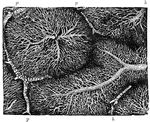
The liver is made up of small roundish or oval portions called lobules, each of which is composed of minute branches of the portal vein, hepatic artery, hepatic duct, and hepatic vein. Shown is the capillary network of the lobules of the rabbit's liver. The figure is taken from a very successful injection of the hepatic veins showing nearly the whole of two lobules, and parts of three others. Labels: p, portal branches running in the interlobular spaces; h, hepatic veins penetrating and radiating from the center of the lobules.

Capillary Network in the Lobules of a Rabbit's Liver

The liver is made up of small roundish or oval portions called lobules, each of which is composed of…
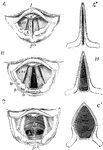
Three laryngoscopic view of the superior aperture of the larynx and surrounding parts. Labels: A, the glottis during the emission of a high note in singing; B, in easy and quite inhalation of air; C, in the state of widest possible dilation, as in inhaling a very deep breath. The diagrams A', B', and C', show in horizontal sections of the glottis in position of the vocal ligaments and arytenoid cartilages in the three several states represented in the other figures. In all the figures, so far as marked, the letters indicate the parts as follows, viz. : l, the base of the tongue; e, the upper free part of the epiglottis; e', the tubercle or cushion of the epiglottis; p h, part of the anterior all of the pharynx behind the larynx; in the margin of the aryteno-epiglottisdean fold w, the swelling of the membrane caused by the cartilages of Wrisberg; s. that of the cartilages of Santorini: a, the tip or summit of the arytenoid cartilages; c v, the true vocal cords r lips of the rima glottidis; c v s, the superior or false vocal cords; between them the ventricle of the larynx; in C, tr, is placed on the anterior wall of the receding trachea, and b indicated the commencement of the two bronchi beyond the bifurcation which may be brought into view in this state of extreme dilation.

Movement of the Vocal Cords

Three laryngoscopic view of the superior aperture of the larynx and surrounding parts. Labels: A, the…
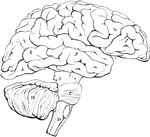
Plan in outline of the encephalon, as seen from the right side. The parts are represented as separated from one another somewhat more than natural, so as to show their connections. A, cerebrum; f, g, h, its anterior middle, and posterior lobes; e, fissure of Sylvius; B, cerebellum; C, pons Varolii; D, medulla oblongata; a, peduncles of the cerebellum; C, pons Varolii; D, medulla oblongata; A, peduncles of the cerebrum; b, c, d, superior, middle, and inferior peduncles of the cerebellum.

Outline of the Encephalon

Plan in outline of the encephalon, as seen from the right side. The parts are represented as separated…
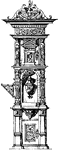
This Toilet-stand clock-case was made during the German Renaissance in 1597. A slender tall cabinet, the upper and lower parts of which are provided with doors, which holds various necessary objects, while the center takes the form of a niche. Inside the niche hangs a metal water-reservoir with a lid and a drain. It also includes metal wrought-iron towel-holders.

Toilet-Stand Clock-Case

This Toilet-stand clock-case was made during the German Renaissance in 1597. A slender tall cabinet,…
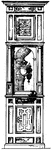
This Toilet-stand clock-case was made during the German Renaissance. Made of various colored wood, it was a slender tall cabinet where the upper and lower parts included doors, which holds various necessary objects. The center takes the form of a niche and inside the niche hangs a metal water-reservoir with a lid and a drain. It also includes metal wrought-iron towel-holders.

Toilet-Stand Clock-Case

This Toilet-stand clock-case was made during the German Renaissance. Made of various colored wood, it…
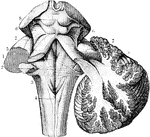
The cerebellum in section and fourth ventricle, with the neighboring parts. Labels: 1, median groove of fourth ventricle, ending below in the calamus scriptorius, with the longitudinal eminence formed by the fasciculi teretes, one on each side; 2, the same groove, at the place where the white streaks of th auditory nerve emerge from it to cross the floor of the ventricle; 3, in inferior crus or peduncle of the cerebellum, formed by the restiform body; 4, posterior pyramid; above this is the calamus scriptorius; 5, superior crus of cerebellum, or processus e cerebello ad cerebrum( or ad testes); 6, fillet to the side of the crura cerebri; 7, lateral grooves of the crura cerebri; 8, corpora quadrigemina.

The Cerebrum and Fourth Ventricle of the Brain

The cerebellum in section and fourth ventricle, with the neighboring parts. Labels: 1, median groove…
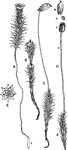
"Hair-cap moss (Polytrichum commune). A, male plant; B, same, proliferating; C, female plant, bearing sporogonium; D, same; g, gametophyte; s, seta; c, capsule; o, operculum; a, calyptra, E, top view of male plant." -Gager, 1916

Hair-Cap Moss

"Hair-cap moss (Polytrichum commune). A, male plant; B, same, proliferating; C, female plant, bearing…
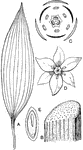
"Morphology of typical monocotyledonous plant. A, leaf, parallel-veined; B, portion of stem, showing irregular distribution of vascular bundles; C, ground plan of flower (the parts in 3's); D, top view of flower; E, seed, showing monocotyledonous embryo." -Gager, 1916

Monocotyledonous Morphology

"Morphology of typical monocotyledonous plant. A, leaf, parallel-veined; B, portion of stem, showing…
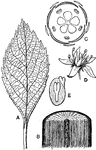
"Morphology of a typical dicotyledonous plant. A, leaf, pinnately-netted veined; B, portion of stem, showing concentric layers of wood; C, ground-plan of flower (the parts in 5's); D, perspective of flower; E, longitudinal section of seed, showing dicotyledonous embryo." -Gager, 1916

Dicotyledonous Morphology

"Morphology of a typical dicotyledonous plant. A, leaf, pinnately-netted veined; B, portion of stem,…
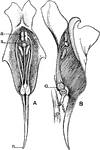
"Sections of flowers of the toad-flax (Linaria vulgaris). A, front view; a, anthers; s, stigma; n, nectar-gland. B, side view; o, ovary." -Gager, 1916

Common Toadflax

"Sections of flowers of the toad-flax (Linaria vulgaris). A, front view; a, anthers; s, stigma; n, nectar-gland.…
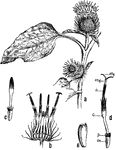
"Inflorescence and flowers of the burdock (Arctium minus). a, Inflorescences; b, longitudinal section of the same; c, bud of individual flower; d, mature flower; sty, stigma; stig, style; a, ring of syngenesius anthers; c, corolla; p, pappus (calyx); ov, ovary; e, mature seed." -Gager, 1916

Lesser Burdock

"Inflorescence and flowers of the burdock (Arctium minus). a, Inflorescences; b, longitudinal section…
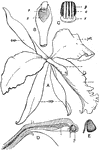
"Floral organs of an orchid (Cattleya sp.). A, the entire flower; sep, sepal; pet, petal; B, column, showing s, stigma and r, the rostellum (beak), with the small glands at the tip; to the glands are attached the four strap-shaped caudicles of the pollinia; C, pollinia, with the four caudicles; below, the gland; D, longitudinal section of the column; p, pollinium; E, the same, enlarged." -Gager, 1916

Orchid Organs

"Floral organs of an orchid (Cattleya sp.). A, the entire flower; sep, sepal; pet, petal; B, column,…
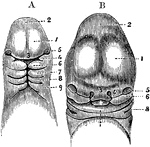
A, Magnified view of the head and neck of a human embryo of three weeks. Labels: 1, anterior cerebral vesicle or cerebrum; 2, middle cerebral vesicle; 3, middle or frontonasal process; 4, superior maxillary process, or first visceral arch, and below it the first cleft; 7, 8, 9, second, third, and fourth arches and clefts. B, Anterior view of the head of a human fetus of about the fifth week. 1, 2, 3, 5, the same parts as in A; 4, the external nasal or lateral frontal process: 6, the superior maxillary process; 7, the lower jaw; X, the tongue; 8, first branchial cleft becoming the meatus auditorius externus.

Head of an Embryo

A, Magnified view of the head and neck of a human embryo of three weeks. Labels: 1, anterior cerebral…
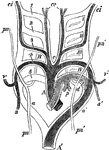
Diagram of the aortic arches in a mammal, showing transformations which give rise to the permanent arterial vessels. A, primitive arterial stem or aortic bulb, now divided into A, the ascending part of the aortic arch, and p, the pulmonary; a, a', right and left aortic roots; A', descending aorta; 1, 2, 3, 4, 5, the five primitive aortic or branchial arches; I, II, III, IV, the four branchial clefts which, for the sake of clearness, have been omitted on the right side. The permanent systemic vessels are deeply, the pulmonary arteries lightly, shaded; the parts of the primitive arches which are transitory are simply outlined; c, placed between the permanent common carotid arteries; c e, external carotid arteries; c i, internal carotid arteries; s, right subclavian, rising from the right aortic root beyond the fifth arch; v, right vertebral from the same, opposite the fourth arch; v' s', left vertebral and subclavian arteries rising together from the left, or permanent aortic root, opposite the forth arch; p, pulmonary arteries rising together from the left fifth arch, forming ductus arteriosus; p n, p n', right and left pneumogastric nerves descending in from of aortic arch, with their recurrent branches represented diagrammatically as passing behind, to illustrate the relations of these nerves respectively to the right subclavian artery (4) and the arch of the aorta and ductus arteriosus (d).

Aortic Arches in a Mammal

Diagram of the aortic arches in a mammal, showing transformations which give rise to the permanent arterial…
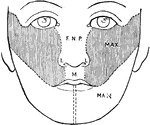
Showing the development of the face. F.N.P., Part formed from the frontonasal process; L, from its lateral and M., from its mesial parts; MAX., formed by the maxillary process; MAN., formed by the mandibular process.

Development of the Face

Showing the development of the face. F.N.P., Part formed from the frontonasal process; L, from its lateral…
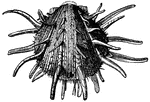
"The more remarkable species of the genus <em>Spondylus</em>; their valves are unequal. A native of the Indian Ocean and rarely met with."

Spondylus Regius (Linn.)

"The more remarkable species of the genus Spondylus; their valves are unequal. A native of…
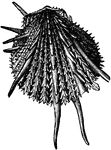
"The more remarkable species of the genus <em>Spondylus</em>; their valves are unequal."

Spondylus Imperialis (Chemn.)

"The more remarkable species of the genus Spondylus; their valves are unequal."
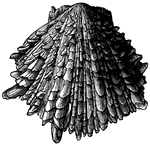
"The more remarkable species of the genus <em>Spondylus</em>; their valves are unequal."

Spondylus Crassisquama (Lamarck.)

"The more remarkable species of the genus Spondylus; their valves are unequal."
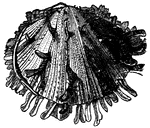
"The more remarkable species of the genus <em>Spondylus</em>; their valves are unequal."

Spondylus Gaederopus (Lina.)

"The more remarkable species of the genus Spondylus; their valves are unequal."
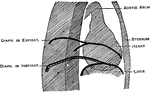
Orthodiagram of the thorax. The position of parts is shown in extreme inspiration; the position of the diaphragm and liver in expiration is also shown.

Orthodiagram of the Thorax

Orthodiagram of the thorax. The position of parts is shown in extreme inspiration; the position of the…
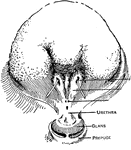
Condition of parts in extroversion of the bladder.

Bladder

Condition of parts in extroversion of the bladder.

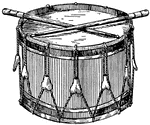
"The snare drum, having two heads, the upper one only being played upon by two sticks of wood; strings or snares, are stretched across the lower one, giving a peculiar resonant tone." -Foster, 1921

Snare Drum

"The snare drum, having two heads, the upper one only being played upon by two sticks of wood; strings…
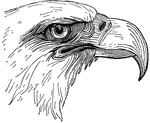
The head of the bald eagle.

Bald Eagle Head

The head of the bald eagle.

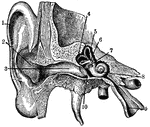
"Section through right ear. 1, helix; 2, concha; 3, outer passage; 4, 5, 6, semi-circular canals; 7, oval window; 8, cochlea; 9, Eustachian tube; 10, eardrum." -Foster, 1921

Ear

"Section through right ear. 1, helix; 2, concha; 3, outer passage; 4, 5, 6, semi-circular canals; 7,…
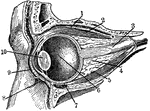
"Section through the left eye, closed. 1, lifting muscle; 2, upper straight muscle; 3, optic nerve; 4, fatty cushion; 5, lower straight muscle; 6, vitreous humor; 7, lower cross muscle; 8, lower eyelid; 9, upper eyelid; 10, crystalline lens." -Foster, 1921

Eye Section

"Section through the left eye, closed. 1, lifting muscle; 2, upper straight muscle; 3, optic nerve;…
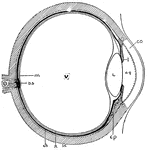
"Cross-section of the eye. Parts: co, cornea; I, iris; aq, anterior chamber of aqueous humor; L, lens; cp, ciliary process; sc, sclerotic coat; R, retina; ch, choroid; V, vitreous body; m, yellow spot; bs, blind spot; O, optic nerve." -Foster, 1921

Eye Cross-Section

"Cross-section of the eye. Parts: co, cornea; I, iris; aq, anterior chamber of aqueous humor; L, lens;…