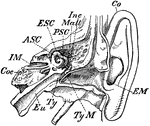
"Transverse Section through Side Walls of Skull, showing the Inner Parts of the Ear. Co, concha or external ear, or pinna; EM, external auditory meatus; TyM, tympanic membrane; Inc, incus; Mall, malleus; ASC, PSC, ESC, anterior, posterior, and external semicircular canals; Coc, cochlea; Eu, Eustachian tube; IM, internal auditory meatus, through which the auditory nerve passes to the organ of hearing." -Whitney, 1911

Inner Ear

"Transverse Section through Side Walls of Skull, showing the Inner Parts of the Ear. Co, concha or external…
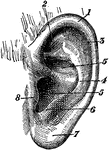
"External Ear, or Pinna. 1, helix; 2, fossa of antihelix, or fossa triangularis; 3, fossa of helix, or fossa scaphoidea; 4, antihelix; 5, 5, concha; 6, antitragus; 7, lobule; 8, tragus." -Whitney, 1911

External Ear

"External Ear, or Pinna. 1, helix; 2, fossa of antihelix, or fossa triangularis; 3, fossa of helix,…
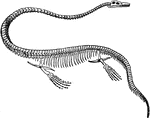
The skeleton of an elasmosaurus, a dinosaur in the order of plesiosaurs.

Elasmosaurus Skeleton

The skeleton of an elasmosaurus, a dinosaur in the order of plesiosaurs.

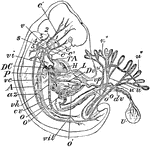
"Early Human Embryo, giving diagrammatically the principal vessels antecedent to the establishment of the regular fetal circulation. H, heart; P, lungs; L, liver; T A, the aortic trunk or cardiac aorta; c, c', c", common, external, and internal carotids; s, subclavian artery; v, vertebral artery; 1, 2, 3, 4, 5, the aortic arches (the persistent left aortic arch hidden); A, subvertebral aorta; o, o', omphalomeseraic artery and vein, to and from U, the umbilical vesicle with its vitelline duct, dv; u, u, the two hypogastric or umbilical arteries, with the ramifications, u", u", in the placenta; u', umbilical vein; vh, hepatic vein; cv, inferior vena cava; vil, iliac veins; az, an azygous vein; vc, a posterior cardinal vein; vi, innominate vein; vp, portal vein; Dv, the ductus venosus; DC, a ductus Cuvieri. The anterior cardinal vein is seen beginning in the head and running down to the ductus Cuvieri, on the under side of the numbers 1, 2, 3, 4, 5." -Whitney, 1911

Human Embryo

"Early Human Embryo, giving diagrammatically the principal vessels antecedent to the establishment of…
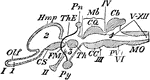
"Diagram of Vertebrate Encephalon ... in longitudinal vertical section. Mb, mid-brain; in front of it all is forebrain, behind it all is hind-brain; laminaterminalis, represented by the heavy black line in upper figure; Olf, olfactory lobes; Hmp, cerebral hemispheres; ThE, thalamencephalon; Py, pituitary body; FM, foramen of Monro; CS, corpus striatum; Th, optic thalamus; CQ, corpora quadrigemina; CC, crura cerebri; Cb, cerebellum; PV, pons Varolii; MO, medulla oblongata; I, olfactory nerves; II, optic nerves; III, point of ext from brain of the oculimotores; IV, of the pathetici; VI, of the abducentes; V-XII, origins of other cerebral nerves; 1, olfactory ventricle; 2, lateral ventricle; 3, third ventricle; 4, fourth ventricle." -Whitney, 1911

Encephalon

"Diagram of Vertebrate Encephalon ... in longitudinal vertical section. Mb, mid-brain; in front of it…
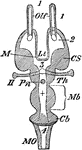
"Diagram of Vertebrate Encephalon ... in horizontal section. Mb, mid-brain; in front of it all is forebrain, behind it all is hind-brain; Lt, laminaterminalis; Olf, olfactory lobes; Pn, pineal body, or conarium; M, foramen of Monro; CS, corpus striatum; Th, optic thalamus; Cb, cerebellum; MO, medulla oblongata; I, olfactory nerves; II, optic nerves; 1, olfactory ventricle; 2, lateral ventricle; 3, third ventricle; 4, fourth ventricle; + is in the iter e tertio ad quartum ventriculum." -Whitney, 1911

Encephalon

"Diagram of Vertebrate Encephalon ... in horizontal section. Mb, mid-brain; in front of it all is forebrain,…
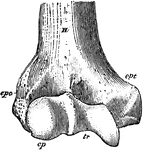
"Anterior View, Distal End, of Right Humerus of a Man. H, humerus; epc, epicondyle, or external supracondyloid protuberance; ept, epitrochlea, or internal supracondyloid protuberance; cp, capitellum, or convex articular suface for head of radius; tr, trochlea, or transversely concave articular surface for the ulna; epc and cp are together the ectocondyle, and ept and tr are together the entocondyle." -Whitney, 1911

Humerus

"Anterior View, Distal End, of Right Humerus of a Man. H, humerus; epc, epicondyle, or external supracondyloid…
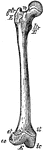
"Right Femur of a Youth. E, E, epiphyses; gtr, ltr, greater and lesser trochanter; h, head; et, it, external and internal tuberosity; ec, ic, external and internal condyle; n, neck." -Whitney, 1911

Youth Femur

"Right Femur of a Youth. E, E, epiphyses; gtr, ltr, greater and lesser trochanter; h, head; et, it,…
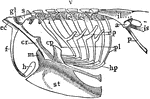
"Epipleurae.-- Thorax, scapular arch, and part of pelvic arch of a bobolink (Dolichonyx oryzivorus). ep, four epipleurae or uncinate processes of as many ribs; pl, pleurapophysial parts of seven ribs; hp, hemapopysial parts of six ribs; v, dorsolumbar vertebrae; st, sternum (the letters are on the carina or keel); m, manubrium sterni; cp, costal process of sternum, bearing f, furcula; ec, epiclidium of furcula; h, hypoclidium of fucula; gl, glenoid fossa, formed by coracoid and scapula; il, ilium; is, ischium; p, pubis; a, acetabulum." -Whitney, 1911

Bobolink Epipleurae

"Epipleurae.-- Thorax, scapular arch, and part of pelvic arch of a bobolink (Dolichonyx oryzivorus).…
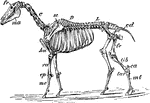
"Skeleton of Horse (Equus caballus). fr, frontal bone; C, cervical vertebrae; D, dorsal vertebrae; L, lumbar vertebrae; cd, caudal vertebrae; sc, scapula; pe, pelvis; ma, mandible; hu, humerus; ra, radius; cp, carpus; mc, metacarpus; fe, femur; tib, tibia; ca, calcaneum; tar, tarsus; mt, metatarsus; p, phalanges." -Whitney, 1911

Horse Skeleton

"Skeleton of Horse (Equus caballus). fr, frontal bone; C, cervical vertebrae; D, dorsal vertebrae; L,…
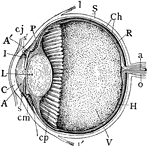
"Human Eye, in Median Vertical Anteroposterior Section. (Ciliary processes shown, through not all lying in this section.) A, anterior, and A', posterior chambers of aqueous humor; a, central artery of retina; C, cornea; Ch, choroid; cj, conjunctiva; cm, ciliary muscle; cp, ciliary processs; H, hyaloid; I, iris; L, crystalline lens in its capsule (the reference-line passes through the pupil); l, l', insertion of tendon of superior and inferior rectus muscles; o, optic nerve; P, canal of Petit; R, retina; S, sclerotic; s, s', circular sinus or canal of Schlemm; V, vitreous body filling back part of the eye." -Whitney, 1911

Median Vertical Anteroposterior Section of Eye

"Human Eye, in Median Vertical Anteroposterior Section. (Ciliary processes shown, through not all lying…
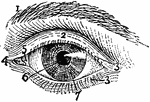
"Exterior of Left Human Eye. 1, supercilium, or eyebrow; 2, palpebra superior, or upper eyelid; 3, 3, cilia, or eyelashes; 4, caruncula lacrymalis; 5, plica semilunaris; 6, pupil; 7, iris." -Whitney, 1911

Exterior of Left Human Eye

"Exterior of Left Human Eye. 1, supercilium, or eyebrow; 2, palpebra superior, or upper eyelid; 3, 3,…
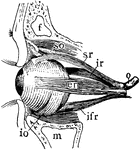
"Muscles of Left Human Eyeball. so, superior oblique, passing through a trochlea or pulley; io, inferior oblique; sr, superior rectus; ifr, interior rectus; ir, internal rectus; er, external rectus; f, frontal sinus; m, maxillary sinus; o, optic nerve." -Whitney, 1911

Muscles of Left Eyeball

"Muscles of Left Human Eyeball. so, superior oblique, passing through a trochlea or pulley; io, inferior…
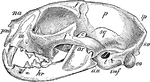
"Skull of Cat (Felis catus), showing the following bones, viz. : na, nasal; pm, premaxillary; m, maxillary; l, lacrymal; f, frontal; j, jugal; pa, palatine; p, parietal; sq, squamosal; ip, interparietal; so, supra-occipital; eo, exoccipital (the line leads to the occipital condyle); t, tympanic bulla; smf, stylomastoid foramen; mf, mental foramen; c, coronoid process of mandible; ar, ascending ramus of mandible; hr, horizontal ramus of mandible; an, angle of jaw." -Whitney, 1911

Domestic Cat Skull

"Skull of Cat (Felis catus), showing the following bones, viz. : na, nasal; pm, premaxillary; m, maxillary;…
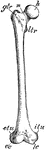
"Anterior View of Human Right Femur. ec, external condyle; etu, external tuberosity; ic, internal condyle; itu, internal tuberosity; ltr, lesser trochanter; gtr, great trochanter; h, head; n, neck." -Whitney, 1911

Anterior View of Human Right Femur

"Anterior View of Human Right Femur. ec, external condyle; etu, external tuberosity; ic, internal condyle;…
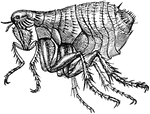
The human flea (Pulex irritans) is a parasite in the the Siphonaptera order of fleas.

Human Flea

The human flea (Pulex irritans) is a parasite in the the Siphonaptera order of fleas.

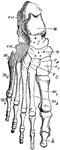
"Bones of Human Foot, or Pes, the third principal segment of the hind limb, consisting of tarsus, metatarsus, and phalanges. a, astralagus; ca, calcaneum; n, navicular, or scaphoid; co, cuboid; c1, c2, c3, entocuneiform, mesocuneiform, and ectocuneiform, or inner, middle, and outer cuneiform bones. The foregoing seven bones constitute the tarsus, and m1 to m5, first to the fifth metatarsal, constitue the metatarsus. The remaining fourteen bones are the phalanges, three to each digit excepting the great toe; h, distal phalanx of the hallux or great toe." -Whitney, 1911

Bones of Human Foot

"Bones of Human Foot, or Pes, the third principal segment of the hind limb, consisting of tarsus, metatarsus,…
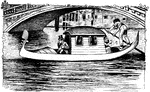
An illustration of a human powered boat with three passengers.

Boat Under Bridge

An illustration of a human powered boat with three passengers.

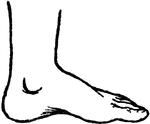
An illustration of a human foot.

Foot

An illustration of a human foot.

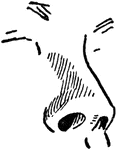
An illustration of a human nose.

Human Nose

An illustration of a human nose.

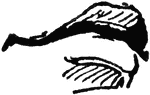
An illustration of a human mouth.

Human Mouth

An illustration of a human mouth.

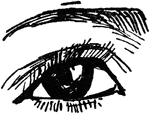
An illustration of a human eye.

Human Eye

An illustration of a human eye.

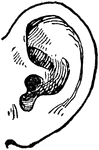
An illustration of a human ear.

Human Ear

An illustration of a human ear.

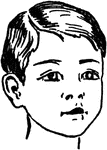
An illustration of the head of a boy.

Head of a Boy

An illustration of the head of a boy.

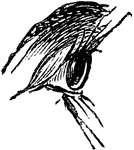
An illustration of an eye.

Eye

An illustration of an eye.

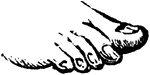
An illustration of a human toes.

Toes

An illustration of a human toes.

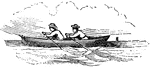
An illustration of a rowboat.

Rowboat

An illustration of a rowboat.

"Cats purr, dogs bark, cocks crow, a cow lows, a donkey brays, an eagle screams, parrots talk, spiders tick, mankind laugh and cry." -Trowbridge, 1866

Animal Rebus

"Cats purr, dogs bark, cocks crow, a cow lows, a donkey brays, an eagle screams, parrots talk, spiders…
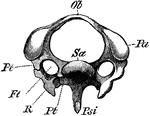
"Third cervical vertebra of Woodpecker (Picus viridis). (Viewed anteriorly.) Ft, vertebrarterial foramen; Ob, upper arch ; Pa, articular process; Psi, haemal spine ; Pt, Pt, the two bars of the transverse process, shewn on one side ancylosed with the cervical rib (R); Sa articular surface of centrum. (From Wieersheim.) A. H. Evans, 1900

The Diagram of a Third Cervical Vertebra of a Woodpecker

"Third cervical vertebra of Woodpecker (Picus viridis). (Viewed anteriorly.) Ft, vertebrarterial foramen;…
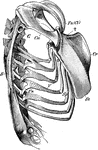
"Skeleton of the trunk of a Falcon. Ca, coracoid, which articulates with the sternum (St) at ; Cr, keel of sternum; Fu (Cl), furcula (clavicles); G, glenoid cavity for humerus; S, scapula; Un uncinate process; V, vertebral, and Sp, sternal, portion of rib. (From Wiedersheim.)" A. H. Evans, 1900

The Skeleton of the Trunk of a Falcon

"Skeleton of the trunk of a Falcon. Ca, coracoid, which articulates with the sternum (St) at ; Cr, keel…
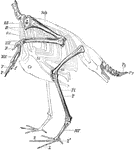
"Skeleton of the Limbs and Tail of a Carinate Bird. (The skeleton of the body is indicated by dotted lines.) F, digits; Fi, fibula; HW, carpus; MF, tarsometatarsus; MH, carpometacarpus; OA, humerus; OS, femur; Py, pygostyle; R, coracoid; Ul, ulna; Sch, scapula; St, sternum, with its keel (Cr); T, tibiotarsus; Rd, radius; Z, Z, digits of foot. (From Wiedersheim.)" A. H. Evans, 1900

Skeleton of the Limbs and Tail of a Carinate Bird

"Skeleton of the Limbs and Tail of a Carinate Bird. (The skeleton of the body is indicated by dotted…
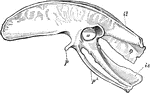
"Pelvis of Apteryx austrlis. Lateral view. a, Acetabulum; il, ilium; is, ischium; p, pectineal process of pubis; p, pubis." (From Wiedersheim.)" A. H. Evans, 1900

Diagram of the Pelvis of a Kiwi

"Pelvis of Apteryx austrlis. Lateral view. a, Acetabulum; il, ilium; is, ischium; p, pectineal process…
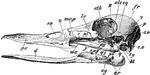
"Skull of a Wild Duck (Anus boscas), from the side. ag, Angular; als, alisphenoid; ar, articular; bt, basitemporal; d, dentaryl en, external nostrils, e.o, exoccipital; eth, ethmoid; fr, frontal; j, jugal; lc, lacrymal; mx, maxilla; mx.p, maxillopalatine process; n, nasal, parietal; pg, pterygoid; pl, palatine; ps, presphenoid; px, premaxilla; q, quadrate; q.j, quadratojugal; s.ag, supra-angular; s.o, supraoccipital; sq, squamosal; ty, tympanic cavity; v, vomer; II, foramen for optic nerve; V, for trigeminal." (From Wiedersheim.)" A. H. Evans, 1900

Diagram of the Skull of a Wild Duck

"Skull of a Wild Duck (Anus boscas), from the side. ag, Angular; als, alisphenoid; ar, articular; bt,…
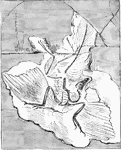
"Archaeornithes is at present represented by but one member, the first undoubted fossil Bird, made known in 1861 by Andreas Wagner form the Jurassic slate formation of Solenhofen in Bavaria, and now preserved in a British Museum. This he described under the name of Griphosaurus; but as Hermann von Meyer had already bestowed the title of Archaeopteryx Lithographica upon a bird, presumably identical, a feather of which had been obtained from the above system." A. H. Evans, 1900 This sample was obtained from the Limestone in Berlin

Archaeopteryx Lithographica

"Archaeornithes is at present represented by but one member, the first undoubted fossil Bird, made known…
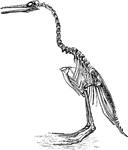
"Hesperornis regalis, (a fossilized restoration) which stood about three feet high, had blunt teeth in the grooves of both maxilla and mandible, the number being thirty or more below, but considerably less above, where they did not reach to the exterior extremity. The bill was long and pointed, the rami of the lower jaw being entirely separate; the head was rather small, the neck long, and the quadrate bone articulated with the skull by one knob only. The sternum was long, broad, and flat, without keel; the furcula was decidedly reduced, the metatarsus, being little more than a humerus; the tail was fairly long and broad, but had no pygostyle." A. H. Evans, 1900

The Restoration of the Hesperornis Regalis

"Hesperornis regalis, (a fossilized restoration) which stood about three feet high, had blunt teeth…
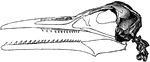
"Ichthyornis victor and I. dispar, ...were small forms of about the size of a Partridge, with the habits and appearance, it is presumed, of Terns or Gulls. The head was extremely large in proportion to the remainder of the skeleton; the beak was long and pointed, with entirely separate rami to the mandible; the sharp teeth, fixed regularly in distinct sockets, were inclined backwards, and occupied the whole of the lower and at least the posterior half of the upper jaw; the keel of the sternum was large and broad; the dorsal and cervico-dorsal vertebrae were biconcave. the quadrate articulated to the skull by one knob,... the metatarsus was short and the whole foot small; a furcula was probably present; the wings were well developed, indicating great powers of flight; while the tail was comparatively short, and ended in a pygostyle." A. H. Evans, 1900

Skeleton Head of a Ichthyornis

"Ichthyornis victor and I. dispar, ...were small forms of about the size of a Partridge, with the habits…
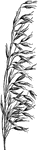
The common oat (Avena sativa) is a species of cereal grain grown for its seed. While oats are suitable for human consumption as oatmeal and rolled oats, one of the most common uses is as livestock feed. Oats make up a large part of the diet of horses and are regularly fed to cattle as well. Oats are also used in some brands of dog and chicken feed.

Oat

The common oat (Avena sativa) is a species of cereal grain grown for its seed. While oats are suitable…
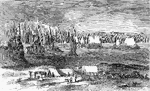
In the Dakotah (Dakota) Territory, the area know as the Bad Lands, is a sunken area thirty miles wide and ninety miles long. It is a type of arid terrain where softer sedimentary rocks and clay-rich soils have been extensively eroded by wind and water. From the bottom of this sunken plain rise domes, pinnacles, monuments, and massive walls. The most impressive feature of this scene is the multitude of fossil bones which appear built into the massive masonry of this mimic architecture.

Bad Lands of Dakota

In the Dakotah (Dakota) Territory, the area know as the Bad Lands, is a sunken area thirty miles wide…
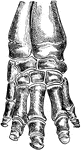
Homology of digits of odd toed mammals, showing gradual reduction in number and consolidation of bones. This figure displays an elephant foot showing five digits.

Bones of Elephant's Foot

Homology of digits of odd toed mammals, showing gradual reduction in number and consolidation of bones.…
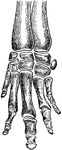
Homology of digits of odd toed mammals, showing gradual reduction in number and consolidation of bones. This figure displays a coney showing five digits.

Bones of Coney's Foot

Homology of digits of odd toed mammals, showing gradual reduction in number and consolidation of bones.…
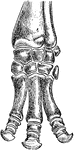
Homology of digits of odd toed mammals, showing gradual reduction in number and consolidation of bones. This figure displays a rhinoceros showing three digits.

Bones of Rhonoceros' Foot

Homology of digits of odd toed mammals, showing gradual reduction in number and consolidation of bones.…

Homology of digits of odd toed mammals, showing gradual reduction in number and consolidation of bones. This figure displays a horse showing one digit.

Bones of Horse's Foot

Homology of digits of odd toed mammals, showing gradual reduction in number and consolidation of bones.…
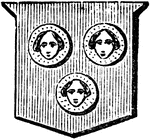
"Gules, three bezants figured. FIGURED. Those bearings which are depicted with a human face, are said to be figured." -Hall, 1862

Bezants Figured

"Gules, three bezants figured. FIGURED. Those bearings which are depicted with a human face, are said…
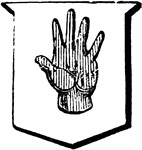
"KNIGHT AND BARONET. A degree of honour next to a baron, created by King James I. to induce the English gentry to settle in the province of Ulster. The title is knight and baronet; it is hereditary: the arms are distinguished by an augmentation of a human hand gules, generally borne on an escutcheon in the centre of the shield." -Hall, 1862

Knight and Baronet of King James I

"KNIGHT AND BARONET. A degree of honour next to a baron, created by King James I. to induce the English…
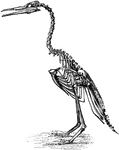
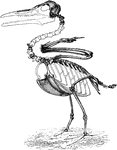
"Hesperornis regalis, (a fossilized restoration) which stood about three feet high, had blunt teeth in the grooves of both maxilla and mandible, the number being thirty or more below, but considerably less above, where they did not reach to the exterior extremity. The bill was long and pointed, the rami of the lower jaw being entirely separate; the head was rather small, the neck long, and the quadrate bone articulated with the skull by one knob only. The sternum was long, broad, and flat, without keel; the furcula was decidedly reduced, the metatarsus, being little more than a humerus; the tail was fairly long and broad, but had no pygostyle." A. H. Evans, 1900

Restoration of Hesperornis regalis

"Hesperornis regalis, (a fossilized restoration) which stood about three feet high, had blunt teeth…
"Ichthyornis, though the wings are well developed, with fused metacarpals, and the sternum is keeled, the vertebrae present the extraordinary primitive character of being biconcave." Elliot Coues, 1884. This bird is believed to come from the Cretaceous of North America and is a seabird."

Restoration of Ichthyornis

"Ichthyornis, though the wings are well developed, with fused metacarpals, and the sternum is keeled,…
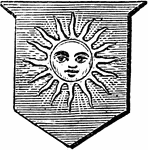
"Azure, a sun in its splendour. SOL, or THE SUN IN ITS SPLENDOUR. The sun is said to be in its splendour when it is figured (that is, delineated with a human face) and surrounded with rays. Sometimes this figure is called a sun in its glory." -Hall, 1862

Sun in its Splendor

"Azure, a sun in its splendour. SOL, or THE SUN IN ITS SPLENDOUR. The sun is said to be in its splendour…
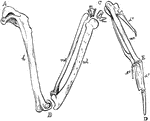
"Fig 27. - Bones of the right wing of a duck, Clangula islandica, A, shoulder, omos; B, elbow, ancon; C, wrist, carpus; D, end of principal finger; E, end of hand proper, metacarpus. AB, upper arm, brachium; BC, fore-arm, antibrachium; CD, whole hand or pinion, manus; composed of CE, hand proper or metacarpus, excepting d2; ED, or d2, d3, d4, fingers, digits, digiti, h, humerus; rd, radius; ul, ulna; sc, outer carpal, scapholunare or radiale; cu, inner carpal, cuneiforme or ulnare; these two composing wrist or carpus. mc, the compound hand-bone or metcarpus, composed of three metacarpal bones, bearing as many digits - the outer digit seated upon a protuberance at the head of the metacarpal, the other two situated at the end of the bone. d2, the outer or radial digit, commonly called the thumb or pollex, composed or two phalanges; d3, the middle digit, of two phalanges; d4, the inner or ulnar digit, of one phalanx d2 is the seat of the feathers of the bastard wing or alula. D to C (whole pinion), seat of the flight feathers called primaries; C to B (fore-arm), seat of the secondaries; at B and above it in direction of A, seat of tertiaries proper; below A, in direction of B, seat of scapularies (upon pteryla humeralis), often called tertiaries. The wing shown half-spread: complete extension would bring A B C D into a right line; in complete folding C goes to A, and D to B; all these motions nearly in the plane of the paper. The elbow-joint and wrist are such perfect hinges, that, in opening or closing the wing, C cannot sink below the paper, nor D fly up above the paper, as would otherwise be the effect of the pressure of the air upon the flight-feathers. Observe also rd and ul are two rods connecting B and C; the construction of their joining at B and C, and with each other, is such, that they can slide lengthwise a little upon each other. Now when the point C, revolving about B, approaches A in the arc of a circle, rd pushes on sc, while ul pulls back cu; the motion is transmitted to D, and makes this point approach B. conversely, in opening the wing, rd pulls back sc, and ul pushes on cu, making D recede from B. In other words, the angle A B C cannot be increased or diminished without similarly increasing or diminishing the angle B C D; so that no part of the wing can be opened or shut without automatically opening or shutting the rest..." Elliot Coues, 1884

The Bones of the Right Wing of a Duck

"Fig 27. - Bones of the right wing of a duck, Clangula islandica, A, shoulder, omos; B, elbow, ancon;…
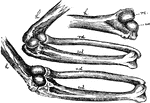
"Fig. 28. - Mechanism of elbow-joint. ..., where rc and uc show respectively the size, shape, and position of the radial condyle and ulnar condyle of the humerus. It is evident that in the flexed state of the elbow, as shown in the middle figure, the radius, rd, is do pushed upon that its end projects beyond ul, the ulna; while in the opposite condition of extension, shown in the lower figure, rd is pulled back to a corresponding extent." Elliot Coues, 1884

Mechanism of the Elbow-Joint

"Fig. 28. - Mechanism of elbow-joint. ..., where rc and uc show respectively the size, shape, and position…
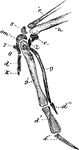
"Fig. 29., from a young grouse (Centrocercus urophasianus, six months old), is designed to show the composition of the carpus and metacarpus before the elements of these bones fuse together: r, radius; u, ulna; s, scapholunar or radiale; c, cuneiform or ulnare; om, a carpal bone believed to be os magnum, later fusing with the metacarpus; z, a carpal bone, supposed to be unciform, later fusing with metacarpus; 8, an unidentified fifth carpal bone, which may be called pentosteon, later fusing with the metacarpus; 7, radial or outer metacarpal bone, bearing the pollex or outer digit, consisting of two phalanges, d and k; 9', principal (median) metacarpal bone, bearing the middle finger, consisting of the two phalanges, d', d"; 9, inner or ulnar metacarpal, bearing a digit of one phalanx, d'". The pieces marked om, z, 7, 8, 9,. all fuse with 9'. (From nature by Dr. R. W. Shufeldt, U.S.A.)."Elliot Coues, 1884

The Wing Bones of a Young Grouse

"Fig. 29., from a young grouse (Centrocercus urophasianus, six months old), is designed to show the…

"Fig. 31. - Ulna of Colaptes mexicanus, showing points of attachment of the secondaries. (Dr. R. W. Shufeldt, U. S. A.)." Elliot Coues, 1884

Red Shafted Woodpecker Ulna

"Fig. 31. - Ulna of Colaptes mexicanus, showing points of attachment of the secondaries. (Dr. R. W.…
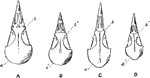
"Fig. 114. -Skulls of Turdidae and Sylvicolidae, nat. size; after Shufeldt. A, Oroscoptes montanus; B, Sialia mexicana; C, Cinclus mexicanus; D, Siurus naevius. Observe likeness between A and B, at points marked c, c', l, l'; and between C and D, at points marked b, b,' d, d'." Elliot Coues, 1884

Bird Skulls

"Fig. 114. -Skulls of Turdidae and Sylvicolidae, nat. size; after Shufeldt. A, Oroscoptes montanus;…
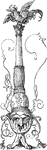
This margin drawing was created by German artist Albrecht Dürer in 1515. It is found in the prayer book of Emperor Maximilian. It is in the shape of a pole with an bird at the top and a human head at the bottom that is partly covered with wings. It stands on a bird's feet.

Margin Drawing

This margin drawing was created by German artist Albrecht Dürer in 1515. It is found in the prayer…
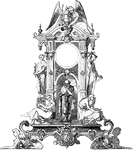
This clock-stand is richly designed with human figures.

Clock-Stand

This clock-stand is richly designed with human figures.

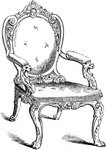
This chair has a simple scroll design around the edges. It has animal heads on the front ends of the arm rests and a human head on the top back of the chair.

Chair

This chair has a simple scroll design around the edges. It has animal heads on the front ends of the…
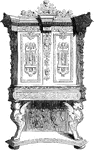
This cabinet is carved in oak by using a method of burning wood into a desired pattern. The ornamental design is of human figures, animals, and leaf scrolls.

Cabinet

This cabinet is carved in oak by using a method of burning wood into a desired pattern. The ornamental…
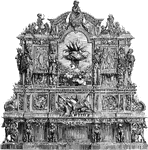
This sideboard is carved in walnut wood in a French Renaissance style. It is richly decorated with human figures and fruit at the top half, and at the base various animals.

Sideboard

This sideboard is carved in walnut wood in a French Renaissance style. It is richly decorated with human…
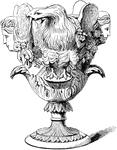
This vase is a maltese design that stands on a pedestal with an unusual design of large bird in the center, and large human figure heads encircling the vase.

Vase

This vase is a maltese design that stands on a pedestal with an unusual design of large bird in the…
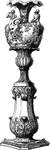
This flower stand with vase is a maltese design. The stand has a simple leaf design with a base that rests on animal claws, while its top flares out. The vase is richly designed with flowers and leaves and unusual human figures seated on each side, as well as, a large horned human head.

Flower Stand with Vase

This flower stand with vase is a maltese design. The stand has a simple leaf design with a base that…
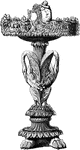
This flower stand has a design on its column of two birds with lowered heads. The top is richly decorated with flowers and two human figures.

Flower Stand

This flower stand has a design on its column of two birds with lowered heads. The top is richly decorated…