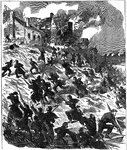
The Battle of Fredericksburg, fought in and around Fredericksburg, Virginia, from December 11 to December 15, 1862, between General Robert E. Lee's Confederate Army of Northern Virginia and the Union Army of the Potomac, commanded by Maj. Gen. Ambrose E. Burnside, is remembered as one of the most one-sided battles of the American Civil War.

The Attack on Fredericksburg

The Battle of Fredericksburg, fought in and around Fredericksburg, Virginia, from December 11 to December…
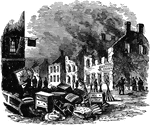
The Battle of Fredericksburg, fought in and around Fredericksburg, Virginia, from December 11 to December 15, 1862, between General Robert E. Lee's Confederate Army of Northern Virginia and the Union Army of the Potomac, commanded by Maj. Gen. Ambrose E. Burnside, is remembered as one of the most one-sided battles of the American Civil War.

Scene in Fredericksburg on the Morning of Dec. 12, 1862

The Battle of Fredericksburg, fought in and around Fredericksburg, Virginia, from December 11 to December…
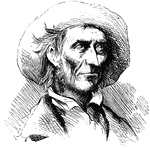
An illustration of a Florida Cracker. Florida Cracker refers to the original colonial era American pioneer settlers of the State of Florida. The first Florida Crackers arrived in 1763 when Spain traded Florida to Great Britain. The British divided the territory into East Florida and West Florida, and began to aggressively recruit settlers to the area, offering free land and financial backing for export-oriented business.

Florida Cracker

An illustration of a Florida Cracker. Florida Cracker refers to the original colonial era American pioneer…
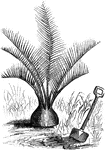
Arrowroot, or obedience plant (Maranta arundinacea), is a large perennial herb of genus Maranta found in rainforest habitats. Arrowroot is also the name of the edible starch from the rhizomes (rootstock) of West Indian arrowroot.

Arrowroot

Arrowroot, or obedience plant (Maranta arundinacea), is a large perennial herb of genus Maranta found…
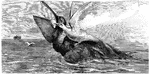
An illustration of a brown pelican with a fish in it's mouth and a sea gull resting on his back. The brown pelican is the smallest of the eight species of pelican, although it is a large bird in nearly every other regard. It lives strictly on coasts from Washington and Virginia south to northern Chile and the mouth of the Amazon River, as well as the island of Saut d'Eau in Trinidad and Tobago. Some immature birds may stray to inland freshwater lakes. After nesting, North American birds move in flocks further north along the coasts, returning to warmer waters for winter. Their young are hatched in broods of about 3, and eat around 150 lbs. of fish in the 8-10 month period they are cared for. Gulls (often informally Seagulls) are birds in the family Laridae. They are typically medium to large birds, usually gray or white, often with black markings on the head or wings. They typically have harsh wailing or squawking calls. They have stout, longish bills, and webbed feet.

Brown Pelican and Sea Gull

An illustration of a brown pelican with a fish in it's mouth and a sea gull resting on his back. The…
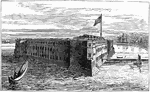
The Fort Zachary Taylor State Historic Site, better known simply as Fort Taylor, (or Fort Zach to locals), is a Florida State Park and National Historic Landmark centered on a Civil War-era fort located near the southern tip of Key West, Florida. Construction of the fort began in 1845 as part of a mid-1800s plan to defend the southeast coast through a series of forts. The fort was named for United States President Zachary Taylor in 1850, a few months after President Taylor's sudden death in office. Yellow fever epidemics and material shortages slowed construction of the fort, which continued throughout the 1850s.

Fort Taylor

The Fort Zachary Taylor State Historic Site, better known simply as Fort Taylor, (or Fort Zach to locals),…
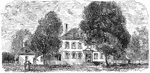
Westover Plantation is located on the north bank of the James River in Charles City County, Virginia. It is located on State Route 5, a scenic byway which runs between the independent cities of Richmond and Williamsburg. It is a US National Historic Landmark. Westover Plantation was formerly claimed to have been built circa 1730 by William Byrd II, the founder of Richmond; this date appears in the 1960 designation of the house as a National Historic Landmark. However, recent dendrochronologic testing on boards and planks in the house shows that they actually date to the 1750s, and this is the date of construction now recognized by the National Park Service. Therefore the house was probably built by William Byrd III, not his father William Byrd II. The house is noteworthy for its secret passages, magnificent gardens, and architectural details. The grounds and garden are open 9 a.m. to 6 p.m. daily, but the house is not open to the public.

Westover Plantation

Westover Plantation is located on the north bank of the James River in Charles City County, Virginia.…
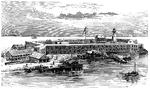
An illustration of Fort Jefferson which is located today in what is Dry Tortugas National Park. Dry Tortugas National Park preserves Fort Jefferson and the Dry Tortugas section of the Florida Keys. The park covers 101 mi² (262 km²), mostly water, about 68 statute miles (109 km) west of Key West in the Gulf of Mexico.

Fort Jefferson

An illustration of Fort Jefferson which is located today in what is Dry Tortugas National Park. Dry…
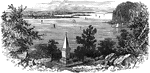
The duel was held on July 11, 1804, along the west bank of the Hudson River on a rocky ledge in Weehawken, New Jersey. The duel was between Alexander Hamilton and Aaron Burr resulting in Hamilton's death.

Where Hamilton Fell

The duel was held on July 11, 1804, along the west bank of the Hudson River on a rocky ledge in Weehawken,…
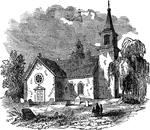
St. John's Church in Hampton, Virginia.

St. John's Church

St. John's Church in Hampton, Virginia.

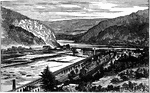
The town of Harper's Ferry, where an important Civil War battle was fought in 1862.

View of Harper's Ferry, 1862, Looking South

The town of Harper's Ferry, where an important Civil War battle was fought in 1862.
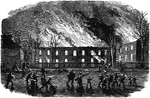
The burning of the arsenal in Harper's Ferry during the American Civil War

Burning of the Arsenal at Harper's Ferry

The burning of the arsenal in Harper's Ferry during the American Civil War
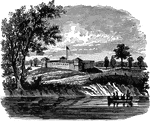
Fort Harrison was an important component of the Confederate defenses of Richmond during the American Civil War.

Fort Harrison, on the Wabash

Fort Harrison was an important component of the Confederate defenses of Richmond during the American…
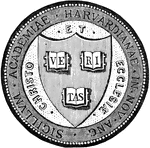
The seal of Harvard University in Massachusetts.

Seal of Harvard

The seal of Harvard University in Massachusetts.

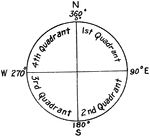
The four cardinal directions or cardinal points are north, south, east, and west.

Cardinal Directions

The four cardinal directions or cardinal points are north, south, east, and west.
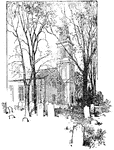
St. John's Church in Virginia overlooking a cemetery.

St. John's Church

St. John's Church in Virginia overlooking a cemetery.

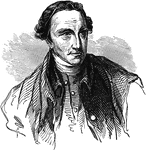
Patrick Henry (May 29, 1736 - June 6, 1799) was a prominent figure in the American Revolution, known and remembered for his "Give me Liberty, or give me Death!" speech.

Patrick Henry

Patrick Henry (May 29, 1736 - June 6, 1799) was a prominent figure in the American Revolution, known…
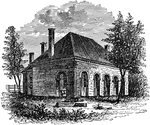
Hanover County Courthouse is the place where Patrick Henry practiced law and argued the case accusing King George III of tyranny in overturning colonial law without regard to the wishes of his subjects.

Hanover Courthouse

Hanover County Courthouse is the place where Patrick Henry practiced law and argued the case accusing…
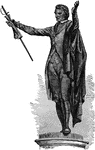
Statue of Patrick Henry, American Revolutionary, in Richmond, Virginia.

Statue of Patrick Henry at Richmond, VA

Statue of Patrick Henry, American Revolutionary, in Richmond, Virginia.
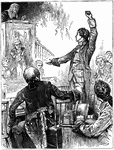
A drawing of Virginia Convention in 1775, at St. John's Church in Richmond, Virginia, when Patrick Henry said his famous speech, "Give me liberty or give me death."

Henry, Patrick, Give me liberty or give me death!

A drawing of Virginia Convention in 1775, at St. John's Church in Richmond, Virginia, when Patrick Henry…
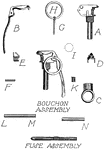
<p>A: Bouchon<br>B: Lever<br>C: Bouchon Seal<br>D: Striker<br>E: Spring<br>F: Hinge Pin<br>G: Split Pin<br>H: Split Pin Ring<br>I: Moisture Cap<br>K: Primer<br>L: Priming Powder<br>M: Fuse<br>N: Detonator</p>

Grenade Parts

A: Bouchon B: Lever C: Bouchon Seal D: Striker E: Spring F: Hinge Pin G: Split Pin H: Split Pin Ring…
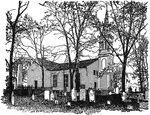
"St. John's Church, Richmond, VA. Where the famous orator Patrick Henry made is great speech." -Gordy, 1916

St. John's Church

"St. John's Church, Richmond, VA. Where the famous orator Patrick Henry made is great speech." -Gordy,…
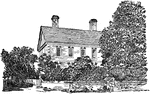
"Nelson House, Yorktown, VA. Which was occupied as headquarters by General Cornwallis.

Nelson House

"Nelson House, Yorktown, VA. Which was occupied as headquarters by General Cornwallis.

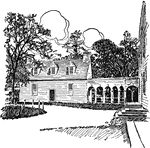
The servant's quarters of George Washington's Mount Vernon plantation in Virginia.

Mount Vernon

The servant's quarters of George Washington's Mount Vernon plantation in Virginia.

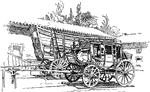
"Modes of travel in the West. An old stage-coach and prairie schooner." -Gordy, 1916

Stagecoach and Prairie Schooner

"Modes of travel in the West. An old stage-coach and prairie schooner." -Gordy, 1916
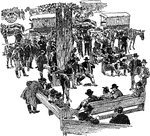
A council of war at Massaponax Church in Virginia.

Massaponax Church

A council of war at Massaponax Church in Virginia.

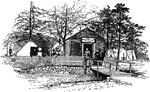
A Sanitary Commission lodge near Alexandria, Virginia during the Civil War.

Sanitary Commission

A Sanitary Commission lodge near Alexandria, Virginia during the Civil War.

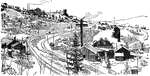
The gold mining camp of Cripple Creek, Colorado.

Cripple Creek Mine

The gold mining camp of Cripple Creek, Colorado.

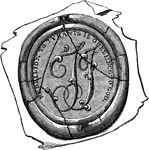
Thomas Jefferson's seal with the motto: "Rebellion to tyrants is obedience to God."

Jefferson's Seal

Thomas Jefferson's seal with the motto: "Rebellion to tyrants is obedience to God."
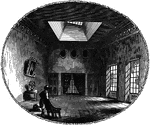
A depiction of the bedroom where Thomas Jefferson died in Charlottesville, Virginia.

Bedroom in Which Jefferson Died

A depiction of the bedroom where Thomas Jefferson died in Charlottesville, Virginia.
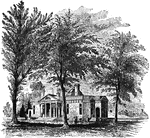
Monticello, located near Charlottesville, Virginia, was the estate of Thomas Jefferson, the principal author of the United States Declaration of Independence, the third President of the United States.

Monticello, Jefferson's Home

Monticello, located near Charlottesville, Virginia, was the estate of Thomas Jefferson, the principal…
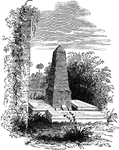
The grave of Thomas Jefferson in Charlottesville, Virginia.

Thomas Jefferson's Grave

The grave of Thomas Jefferson in Charlottesville, Virginia.

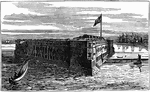
Fort Taylor was built in 1845 in Key West, Florida and used in the American Civil War.

Fort Taylor, Key West

Fort Taylor was built in 1845 in Key West, Florida and used in the American Civil War.
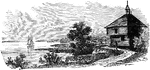
York is a community in Toronto, Ontario, Canada. Formerly a separate city, it was one of six municipalities that amalgamated in 1998 to form the current city of Toronto. York Township was incorporated by Canada West in 1850 (Canada West later became Ontario in 1867).

York (Toronto) in 1813, From the Block House East of the Don

York is a community in Toronto, Ontario, Canada. Formerly a separate city, it was one of six municipalities…
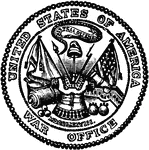
The seal of the War Office of the United States of America. The term "War Office" used during the Revolution, and for many years afterward, was associated with the Headquarters of the Army.

United States of America War Office

The seal of the War Office of the United States of America. The term "War Office" used during the Revolution,…
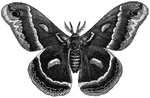
The cecropia moth is one of the largest moths found in North America. It is a member of the Saturniidae family, or giant silk moths. Females with a wingspan of 130 mm or more have been documented. It is found as far west as the Rocky Mountains and north into the maritime provinces of Canada. The larvae of these moths are most commonly found on Maple trees, but they have been known to feed on Wild Cherry and Birch trees among many others.

Cecropia Moth

The cecropia moth is one of the largest moths found in North America. It is a member of the Saturniidae…
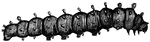
An illustration of the larva of a ceropia moth. The cecropia moth is one of the largest moths found in North America. It is a member of the Saturniidae family, or giant silk moths. Females with a wingspan of 130 mm or more have been documented. It is found as far west as the Rocky Mountains and north into the maritime provinces of Canada. The larvae of these moths are most commonly found on Maple trees, but they have been known to feed on Wild Cherry and Birch trees among many others.

Larva of Cecropia Moth

An illustration of the larva of a ceropia moth. The cecropia moth is one of the largest moths found…
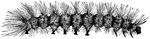
An illustration of a yellow woolly bear caterpillar. The Yellow woolly bear caterpillar, Spilosoma virginica, is the larva of the Virginia tiger moth. It has a diet of a wide range of low-growing plants, including ground cover like grass and clover. This species tends to have two to three life cycles per year, with one hibernating for the winter in temperate climates.

Yellow Woolly Bear Caterpillar

An illustration of a yellow woolly bear caterpillar. The Yellow woolly bear caterpillar, Spilosoma virginica,…
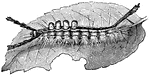
Orgyia leucostigma, the White-marked tussock moth, is a moth in the family Lymantriidae. The caterpillar is very common especially in late summer in eastern North America, as far west as Texas, Colorado, and Alberta. There are two or more generations a year in eastern North America (Wagner 2005). They overwinter in the egg stage. Eggs are laid in a single mass over the cocoon of the female, and covered in a froth (Wagner 2005). Up to 300 eggs are laid at a time. he larvae are brightly coloured, with tufts of hair-like setae. The head is bright red, the body has yellow or white stripes, with a black stripe along the middle of the back. There are bright red defensive glands on the hind end of the back. Four white toothbrush-like tufts stand out from the back, and there is a grey-brown hair pencil at the hind end. Touching the hairs will set off an allergic reaction in many humans (Wagner 2005). Young larvae skeletonize the surface of the leaf, while older larvae eat everything except the larger veins (Rose and Lindquist, 1982). They grow to about 35 mm.

White-marked Tussock Caterpillar

Orgyia leucostigma, the White-marked tussock moth, is a moth in the family Lymantriidae. The caterpillar…
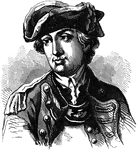
Charles Lee (February 6, 1732 &ndash; October 2, 1782) was a British soldier turned Virginia planter who was a major general of the Continental Army in the American Revolutionary War.

Charles Lee

Charles Lee (February 6, 1732 – October 2, 1782) was a British soldier turned Virginia planter…
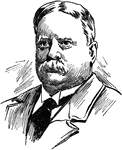
Fitzhugh Lee (November 19, 1835 – April 18, 1905), nephew of Robert E. Lee, was a Confederate cavalry general in the American Civil War, Governor of Virginia, diplomat, and United States Army general in the Spanish-American War.

Fitzhugh Lee

Fitzhugh Lee (November 19, 1835 – April 18, 1905), nephew of Robert E. Lee, was a Confederate cavalry…
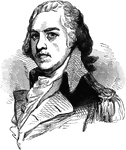
Henry Lee III (January 29, 1756–March 25, 1818) was an early American patriot who served as the Governor of Virginia and as the Virginia Representative to the United States Congress. During the American Revolution, Lee served as a cavalry officer in the Continental Army and earned the name Light Horse Harry.

Henry Lee

Henry Lee III (January 29, 1756–March 25, 1818) was an early American patriot who served as the Governor…
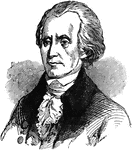
Richard Henry Lee (January 20, 1732 – June 19, 1794) was an American statesman from Virginia best known for proposing the motion in the Second Continental Congress calling for the colonies' independence from Great Britain.

Richard Henry Lee

Richard Henry Lee (January 20, 1732 – June 19, 1794) was an American statesman from Virginia best…
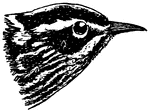
The Black-and-white Warbler, Mniotilta varia, is a small New World warbler. It breeds in northern and eastern North America from southern Canada to Florida. This species is migratory, wintering in Florida, Central America and the West Indies down to Peru. This species is a very rare vagrant to western Europe, mainly to Ireland and Great Britain. This species is 13 cm long and weighs 11 g. The summer male Black-and-white Warbler is boldly streaked in black and white, and the bird has been described as a flying humbug. There are two white wing bars. Female and juvenile plumages are similar, but duller and less streaked.

Black and White Warbler

The Black-and-white Warbler, Mniotilta varia, is a small New World warbler. It breeds in northern and…
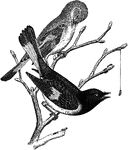
The American Redstart, Setophaga ruticilla, is a New World warbler. They breed in North America, across southern Canada and the eastern USA. These birds are migratory, wintering in Central America, the West Indies, and northern South America. They are very rare vagrants to western Europe. This species is unrelated to the Old World redstarts. This species derives its name from the male's red tail, start being an old word for tail.

American Redstart

The American Redstart, Setophaga ruticilla, is a New World warbler. They breed in North America, across…

The seal and signature of William Tryon. Tryon was the royal governor North Carolina and New York. The history of Tryon's administration is a record of folly, extortion, and crime, and he gained the name of "The Wolf of North Carolina." He was governor of New York when the Revolutionary War broke out, and he was the last governor of that province appointed by the crown.

Seal and Signature of Tryon

The seal and signature of William Tryon. Tryon was the royal governor North Carolina and New York. The…
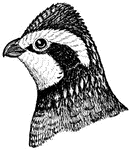
The Northern Bobwhite, Virginia Quail or (in its home range) Bobwhite Quail (Colinus virginianus) is a ground-dwelling bird native to North America and northern Central America and the Caribbean. It is a member of the group of species known as New World quails (Odontophoridae). They were initially placed with the Old World quails in the pheasant family (Phasianidae), but are not particularly closely related. The name "bobwhite" derives from its characteristic whistling call.

Northern Bobwhite

The Northern Bobwhite, Virginia Quail or (in its home range) Bobwhite Quail (Colinus virginianus) is…
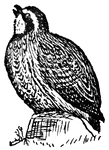
The Northern Bobwhite, Virginia Quail or (in its home range) Bobwhite Quail (Colinus virginianus) is a ground-dwelling bird native to North America and northern Central America and the Caribbean. It is a member of the group of species known as New World quails (Odontophoridae). They were initially placed with the Old World quails in the pheasant family (Phasianidae), but are not particularly closely related. The name "bobwhite" derives from its characteristic whistling call.

Northern Bobwhite

The Northern Bobwhite, Virginia Quail or (in its home range) Bobwhite Quail (Colinus virginianus) is…
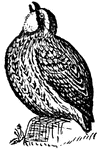
The Northern Bobwhite, Virginia Quail or (in its home range) Bobwhite Quail (Colinus virginianus) is a ground-dwelling bird native to North America and northern Central America and the Caribbean. It is a member of the group of species known as New World quails (Odontophoridae). They were initially placed with the Old World quails in the pheasant family (Phasianidae), but are not particularly closely related. The name "bobwhite" derives from its characteristic whistling call.

Northern Bobwhite

The Northern Bobwhite, Virginia Quail or (in its home range) Bobwhite Quail (Colinus virginianus) is…
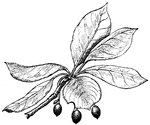
The tupelos, or pepperidge tree, genus Nyssa, are a small genus of about 9 to 11 species of trees with alternate, simple leaves. Most are highly tolerant of wet soils and flooding, some needing to grow in such environments. Five of the species are native to eastern North America from the extreme south of Canada south to eastern Mexico; the others to east and south Asia from China south to Malaysia and west to the Himalaya. A related genus, Davidia, the Dove tree, occurs in China.

Tupelp

The tupelos, or pepperidge tree, genus Nyssa, are a small genus of about 9 to 11 species of trees with…
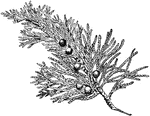
Juniperus virginiana (Eastern Redcedar, Red Cedar, Eastern Juniper, Red Juniper, Pencil Cedar) is a species of juniper native to eastern North America, from southeastern Canada to the Gulf of Mexico, east of the Great Plains. Further west, it is replaced by the related Juniperus scopulorum (Rocky Mountain Juniper), and to the southwest, by Juniperus ashei (Ashe Juniper). The Lakota Native American name is Chansha, "redwood" or Hante'. In its native range, it is commonly called "cedar" or "red cedar", names rejected by the American Joint Committee on Horticultural Nomenclature as it is a juniper, not a true cedar

Eastern Juniper

Juniperus virginiana (Eastern Redcedar, Red Cedar, Eastern Juniper, Red Juniper, Pencil Cedar) is a…
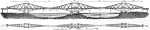
The Forth Bridge is a cantilever railway bridge over the Firth of Forth in the east of Scotland, to the east of the Forth Road Bridge, and 14 km (9 miles) west of central Edinburgh. It is often called the Forth Rail Bridge or Forth Railway Bridge to distinguish it from the Forth Road Bridge, but should correctly be referred to as the Forth Bridge. The bridge connects Scotland's capital Edinburgh with the Kingdom of Fife, and acts as a major artery connecting the north-east and south-east of the country. Described as "the one internationally recognised Scottish landmark", it may be nominated by the British government as a UNESCO World Heritage Site. The bridge and its associated railway infrastructure is owned by Network Rail Infrastructure Limited.

Forth Bridge

The Forth Bridge is a cantilever railway bridge over the Firth of Forth in the east of Scotland, to…
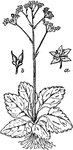
"Flowering plant of saxifrage (Saxifraga virginiensis). a, a flower; b, the fruit." -Whitney, 1911
Early Saxifrage

"Flowering plant of saxifrage (Saxifraga virginiensis). a, a flower; b, the fruit." -Whitney, 1911

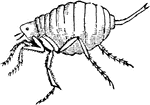
The chigoe flea (Tunga penetrans) is a parasitic arthropod found in tropical climates, especially South America and the West Indies. At 1 mm long, the chigoe flea is the smallest known flea. Breeding female chigoes burrow into exposed skin and lay eggs, causing intense irritation. After this point, the skin lesion looks like a 5 to 10 mm white spot with a central black dot, which are the flea's exposed hind legs, respiratory spiracles and reproductive organs.

Chigoe Flea (Male)

The chigoe flea (Tunga penetrans) is a parasitic arthropod found in tropical climates, especially South…
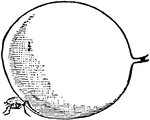
The chigoe flea (Tunga penetrans) is a parasitic arthropod found in tropical climates, especially South America and the West Indies. At 1 mm long, the chigoe flea is the smallest known flea. Breeding female chigoes burrow into exposed skin and lay eggs, causing intense irritation. After this point, the skin lesion looks like a 5 to 10 mm white spot with a central black dot, which are the flea's exposed hind legs, respiratory spiracles and reproductive organs.

Chigoe Flea (Female)

The chigoe flea (Tunga penetrans) is a parasitic arthropod found in tropical climates, especially South…
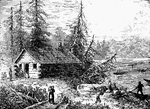
During this early period Virginia's population grew with the introduction of settlers and servants into the burgeoning plantation economy. Land from the Native Americans was appropriated by force and treaty, including the Treaty of 1677, which made the signatory tribes tributary states. In 1619 the House of Burgesses was established as the colony's elected governance, and African servants were first introduced, with slavery being codified in 1661.

Early Settlers

During this early period Virginia's population grew with the introduction of settlers and servants into…
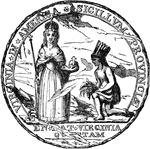
The Colonial Seal of Virginia. An Indian kneels before a prominent royal figure.

Colonial Seal of Virginia

The Colonial Seal of Virginia. An Indian kneels before a prominent royal figure.
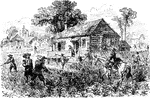
Tobacco being harvested in the Virginia Colony. By 1612, John Rolfe's new strains of tobacco had been successfully cultivated and exported. Finally, a cash crop to export had been identified, and plantations and new outposts sprung up, initially both upriver and downriver along the navigable portion of the James River, and thereafter along the other rivers and waterways of the area.

Tobacco Cultivation in Colonial Virginia

Tobacco being harvested in the Virginia Colony. By 1612, John Rolfe's new strains of tobacco had been…
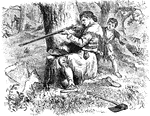
A man and his son hunting in the mountains of Virginia.

Virginia Mountaineers in Colonial Times

A man and his son hunting in the mountains of Virginia.

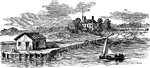
On December 4, 1619, a group of 38 English settlers arrived at Berkeley Hundred, about eight thousand acres (32 km²) on the north bank of the James River near Herring Creek in an area then known as Charles Cittie. It was about 20 miles upstream from Jamestown, where the first permanent settlement of the Colony of Virginia was established on May 14, 1607.

Berkeley, Virginia (Near Harrison's Landing)

On December 4, 1619, a group of 38 English settlers arrived at Berkeley Hundred, about eight thousand…