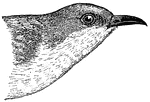
The Black-billed Cuckoo, Coccyzus erythropthalmus, is a cuckoo. Adults have a long brown tail and a black bill. The head and upper parts are brown and the underparts are white. There is a red ring around the eye. Juveniles are drabber, and the eye ring is greenish. Their breeding habitat is edges of wooded areas across North America east of the Rockies. They nest in a low tree or shrub, sometimes on the ground. They sometimes lay eggs in the nests of other birds.

Black-billed Cuckoo

The Black-billed Cuckoo, Coccyzus erythropthalmus, is a cuckoo. Adults have a long brown tail and a…
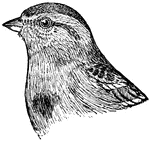
The Tree Sparrow, Passer montanus, breeds over most of Europe and Siberia, and allied forms occur in other parts of Asia. It has been introduced to Australia, and the United States (where it is known as the Eurasian Tree Sparrow or German Sparrow to differentiate it from the native, unrelated American Tree Sparrow), where German immigrants introduced it to the area around St. Louis in the 1870s. From there, it has slowly expanded its range into Illinois and Missouri. Changes in farming methods have meant that this species is declining in some parts of western Europe.

Tree Sparrow

The Tree Sparrow, Passer montanus, breeds over most of Europe and Siberia, and allied forms occur in…
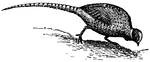
The Common Pheasant (Phasianus colchicus), is a bird in the pheasant family (Phasianidae). It is native to Asia but has been widely introduced elsewhere as a game bird. In parts of its range, namely in places where none of its relatives occur such as in Europe (where it is naturalized), it is simply known as "the pheasant". It is a well-known gamebird, among those of more than regional importance perhaps the most widespread and ancient one in the whole world.

Common Pheasant

The Common Pheasant (Phasianus colchicus), is a bird in the pheasant family (Phasianidae). It is native…

The Whip-poor-will or whippoorwill, Caprimulgus vociferus, is a medium-sized (22-27 cm) nightjar from North and Central America. The Whip-poor-will is commonly heard within its range, but less often seen. It is named onomatopoeically after its call. This bird is sometimes confused[1] with the related Chuck-will's-widow (Caprimulgus carolinensis) which has a similar but lower-pitched and slower call. Adults have mottled plumage: the upperparts are grey, black and brown; the lower parts are grey and black. They have a very short bill and a black throat. Males have a white patch below the throat and white tips on the outer tail feathers; in the female, these parts are light brown.

Whip-poor-will

The Whip-poor-will or whippoorwill, Caprimulgus vociferus, is a medium-sized (22-27 cm) nightjar from…
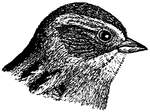
The Swamp Sparrow, Melospiza georgiana, is a medium-sized sparrow. Adults have streaked rusty and black upperparts with a grey breast, light belly and a white throat. They have a rust-coloured cap and wings. Their face is grey with a dark line through the eye. They have a short bill and fairly long legs. Their breeding habitat is marshes, including salt marshes, across eastern North America and central Canada. The bulky nest is attached to marsh vegetation, often with leaves arching over the top. On the central Atlantic coast, in the southern parts of their summer range, they are permanent residents. Other birds migrate to the southern United States.

Swamp Sparrow

The Swamp Sparrow, Melospiza georgiana, is a medium-sized sparrow. Adults have streaked rusty and black…
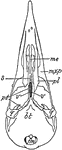
"Saurognathous skull of woodpecker (Colaptes auratus). v, v, the posterior parts of the abortive vomer; s, point of sphenoid; mxp, maxillopalatine; pt, pterygoid; me, ossified mesethmoid; pl, palatine; q, quadrate; bt, basitemporal; fm, foramen magnum. The posterior part of one palatine is cut away to show the long anterior projection of the pterygoid." -Whitney, 1911

Woodpecker Skull

"Saurognathous skull of woodpecker (Colaptes auratus). v, v, the posterior parts of the abortive vomer;…
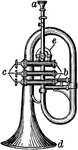
The saxhorn is a brass instrument with: a, mouthpiece; b, valves; c, keys; d, bell; e, crook.

Saxhorn

The saxhorn is a brass instrument with: a, mouthpiece; b, valves; c, keys; d, bell; e, crook.
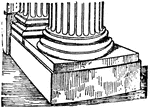
The scamillus is the piece of stone sitting directly underneath a column.

Scamillus

The scamillus is the piece of stone sitting directly underneath a column.

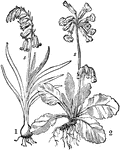
A scape is a flowering, leafless stem; shown here on two different plants. "1. Wild hyacinth (Scilla nonscripta). 2. Oxlip (Primula elatior). s, s, scapes." -Whitney, 1911

Scapes

A scape is a flowering, leafless stem; shown here on two different plants. "1. Wild hyacinth (Scilla…
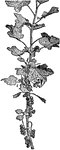
The Red currant (Ribes rubrum) is a member of the genus Ribes in the gooseberry family Grossulariaceae, native to parts of western Europe (Belgium, France, Germany, Netherlands, Northern Italy and Northern Spain). It is a deciduous shrub normally growing to 1-1.5 m tall, occasionally 2 m, with five-lobed leaves arranged spirally on the stems. The flowers are inconspicuous yellow-green, in pendulous 4-8 cm racemes, maturing into bright red translucent edible berries about 8-12 mm diameter, with 3-10 berries on each raceme.

Red Currant

The Red currant (Ribes rubrum) is a member of the genus Ribes in the gooseberry family Grossulariaceae,…
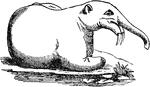
Deinotherium ("terrible beast"), also called the Hoe tusker was a gigantic prehistoric relative of modern-day elephants that appeared in the Middle Miocene and continued until the Early Pleistocene. During that time it changed very little. In life it probably resembled modern elephants, except that its trunk was shorter, and it had downward curving tusks attached to the lower jaw. Deinotherium is the third largest land mammal known to have existed; only Indricotherium and Mammuthus sungari were larger. Males were generally between 3.5 and 4.5 meters (12 and 15 feet) tall at the shoulders although large specimens may have been up to 5m (16ft). Their weight is estimated to have been between 5 and 10 tonnes (5.5 and 11 US Standard tons), with the largest males weighing in excess of 14 tonnes (15.4 US Standard tons). Deinotherium's range covered parts of Asia, Africa, and Europe.

Deinotherium

Deinotherium ("terrible beast"), also called the Hoe tusker was a gigantic prehistoric relative of modern-day…
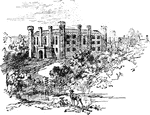
Willian de Wessyngton was a forebear of George Washington, the first President of the United States. Though it was not from Washington, Sunderland, that George Washington's great-grandfather John Washington left for Virginia, but from Essex, Washington Old Hall was the family home of George Washington's ancestors, and the present structure does incorporate small parts of the medieval home in which they lived.

Washington Old Hall

Willian de Wessyngton was a forebear of George Washington, the first President of the United States.…
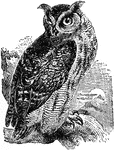
The American horned owls and the Old World eagle-owls make up the genus Bubo, at least as traditionally circumscribed. This genus, depending on definition, contains about one or two dozen species of typical owls (family Strigidae) and occurs in many parts of the world. Some of the largest living Strigiformes are in Bubo. Traditionally, only owls with ear-tufts were included here, but this is now known to be wrong.

Great Horned Owl

The American horned owls and the Old World eagle-owls make up the genus Bubo, at least as traditionally…
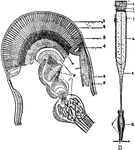
A, section through the compound eye of a crayfish. Labels: 1, cornea; 2, crystaline cones; 3, retinulae; 4, pigment cells; 5, cuticle; 6, epithelium; n, optic nerve; g, ganglia. B, A single element (ommatidium) from the compound eye of a crayfish. Labels: 1, corneal lens; 2, corneal cells; 3, crystalline cone cells; 4, 5, outer and inner parts of the crystalline cone; p, pigment cells; r, retinula; R, rhabdome; b, basement membrane.

Eye of a Crayfish

A, section through the compound eye of a crayfish. Labels: 1, cornea; 2, crystaline cones; 3, retinulae;…
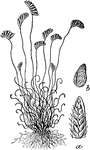
Schizaea pusilla, or Little Curlygrass Fern is a small species of fern in the Curlygrass family (Schizaeaceae). here showing: "a, pinnule with sporangia; b, a sporangium, on larger scale." -Whitney, 1911

Curlygrass Fern

Schizaea pusilla, or Little Curlygrass Fern is a small species of fern in the Curlygrass family (Schizaeaceae).…
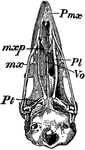
"Schizognathous skull of common fowl. pmx, premaxilla; mxp, maxillopalatine; mx, maxilla; pl, palatine; pt, pterygoid; vo, vomer." -Whitney, 1911

Bird Skull

"Schizognathous skull of common fowl. pmx, premaxilla; mxp, maxillopalatine; mx, maxilla; pl, palatine;…
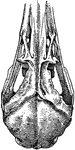
"Schizorhinal skull of curlew (top view), showing the long cleft, a, between upper and lower forks of each nasal bone." -Whitney, 1911

Curlew Skull

"Schizorhinal skull of curlew (top view), showing the long cleft, a, between upper and lower forks of…
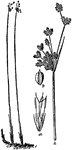
"1. Flowering plant of Bulrush (Scirpus lacustris). 2. The inflorescence. a, a flower; b, the fruit." -Whitney, 1911

Bulrush

"1. Flowering plant of Bulrush (Scirpus lacustris). 2. The inflorescence. a, a flower; b, the fruit."…
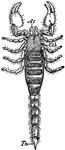
The Black Rock Scorpion (Scorpio (Buthus) Afer), "seen from above. At, the chelicerae, or chelate antennae; the large claws are chelate pedipalpi; Cth, cephalothorax; the first two legs are cephalic appendages, the next two thoracic; Tn, the telson or sting." -Whitney, 1911

Black Rock Scorpion

The Black Rock Scorpion (Scorpio (Buthus) Afer), "seen from above. At, the chelicerae, or chelate antennae;…
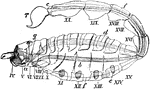
"Diagram of structure of Scopionidae (most of the appendages removed). IV. to XX., fourth to twentieth somite; IV., basis of the pedipalpi or great claws; V., VI., of two succeeding cephalic segments; T, telson of sting; a, mouth; b, alimentary canal; c, anus; d, heart; e, a pulmonary sac; f, line of ventral ganglionated cord; g, cerebroganglia." -Whitney, 1911

Scorpion Diagram

"Diagram of structure of Scopionidae (most of the appendages removed). IV. to XX., fourth to twentieth…
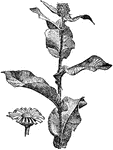
Elecampane, also called Horse-heal (Inula helenium) or Marchalan (in Welsh), is a perennial composite plant common in many parts of Great Britain, and ranges throughout central and Southern Europe, and in Asia as far eastwards as the Himalayas. It is a rather rigid herb, the stem of which attains a height of from 3 to 5 feet; the leaves are large and toothed, the lower ones stalked, the rest embracing the stem; the flowers are yellow, 2 inches broad, and have many rays, each three-notched at the extremity. The root is thick, branching and mucilaginous, and has a warm, bitter taste and a camphoraceous odor.

Elecampane

Elecampane, also called Horse-heal (Inula helenium) or Marchalan (in Welsh), is a perennial composite…
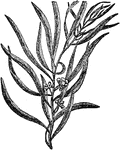
Eucalyptus is a diverse genus of trees (and a few shrubs), the members of which dominate the tree flora of Australia. There are more than seven hundred species of Eucalyptus, mostly native to Australia, with a very small number found in adjacent parts of New Guinea and Indonesia and one as far north as the Philippines islands. Species of Eucalyptus are cultivated throughout the tropics and subtropics including the Americas, England, Africa, the Mediterranean Basin, the Middle East, China and the Indian Subcontinent.

Eucalyptus

Eucalyptus is a diverse genus of trees (and a few shrubs), the members of which dominate the tree flora…
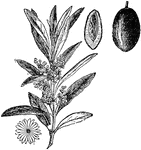
The Olive (Olea europaea) is a species of small tree in the family Oleaceae, native to the coastal areas of the eastern Mediterranean region, from Lebanon, Syria and the maritime parts of Asia Minor and northern Iran at the south end of the Caspian Sea. Its fruit, the olive, is of major agricultural importance in the Mediterranean region as the source of olive oil. The Olive tree is an evergreen tree or shrub native to the Mediterranean, Asia and parts of Africa. It is short and squat, and rarely exceeds 8–15 meters in height. The silvery green leaves are oblong in shape, measuring 4–10 cm long and 1–3 cm wide. The trunk is typically gnarled and twisted.The small white flowers, with four-cleft calyx and corolla, two stamens and bifid stigma, are borne generally on the last year's wood, in racemes springing from the axils of the leaves. The fruit is a small drupe 1–2.5 cm long, thinner-fleshed and smaller in wild plants than in orchard cultivars. Olives are harvested at the green stage or left to ripen to a rich purple colour (black olive). Canned black olives may contain chemicals that turn them black artificially.

Olive Branch

The Olive (Olea europaea) is a species of small tree in the family Oleaceae, native to the coastal areas…
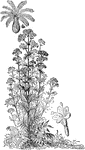
Valerian (Valeriana officinalis, Valerianaceae) is a hardy perennial flowering plant, with heads of sweetly scented pink or white flowers. The flowers are in bloom in the northern hemisphere from June to September. Valerian was used as a perfume in the sixteenth century. Native to Europe and parts of Asia, Valerian has been introduced into North America. It is consumed as food by the larvae of some Lepidoptera (butterfly and moth) species including Grey Pug.

Valerian

Valerian (Valeriana officinalis, Valerianaceae) is a hardy perennial flowering plant, with heads of…
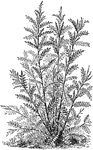
Licorice is the root of Glycyrrhiza glabra, from which a sweet flavour can be extracted. The liquorice plant is a legume (related to beans and peas) and native to southern Europe and parts of Asia. It is an herbaceous perennial, growing to 1 m in height, with pinnate leaves about 7–15 centimetres (3–6 inches) long, with 9–17 leaflets. The flowers are 0.8–1.2 cm (1/3 to 1/2 inch) long, purple to pale whitish blue, produced in a loose inflorescence. The fruit is an oblong pod, 2–3 centimetres (about 1 inch) long, containing several seeds.

Licorice

Licorice is the root of Glycyrrhiza glabra, from which a sweet flavour can be extracted. The liquorice…
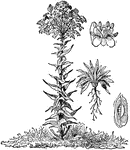
Woad (or glastum) is the common name of the flowering plant Isatis tinctoria in the family Brassicaceae. It is commonly called dyer's woad, and sometimes incorrectly listed as Isatis indigotica (a newer and invalid name for the same plant). It is occasionally known as Asp of Jerusalem. Woad is also the name of a blue dye produced from the plant. Woad is native to the steppe and desert zones of the Caucasus, Central Asia to eastern Siberia and Western Asia (Hegi), but is now found in southeastern and some parts of Central Europe as well. It has been cultivated throughout Europe, especially in Western and southern Europe, since ancient times.

Woad

Woad (or glastum) is the common name of the flowering plant Isatis tinctoria in the family Brassicaceae.…
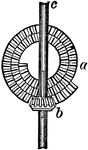
"a, scroll-wheel, intermeshing with the pinion b, which, sliding by a feather on the shaft, c, imparts a gradually decreasing velocity to the latter as b is moved toward the center of a." -Whitney, 1911

Scroll Wheel

"a, scroll-wheel, intermeshing with the pinion b, which, sliding by a feather on the shaft, c, imparts…
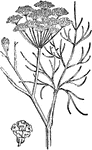
Fennel (Foeniculum vulgare) is a plant species in the genus Foeniculum (treated as the sole species in the genus by most botanists). It is a hardy, perennial, umbelliferous herb, with yellow flowers and feathery leaves, grows wild in most parts of temperate Europe, but is generally considered indigenous to the shores of the Mediterranean, whence it spreads eastwards to India and even in England in Bedfont Lakes Country Park and Thurrock . It has followed, especially where Romans have colonized, and may be found growing wild in many parts of the world upon dry soils near the sea-coast and upon river-banks. It is a member of the family Apiaceae. It is a highly aromatic and flavorful herb with culinary and medicinal uses, and is one of the primary ingredients of absinthe. Fennel is used as a food plant by the larvae of some Lepidoptera species including the Mouse Moth and the Anise Swallowtail.

Fennel

Fennel (Foeniculum vulgare) is a plant species in the genus Foeniculum (treated as the sole species…
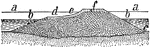
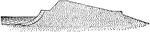
"Sea-walls. A. Plymouth (England) breakwater; a, a, level of the top; b, b, low water at spring tide; c, bottom; d, foreshore; e, sea-slope; f, top." -Whitney, 1911

Plymouth Breakwater

"Sea-walls. A. Plymouth (England) breakwater; a, a, level of the top; b, b, low water at spring tide;…
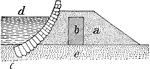
"B. Sea-dike: e, the sea-bottom; a, rubble; b, core; c, facing of stone; d, sea-level." -Whitney, 1911
Sea-Dike

"B. Sea-dike: e, the sea-bottom; a, rubble; b, core; c, facing of stone; d, sea-level." -Whitney, 1911

'C and D. Sectional diagrams of inclosure of Zuid Plas, near Rotterdam, Holland." -Whitney, 1911

Zuidplas

'C and D. Sectional diagrams of inclosure of Zuid Plas, near Rotterdam, Holland." -Whitney, 1911
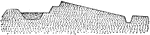
'C and D. Sectional diagrams of inclosure of Zuid Plas, near Rotterdam, Holland." -Whitney, 1911

Zuidplas

'C and D. Sectional diagrams of inclosure of Zuid Plas, near Rotterdam, Holland." -Whitney, 1911
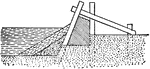
"E. Dutch polder-bank, consisting of sheet-piling with earth filling, and an apron of rubble on the side toward the sea." -Whitney, 1911

Polder

"E. Dutch polder-bank, consisting of sheet-piling with earth filling, and an apron of rubble on the…
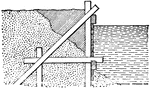
"F. Wall of sheet-piling at Havre, France, with earth embankment behind the piles." -Whitney, 1911
Sheet Piling

"F. Wall of sheet-piling at Havre, France, with earth embankment behind the piles." -Whitney, 1911

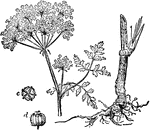
Northern Water Hemlock is a species of Cicuta, native to northern and central Europe, northern Asia and northwestern North America. It is a perennial herbaceous plant which grows up to 1–2 m tall. The stems are smooth, branching, swollen at the base, purple-striped, and hollow except for partitions at the junction of the leaves and stem. In cross section the stems have one flat side and the other sides are rounded. The leaves are alternate, tripinnate, only coarsely toothed, unlike the ferny, lacy leaves found in many other members of the family Apiaceae. The flowers are small, white and clustered in umbrella shaped inflorescences typical of the family. The many flowered umbellets have unequal pedicels that range from 5 to 11 cm long during fruiting. An oily, yellow liquid oozes from cuts to the stems and roots.

Northern Water Hemlock

Northern Water Hemlock is a species of Cicuta, native to northern and central Europe, northern Asia…
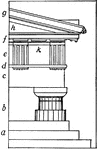
A, crepidoma or stylobate; B, column; C, architrave; D, tænia; E, frieze; F, horizontal cornice; G, raking cornice; H, tympanum of pediment; K, metope.In this and other cuts of this order, only the upper and lower parts of the shaft are shown, the intervening and greater part of the shaft being omitted, to save space.

Greek Doric Order

A, crepidoma or stylobate; B, column; C, architrave; D, tænia; E, frieze; F, horizontal cornice;…
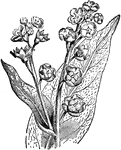
Cynoglossum officinale (hound's tongue, dog's tongue, gypsy flower, and rats and mice due to its smell) is a herbaceous plant of the family Boraginaceae, found in most parts of Europe, and also North America where it was accidentally introduced. It can be either annual or biennial, with reddish-purple flowers blooming between May and September. It lives in wet places, waste land and hedges.

Hound's Tongue

Cynoglossum officinale (hound's tongue, dog's tongue, gypsy flower, and rats and mice due to its smell)…

An illustration showing a "floral diagram of [the' Viola [plant], showing arrangement of parts in horizontal plan. b, pair of bractoeles below the flower; s, sepals; p, petals; st, stamens; o, ovary" (Britannica, 102).

Viola Diagram

An illustration showing a "floral diagram of [the' Viola [plant], showing arrangement of parts in horizontal…
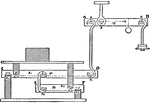
An illustration of an unequal-arm balance.

Unequal-arm Balance

An illustration of an unequal-arm balance.

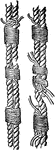
Two seizings, a class of knots used to bind two parts of the same rope or to another object.

Seizing

Two seizings, a class of knots used to bind two parts of the same rope or to another object.
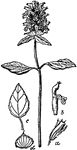
"Self-heal. (Prunella vulgaris). The upper part of the stem with flowers. a, the calyx; b, the corolla; c, a leaf; d, a bract from the inflorescence." -Whitney, 1911

Self-Heal

"Self-heal. (Prunella vulgaris). The upper part of the stem with flowers. a, the calyx; b, the corolla;…
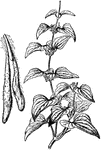
Yam is the common name for some species in the genus Dioscorea (family Dioscoreaceae).These are perennial herbaceous vines cultivated for the consumption of their starchy tubers in Africa, Asia, Latin America and Oceania. There are hundreds of cultivars among the cultivated species. The sweet potato (Ipomoea batatas) has traditionally been referred to as a "yam" in parts of the southern United States and Canada even though it is not part of the Dioscoreaceae family. The vegetable has a rough skin which is difficult to peel, but which softens after heating. The skins vary in color from dark brown to light pink

Yam

Yam is the common name for some species in the genus Dioscorea (family Dioscoreaceae).These are perennial…
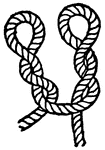
"Cat's-paw - Twist up two parts of a lanyard in opposite directions and hook the tackle in the eyes...A piece of wood should be placed between the parts at g. A large lanyard should be clove-hitched round a large toggle and strap passed round it below the toggle." -Britannica, 1910

Cat's-paw

"Cat's-paw - Twist up two parts of a lanyard in opposite directions and hook the tackle in the eyes...A…
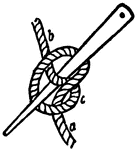
"Marling-spike Hitch -- Lay the end a over c; fold the loop over on the standing part b; then pass the marline-spike through, over both parts of the bight and under the prt b. Used for tightening each turn of a seizing." -Britannica, 1910

Marling-spike Hitch

"Marling-spike Hitch -- Lay the end a over c; fold the loop over on the standing part b; then pass the…
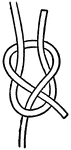
"Sheet Bend -- Pass the end of one rope though the bight of another, round both parts of the other, and under its own standing part. Used for bending small sheets to the clews of sails, which present bights ready for the hitch. An ordinary net is composed of a series of sheet bends. A weaver's knot is made like a sheet bend." -Britannica, 1910

Sheet Bend

"Sheet Bend -- Pass the end of one rope though the bight of another, round both parts of the other,…
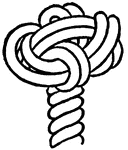
"Double Wall and Double Crown -- Form a single wall crowned; let the ends follow their own parts round until all the parts appear double. Put the ends down through the knot." -Britannica, 1910

Double Wall and Double Crown

"Double Wall and Double Crown -- Form a single wall crowned; let the ends follow their own parts round…
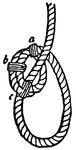
"Inside Clinch -- The end is bent close round the standing part till it forms a circle and a half, when it is securely seized at a, b, and c, thus making a running eye; when taut round anything it jams the end. It is used for securing hemp cables to anchors, the standing parts of topsail sheets, and for many other purposes. If the eye were formed outside the bight an outside clinch would be made, depending entirely on the seizings, but more ready for slipping." -Britannica, 1910

Inside Clinch

"Inside Clinch -- The end is bent close round the standing part till it forms a circle and a half, when…
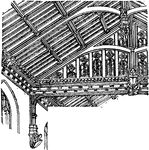
The English treated woodwork with consummate skill. They invented and developed a variety of forms of roof-truss in which the proper distribution of the strains was combined with a highly decorative treatment of the several parts by carving, moulding, and arcading. The ceiling surfaces between the trusses were handled decoratively, and the oaken open-timber ceilings of many of the English churches and civic of academic halls are such noble and beautiful works as quite to justify the substitution of wooden for vaulted ceilings.

Roof of Nave, St. Mary's, Westonzoyland

The English treated woodwork with consummate skill. They invented and developed a variety of forms of…
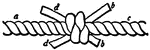
"Shroud Knot -- Pass a stop at such a distance from each end of the broken shroud as to afford sufficient length of strands, when it is unlaid, to form a single wall knot on each side after the parts have been married." -Britannica, 1910

Shroud Knot

"Shroud Knot -- Pass a stop at such a distance from each end of the broken shroud as to afford sufficient…
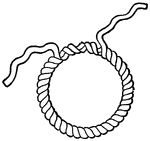
"Grummet-Stop -- Made by unlaying a piece of rope of the desired size about a foot more that three times the length required for the strop. Place the centre of the open round the block and thimble; mark with chalk where the parts cross; take one strand out of the rope; bring the two chalk marks together; and cross the strand in the lay on both sides, continuing round and round till the two ends meet the third time; they are then halved, and the upper halves half-knotted and passed over and under the next strands, exactly as one part of a long splice." -Britannica, 1910

Grummet-Strop

"Grummet-Stop -- Made by unlaying a piece of rope of the desired size about a foot more that three times…
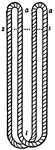
"Double Strop -- Made with one piece of rope, the splice being brought as usual to the crown of the block t, the bights fitting into scores with some inches apart, converging to the upper part, above which the thimble receives the bights, a,a; and the four parts of the strop are secured at s, s, by a round seizing double crossed." -Britanncia, 1910

Double Strop

"Double Strop -- Made with one piece of rope, the splice being brought as usual to the crown of the…
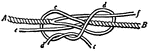
"Knotting Yarns -- This operation becomes necessary when a comparatively short piece of junk is to be make into a spun-yarn, or large rope into small, which is called twice laid. The end of each is divided, rubbed smooth and married (as for splicing). Two of the divided parts, as c, c and d, d, are passed in opposite directions round all the other parts and knotted. The ends e and f remain passive. The figure is drawn open, but the forks of A and B should be pressed close together, the knot hauled taut and the ends cut off." -Britannica, 1910

Knotting Yarns

"Knotting Yarns -- This operation becomes necessary when a comparatively short piece of junk is to be…
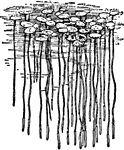
An illustration of duckweed. Duckweed is an important food source for waterfowl and are eaten by humans in some parts of Southeast Asia (as khai-nam). Some duckweeds are used in freshwater aquariums and ponds where they may spread rapidly, although in a large pond they may be difficult to eradicate once established. The plants can provide nitrate removal (if cropped) and cover for fry. The plants are used as shelter by pond water species, such as bullfrogs and bluegills. The duckweeds are important in the process of bioremediation because they grow rapidly, absorbing excess mineral nutrients, particularly nitrogen and phosphates. A cover of duckweeds will reduce evaporation of water compared to a clear surface.

Duckweed

An illustration of duckweed. Duckweed is an important food source for waterfowl and are eaten by humans…
An illustration of duckweed. Duckweed is an important food source for waterfowl and are eaten by humans in some parts of Southeast Asia (as khai-nam). Some duckweeds are used in freshwater aquariums and ponds where they may spread rapidly, although in a large pond they may be difficult to eradicate once established. The plants can provide nitrate removal (if cropped) and cover for fry. The plants are used as shelter by pond water species, such as bullfrogs and bluegills. The duckweeds are important in the process of bioremediation because they grow rapidly, absorbing excess mineral nutrients, particularly nitrogen and phosphates. A cover of duckweeds will reduce evaporation of water compared to a clear surface.

Duckweed

An illustration of duckweed. Duckweed is an important food source for waterfowl and are eaten by humans…
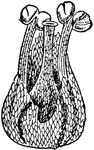
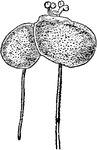
An illustration of duckweed inflorescence containing two male flowers each of one stamen and a female flower, the whole enclosed in a sheath. Duckweed is an important food source for waterfowl and are eaten by humans in some parts of Southeast Asia.

Duckweed Inflorescence

An illustration of duckweed inflorescence containing two male flowers each of one stamen and a female…
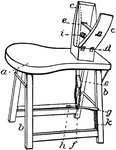
"Sewing-horse. In saddlery, a sewing-clamp with its supports. a, seat; b, legs; c, c', clamping-jaws, c' hinged to c at d; e, strap fastened to c' passing through c, and attached by chain f to the foot-lever g, the latter pivoted at h; i, spring which opens the jaws when not pulled together by e; k, ratch which g engages to hold he jaws together." -Whitney, 1911

Sewing Horse

"Sewing-horse. In saddlery, a sewing-clamp with its supports. a, seat; b, legs; c, c', clamping-jaws,…
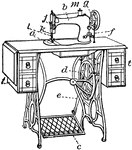
"Singer sewing-machine. a is the frame and cloth-plate or bed-plate; b, arm; c, treadle; e, pitman; d, main driving-wheel; f, band; g, small driving-wheel attached to shaft ... j, take-up lever with roller and stud; k, presser-bar carrying presser-foot; l, needle-bar; m, spool-pin; ... t, drawers." -Whitney, 1911

Singer Sewing Machine

"Singer sewing-machine. a is the frame and cloth-plate or bed-plate; b, arm; c, treadle; e, pitman;…
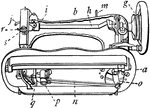
"Singer sewing-machine. a is the frame and cloth-plate or bed-plate; b, arm; ... g, small driving-wheel attached to shaft h; i, take-up cam with set-screw; j, take-up lever with roller and stud; ... m, spool-pin; n, shuttle-pitman taking motion from crank o; p, shuttle bell-crank; q, shuttle-carrier and shuttle; r, thread-guide; s, tension-disk ..." -Whitney, 1911

Singer Sewing Machine

"Singer sewing-machine. a is the frame and cloth-plate or bed-plate; b, arm; ... g, small driving-wheel…
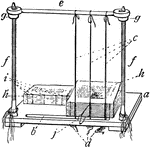
Used in bookbinding. "Sewing-press. a, table with slot b, through which the cords c pass; d, staples by which the lower ends of the cords are held from passing through the slot when stretched; e, adjustable bar around which the upper ends of the cords are looped; f, screw-threaded rods upon which the nuts g are turned, to adjust the bar e; h, h', book-sections to be stitched to the cords; i, grooves cut in the backs of the sections for reception of the cords; j, needle and thread, illustrating method of stitching." -Whitney, 1911

Sewing Press

Used in bookbinding. "Sewing-press. a, table with slot b, through which the cords c pass; d, staples…
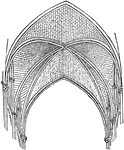
The Nave of Bourges Cathedral in France showing the sexpartite vaulting, divided into six parts.

Sexpartite Vaulting

The Nave of Bourges Cathedral in France showing the sexpartite vaulting, divided into six parts.