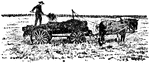
A farmer spreading manure firectly from atop a wagon.

Spreading manure from a wagon

A farmer spreading manure firectly from atop a wagon.

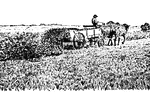
A manure spreader in operation. The manure was pitched from the stable to the spreader, handled only once.

Manure Spreader

A manure spreader in operation. The manure was pitched from the stable to the spreader, handled only…
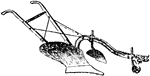
A good plow.

Plow

A good plow.

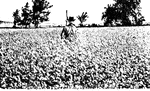
A farmer standing waist-deep in a field of buckwheat on land that was plowed early and well fitted.
Buckwheat field

A farmer standing waist-deep in a field of buckwheat on land that was plowed early and well fitted.

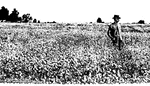
Farmer standing in a sparse and stunted field of buckwheat, which was on land that was plowed late.
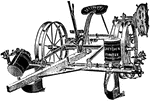
Buckwheat field

Farmer standing in a sparse and stunted field of buckwheat, which was on land that was plowed late.

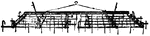
A smoothing harrow, which is a good tool for killing weeds and fitting land

Smoothing harrow

A smoothing harrow, which is a good tool for killing weeds and fitting land

A check-row corn-planter, which plants two rows at once and rows the corn both ways.

Check-Row Corn-Planter

A check-row corn-planter, which plants two rows at once and rows the corn both ways.
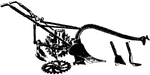
A lister, used for planting corn in semi-arid regions.

Lister

A lister, used for planting corn in semi-arid regions.

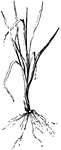
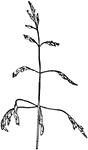
A normal rye plant.

Rye

A normal rye plant.

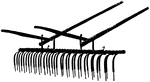
A weeder. A good weed killer, better than a smoothing-harrow on stony land.

Weeder

A weeder. A good weed killer, better than a smoothing-harrow on stony land.

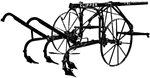
An undesirable cultivator. Shovels are too large and the man is required to walk.

Cultivator

An undesirable cultivator. Shovels are too large and the man is required to walk.

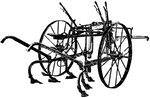
A good riding cultivator.

Cultivator, riding

A good riding cultivator.

A planker, used for crushing clods of soil.

Planker

A planker, used for crushing clods of soil.

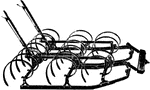
A spring-tooth harrow, particularly useful on stony land.

Spring-tooth harrow

A spring-tooth harrow, particularly useful on stony land.

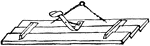
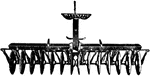
A disc-harrow.

Disc harrow

A disc-harrow.

A closer view of a stalk of Kentucky blue-grass.

Kentucky blue-grass

A closer view of a stalk of Kentucky blue-grass.

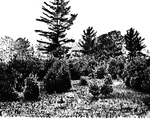
White pines coming into a pasture. On this land trees pay better than the poor pasture.

Pasture with Trees

White pines coming into a pasture. On this land trees pay better than the poor pasture.
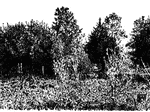
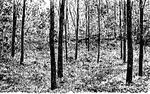
Trees in a pasture.

Trees in a pasture

Trees in a pasture.

A grove of black-locust trees. Contrast with the brush in the background on an adjoining farm.

Grove of black-locust trees

A grove of black-locust trees. Contrast with the brush in the background on an adjoining farm.
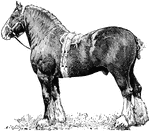
A Clydesdale horse, used for pulling heavy loads.

Draft Horse

A Clydesdale horse, used for pulling heavy loads.

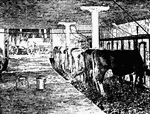
A clean dairy barn, with cows feeding.

Dairy barn

A clean dairy barn, with cows feeding.

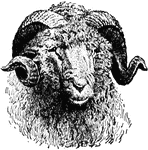
A sheep, the head of the herd.

Sheep

A sheep, the head of the herd.

An attractive farm home, with barn nearby.

Farmhouse

An attractive farm home, with barn nearby.

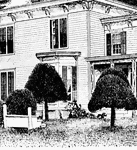
Scattered planting of trees pruned in artificial shapes in front of a farmhouse.

Side View of Farmhouse

Scattered planting of trees pruned in artificial shapes in front of a farmhouse.
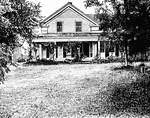
A well-planted farmyard, with trees at the sides, flowers in the corners and about the house, and an open lawn.

Farmhouse

A well-planted farmyard, with trees at the sides, flowers in the corners and about the house, and an…
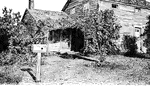
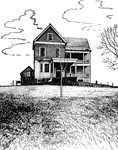
A dilapidated farmhouse made attractive by vines and flowers.

Dilapidated farmhouse

A dilapidated farmhouse made attractive by vines and flowers.

A city house in the country.  A low house would be better suited to sitting alone on a hill.

City House

A city house in the country. A low house would be better suited to sitting alone on a hill.

Seal, with a shovel and hoe on it.

True-temper seal

Seal, with a shovel and hoe on it.

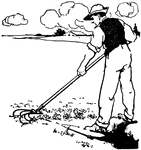
A man using a cultivator in a field.

Man using a cultivator

A man using a cultivator in a field.

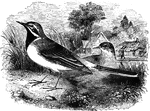
A pair of gray wagtails, found in Southern Europe.

Gray Wagtail

A pair of gray wagtails, found in Southern Europe.

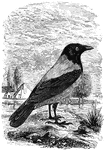
The hooded-crow of Europe, with some farm buildings in the background.

Hooded Crow of Europe

The hooded-crow of Europe, with some farm buildings in the background.

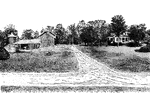
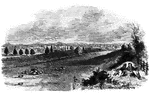
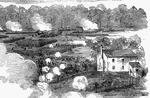
This view is taken from near the house of Mr. Neilson, looking northwest. In the foreground, on the right, are seen the remains of the intrenchments which here crossed the road from Fort Neilson, the fortified long barn. The light field in the distance, toward the right of the picture, with a small house within it, is the ld clearing called 'Freeman's Farm.'

Battle-ground

This view is taken from near the house of Mr. Neilson, looking northwest. In the foreground, on the…
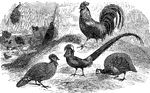
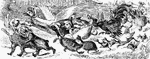
A group of birds of the order <em>Rasores</em>, settled around a farmyard scene.

Rasores

A group of birds of the order Rasores, settled around a farmyard scene.

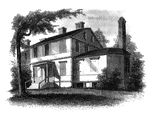
Liberty Hall. Some time after the death of Governor Livingston this property was purchased by Lord Blingbroke, who, under the assumed name of John Belesis, ran away from England with a daughter of Baron Hompasch, a German general. She was at a boarding school there, and Bolingbroke had a wife living. He married the girl here. She died in England in 1848. The grandmother of the present proprietor, Susan, the daughter of Peter Van Burgh Livingston, bought the farm of Lord Bolingbroke, and it has been in possession of the family ever since. Her first husband was John Kean, a member of Congress from South Carolina from 1785 to 1787, and was first cashier of the first United States Bank, chartered by an act of Congress passed February 8th, 1791. Her second husband was Count Niemcewicz, a Polish nobleman.

Liberty Hall

Liberty Hall. Some time after the death of Governor Livingston this property was purchased by Lord Blingbroke,…
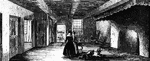
"The dining-hall, or room with seven doors. In the December number of the New York Mirror for 1834, is an interesting account of this old building, by Gulian C. Verplanck, Esq. He relates the following anecdote connected with this room, which he received from Colonel Nicholas Fish, father of the late governor of the State of New York. Just before La Fayette's death, himself and the American minister, with several of his countrymen, were invited to dine at the house of that distinguished Frenchman, Marbois, who was the French secretary of legation here during the Revolution. At the supper hour the company were shown into a room which contrasted quite oddly with the Parisian elegance of the other apartments where they had spent the evening. A low boarded, painted ceiling, with large beams, a single small, uncurtained window, with numerous small doors, as well as the general style of the whole, gave, at first, the idea of the kitchen, or largest room of a dutch or Belgian farm-house. On a long rough table was a repast, just as little in keeping with the refined kitchens of Paris as the room was with its architecture. It consisted of a large dish of meat, uncouth-looking pastry, and wine in decanters and bottles, accompanied by glasses and silver mugs, such as indicated other habits and tastes than those of modern Paris."&mdash;Lossing, 1851

Dining-Hall

"The dining-hall, or room with seven doors. In the December number of the New York Mirror for 1834,…
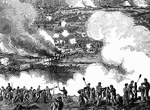
"Battle of White Oak Swamp Bridge, Monday June 30th, 1862- Ayres's, Mott's and Randall's batteries checking the advance of the Confederates. After the battle of Savage's Station the Federals continued on their retreat, and by eight o'clock on the morning of June 30th, 1862, they had crossed White Oak Swamp and Creek, after destroying the bridge over the latter and warding off the repeated attacks to which they were subjected throughout the night. After crossing White Oak Creek the Federals had quickly formed a new line of battle at Willis Church, General Hancock's forces being on the extreme right, while Porter's occupied the left, and Heintzelman's and Sumner's the intervening space. Jackson's advance was checked by the destruction of the bridge, and when he reached the creek, at about noon, he found the approaches well defended by artillery. Jackson opened upon Hancock's troops, and made repeated efforts to rebuild the bridge under cover of his heavy artillery, but he was every time repulsed. While this was going on Longstreet and Hill had come upon a Federal force at a place two miles away, called Frazier's Farm. Here stood Sumner and Hooker, on the extreme right, McCall somewhat in advance toward the centre and Kearny on the extreme left. When Longstreet found this force arrayed against him he waited for re-enforcements to come up, and it was four o'clock when he commenced the attack. McCall's left was first assailed by Kenper's brigade, which was met by the Pennsylvania Reserves under Colonel Simmons, who, after a bitter conflict, drove the Confederates into the woods with a loss of 250 killed and wounded and about 200 prisoners. Fresh troops then enabled the Confederates to drive back the Federals, who in turn lost heavily. Longstreet and Hill now pressed on, and the conflict became a severe one along the entire front. One point, then another, was vainly tried in the determined effort to break the Federal line. At length Wilcox's Alabama Brigade rushed across an open field upon McCall's left, directly against Randall's battery, which centered upon the Confederates a most galling fire. Nothing daunted, they moved on, and finally engaging in a desperate hand-to-hand fight, first captured Cooper's battery, and afterward Randall's battery, which had been doing such terrible execution. A charge was then ordered for the recapture of the guns. The Confederates bravely met the severe attacks that followed. A still more desperate hand-to-hand struggle took place for the possession of the lost batteries, which were finally recaptured. By dark the Confederates had retired into the woods, and the Federals remained on that portion of the field which they had lost earlier in the action. The Federal loss was about 1,800 killed and wounded, whilst that of the Confederates was over 2,000. Colonel Simmons and General Meade were both severely wounded, while General McCall was a made prisoner." —Leslie, 1896

Battle of White Oak Swamp Bridge

"Battle of White Oak Swamp Bridge, Monday June 30th, 1862- Ayres's, Mott's and Randall's batteries checking…
"Battle of White Oak Swamp Bridge, Monday June 30th, 1862- Ayres's, Mott's and Randall's batteries checking the advance of the Confederates. After the battle of Savage's Station the Federals continued on their retreat, and by eight o'clock on the morning of June 30th, 1862, they had crossed White Oak Swamp and Creek, after destroying the bridge over the latter and warding off the repeated attacks to which they were subjected throughout the night. After crossing White Oak Creek the Federals had quickly formed a new line of battle at Willis Church, General Hancock's forces being on the extreme right, while Porter's occupied the left, and Heintzelman's and Sumner's the intervening space. Jackson's advance was checked by the destruction of the bridge, and when he reached the creek, at about noon, he found the approaches well defended by artillery. Jackson opened upon Hancock's troops, and made repeated efforts to rebuild the bridge under cover of his heavy artillery, but he was every time repulsed. While this was going on Longstreet and Hill had come upon a Federal force at a place two miles away, called Frazier's Farm. Here stood Sumner and Hooker, on the extreme right, McCall somewhat in advance toward the centre and Kearny on the extreme left. When Longstreet found this force arrayed against him he waited for re-enforcements to come up, and it was four o'clock when he commenced the attack. McCall's left was first assailed by Kenper's brigade, which was met by the Pennsylvania Reserves under Colonel Simmons, who, after a bitter conflict, drove the Confederates into the woods with a loss of 250 killed and wounded and about 200 prisoners. Fresh troops then enabled the Confederates to drive back the Federals, who in turn lost heavily. Longstreet and Hill now pressed on, and the conflict became a severe one along the entire front. One point, then another, was vainly tried in the determined effort to break the Federal line. At length Wilcox's Alabama Brigade rushed across an open field upon McCall's left, directly against Randall's battery, which centered upon the Confederates a most galling fire. Nothing daunted, they moved on, and finally engaging in a desperate hand-to-hand fight, first captured Cooper's battery, and afterward Randall's battery, which had been doing such terrible execution. A charge was then ordered for the recapture of the guns. The Confederates bravely met the severe attacks that followed. A still more desperate hand-to-hand struggle took place for the possession of the lost batteries, which were finally recaptured. By dark the Confederates had retired into the woods, and the Federals remained on that portion of the field which they had lost earlier in the action. The Federal loss was about 1,800 killed and wounded, whilst that of the Confederates was over 2,000. Colonel Simmons and General Meade were both severely wounded, while General McCall was a made prisoner." —Leslie, 1896

Battle of White Oak Swamp Bridge

"Battle of White Oak Swamp Bridge, Monday June 30th, 1862- Ayres's, Mott's and Randall's batteries checking…
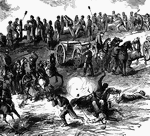
"Battle of White Oak Swamp Bridge, Monday June 30th, 1862- Ayres's, Mott's and Randall's batteries checking the advance of the Confederates. After the battle of Savage's Station the Federals continued on their retreat, and by eight o'clock on the morning of June 30th, 1862, they had crossed White Oak Swamp and Creek, after destroying the bridge over the latter and warding off the repeated attacks to which they were subjected throughout the night. After crossing White Oak Creek the Federals had quickly formed a new line of battle at Willis Church, General Hancock's forces being on the extreme right, while Porter's occupied the left, and Heintzelman's and Sumner's the intervening space. Jackson's advance was checked by the destruction of the bridge, and when he reached the creek, at about noon, he found the approaches well defended by artillery. Jackson opened upon Hancock's troops, and made repeated efforts to rebuild the bridge under cover of his heavy artillery, but he was every time repulsed. While this was going on Longstreet and Hill had come upon a Federal force at a place two miles away, called Frazier's Farm. Here stood Sumner and Hooker, on the extreme right, McCall somewhat in advance toward the centre and Kearny on the extreme left. When Longstreet found this force arrayed against him he waited for re-enforcements to come up, and it was four o'clock when he commenced the attack. McCall's left was first assailed by Kenper's brigade, which was met by the Pennsylvania Reserves under Colonel Simmons, who, after a bitter conflict, drove the Confederates into the woods with a loss of 250 killed and wounded and about 200 prisoners. Fresh troops then enabled the Confederates to drive back the Federals, who in turn lost heavily. Longstreet and Hill now pressed on, and the conflict became a severe one along the entire front. One point, then another, was vainly tried in the determined effort to break the Federal line. At length Wilcox's Alabama Brigade rushed across an open field upon McCall's left, directly against Randall's battery, which centered upon the Confederates a most galling fire. Nothing daunted, they moved on, and finally engaging in a desperate hand-to-hand fight, first captured Cooper's battery, and afterward Randall's battery, which had been doing such terrible execution. A charge was then ordered for the recapture of the guns. The Confederates bravely met the severe attacks that followed. A still more desperate hand-to-hand struggle took place for the possession of the lost batteries, which were finally recaptured. By dark the Confederates had retired into the woods, and the Federals remained on that portion of the field which they had lost earlier in the action. The Federal loss was about 1,800 killed and wounded, whilst that of the Confederates was over 2,000. Colonel Simmons and General Meade were both severely wounded, while General McCall was a made prisoner." —Leslie, 1896

Battle of White Oak Swamp Bridge

"Battle of White Oak Swamp Bridge, Monday June 30th, 1862- Ayres's, Mott's and Randall's batteries checking…
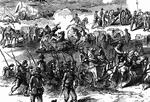
"Battle of White Oak Swamp Bridge, Monday June 30th, 1862- Ayres's, Mott's and Randall's batteries checking the advance of the Confederates. After the battle of Savage's Station the Federals continued on their retreat, and by eight o'clock on the morning of June 30th, 1862, they had crossed White Oak Swamp and Creek, after destroying the bridge over the latter and warding off the repeated attacks to which they were subjected throughout the night. After crossing White Oak Creek the Federals had quickly formed a new line of battle at Willis Church, General Hancock's forces being on the extreme right, while Porter's occupied the left, and Heintzelman's and Sumner's the intervening space. Jackson's advance was checked by the destruction of the bridge, and when he reached the creek, at about noon, he found the approaches well defended by artillery. Jackson opened upon Hancock's troops, and made repeated efforts to rebuild the bridge under cover of his heavy artillery, but he was every time repulsed. While this was going on Longstreet and Hill had come upon a Federal force at a place two miles away, called Frazier's Farm. Here stood Sumner and Hooker, on the extreme right, McCall somewhat in advance toward the centre and Kearny on the extreme left. When Longstreet found this force arrayed against him he waited for re-enforcements to come up, and it was four o'clock when he commenced the attack. McCall's left was first assailed by Kenper's brigade, which was met by the Pennsylvania Reserves under Colonel Simmons, who, after a bitter conflict, drove the Confederates into the woods with a loss of 250 killed and wounded and about 200 prisoners. Fresh troops then enabled the Confederates to drive back the Federals, who in turn lost heavily. Longstreet and Hill now pressed on, and the conflict became a severe one along the entire front. One point, then another, was vainly tried in the determined effort to break the Federal line. At length Wilcox's Alabama Brigade rushed across an open field upon McCall's left, directly against Randall's battery, which centered upon the Confederates a most galling fire. Nothing daunted, they moved on, and finally engaging in a desperate hand-to-hand fight, first captured Cooper's battery, and afterward Randall's battery, which had been doing such terrible execution. A charge was then ordered for the recapture of the guns. The Confederates bravely met the severe attacks that followed. A still more desperate hand-to-hand struggle took place for the possession of the lost batteries, which were finally recaptured. By dark the Confederates had retired into the woods, and the Federals remained on that portion of the field which they had lost earlier in the action. The Federal loss was about 1,800 killed and wounded, whilst that of the Confederates was over 2,000. Colonel Simmons and General Meade were both severely wounded, while General McCall was a made prisoner." —Leslie, 1896

Battle of White Oak Swamp Bridge

"Battle of White Oak Swamp Bridge, Monday June 30th, 1862- Ayres's, Mott's and Randall's batteries checking…
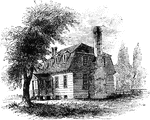
"This is a view from the lawn, looking south. It is a frame building with a brick foundation. At the time of the siege it belonged in fee to Governor Nelson, but its occupant, a widow Moore, had a life interest in it, and it was known as Moore's house. The narrow piazza in front is a modern addition. This house is upon the Temple Farm, so called from the fact that vestiges of a small temple or church, and the remains of an ancient settlement, are there seen, about a mile and a half south of Yorktown. Around the temple was a wall, and within are several tomb-stones. One of these bear the name of Major William Gooch, and the date of his death, 1655."&mdash;Lossing, 1851

Moore's House

"This is a view from the lawn, looking south. It is a frame building with a brick foundation. At the…
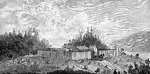
"A stockade. Those settlers who lived outside of Roston and the few seaport villages built palisades about their houses and farm buildings. A group of buildings thus protected was called a stockade."&mdash;Scudder, 1897

stockade

"A stockade. Those settlers who lived outside of Roston and the few seaport villages built palisades…
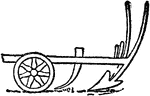
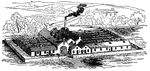
An old Roman plow.

Roman plow

An old Roman plow.

Farm housing in early america.

Homestead

Farm housing in early america.

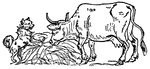
A cow and dog in the hay.

Cow and Dog

A cow and dog in the hay.

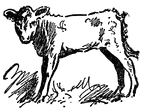
A cow

Cow

A cow

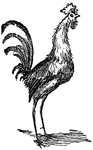
A rooster

Rooster

A rooster

Farm animals from a nursery rhyme

Farm Animals

Farm animals from a nursery rhyme

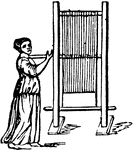
"Tela, a loom. Although weaving was among the Greeks and Romans a distinct trade, carried on by a separate class of persons, yet every considerable domestic establishment, especially in the country, contained a loom, together with the whole apparatus necessary for the working of wool. These occupations were all supposed to be carried on under the protection of Athena or Minerva, specially denominated Ergane. When the farm or the palace was sufficiently large to admit of it, a portion of it called the histon or textrinum, was devoted to this purpose. The work was there principally carried on by female slaves, under the superintendence of the mistress of the house." &mdash; Smith; 1873

Tela

"Tela, a loom. Although weaving was among the Greeks and Romans a distinct trade, carried on by a separate…
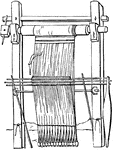
"Tela, a loom. Although weaving was among the Greeks and Romans a distinct trade, carried on by a separate class of persons, yet every considerable domestic establishment, especially in the country, contained a loom, together with the whole apparatus necessary for the working of wool. These occupations were all supposed to be carried on under the protection of Athena or Minerva, specially denominated Ergane. When the farm or the palace was sufficiently large to admit of it, a portion of it called the histon or textrinum, was devoted to this purpose. The work was there principally carried on by female slaves, under the superintendence of the mistress of the house." &mdash Smith; 1873

Tela

"Tela, a loom. Although weaving was among the Greeks and Romans a distinct trade, carried on by a separate…
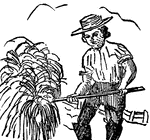
Grass cut and dried for fodder.

Hay

Grass cut and dried for fodder.

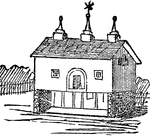
A building for hay and other farm products; also for stabling cattle and horses.

Barn

A building for hay and other farm products; also for stabling cattle and horses.

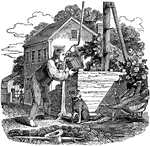
A man drinking water from a well.

Man drinking from well

A man drinking water from a well.

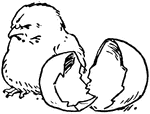
A newly hatched chick, with broken eggshell nearby.

Newly Hatched Chick

A newly hatched chick, with broken eggshell nearby.

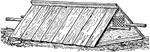
"This triangular shape is a good one also for a movable poultry-house in its simplest form." &mdash; Harcourt, 1889

Triangular coop

"This triangular shape is a good one also for a movable poultry-house in its simplest form." —…
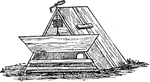
"This triangular shape is a good one also for a movable poultry-house in its simplest form." &mdash; Harcourt, 1889

Triangular coop

"This triangular shape is a good one also for a movable poultry-house in its simplest form." —…
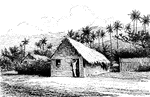
A Brazilian farmhouse.

Brazilian farmhouse

A Brazilian farmhouse.

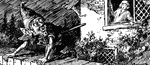
A scene from the story, <em>Olaf of Orchard Farm</em>.

Olaf

A scene from the story, Olaf of Orchard Farm.

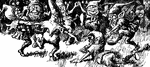
A scene from the story, <em>Olaf of Orchard Farm</em>.

Olaf

A scene from the story, Olaf of Orchard Farm.

A frame of a scene from the story, <em>Olaf of Orchard Farm</em>.

Olaf

A frame of a scene from the story, Olaf of Orchard Farm.

A frame of a scene from the story, <em>Olaf of Orchard Farm</em>.

Olaf

A frame of a scene from the story, Olaf of Orchard Farm.