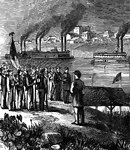
"Bellaire, O.- Steamboats conveying troops and munitions of war for the Federal forces on the Great Kanawha. Bellaire is a town situated on the Ohio River, three miles below Wheeling, Va. It is the eastern terminus of the Central Ohio Railroad, and the point for crossing the river connecting the Baltimore and Ohio with the above-named railroad. The place contained a population of fifteen hundred or two thousand inhabitants in 1861. Its importance was owing to its eligible position for the rapid concentration of troops. The sketch represents a fleet of boats lying in the river awaiting the quoata of troops and munitions for the prosecution of the war on the Great Kanawha. At this date, 1896, two weekly newspapers are published here. It has two banks, two churches, also manufactures of window-glass and flintware, nails, pig iron, galvanized ware and agricultural machines. The city is lighted with gas, and has waterworks and a street railway. Coal, limestone and fire-clay abound here. Population, about ten thousand." —Leslie, 1896

Bellaire

"Bellaire, O.- Steamboats conveying troops and munitions of war for the Federal forces on the Great…
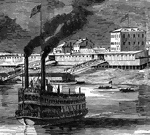
"Bellaire, O.- Steamboats conveying troops and munitions of war for the Federal forces on the Great Kanawha. Bellaire is a town situated on the Ohio River, three miles below Wheeling, Va. It is the eastern terminus of the Central Ohio Railroad, and the point for crossing the river connecting the Baltimore and Ohio with the above-named railroad. The place contained a population of fifteen hundred or two thousand inhabitants in 1861. Its importance was owing to its eligible position for the rapid concentration of troops. The sketch represents a fleet of boats lying in the river awaiting the quoata of troops and munitions for the prosecution of the war on the Great Kanawha. At this date, 1896, two weekly newspapers are published here. It has two banks, two churches, also manufactures of window-glass and flintware, nails, pig iron, galvanized ware and agricultural machines. The city is lighted with gas, and has waterworks and a street railway. Coal, limestone and fire-clay abound here. Population, about ten thousand." —Leslie, 1896

Bellaire

"Bellaire, O.- Steamboats conveying troops and munitions of war for the Federal forces on the Great…
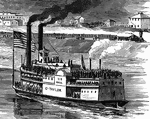
"Bellaire, O.- Steamboats conveying troops and munitions of war for the Federal forces on the Great Kanawha. Bellaire is a town situated on the Ohio River, three miles below Wheeling, Va. It is the eastern terminus of the Central Ohio Railroad, and the point for crossing the river connecting the Baltimore and Ohio with the above-named railroad. The place contained a population of fifteen hundred or two thousand inhabitants in 1861. Its importance was owing to its eligible position for the rapid concentration of troops. The sketch represents a fleet of boats lying in the river awaiting the quoata of troops and munitions for the prosecution of the war on the Great Kanawha. At this date, 1896, two weekly newspapers are published here. It has two banks, two churches, also manufactures of window-glass and flintware, nails, pig iron, galvanized ware and agricultural machines. The city is lighted with gas, and has waterworks and a street railway. Coal, limestone and fire-clay abound here. Population, about ten thousand." —Leslie, 1896

Bellaire

"Bellaire, O.- Steamboats conveying troops and munitions of war for the Federal forces on the Great…
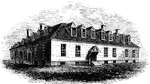
"Raleigh Tavern. When I visited Williamsburg in December, 1848, the front part of the old Raleigh tavern had been torn down, and a building in modern style was erected in its place. The old tavern was in the form of an L, one portion fronting the street, the other extending at right angles, in the rear. Both parts were precisely alike in external appearance, and as the rear building was yet standing and unaltered. I am able to give a restored view of the Raleigh, as it appeared during the Revolution. The wooden bust of Sir Walter Raleigh, which graved the front of the old inn, now ornaments the new building."—Lossing, 1851

Raleigh Tavern

"Raleigh Tavern. When I visited Williamsburg in December, 1848, the front part of the old Raleigh tavern…
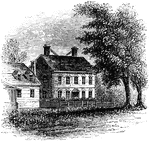
"The Nelson Mansion. This view is from the street looking northwest. A long wooden building, with steep roof and dormer windows, a portion of which is seen on the left, is also a relic of the Revolutionary era. It, too, was much damaged by the bombardment. A few feet from the door of Mr. Nelson's dwelling is a fine laurel-tree. On the occasion of La Fayette's visit to Yorktown in 1824, a large concourse of people were assembled; branches were taken from this laurel-tree, woven into a civic crown, and placed upon that of Preserved Fish, who accompanied him, remarked that none in all that company was better entitled to wear the mark of honor than he."—Lossing, 1851

Nelson Mansion

"The Nelson Mansion. This view is from the street looking northwest. A long wooden building, with steep…
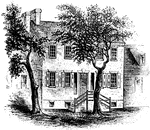
"Dwelling of General McIntosh. This house is the third eastward from Drayton Street, and is said to be the oldest brick house in Savannah. Broad Street, upon which it stands, is a noble avenue, shaded by four rows of Pride-of-India-Trees."—Lossing, 1851

McIntosh's House

"Dwelling of General McIntosh. This house is the third eastward from Drayton Street, and is said to…
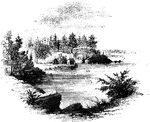
"View at Turtle Bay. Turtle Bay is a small rock-bound cove of the East River, at the foot of Forty-seventh Street. The banks are high and precipitous, and afforded a safe retreat for small vessels. Here the government had made a magazine of military stores, and these the Sons of Liberty determined to seize. Under the direction of Lamb, Sears, Willett, and McDougal, a party procured a sloop at Greenwich, came stealthily through the dangerous vortex of Hell Gate at twilight, and at midnight surprised and captured the guard, and secured the stores. The old store-house in which they were deposited is yet standing upon a wharf on the southern side of the little bay. The above view is from the bank at the foot of Forty-sixth Street. Beyond the rocky point on the north side of the bay is seen the lower end of Blackwell's Island, with the shore of Long Island in the distance. On the left of the old store-house, is seen the bridge across the mouth of Newtown Creek, a locality which will be mentioned presently in connection with a notice of the landing of troops under Sir Henry Clinton."—Lossing, 1851

Turtle Bay

"View at Turtle Bay. Turtle Bay is a small rock-bound cove of the East River, at the foot of Forty-seventh…
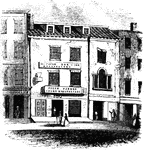
"Washington's head-quarters. I was informed by the venerable Anna van Antwerp, about a fortnight before her death, in the autumn of 1851, that Washington made his head-quarters, on first entering the city, at the spacious house (half of which is yet standing at 180 Pearl Street, opposite Cedar Street), delineated in the engraving. The large window, with no arch, toward the right, indicates the center of the original building. It is of brick, stuccoed, and roofed with tiles. There Washington remained until sommoned to visit Congress at Philadelphia, toward the last of May. On his return, he went to the Kennedy House, No. 1 Broadway, where he remained until the evacuation in September."—Lossing, 1851

Washington's Head-Quarters

"Washington's head-quarters. I was informed by the venerable Anna van Antwerp, about a fortnight before…
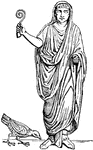
"Among the anceient Romans, a functionary whose duty it was to observe and to interpret, according to traditional rules, the auspices, or reputed natural signs concerning future events."-Whitney, 1902.

Auger

"Among the anceient Romans, a functionary whose duty it was to observe and to interpret, according to…
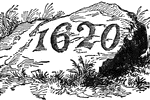
"Plymouth is a town and county-seat of Plymouth co., Mass.; on Plymouth Bay, 37 miles S. E. of Boston. Plymouth is of importance as the spot where the Pilgrim Fathers landed on Dec. 21, 1620. A portion of the rock on which they first stepped has been placed in front of Pilgrim Hall, in which are preserved old books, paintings, pictures, and other valuable relics. The rock itself is in Water Street, and is covered by a handsome granite canopy."—(Charles Leonard-Stuart, 1911)

Plymouth Rock

"Plymouth is a town and county-seat of Plymouth co., Mass.; on Plymouth Bay, 37 miles S. E. of Boston.…
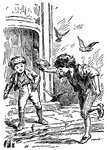
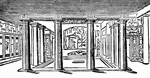
Children with the Tin Solder in "The Brave Tin Soldier."

Children

Children with the Tin Solder in "The Brave Tin Soldier."

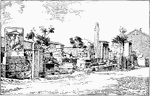
"House construction consists mainly of concrete or brick, and sometimes of stone blocks, especially at the corners. Two-storied, sometimes three-storied houses are numerous, though the upper floors, built of wood, have been consumed by the eruption. Stores usually occupied the ground floors of dwelling-houses, on their street aspect, let out to merchants or dealers as at the present day, but not connected with the back part of the house. They could be separated from the street by large wooden doors, while inside they had tables covered with marble, in which earthen vessels for wine or oil were inserted. The storekeeper had sometimes a second room at the back, when he did not live on an upper floor or in another part of the town."—(Charles Leonard-Stuart, 1911)

Pompeiian House

"House construction consists mainly of concrete or brick, and sometimes of stone blocks, especially…
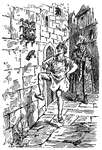
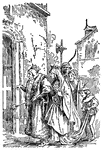
Soldier and Witch from "The Tinder-Box."

Soldier and Witch

Soldier and Witch from "The Tinder-Box."

The King from "The Tinder-Box."

King

The King from "The Tinder-Box."

The Soldier with the Princess and dog in "The Tinder-Box."

Soldier and Princess

The Soldier with the Princess and dog in "The Tinder-Box."

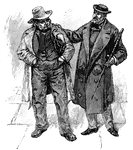
Two men in their jackets and hats, on the street.

Men

Two men in their jackets and hats, on the street.

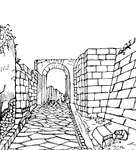
"The following cut gives a view of of a portion of the paved street at the entrance of Pompeii. The upper surface consists of large polygonal blocks of the hardest stone, fitted and jointed with the utmost nicety, so as to present a perfectly even surface, as free from gaps or irregularities, as if the whole had been one solid mass." — Anthon, 1891

Pompeii

"The following cut gives a view of of a portion of the paved street at the entrance of Pompeii. The…
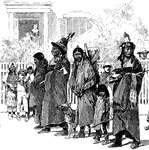
Indians lined up to go into the court-house yard

Indians Walking along a Street

Indians lined up to go into the court-house yard

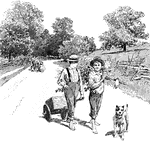
Boys walking down a street with their dog

Boys

Boys walking down a street with their dog

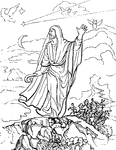
"Represents a Roman augur, with his litmus or divining staff, observing the signs in the heavens." — Anthon, 1891

Roman augur

"Represents a Roman augur, with his litmus or divining staff, observing the signs in the heavens." —…
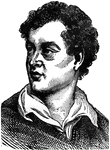
"George Gordon, Lord Byron, was born in Holles Street, London." —The Popular Cyclopedia, 1888

Lord George Gordon Byron

"George Gordon, Lord Byron, was born in Holles Street, London." —The Popular Cyclopedia, 1888
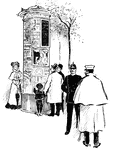
"Each is as big around as a hogshead, and about fifteen feet high; it is covered with printed manner, and has a clock near the top." —Carpenter, 1902

German Street Corner

"Each is as big around as a hogshead, and about fifteen feet high; it is covered with printed manner,…
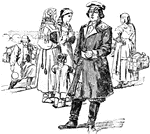
"Odessa is the chief city of southern Russia, and men from all the countries about come here to trade." —Carpenter, 1902

People of Odessa

"Odessa is the chief city of southern Russia, and men from all the countries about come here to trade."…
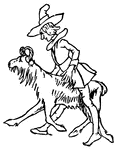
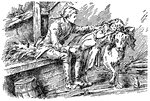
From a nursery rhyme, <em>Simple Simon Met a Pieman</em>. The Simple Simon went a-hunting for to catch a hare; He rode a goat about the street, but could not find one there. Simple Simon went to town to buy a piece of meat; He tied it to his horse's tail to keep it clean and sweet.

Simple Simon

From a nursery rhyme, Simple Simon Met a Pieman. The Simple Simon went a-hunting for to catch…
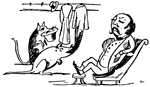
A scene from the nursery rhyme, <em>The Nonsense of Edward Lear</em>. There was an old man who supposed, that the street door was properly closed; But some very large rats ate his coats and his hats, while that sleepy old gentleman dozed.

Edward Lear

A scene from the nursery rhyme, The Nonsense of Edward Lear. There was an old man who supposed,…
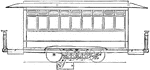
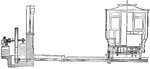
A street-car with spring motive power.

Street-Car

A street-car with spring motive power.

Winding up the street-car springs.

Car Springs

Winding up the street-car springs.

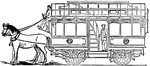
Street railway car, drawn by horses.

Street Car

Street railway car, drawn by horses.

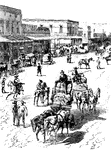
Cotton Wagons on Elm Street, in Dallas, Texas.

Dallas

Cotton Wagons on Elm Street, in Dallas, Texas.

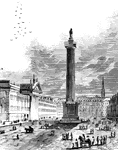
The Nelson Monument, Sackille Street, Dublin.

Nelson

The Nelson Monument, Sackille Street, Dublin.

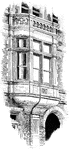
An oriel is a bay window that projects from an upper floor of a building. This example is from a house on Fifty-Fourth Street in New York. C. C. Haight, Architect.

Oriel

An oriel is a bay window that projects from an upper floor of a building. This example is from a house…
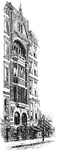
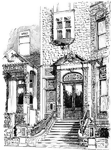
House in Fifty-Sixth Street, New York. Bruce Price, Architect.

House

House in Fifty-Sixth Street, New York. Bruce Price, Architect.

Doorway at Fifth Avenue and Sixty-Seventh Street in New York. Lamb and Rich, Architects.

Fifth Avenue

Doorway at Fifth Avenue and Sixty-Seventh Street in New York. Lamb and Rich, Architects.
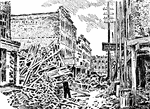
A street in Charleston after the earthquake in 1886.

Earthquake

A street in Charleston after the earthquake in 1886.

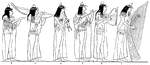
This image shows a group of ancient egyptian street musicians. (1) Woman with a tall light harp with fourteen strings. (2) Cithara. (3) Te-bouni, or banjo. (4) Double flute. (5) Shoulder Harp. (6) Singer, clapping hands.

Ancient Egyptian Music

This image shows a group of ancient egyptian street musicians. (1) Woman with a tall light harp with…
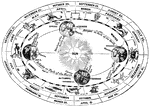
A diagram that shows constellations, seasons, equinoxes, solstices and astrological signs.

Seasons etc.

A diagram that shows constellations, seasons, equinoxes, solstices and astrological signs.
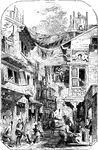
A street in the city of Canton.

Canton

A street in the city of Canton.

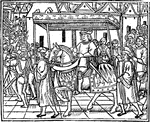
A man traveling on horseback through the streets of town.

Man on Horse

A man traveling on horseback through the streets of town.

"In street architecture a covered way or passage, either open at the side with a range of pillars, or completely covered over. The finest arcades of this description are to be found in Paris." &mdash; Encyclopedia Britanica, 1893

Arcade

"In street architecture a covered way or passage, either open at the side with a range of pillars, or…
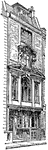
"House in Margaret Street, London." &mdash; The Encyclopedia Britannica, 1910

Margaret Street

"House in Margaret Street, London." — The Encyclopedia Britannica, 1910

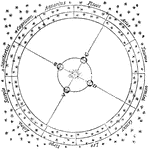
"The twelve signs of the zodiac, together with the Sun, and the Earth revolving around him. When the Earth is at A, the Sun will appear to be just entering the sign Aries, because then, when seen from the Earth, he ranges towards certain stars at the beginning of that constellation. When the Earth is at C, the Sun will appear in the opposite part of the heavens, and therefore in the beginning of Libra. The middle line, dividing the circle of the zodiac into equal parts, is the line of the ecliptic." &mdash;Comstock, 1850

Zodiac Signs

"The twelve signs of the zodiac, together with the Sun, and the Earth revolving around him. When the…
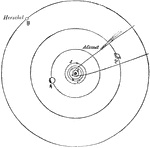
"Relative distance of the Planets. Having now given a short account of each planet composing the solar system, the relative situation of their several orbits, with the exception of those of the Asteroids, are shown in this figure. The orbits are marked by the signs of each planet, of which the first, or that nearest the Sun, is Mercury, the next Venus, the third the Earth, the fourth Mars then come those of the Asteroids, then Jupiter, then Saturn and lastly Herschel." &mdash;Comstock, 1850

Planet Distance

"Relative distance of the Planets. Having now given a short account of each planet composing the solar…
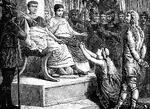
Caractacus was a British Chief that had fought very bravely against the Romans. He was brought to Rome with chains on his hands and feet and set before the emperor of Rome. The wife of Caratacus, who had also been brought a prisoner to Rome, fell upon her knees imploring pity, but Caractacus asked for nothing and exhibited no signs of fear.

Caractacus And Claudius

Caractacus was a British Chief that had fought very bravely against the Romans. He was brought to Rome…
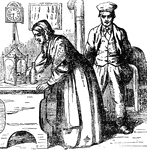
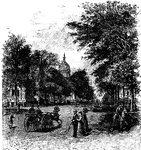
A scene from the story, "The Old Street Lamp."

The Old Street Lamp

A scene from the story, "The Old Street Lamp."

A shady street in a town.

Town

A shady street in a town.

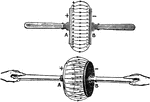
"Electrification produced by rubbing dissimilar bodies together and then separating them. If the insulated glass and leather discs A and B be rubbed together, but not separated, no signs of electrification can be detected; but if the discs be drawn apart a little distance the space betwen them is found to be and electric field, and as they separate farther and farther, electric forces will be found to exist in more and more of the surrounding space, the electrification being indicated by 'lines of force.' " -Hawkins, 1917

Electrification

"Electrification produced by rubbing dissimilar bodies together and then separating them. If the insulated…

"Two motors are usually employed on each [electric railway] car, and the connection between them and the rails is made through the car-wheels and axles, and between them and the line wire, by a wire connected with a wheel called the <em>trolley.,/i> which is carried at the end of a pole supported on the car roof...." -Atkinson 1903

Electric Railway

"Two motors are usually employed on each [electric railway] car, and the connection between them and…
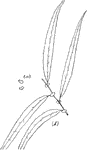
Leaves - simple; alternate; edge very finely sharp-toothed. Outline - long and narrow, often "scythe-shaped." Apex - long, taper-pointed. Base - gradually narrowing and pointed or slightly rounded. Leaf/Stem - short. Stipules - (two small, leaf-like appendages at the base of the leaf-stem), not falling off when young, as in most of the willows; moon-shaped, finely toothed, wider than long. Leaf - four to eight inches long; green and smooth above and below (silky-downy when young). Found - on low ground from New England to the Middle States and westward. General Information - A small tree (or sometimes a shrub). The persistent stipules and the length of the leaf furnish ready signs for distinguishing it from S. nigra. Salix from two Celtic words meaning "near" and "water."

Genus Salix, L. (Willow)

Leaves - simple; alternate; edge very finely sharp-toothed. Outline - long and narrow, often "scythe-shaped."…
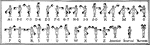
The complete alphabet of the Boy Scouts' signal code.

Scouts' Signals

The complete alphabet of the Boy Scouts' signal code.

"Street of tombs outside Ancient Athens." -Breasted, 1914

Athenian Tombs

"Street of tombs outside Ancient Athens." -Breasted, 1914

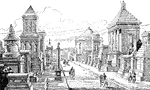
"A street of tombs outside Rome, on the Appian Way." -Breasted, 1914

Appian Way Tombs

"A street of tombs outside Rome, on the Appian Way." -Breasted, 1914

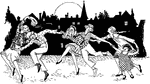
Girls holding hands and playing in the street.

Girls Playing

Girls holding hands and playing in the street.

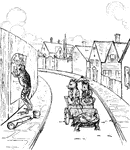
A mouse couple in their turtle-drawn carriage watching a frog post signs.

Mice in a Turtle-Drawn Carriage.

A mouse couple in their turtle-drawn carriage watching a frog post signs.
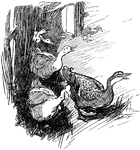
Five geese waddling under a fence out to the street.

Geese Waddling

Five geese waddling under a fence out to the street.

The Indians and the Highlander. Caption below illustration: "The Scotchman requested that the broad sword should be given to the most alert and most vigorous person in the assembly; and laying bare his neck after he had rubbed it over with magic signs , and muttered a few inarticulate words, he called out, with a loud voice and cheerful air."

Indians and the Highlander

The Indians and the Highlander. Caption below illustration: "The Scotchman requested that the broad…
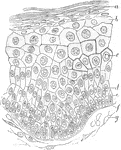
Vertical section of epidermis of the prepuce. Labels: a, stratum corneum, of very few layers, the stratum lucidum and stratum granulosum not being distinctly represented; b, c, d, and e, the layers f the stratum Malpighi, a certain number of the cells in layers d and e showing signs of segmentation; layers c consists chiefly of prickle or ridge and furrow cells; f, basement membrane; g, cells in cutis vera.

Epidermis

Vertical section of epidermis of the prepuce. Labels: a, stratum corneum, of very few layers, the stratum…
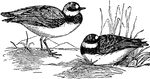
"It is only requisite to exhibit the outward signs of bacchanalian excitement, and the birds will be filled with a sense of false security, so that you may approach within a few yards of them."

Common Dotterel

"It is only requisite to exhibit the outward signs of bacchanalian excitement, and the birds will be…
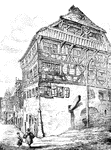
"Albrecht D&uuml;rer's House in N&uuml;rnberg. From the engraving in Dibdin's 'Biographical Tour.'" -Heath, 1901

Albrecht Dürer's House in Nürnberg

"Albrecht Dürer's House in Nürnberg. From the engraving in Dibdin's 'Biographical Tour.'"…
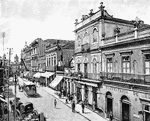
Sao Paulo is the largest city in Brazil.

Sao Paulo

Sao Paulo is the largest city in Brazil.

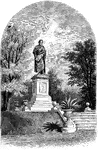
The first bandstand was constructed in 1867 coinciding with the opening of Benton Place -- a private street (or, in the local terminology, "private place)" off Park Avenue. In 1868, an historic crowd of 25,000 to 40,000 gathered to witness the unveiling of a bronze statue of Senator Thomas Hart Benton.

Statue of Benton

The first bandstand was constructed in 1867 coinciding with the opening of Benton Place -- a private…