A cave is a natural underground void large enough for a human to enter.

Cave

A cave is a natural underground void large enough for a human to enter.

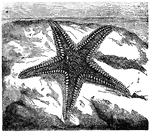
"The body of the Asterias is supported by a calcareous envelop composed of juxta-imposed pieces at once various and numerous."

Aserias Aurantiaca (Lamarck)

"The body of the Asterias is supported by a calcareous envelop composed of juxta-imposed pieces at once…
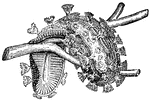
"The whole internal cavity in these animals is occupied by little, white tubes. The mouth opens at the extremity of the body; it forms a sort of funnel, surrounded like a crown with an elegant circle of tentacula."

Cristatella Mucedo (Cuvier)

"The whole internal cavity in these animals is occupied by little, white tubes. The mouth opens at the…
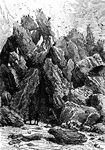
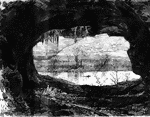
An illustration of a cliff with with a cave. A cave is a natural underground void large enough for a human to enter.

Cave

An illustration of a cliff with with a cave. A cave is a natural underground void large enough for a…
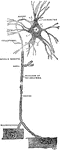
Scheme of the central motor neuron. The motor cell body, together with all its protoplasmic processes, its axis-cylinder process, collaterals, and end ramifications, represent parts of a single  cell or neuron. Labels: a, h, Axone-hillock devoid of Nissl bodies, and showing fibrilation; c, cytoplasm showing Nissl bodies and lighter ground substance. n', nucleolus.

Scheme of the Central Motor Neuron

Scheme of the central motor neuron. The motor cell body, together with all its protoplasmic processes,…
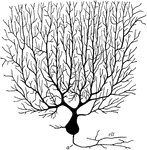
Purkinjean cell from human cerebellum, as seen in a plane transverse to the long axis of a cerebellar folium. Labels: a, axon; clt., collaterals.

Purkinjean Cell from Cerebellum

Purkinjean cell from human cerebellum, as seen in a plane transverse to the long axis of a cerebellar…
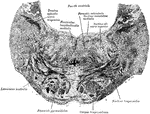
The pons is composed chiefly of transverse fibers arranged in coarse bundles, longitudinal fibers gathered in compact bundles, and diffusely scattered masses of gray substance among the fiber bundles, the nuclei pontis. Shown is a section of the pons at its middle, showing trapezoid body.

Section of the Pons

The pons is composed chiefly of transverse fibers arranged in coarse bundles, longitudinal fibers gathered…
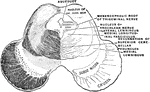
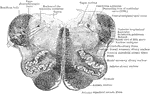
Section of the midbrain through the level of the inferior quadrigeminal body.

Section Through the Midbrain

Section of the midbrain through the level of the inferior quadrigeminal body.
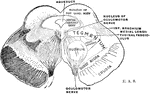
Section of the midbrain through the level of the superior quadrigeminal body.

Section Through the Midbrain

Section of the midbrain through the level of the superior quadrigeminal body.
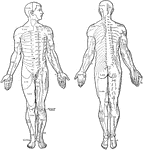
Distribution of cutaneous nerves.

Cutaneous Nerves of the Body

Distribution of cutaneous nerves.

Longitudinal section through human nail and its nail groove (sulcus).

Longitudinal Section Through Fingernail

Longitudinal section through human nail and its nail groove (sulcus).

Transverse section through human nail and its nail groove (sulcus).

Transverse Section Through Fingernail

Transverse section through human nail and its nail groove (sulcus).

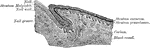
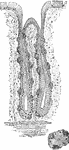
The peptic gastric glands are distributed throughout the entire fundus and body, and may be found even at the pylorus. They are mainly of the simple tubular variety, and are lined by simple epithelial cells resting upon a delicate basement membrane supported by the tunica propria. The duct of these gland is shorter than in other variety.

Peptic Gastric Gland

The peptic gastric glands are distributed throughout the entire fundus and body, and may be found even…

Thomas Hart Benton (3/14/1784 - 4/10/1858) was a U.S. Senator from Missouri and a staunch advocate of westward expansion of the United States. He served in the Senate from 1821 to 1851, becoming the first member of that body to serve five terms. Benton was an architect and champion of westward expansion by the United States, a case that became known as the Manifest Destiny.

Thomas Benton

Thomas Hart Benton (3/14/1784 - 4/10/1858) was a U.S. Senator from Missouri and a staunch advocate of…

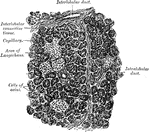
Section of human pancreas, showing pancreatic islands.

Section of Pancreas

Section of human pancreas, showing pancreatic islands.

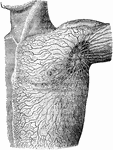
Lymphatics and lymphatic glands on the left side of the body and shoulder.

Lymphatics of the Shoulder

Lymphatics and lymphatic glands on the left side of the body and shoulder.

The maturation of the ovum. A, An ovum at the commencement process. B, After the formation of the spindle. The chromosomes are gathered at the equator of the spindle in groups of four, i.e. in tetrads, each which consists of two dyads. C, One apex of the spindle has projected into a bud on the surface, and the dyads have passed to the poles. D, The separation of the first polar body. E, The commencement of the second polar body; F, The completion of the second polar body.

Maturation of the Ovum

The maturation of the ovum. A, An ovum at the commencement process. B, After the formation of the spindle.…

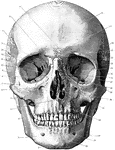
Shown is norma frontalis, which refers to the front of the skull. Labels: 1, mental protuberance; 2, body of lower jaw; 3, ramus of lower jaw; 4, anterior nasal spine; 5, canine fossa; 6, infraorbital canal; 7, malar canal; 8 orbital surface of superior maxilla; 9, temporal fossa; 10, os planum of ethmoid; 11, sphenoidal fissure; 12, lachrymal bone and groove; 13, optic foramen; 14, orbital foramina; 15, temporal ridge; 16, supraorbital notch; 17, glabella; 18, frontal eminence; 19, superciliary ridge; 20, parietal bone; 21, front-nasal suture; 22, pterion; 23, great wing of sphenoid; 24, orbital surface of great wing of sphenoid; 25, squamous temporal; 26, left nasal bone; 27, malar bone; 28, sphenomaxillary fissure; 29, zygomatic arch; 30, anterior nasal aperture, displaying nasal septum and inferior and middle turbinated bones; 31, mastoid process; 32, incisor fossa; 33, angle of jaw; 34, mental foramen; 35, symphysis.

Front of the Skull

Shown is norma frontalis, which refers to the front of the skull. Labels: 1, mental protuberance; 2,…

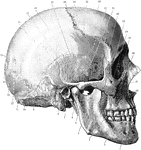
Shown is norma lateralis, which refers to the side of the skull. Labels: 1, mental foramen; 2, body of lower jaw; 3, superior maxillary; 4, ramus of lower jaw; 5, zygomatic arch; 6, styloid process; 7, external auditory meatus; 8, mastoid process; 9, asterion; 10, superior curved line of occipital bone; 11, external occipital protuberance; 12, lambdoid suture; 13, occipital bone; 14, lambda; 15, obelion placed between the two parietal foramina; 16, parietal bone; 17, lower temporal ridge; 18, upper temporal ridge; 19, squamous part of temporal bone; 20, bregma; 21, coronal suture; 22, stephanion; 23, frontal bone; 24, pterion; 25, temporal fossa; 26, great wing of sphenoid; 27, malar bone; 28, malar canal; 29, lachrymal bone; 30, nasal bone; 31, infraorbital canal; 32, anterior nasal aperture.

Side of the Skull

Shown is norma lateralis, which refers to the side of the skull. Labels: 1, mental foramen; 2, body…

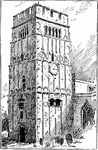
The influence is very much Roman, and this can be seen by looking at the doors and windows of the tower. The tower has a number of functions. At Earls Barton, the ground floor probably served as the main body of the church and would have been annexed by a chancel to the east.

Earls-Barton Saxon Tower

The influence is very much Roman, and this can be seen by looking at the doors and windows of the tower.…

Edward VI (12 October 1537 – 6 July 1553) became King of England and Ireland on 28 January 1547 and was crowned on 20 February at the age of nine. During Edward's reign, the realm was governed by a Regency Council, because he never reached maturity. Edward's reign was marked by economic problems, military withdrawal from Scotland and Boulogne, and social unrest that in 1549 erupted into riot and rebellion. It also saw the transformation of the Anglican Church into a recognizably Protestant body. On Edward's death at the age of 15, the succession was disputed. Jane survived as queen for only nine days, before the Privy Council proclaimed Mary, for whom the people had risen in support in the counties.

Edward VI of England

Edward VI (12 October 1537 – 6 July 1553) became King of England and Ireland on 28 January 1547…

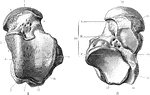
The right astragalus. A, Upper surface. B, Under surface. Labels: 1, groove for flex, long, hallucis; 2, internal tubercle; 3, trochlear surface for tibia; 4, body; 5, for articulation with internal malleolus; 6, head; 7, for articulation with internal malleolus; 8, neck; 9, for articulation with external malleolus; 10, surface against which the inferior tibio fibular ligament rests; 11, external tubercle; 12, external tubercle; 13, posterior, middle, and anterior facets for os calcis; 14, for articulation with navicular; 15, surface resting on inferior calcaneo-navicular ligament; 16, interosseous groove; 17, internal tubercle; 18, groove for the flexor longus hallucis.

Astragalus

The right astragalus. A, Upper surface. B, Under surface. Labels: 1, groove for flex, long, hallucis;…

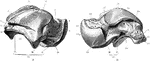
The right astragalus. A, As seen from the outer side. B, As seen from the inner side. Labels: 1, external tubercle; 2, groove for flexor longus hallucis; 3, internal tubercle; 4, surface against which the inferior tibio-fibular ligament rests; 5, trochlea for tibia; 6, for articulation with external malleolus; 7, neck; 8, head; 9, for articulation with navicular; 10, interosseous groove; 11, anterior, middle, and posterior facets for os calcis; 12, body; 13, surface resting on internal calcaneo navicular ligament; 14, for articulation with navicular; 15, head; 16, neck; 17, trochlea for tibia; 18, for articulation with internal malleolus; 19, body; 20, impression for internal lateral ligament; 21, internal tubercle; 22, groove for flexor longus hallucis; 23, external tubercle; 24, interosseous groove; 25, posterior and middle facets for os calis.

Astragalus

The right astragalus. A, As seen from the outer side. B, As seen from the inner side. Labels: 1, external…

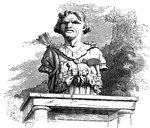
A bust is a sculpted or cast representation of the upper part of the human figure, depicting a person's head and neck, as well as a variable portion of the chest and shoulders. The piece is normally supported by a plinth. These forms recreate the likeness of an individual. These may be of any suitable material (such as marble, bronze or clay).

Bust of Man

A bust is a sculpted or cast representation of the upper part of the human figure, depicting a person's…

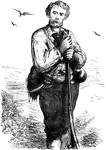
An illustration of an adult man holding a rifle in front of his body.

Man and Rifle

An illustration of an adult man holding a rifle in front of his body.

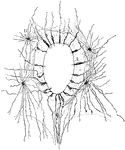
Section through the central canals of the spinal cord of a human embryo, showing ependymal (A) and neuroglial cells (B).

Section Through Spinal Cord Showing Neuroglial Cell

Section through the central canals of the spinal cord of a human embryo, showing ependymal (A) and neuroglial…

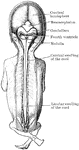
Human fetus in the third month of development, with the brain and spinal cord exposed from behind.

Brain and Spinal Cord of Fetus

Human fetus in the third month of development, with the brain and spinal cord exposed from behind.

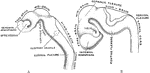
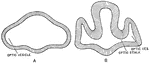
Two stages in the development of the human brain. A. Brain of an human embryo of the third week. B. Brain of an embryo of five weeks.

Development of Human Brain

Two stages in the development of the human brain. A. Brain of an human embryo of the third week. B.…

Two cross sections through the forebrain. A. Through the forebrain of the early human embryo. B. Through the forebrain and optic vesicles of Lepidosteus embryo of eight days.

Section Through Forebrain of Human and Lepidosteus Embryos

Two cross sections through the forebrain. A. Through the forebrain of the early human embryo. B. Through…

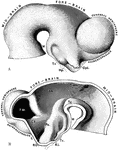
The brain of a human embryo in the fifth week. A, Brain as seen in profile. B, Mesial section through the same brain. Labels: M, mammillary eminence, Tc, tuber cinereum; Hp, Hypophysis (pituitary diverticulum from buccal cavity); Opt, optic stalk; TH, optic thalamus; Tg, tegmental part of mesencephalon; Ps, pars subtalamica; Cs, corpus striatum; FM, foramen of Monro; L, lamina terminalis; RO, recessus opticus; RI, recessus infundibuli.

Brain of Embryo

The brain of a human embryo in the fifth week. A, Brain as seen in profile. B, Mesial section through…

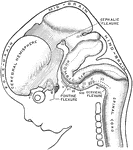
Profile view of brain of a human embryo of ten weeks. The various cranial nerves are indicated by numerals. A, Cerebral diverticulum of pituitary body. B, Buccal diverticulum of pituitary body.

Brain of Embryo

Profile view of brain of a human embryo of ten weeks. The various cranial nerves are indicated by numerals.…

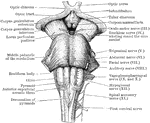
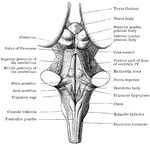
Front view of the medulla, pons, and mesencephalon of a full term human fetus.

Front view of Medulla, Pons, and Mesencephalon

Front view of the medulla, pons, and mesencephalon of a full term human fetus.

Back view of the medulla, pons, and mesencephalon of a full term human fetus.

Back View of Medulla, Pons, and Mesencephalon

Back view of the medulla, pons, and mesencephalon of a full term human fetus.

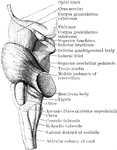
Lateral view of the medulla, pons, and mesencephalon of a full term human fetus.

Lateral View of Medulla, Pons, and Mesencephalon

Lateral view of the medulla, pons, and mesencephalon of a full term human fetus.

Transverse section through the closed part of the human medulla immediately above the decussation of the pyramids.

Transverse Section Through Closed Part of Medulla

Transverse section through the closed part of the human medulla immediately above the decussation of…

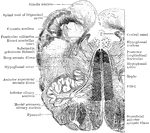
Transverse section through the human medulla in the lower olivary region.

Section Through Medulla in Olivary Region

Transverse section through the human medulla in the lower olivary region.

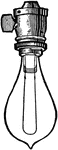
The incandescent light bulb, incandescent lamp or incandescent light globe is a source of electric light that works by incandescence, (a general term for heat-driven light emissions which includes the simple case of black body radiation).

Incandescent Lamp

The incandescent light bulb, incandescent lamp or incandescent light globe is a source of electric light…

Transverse section through the the middle of the olivary region of the human medulla or bulb.

Section Through Medulla in Olivary Region

Transverse section through the the middle of the olivary region of the human medulla or bulb.

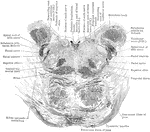
Section through the lower part of the human pons varolii immediately above the medulla.

Section Through Pons Varolii

Section through the lower part of the human pons varolii immediately above the medulla.

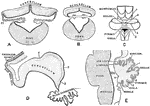
Showing the development of the cerebellum. A, Transverse section through the forepart of the cerebellum of a sheep embryo. B, Transverse section through the hinder part of the cerebellum of a sheep embryo. C, Cerebellum of a human fetus 17 cm long. D, Median section through cerebellum of sheep embryo 5 cm long.E, Median section through cerebellum of human fetus 17 cm long. Labels: 1, sulcus primarius; 2, sulcus above and afterwards behind the pyramid; 3, sulcus between pyramid and uvula; 4, great horizontal fissure; r.l., lateral recess ventricle IV; T, transverse groove in roof of ventricle IV.

Development of Cerebellum

Showing the development of the cerebellum. A, Transverse section through the forepart of the cerebellum…

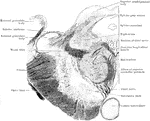
Transverse section through the mesencephalon at the level of the inferior quadrigeminal body.

Section of Mesencephalon at Inferior Quadrigeminal Body

Transverse section through the mesencephalon at the level of the inferior quadrigeminal body.

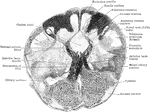
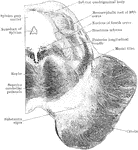
Transverse section through the mesencephalon at the level of the superior quadrigeminal body.
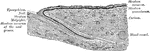
Section of Mesencephalon at Superior Quadrigeminal Body

Transverse section through the mesencephalon at the level of the superior quadrigeminal body.
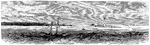
An illustration of Biscayne Bay, is a lagoon that is approximately 35 miles (56 km) long and up to 8 miles (13 km) wide located on the Atlantic coast of south Florida. It is usually divided for purposes of discussion and analysis into three parts, North Bay, Central Bay and South Bay. North Bay separates Miami Beach on its barrier island from Miami on the mainland. It has been severely affected over the last century by raw sewage releases, urban runoff, shoreline bulkheading, dredging, the creation of artificial islands and the loss of natural fresh water flow into the bay. North Bay accounts for only 10% of the water area of the bay. Central Bay is the largest part of the bay. It is separated from the Atlantic Ocean by the Safety Valve, a series of shallow flats separated by tidal flow channels, stretching from the south end of Key Biscayne to the Ragged Keys at the north end of the Florida Keys. It has been adversely affected primarily by bulkheading, urban runoff discharged by canals, and the loss of natural fresh water flow. South Bay is nearly as large as Central Bay, and is the least affected by human activities, although it also suffers from the loss of natural fresh water flow. South Bay is separated from the Atlantic Ocean by the northernmost of the Florida Keys, and is connected to Florida Bay through channels and "sounds" lying between the mainland and the keys.

Biscayne Bay

An illustration of Biscayne Bay, is a lagoon that is approximately 35 miles (56 km) long and up to 8…
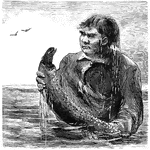
An illustration of a man holding a sea cucumber. The sea cucumber (also known as trepang and sea slug) is an echinoderm of the class Holothuroidea, with an elongated body and leathery skin, which is found on the sea floor worldwide. It is so named because of its cucumber-like shape. The body contains a single, branched gonad. Like all echinoderms, sea cucumbers have an endoskeleton just below the skin, calcified structures that are usually reduced to isolated microscopic ossicles (or sclerietes) joined by connective tissue. These can sometimes be enlarged to flattened plates, forming an armor.

Man Holding Sea Cucumber

An illustration of a man holding a sea cucumber. The sea cucumber (also known as trepang and sea slug)…
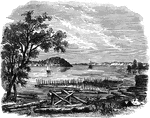
General Jacob Brown made camp at French Creek on October 29th, 1813. Brown's force was the advance guard of General Wilkinson's army marching on Montreal.

Mouth of French Creek

General Jacob Brown made camp at French Creek on October 29th, 1813. Brown's force was the advance guard…
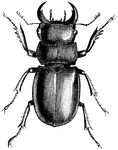
The longhorn beetles (Cerambycidae; also known as long-horned beetles or, more archaically, llongicorns) are a cosmopolitan family of beetles, typically characterized by extremely long antennae, which are often as long as or longer than the beetle's body. The family is large, with over 20,000 species described, slightly more than half from the Eastern Hemisphere. Several are serious pests, with the larvae boring into wood, where they can cause extensive damage to either living trees or untreated lumber.

Longhorn Beetle

The longhorn beetles (Cerambycidae; also known as long-horned beetles or, more archaically, llongicorns)…
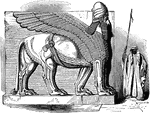
The Shedu is a celestial being from Mesopotamian mythology. He is a human above the waist and a bull below the waist. He also has the horns and the ears of a bull. The bull man helps people fight evil and chaos. He holds the gates of dawn open for the sun god Shamash and supports the sun disc. He is often shown on Cylinder Seals. It appears frequently in Mesopotamian art, sometimes with wings. Statues of the bull-man were often used as gatekeepers.

Shedu

The Shedu is a celestial being from Mesopotamian mythology. He is a human above the waist and a bull…
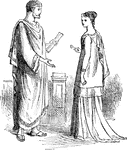
An illustration of a man and woman standing in typical Roman clothing. Clothing in ancient Rome generally consisted of the toga, the stola, brooches for these, and breeches. The toga, a distinctive garment of Ancient Rome, was a sash of perhaps twenty feet (6 meters) in length which was wrapped around the body and was generally worn over a tunic. The stola was the traditional garment of Roman women, corresponding to the toga that was worn by men. In ancient Rome, it was considered disgraceful for a woman to wear a toga; wearing the male garment was associated with prostitution. The stola was a long, pleated dress, worn over a tunic. A brooch (also known in ancient times as a fibula) is a decorative jewelry item designed to be attached to garments. It is usually made of metal, often silver or gold but sometimes bronze or some other material.

Man and Woman in Roman Clothing

An illustration of a man and woman standing in typical Roman clothing. Clothing in ancient Rome generally…
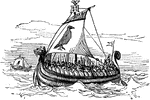
An illustration of a Norse Galley. Norse is an adjective relating things to Norway, Denmark, Faroe Islands, Greenland, Iceland and Sweden. A galley is an ancient ship which can be propelled entirely by human oarsmen, used for warfare and trade. Oars are known from at least the time of the Egyptian Old Kingdom. Many galleys had masts and sails for use when the winds were favorable.

Norse Galley

An illustration of a Norse Galley. Norse is an adjective relating things to Norway, Denmark, Faroe Islands,…
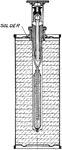
Instead of a standard bouchon assembly being used this grenade is equipped with a Percussion Plug Assembly, Mark I, containing the striker, primer and standard two inch length Bickford fuse. The grenade is ignited by means of first, removing the percussion cover of cap, then knocking or striking the head of the striker sharply against a hard object or against the body.

Cross-Section of a Grenade

Instead of a standard bouchon assembly being used this grenade is equipped with a Percussion Plug Assembly,…
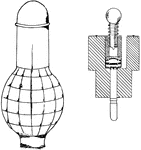
This grenade consists of three parts: (1) a lemon-shaped, serrated, cast iron body; (2) a special igniter the body of which is a hollow piece of wood fixed in the collar of the grenade by three wooden pins; (3) the charge.

French Grenade (C.F.)

This grenade consists of three parts: (1) a lemon-shaped, serrated, cast iron body; (2) a special igniter…
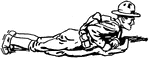
A soldier lying in the prone position. In anatomy,the prone position is a position of the body lying face down.

Soldier, Prone

A soldier lying in the prone position. In anatomy,the prone position is a position of the body lying…
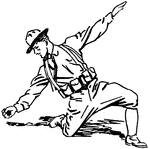
A soldier lying in the prone position, throwing a grenade. In anatomy,the prone position is a position of the body lying face down.

Soldier, Prone, Throwing Grenade

A soldier lying in the prone position, throwing a grenade. In anatomy,the prone position is a position…
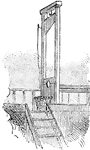
The guillotine was a device used for carrying out executions by decapitation. It consists of a tall upright frame from which a heavy blade is suspended. This blade is raised with a rope and then allowed to drop, severing the victim's head from his or her body. The device is noted for long being the main method of execution in France and, more particularly, for its use during the French Revolution. The guillotine also "became a part of popular culture, celebrated as the people's avenger by supporters of the Revolution and vilified as the preeminent symbol of the Terror by opponents.

Guillotine

The guillotine was a device used for carrying out executions by decapitation. It consists of a tall…
An illustration of a crowded promenade. An esplanade is a long, open, level area, usually next to a river or large body of water, where people may walk. This allows people to promenade along the sea front, usually for recreational purposes, whatever the state of the tide, without having to walk on the beach. Esplanades became popular in Victorian times when it was fashionable to visit seaside resorts. The original meaning of esplanade was a large, open, level area outside fortress or city walls. Esplanade and promenade are sometimes used interchangeably, but that is a mistake. A promenade can be anywhere, and it is exclusively for walking, while an esplanade is for walking but also can include large boulevards or avenues with cars.

Promenade

An illustration of a crowded promenade. An esplanade is a long, open, level area, usually next to a…
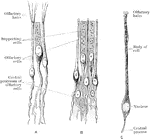
Olfactory and supporting cells in a frog and a human. A. Frog. B. Human. C. Human.

Olfactory and Supporting Cells

Olfactory and supporting cells in a frog and a human. A. Frog. B. Human. C. Human.
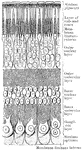
Diagrammatic section of the human retina.

Section of Retina

Diagrammatic section of the human retina.

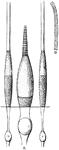
A. A cone and two rods from the human retina (modified from Max Schultze); B. Outer part of rod separated into discs.

Cones and Rods of Retina

A. A cone and two rods from the human retina (modified from Max Schultze); B. Outer part of rod separated…
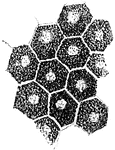
Pigment epithelium of human retina (viewed from the surface).

Pigment Epithelium of Retina

Pigment epithelium of human retina (viewed from the surface).

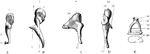
Tympanic ossicles of left ear. A, incus as seen from front. B, Malleus, viewed from behind. C, Incus seen from inner aspect. D, Malleus seen from inner aspect. E, Stapes. Labels: 1, body of incus, with articular surface for head of malleus; 2, processus longus; 3, processus lenticularis; 4, articular surface of incus; 5, head; 6, neck; 7, processus brevis; 8, manubrium; 9, body; 10, short process; 11, long process; 12, processus longus; 13, head; 14, facet for incus; 15, manubrium; 16, head; 17, neck; 18, crus anterior; 19, crus posterior; 20, footplate.

Tympanic Ossicles

Tympanic ossicles of left ear. A, incus as seen from front. B, Malleus, viewed from behind. C, Incus…