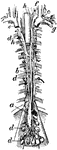
"Human Thoracic Duct and Azygous Veins. a, receptacle of the chyle; b, trunk of the thoracic duct, opening at c into root of left innominate vein at junction of f, left jugular, and g, left subclavian vein; e, right innominate vein; d, d, d, several thoracic and lumbar lymphatic glands; h, h, a short portion of the esophagus. Two azygous veins run parallel with and on each side of the duct, until the left crosses behind the duct to join the right. The structures represented rest nearly upon the back-bone." -Whitney, 1911

Thoracic Duct

"Human Thoracic Duct and Azygous Veins. a, receptacle of the chyle; b, trunk of the thoracic duct, opening…
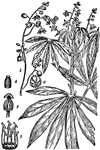
The cassava, yuca, manioc, mogo or mandioca (Manihot esculenta) is a woody shrub of the Euphorbiaceae (spurge family) native to South America that is extensively cultivated as an annual crop in tropical and subtropical regions for its edible starchy tuberous root, a major source of carbohydrates. Cassava is the third largest source of carbohydrates for human food in the world, with Africa its largest center of production. The flour made of the roots is called tapioca.

Yuca

The cassava, yuca, manioc, mogo or mandioca (Manihot esculenta) is a woody shrub of the Euphorbiaceae…
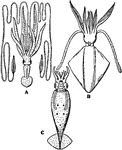
The cephalopods are the mollusk class Cephalopoda characterized by bilateral body symmetry, a prominent head, and a modification of the mollusk foot, a muscular hydrostat, into the form of arms or tentacles. Teuthology, a branch of malacology, is the study of cephalopods. The class contains two extant subclasses. In the Coleoidea, the mollusk shell has been internalized or is absent; this subclass includes the octopuses, squid, and cuttlefish. In the Nautiloidea the shell remains; this subclass includes the nautilus. About 786 distinct living species of cephalopods have been identified. Two important extinct taxa are Ammonoidea, the ammonites, and Belemnoidea, the belemnites Cephalopods are found in all the oceans of Earth, at all depths. None of them can tolerate freshwater, but a few species tolerate more or less brackish water.

Cephalopod

The cephalopods are the mollusk class Cephalopoda characterized by bilateral body symmetry, a prominent…
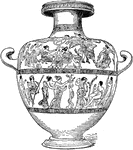
A hydria is a type of Greek pottery used for carrying water. The hydria has three handles. Two horizontal handles on either side of the body of the pot were used for lifting and carrying the pot. The third handle, a vertical one, located in the center of the other two handles, was used when pouring water. This water vessel can be found in both the red and black figure pottery styles. They often depicted scenes of Greek mythology, that reflected moral and social obligations.

Hydria

A hydria is a type of Greek pottery used for carrying water. The hydria has three handles. Two horizontal…
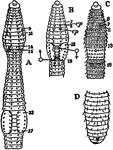
"Diagrams of various earthworms to illustrate external characters. A, B, C, anterior segments from the ventral surface; D, hinder end of the body of Urochaeta." (Britannica, 1910)

Earthworm

"Diagrams of various earthworms to illustrate external characters. A, B, C, anterior segments from the…
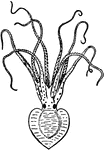
An illustration of pinnoctopus cordiformis, a type of cephalopods. The cephalopods are the mollusc class Cephalopoda characterized by bilateral body symmetry, a prominent head, and a modification of the mollusk foot, a muscular hydrostat, into the form of arms or tentacles. Teuthology, a branch of malacology, is the study of cephalopods.

Pinnoctopus Cordiformis

An illustration of pinnoctopus cordiformis, a type of cephalopods. The cephalopods are the mollusc class…
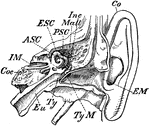
"Transverse Section through Side Walls of Skull, showing the Inner Parts of the Ear. Co, concha or external ear, or pinna; EM, external auditory meatus; TyM, tympanic membrane; Inc, incus; Mall, malleus; ASC, PSC, ESC, anterior, posterior, and external semicircular canals; Coc, cochlea; Eu, Eustachian tube; IM, internal auditory meatus, through which the auditory nerve passes to the organ of hearing." -Whitney, 1911

Inner Ear

"Transverse Section through Side Walls of Skull, showing the Inner Parts of the Ear. Co, concha or external…
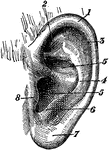
"External Ear, or Pinna. 1, helix; 2, fossa of antihelix, or fossa triangularis; 3, fossa of helix, or fossa scaphoidea; 4, antihelix; 5, 5, concha; 6, antitragus; 7, lobule; 8, tragus." -Whitney, 1911

External Ear

"External Ear, or Pinna. 1, helix; 2, fossa of antihelix, or fossa triangularis; 3, fossa of helix,…
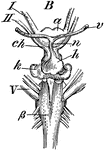
"Brain of Skate (Raia batis), an elasmobranchiate fish. B, from below, in part enlarged: ch, optic chiasm; h, pituitary body; n and v, vessels connected with h; k, saccus vasculosus; ß, pyrimids of medulla oblongata; a, I, II, V, same as in A." -Whitney, 1911

Skate Brain

"Brain of Skate (Raia batis), an elasmobranchiate fish. B, from below, in part enlarged: ch, optic chiasm;…
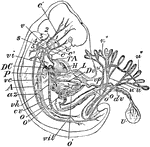
"Early Human Embryo, giving diagrammatically the principal vessels antecedent to the establishment of the regular fetal circulation. H, heart; P, lungs; L, liver; T A, the aortic trunk or cardiac aorta; c, c', c", common, external, and internal carotids; s, subclavian artery; v, vertebral artery; 1, 2, 3, 4, 5, the aortic arches (the persistent left aortic arch hidden); A, subvertebral aorta; o, o', omphalomeseraic artery and vein, to and from U, the umbilical vesicle with its vitelline duct, dv; u, u, the two hypogastric or umbilical arteries, with the ramifications, u", u", in the placenta; u', umbilical vein; vh, hepatic vein; cv, inferior vena cava; vil, iliac veins; az, an azygous vein; vc, a posterior cardinal vein; vi, innominate vein; vp, portal vein; Dv, the ductus venosus; DC, a ductus Cuvieri. The anterior cardinal vein is seen beginning in the head and running down to the ductus Cuvieri, on the under side of the numbers 1, 2, 3, 4, 5." -Whitney, 1911

Human Embryo

"Early Human Embryo, giving diagrammatically the principal vessels antecedent to the establishment of…
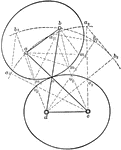
Illustration showing a centroid, "the curve passing through the successive positions of the instantaneous centre of a body having a combined motion of rotation and translation is called a centroid." A smooth curve passes through the successive positions of the instantaneous centers (all the centers marked o)will be the centroid ab.

Centroid

Illustration showing a centroid, "the curve passing through the successive positions of the instantaneous…
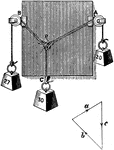
"In the apparatus shown... three forces act on a small body and are allowed to assume a position of equilibrium. A triangle is then constructed with sides parallel respectively to the three forces; it will be found by measurement that the sides are also the lengths proportional to the forces, and as will be seen the arrowheads point concurrently round the triangle.

Polygon of Forces

"In the apparatus shown... three forces act on a small body and are allowed to assume a position of…
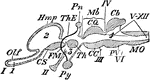
"Diagram of Vertebrate Encephalon ... in longitudinal vertical section. Mb, mid-brain; in front of it all is forebrain, behind it all is hind-brain; laminaterminalis, represented by the heavy black line in upper figure; Olf, olfactory lobes; Hmp, cerebral hemispheres; ThE, thalamencephalon; Py, pituitary body; FM, foramen of Monro; CS, corpus striatum; Th, optic thalamus; CQ, corpora quadrigemina; CC, crura cerebri; Cb, cerebellum; PV, pons Varolii; MO, medulla oblongata; I, olfactory nerves; II, optic nerves; III, point of ext from brain of the oculimotores; IV, of the pathetici; VI, of the abducentes; V-XII, origins of other cerebral nerves; 1, olfactory ventricle; 2, lateral ventricle; 3, third ventricle; 4, fourth ventricle." -Whitney, 1911

Encephalon

"Diagram of Vertebrate Encephalon ... in longitudinal vertical section. Mb, mid-brain; in front of it…
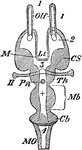
"Diagram of Vertebrate Encephalon ... in horizontal section. Mb, mid-brain; in front of it all is forebrain, behind it all is hind-brain; Lt, laminaterminalis; Olf, olfactory lobes; Pn, pineal body, or conarium; M, foramen of Monro; CS, corpus striatum; Th, optic thalamus; Cb, cerebellum; MO, medulla oblongata; I, olfactory nerves; II, optic nerves; 1, olfactory ventricle; 2, lateral ventricle; 3, third ventricle; 4, fourth ventricle; + is in the iter e tertio ad quartum ventriculum." -Whitney, 1911

Encephalon

"Diagram of Vertebrate Encephalon ... in horizontal section. Mb, mid-brain; in front of it all is forebrain,…
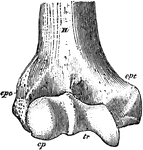
"Anterior View, Distal End, of Right Humerus of a Man. H, humerus; epc, epicondyle, or external supracondyloid protuberance; ept, epitrochlea, or internal supracondyloid protuberance; cp, capitellum, or convex articular suface for head of radius; tr, trochlea, or transversely concave articular surface for the ulna; epc and cp are together the ectocondyle, and ept and tr are together the entocondyle." -Whitney, 1911

Humerus

"Anterior View, Distal End, of Right Humerus of a Man. H, humerus; epc, epicondyle, or external supracondyloid…
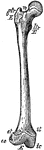
"Right Femur of a Youth. E, E, epiphyses; gtr, ltr, greater and lesser trochanter; h, head; et, it, external and internal tuberosity; ec, ic, external and internal condyle; n, neck." -Whitney, 1911

Youth Femur

"Right Femur of a Youth. E, E, epiphyses; gtr, ltr, greater and lesser trochanter; h, head; et, it,…
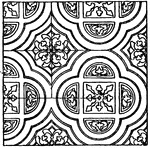
The painting pattern is a 13th century design found in the consistory (governing body) church in Assisi, Italy.

Painting Pattern

The painting pattern is a 13th century design found in the consistory (governing body) church in Assisi,…
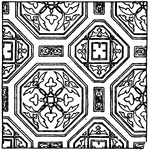
The painting pattern is a 13th century design found in the consistory (governing body) church in Assisi, Italy.

Painting Pattern

The painting pattern is a 13th century design found in the consistory (governing body) church in Assisi,…
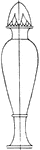
The Egyptian phiale with cover is a slender vessel without handles. It has an elongated body with a long narrow neck made out of clay or glass.

Egyptian Phiale

The Egyptian phiale with cover is a slender vessel without handles. It has an elongated body with a…
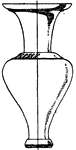
This antique phiale is made out of painted clay. It is a slender vessel without handles that has an elongated body with a long narrow neck.

Antique Phiale

This antique phiale is made out of painted clay. It is a slender vessel without handles that has an…
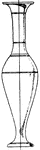
This Antique glass phiale is a slender vessel without handles. It has an elongated body with a long narrow neck.

Antique Glass Phiale

This Antique glass phiale is a slender vessel without handles. It has an elongated body with a long…
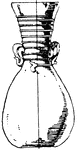
This vase alabastron is made out of iridescent glass. It has a bag-like body with no foot and a narrow neck with ear-shaped handles.

Vase Alabastron

This vase alabastron is made out of iridescent glass. It has a bag-like body with no foot and a narrow…
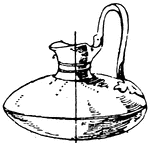
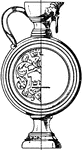
This Antique Olpe is made out of bronze. It has a bag shaped body that is small.

Antique Olpe

This Antique Olpe is made out of bronze. It has a bag shaped body that is small.

This Old German lip-spout pitcher is made out of stoneware and has a disc shaped body.

Old German Lip-Spout Pitcher

This Old German lip-spout pitcher is made out of stoneware and has a disc shaped body.
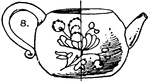
This milk-ewer pipe-spout pot is an 18th century painted faience (tin-glazed). It has an oval body with a flaring spout.

Milk-Ewer Pipe-Spout Pot

This milk-ewer pipe-spout pot is an 18th century painted faience (tin-glazed). It has an oval body with…
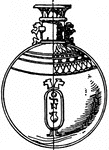
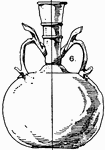
This Egyptian bottle has a spherical bag-like body, almost disc shaped.

Egyptian Bottle

This Egyptian bottle has a spherical bag-like body, almost disc shaped.

This Antique bottle has two handles on a narrow neck with a bag-like body.

Antique Bottle

This Antique bottle has two handles on a narrow neck with a bag-like body.

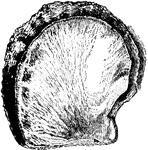
An illustration of a oyster shell. The common name oyster is used for a number of different groups of bivalve mollusks, most of which live in marine habitats or brackish water. The shell consists of two usually highly calcified valves which surround a soft body. Gills filter plankton from the water, and strong adductor muscles are used to hold the shell closed.

Oyster Shell

An illustration of a oyster shell. The common name oyster is used for a number of different groups of…
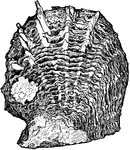
An illustration of a oyster shell. The common name oyster is used for a number of different groups of bivalve mollusks, most of which live in marine habitats or brackish water. The shell consists of two usually highly calcified valves which surround a soft body. Gills filter plankton from the water, and strong adductor muscles are used to hold the shell closed.

Oyster Shell

An illustration of a oyster shell. The common name oyster is used for a number of different groups of…
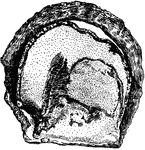
An illustration of a oyster shell. The common name oyster is used for a number of different groups of bivalve mollusks, most of which live in marine habitats or brackish water. The shell consists of two usually highly calcified valves which surround a soft body. Gills filter plankton from the water, and strong adductor muscles are used to hold the shell closed.

Oyster Shell

An illustration of a oyster shell. The common name oyster is used for a number of different groups of…
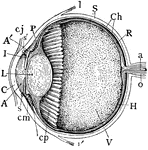
"Human Eye, in Median Vertical Anteroposterior Section. (Ciliary processes shown, through not all lying in this section.) A, anterior, and A', posterior chambers of aqueous humor; a, central artery of retina; C, cornea; Ch, choroid; cj, conjunctiva; cm, ciliary muscle; cp, ciliary processs; H, hyaloid; I, iris; L, crystalline lens in its capsule (the reference-line passes through the pupil); l, l', insertion of tendon of superior and inferior rectus muscles; o, optic nerve; P, canal of Petit; R, retina; S, sclerotic; s, s', circular sinus or canal of Schlemm; V, vitreous body filling back part of the eye." -Whitney, 1911

Median Vertical Anteroposterior Section of Eye

"Human Eye, in Median Vertical Anteroposterior Section. (Ciliary processes shown, through not all lying…
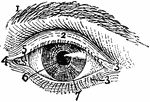
"Exterior of Left Human Eye. 1, supercilium, or eyebrow; 2, palpebra superior, or upper eyelid; 3, 3, cilia, or eyelashes; 4, caruncula lacrymalis; 5, plica semilunaris; 6, pupil; 7, iris." -Whitney, 1911

Exterior of Left Human Eye

"Exterior of Left Human Eye. 1, supercilium, or eyebrow; 2, palpebra superior, or upper eyelid; 3, 3,…
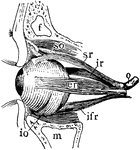
"Muscles of Left Human Eyeball. so, superior oblique, passing through a trochlea or pulley; io, inferior oblique; sr, superior rectus; ifr, interior rectus; ir, internal rectus; er, external rectus; f, frontal sinus; m, maxillary sinus; o, optic nerve." -Whitney, 1911

Muscles of Left Eyeball

"Muscles of Left Human Eyeball. so, superior oblique, passing through a trochlea or pulley; io, inferior…
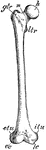
"Anterior View of Human Right Femur. ec, external condyle; etu, external tuberosity; ic, internal condyle; itu, internal tuberosity; ltr, lesser trochanter; gtr, great trochanter; h, head; n, neck." -Whitney, 1911

Anterior View of Human Right Femur

"Anterior View of Human Right Femur. ec, external condyle; etu, external tuberosity; ic, internal condyle;…
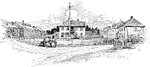
Fort Garry, also known as Upper Fort Garry, was a Hudson's Bay Company trading post at the confluence of the Red and Assiniboine rivers in what is now downtown Winnipeg. It was established in 1822 on or near the site of the North West Company's Fort Gibraltar. Fort Garry was named after Nicholas Garry, deputy governor of the Hudson's Bay Company. It served as the centre of fur trade within the Red River Settlement. Unfortunately in 1826, a severe flood destroyed the fort. It was rebuilt in 1835 by the HBC and named Upper Fort Garry to differentiate it from "the Lower Fort," or Lower Fort Garry, 32 km downriver, which was established in 1831. Throughout the mid to late 1800s, Upper Fort Garry played a minor role in the actual trading of furs, but was central to the administration of the HBC and the surrounding settlement. The Council of Assiniboia, the administrative and judicial body of the Red River Settlement mainly run by HBC officials, met at Upper Fort Garry.

Interior of Fort Garry

Fort Garry, also known as Upper Fort Garry, was a Hudson's Bay Company trading post at the confluence…
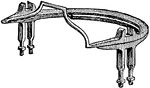
"Fifth wheel, a horizontal plate, bent to form a whole or part of a circle, placed on the forward axle of a carriage. It is designed to support the fore part of the body while allowing it to turn freely in a horizontal plane." Today, the fifth wheel is used in coupling of trailers and towing trucks. -Whitney, 1911

Fifth Wheel

"Fifth wheel, a horizontal plate, bent to form a whole or part of a circle, placed on the forward axle…
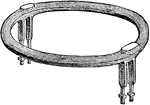
"Fifth wheel, a horizontal plate, bent to form a whole or part of a circle, placed on the forward axle of a carriage. It is designed to support the fore part of the body while allowing it to turn freely in a horizontal plane." Today, the fifth wheel is used in coupling of trailers and towing trucks. -Whitney, 1911

Fifth Wheel

"Fifth wheel, a horizontal plate, bent to form a whole or part of a circle, placed on the forward axle…
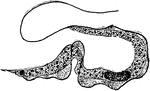
Trypanosoma are of the class kinetoplastida, a monophyletic group of unicellular parasitic protozoa. The name is derived from the Greek trypaô (boring) and soma (body) because of their corkscrew-like motion. Trypanosomes infect a variety of hosts and cause various disease, including the fatal disease sleeping sickness in humans.

Trypanosoma

Trypanosoma are of the class kinetoplastida, a monophyletic group of unicellular parasitic protozoa.…
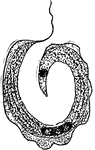
Trypanosoma are of the class kinetoplastida, a monophyletic group of unicellular parasitic protozoa. The name is derived from the Greek trypaô (boring) and soma (body) because of their corkscrew-like motion. Trypanosomes infect a variety of hosts and cause various disease, including the fatal disease sleeping sickness in humans.

Trypanosoma

Trypanosoma are of the class kinetoplastida, a monophyletic group of unicellular parasitic protozoa.…
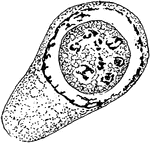
An illustration of the growth of a Cyclospora Cayetanensis Spore in the nucleus.

Growth of Cyclospora Cayetanensis Spore in Nucleus

An illustration of the growth of a Cyclospora Cayetanensis Spore in the nucleus.
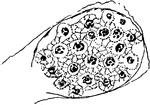
An illustration of the growth of spores of a Cyclospora Cayetanensis.

Formation of Cyclospora Cayetanensis Spores

An illustration of the growth of spores of a Cyclospora Cayetanensis.
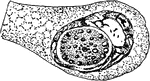
An illustration of the formation of the Cyclospora Cayetanensis egg-cell.

Formation of Cyclospora Cayetanensis Egg-cell

An illustration of the formation of the Cyclospora Cayetanensis egg-cell.
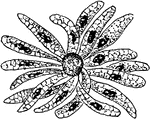
An illustration of the growth of spores of a Cyclospora Cayetanensis.

Formation of Cyclospora Cayetanensis Spores

An illustration of the growth of spores of a Cyclospora Cayetanensis.
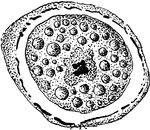
An illustration of the formation of the Cyclospora Cayetanensis egg-cell.

Formation of Cyclospora Cayetanensis Egg-cell

An illustration of the formation of the Cyclospora Cayetanensis egg-cell.
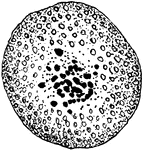
An illustration of the formation of the Cyclospora Cayetanensis egg-cell.

Formation of Cyclospora Cayetanensis Egg-cell

An illustration of the formation of the Cyclospora Cayetanensis egg-cell.
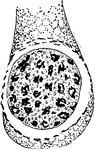
An illustration of the formation of the CCyclospora Cayetanensis spermatozooids

Formation of Cyclospora Cayetanensis Spermatozooids

An illustration of the formation of the CCyclospora Cayetanensis spermatozooids
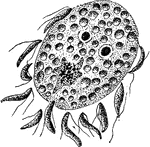
An illustration of the fertilization of the egg by the spermatozooids of a Cyclospora Cayetanensis.
Fertilization of Cyclospora Cayetanensis

An illustration of the fertilization of the egg by the spermatozooids of a Cyclospora Cayetanensis.

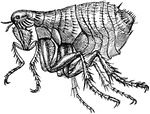
The human flea (Pulex irritans) is a parasite in the the Siphonaptera order of fleas.

Human Flea

The human flea (Pulex irritans) is a parasite in the the Siphonaptera order of fleas.

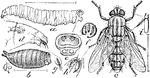
"Sarracenia Flesh-fly (Sarcophaga sarraceniae). a, larva; b, pupa; c, fly; d, head and prothoracic joints of larva, showing curved hooks, lower lip, and prothoracic spiracles; e, end of body of larva, showing stigmata, prolegs, and vent; h, tarsal claws of fly with protecting pads; i, antenna of fly." -Whitney, 1911

Sarracenia Flesh Fly

"Sarracenia Flesh-fly (Sarcophaga sarraceniae). a, larva; b, pupa; c, fly; d, head and prothoracic joints…
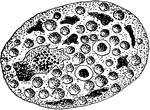
An illustration of the fusion of egg and sperm-nuclei of a Cyclospora Cayetanensis.

Fusion of Egg and Sperm-nuclei of Cyclospora Cayetanensis

An illustration of the fusion of egg and sperm-nuclei of a Cyclospora Cayetanensis.
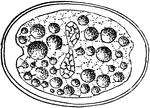
An illustration of the division of a zygote of Cyclospora Cayetanensis into two sporoblasts.

Division of Zygote

An illustration of the division of a zygote of Cyclospora Cayetanensis into two sporoblasts.
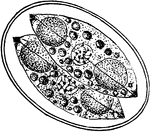
An illustration of the formation of capsules about two sporoblasts of Cyclospora Cayetanensis.

Formation of Capsules about the Two Sporoblasts

An illustration of the formation of capsules about two sporoblasts of Cyclospora Cayetanensis.
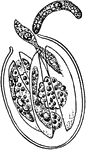
An illustration of the liberation of Cyclospora Cayetanensis spores.

Liberation of Spores

An illustration of the liberation of Cyclospora Cayetanensis spores.

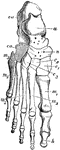
"Bones of Human Foot, or Pes, the third principal segment of the hind limb, consisting of tarsus, metatarsus, and phalanges. a, astralagus; ca, calcaneum; n, navicular, or scaphoid; co, cuboid; c1, c2, c3, entocuneiform, mesocuneiform, and ectocuneiform, or inner, middle, and outer cuneiform bones. The foregoing seven bones constitute the tarsus, and m1 to m5, first to the fifth metatarsal, constitue the metatarsus. The remaining fourteen bones are the phalanges, three to each digit excepting the great toe; h, distal phalanx of the hallux or great toe." -Whitney, 1911

Bones of Human Foot

"Bones of Human Foot, or Pes, the third principal segment of the hind limb, consisting of tarsus, metatarsus,…
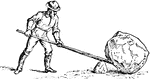
"In mechanics, the point of rest about which a lever turns in lifting a body; also, a prop or support for a lever at this point. F, Fulcrum; L, lever." -Whitney, 1911

Man with Lever and Fulcrum

"In mechanics, the point of rest about which a lever turns in lifting a body; also, a prop or support…
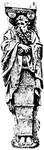
"Gaine. Renaissance sculpture. Maison de Pierre, Toulouse, France. In sculpture, the lower part of a figure of which the head, with sometimes the bust, is alone carved to represent nature, the remaining portion presenting, as it were, the appearance of a sheath closely enveloping the body, and consequently broader at the shoulders than at the feet." -Whitney, 1911

Gaine of Renaissance Sculpture

"Gaine. Renaissance sculpture. Maison de Pierre, Toulouse, France. In sculpture, the lower part of a…
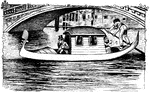
An illustration of a human powered boat with three passengers.

Boat Under Bridge

An illustration of a human powered boat with three passengers.

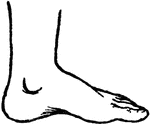
An illustration of a human foot.

Foot

An illustration of a human foot.

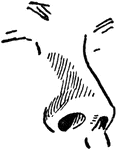
An illustration of a human nose.

Human Nose

An illustration of a human nose.

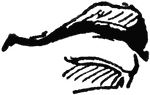
An illustration of a human mouth.

Human Mouth

An illustration of a human mouth.