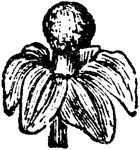
An illustration of an anamirta cocculus male flower. Anamirta cocculus is an Southeast Asian and Indian climbing plant. Its fruit, Cocculus indicus, is the source of picrotoxin, a poisonous alkaloid with stimulant properties. The plant is large-stemmed (up to 10cm in diameter); the bark is "corky gray" with white wood. The "small, yellowish-white, sweet-scented" flowers vary between 6 to 10 centimeters across; the fruit produced is a drupe, "about 1 cm in diameter when dry".

Anamirta cocculus Flower (Male)

An illustration of an anamirta cocculus male flower. Anamirta cocculus is an Southeast Asian and Indian…
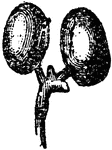
An illustration of an anamirta cocculus male flower with the sephals removed. Anamirta cocculus is an Southeast Asian and Indian climbing plant. Its fruit, Cocculus indicus, is the source of picrotoxin, a poisonous alkaloid with stimulant properties. The plant is large-stemmed (up to 10cm in diameter); the bark is "corky gray" with white wood. The "small, yellowish-white, sweet-scented" flowers vary between 6 to 10 centimeters across; the fruit produced is a drupe, "about 1 cm in diameter when dry".

Anamirta cocculus Fruit

An illustration of an anamirta cocculus male flower with the sephals removed. Anamirta cocculus is an…

An illustration of a cocoanut palm's spadix. In botany, a spadix (pl. spadices) is a type of spike: an inflorescence with small flowers crowded on a thickened, fleshy axis. The term is applied to certain monocotyledons, especially members of the Family Araceae called arums or aroids. In these flower heads there is typically also a spathe (from Ancient Greek spathe "broad blade") present: a large, usually showy and solitary, bract that either subtends (lies just below) or partially encloses the spadix. The "flower" of the anthurium is a typical spadix with a large colorful spathe.

Cocoanut Palm Spadix

An illustration of a cocoanut palm's spadix. In botany, a spadix (pl. spadices) is a type of spike:…

An illustration of a cocoanut palm's flower.

Cocoanut Palm Flower

An illustration of a cocoanut palm's flower.

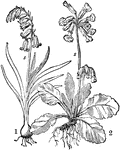
A scape is a flowering, leafless stem; shown here on two different plants. "1. Wild hyacinth (Scilla nonscripta). 2. Oxlip (Primula elatior). s, s, scapes." -Whitney, 1911

Scapes

A scape is a flowering, leafless stem; shown here on two different plants. "1. Wild hyacinth (Scilla…
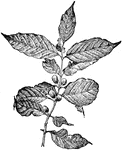
Coffea arabica is a species of coffee indigenous to Ethiopia and Yemen. It is also known as the "coffee shrub of Arabia", "mountain coffee" or "arabica coffee". Coffea arabica is believed to be the first species of coffee to be cultivated, being grown in southwest Arabia for well over 1,000 years. It is considered to produce better coffee than the other major commercially grown coffee species, Coffea canephora (robusta). Arabica contains less caffeine than any other commercially cultivated species of coffee. Wild plants grow to between 9 and 12 m tall, and have an open branching system; the leaves are opposite, simple elliptic-ovate to oblong, 6-12 cm long and 4-8 cm broad, glossy dark green. The flowers are white, 10-15 mm in diameter and grow in axillary clusters. The fruit is a drupe (though commonly called a "berry") 10-15 mm in diameter, maturing bright red to purple and typically contain two seeds (the coffee 'bean').

Coffea Arabica

Coffea arabica is a species of coffee indigenous to Ethiopia and Yemen. It is also known as the "coffee…

A crocket is a hook-shaped decorative element common in Gothic architecture. It is in the form of a stylised carving of curled leaves, buds or flowers which is used at regular intervals to decorate the sloping edges of spires, finials, pinnacles, and wimpergs.

Crocket

A crocket is a hook-shaped decorative element common in Gothic architecture. It is in the form of a…
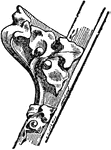
A crocket is a hook-shaped decorative element common in Gothic architecture. It is in the form of a stylised carving of curled leaves, buds or flowers which is used at regular intervals to decorate the sloping edges of spires, finials, pinnacles, and wimpergs.

Crocket

A crocket is a hook-shaped decorative element common in Gothic architecture. It is in the form of a…
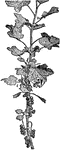
The Red currant (Ribes rubrum) is a member of the genus Ribes in the gooseberry family Grossulariaceae, native to parts of western Europe (Belgium, France, Germany, Netherlands, Northern Italy and Northern Spain). It is a deciduous shrub normally growing to 1-1.5 m tall, occasionally 2 m, with five-lobed leaves arranged spirally on the stems. The flowers are inconspicuous yellow-green, in pendulous 4-8 cm racemes, maturing into bright red translucent edible berries about 8-12 mm diameter, with 3-10 berries on each raceme.

Red Currant

The Red currant (Ribes rubrum) is a member of the genus Ribes in the gooseberry family Grossulariaceae,…
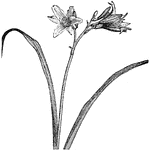
Hemerocallis lilioasphodelus, (syn. Hemerocallis flava, Lemon Day-lily Lemon Lily, Yellow Day-lily) is a plant of the genus Hemerocallis. It is found across China, in Europe in N.E. Italy and Slovenia and is one of the first daylilies used for breeding. Hemerocallis lilioasphodelus grows in big spreading clumps and its leaves grow to 75 cm (30 in) long. It has lemon-yellow flowers with a sweet scent in a cluster of 3 to 9 flowers.

Yellow Day-lily

Hemerocallis lilioasphodelus, (syn. Hemerocallis flava, Lemon Day-lily Lemon Lily, Yellow Day-lily)…
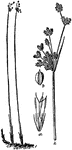
"1. Flowering plant of Bulrush (Scirpus lacustris). 2. The inflorescence. a, a flower; b, the fruit." -Whitney, 1911

Bulrush

"1. Flowering plant of Bulrush (Scirpus lacustris). 2. The inflorescence. a, a flower; b, the fruit."…
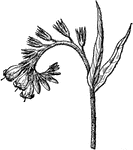
The Common Comfrey (Symphytum officinale) is a flowering plant in the Boraginaceae family. Here showing its scorpioid inflorescence.

Common Comfrey

The Common Comfrey (Symphytum officinale) is a flowering plant in the Boraginaceae family. Here showing…
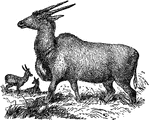
The common eland (Taurotragus oryx, also known as the southern eland) is a savannah and plains antelope found in East and Southern Africa. Common eland live on the open plains of Southern Africa and along the foothills of the great South African plateau. They eat grass, branches and leaves and are diurnal but tend to be inactive during the heat of day. Herds usually have 30 to 80 individuals, but are known to exceed 400. The common eland has an unusual social life, leaving or joining herds as necessary without forming close ties. Predators in the wild are predominantly lions and the endangered African wild dog.

Eland

The common eland (Taurotragus oryx, also known as the southern eland) is a savannah and plains antelope…
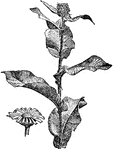
Elecampane, also called Horse-heal (Inula helenium) or Marchalan (in Welsh), is a perennial composite plant common in many parts of Great Britain, and ranges throughout central and Southern Europe, and in Asia as far eastwards as the Himalayas. It is a rather rigid herb, the stem of which attains a height of from 3 to 5 feet; the leaves are large and toothed, the lower ones stalked, the rest embracing the stem; the flowers are yellow, 2 inches broad, and have many rays, each three-notched at the extremity. The root is thick, branching and mucilaginous, and has a warm, bitter taste and a camphoraceous odor.

Elecampane

Elecampane, also called Horse-heal (Inula helenium) or Marchalan (in Welsh), is a perennial composite…
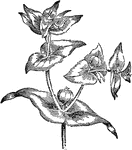
Euphorbia lathyris (Caper Spurge or Paper Spurge) is a species of spurge native to southern Europe (France, Italy, Greece, and possibly southern England), northwest Africa, and eastward through southwest Asia to western China. Other names occasionally used include Gopher Spurge, Gopher Plant or Mole Plant.It is an erect biennial (occasionally annual) plant growing up to 1.5 m tall, with a glaucous blue-green stem. The leaves are arranged in decussate opposite pairs, and are lanceolate, 5-15 cm long and 1-2.5 cm broad, glaucous blue-green with a waxy texture and pale greenish-white midrib and veins. The flowers are green to yellow-green, 4 mm diameter, with no petals. The seeds are green ripening brown or grey, produced in globular clusters 13-17 mm diameter of three seeds compressed together.

Caper Spurge

Euphorbia lathyris (Caper Spurge or Paper Spurge) is a species of spurge native to southern Europe (France,…
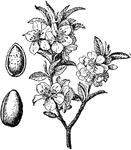
The almond is native to Iran, from northwestern Saudi Arabia, north through western Jordan, Israel, Lebanon, western Syria, to southern Turkey. It is a small deciduous tree, growing to between 4 and 10 meters in height, with a trunk of up to 30 centimeters in diameter. The young shoots are green at first, becoming purplish where exposed to sunlight, then grey in their second year. The leaves are 1 cm long and 1.2–4 cm broad, with a serrated margin and a 2.5 cm petiole. The flowers are white or pale pink, 3–5 cm diameter with five petals, produced singly or in pairs before the leaves in early spring. The fruit is a drupe 3.5–6 cm long, with a downy outer coat. The outer covering or exocarp, (fleshy in other members of Prunus such as the plum and cherry), is instead a leathery grey-green coating called the hull, which contains inside a hard shell, and the edible seed, commonly called a nut in culinary terms. Generally, one seed is present, but occasionally there are two. In botanical terms, an almond is not a true nut. The reticulated hard woody shell (like the outside of a peach pit) surrounding the edible seed is called the endocarp. The fruit is mature in the autumn, 7–8 months after flowering.

Almond Tree and Fruit

The almond is native to Iran, from northwestern Saudi Arabia, north through western Jordan, Israel,…
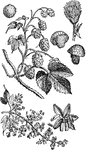
The hop (Humulus) is a small genus of flowering plants, native to the temperate Northern Hemisphere. The female flowers, commonly called hops, are used as flavoring and stabilizers during beer brewing. The hop is part of the family Cannabaceae, which also includes the genus cannabis (also known as hemp). Hops are the female flower cones of the hop plant (Humulus lupulus). They are used primarily as a flavoring and stability agent in beer, and also in other beverages and in herbal medicine. The first documented use in beer is from the eleventh century. Hops contain several characteristics favorable to beer, balancing the sweetness of the malt with bitterness, contributing flowery, citrus, fruity or herbal aromas, and having an antibiotic effect that favors the activity of brewer's yeast over less desirable microorganisms. The hop plant is a vigorous climbing herbaceous perennial, usually grown up strings in a field called a hopfield, hop garden or hop yard. Many different varieties of hops are grown by farmers all around the world, with different types being used for particular styles of beer.

Hops

The hop (Humulus) is a small genus of flowering plants, native to the temperate Northern Hemisphere.…
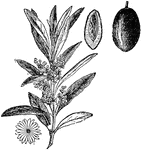
The Olive (Olea europaea) is a species of small tree in the family Oleaceae, native to the coastal areas of the eastern Mediterranean region, from Lebanon, Syria and the maritime parts of Asia Minor and northern Iran at the south end of the Caspian Sea. Its fruit, the olive, is of major agricultural importance in the Mediterranean region as the source of olive oil. The Olive tree is an evergreen tree or shrub native to the Mediterranean, Asia and parts of Africa. It is short and squat, and rarely exceeds 8–15 meters in height. The silvery green leaves are oblong in shape, measuring 4–10 cm long and 1–3 cm wide. The trunk is typically gnarled and twisted.The small white flowers, with four-cleft calyx and corolla, two stamens and bifid stigma, are borne generally on the last year's wood, in racemes springing from the axils of the leaves. The fruit is a small drupe 1–2.5 cm long, thinner-fleshed and smaller in wild plants than in orchard cultivars. Olives are harvested at the green stage or left to ripen to a rich purple colour (black olive). Canned black olives may contain chemicals that turn them black artificially.

Olive Branch

The Olive (Olea europaea) is a species of small tree in the family Oleaceae, native to the coastal areas…
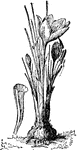
Crocus (plural: crocus, crocuses) is a genus of perennial flowering plants, native to a large area from coastal and subalpine areas of central and southern Europe (including the islands of the Aegean), North Africa and the Middle East, across Central Asia to western China. The genus Crocus is placed botanically in the iris family (Iridaceae). The plants grow from corms and are mainly hardy perennials, and are found in a wide range of habitats, including woodland, scrub and meadows. There are about eighty species of crocus (of which approximately 30 are cultivated). Their cup-shaped, solitary, salverform flowers taper off into a narrow tube. Their color varies enormously, although lilac, mauve, yellow and white are predominant. The grass-like, ensiform leaf shows generally a white central stripe along the leaf axis. The leaf margin is entire. All crocuses typically have three stamens. The spice saffron is obtained from the stigmas of Crocus sativus, an autumn/fall-blooming species.

Crocus

Crocus (plural: crocus, crocuses) is a genus of perennial flowering plants, native to a large area from…
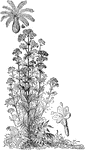
Valerian (Valeriana officinalis, Valerianaceae) is a hardy perennial flowering plant, with heads of sweetly scented pink or white flowers. The flowers are in bloom in the northern hemisphere from June to September. Valerian was used as a perfume in the sixteenth century. Native to Europe and parts of Asia, Valerian has been introduced into North America. It is consumed as food by the larvae of some Lepidoptera (butterfly and moth) species including Grey Pug.

Valerian

Valerian (Valeriana officinalis, Valerianaceae) is a hardy perennial flowering plant, with heads of…
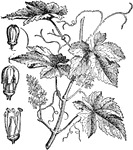
Vitis vinifera (Common Grape Vine) is a species of Vitis, native to the Mediterranean region, central Europe, and southwestern Asia, from Morocco and Spain north to southern Germany and east to northern Iran. It is a liana growing to 35 m tall, with flaky bark. The leaves are alternate, palmately lobed, 5–20 cm long and broad. The fruit is a berry, known as a grape; in the wild species it is 6 mm diameter and ripens dark purple to blackish with a pale wax bloom; in cultivated plants it is usually much larger, up to 3 cm long, and can be green, red, or purple. The species typically occurs in humid forests and streamsides.

European Grape

Vitis vinifera (Common Grape Vine) is a species of Vitis, native to the Mediterranean region, central…
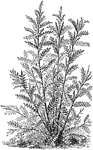
Licorice is the root of Glycyrrhiza glabra, from which a sweet flavour can be extracted. The liquorice plant is a legume (related to beans and peas) and native to southern Europe and parts of Asia. It is an herbaceous perennial, growing to 1 m in height, with pinnate leaves about 7–15 centimetres (3–6 inches) long, with 9–17 leaflets. The flowers are 0.8–1.2 cm (1/3 to 1/2 inch) long, purple to pale whitish blue, produced in a loose inflorescence. The fruit is an oblong pod, 2–3 centimetres (about 1 inch) long, containing several seeds.

Licorice

Licorice is the root of Glycyrrhiza glabra, from which a sweet flavour can be extracted. The liquorice…
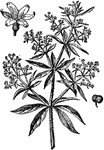
Madder is the common name of the plant genus Rubia, the type genus of the madder family Rubiaceae. The genus contains about 60 species of perennial scrambling or climbing herbs and sub-shrubs native to the Old World, Africa, temperate Asia and America. The best known species are Common Madder (Rubia tinctorum), Wild Madder (Rubia peregrina), and Indian Madder (Rubia cordifolia). The Common Madder can grow to 1.5 m in height. The evergreen leaves are 5-10 cm long and 2-3 cm broad, produced in whorls of 4-7 starlike around the central stem. It climbs with tiny hooks at the leaves and stems. The flowers are small (3-5 mm across), with five pale yellow petals, in dense racemes, and appear from June to August, followed by small (4-6 mm diameter) red to black berries. The roots can be over a metre long, up to 12 mm thick and the source of a red dye known as rose madder. It prefers loamy soils with a constant level of moisture. Madders are used as food plants for the larvae of some Lepidoptera species including Hummingbird hawk moth.

Madder

Madder is the common name of the plant genus Rubia, the type genus of the madder family Rubiaceae. The…
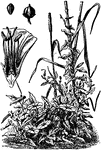
Convolvulus is a genus of about 250 species of flowering plants in the bindweed family Convolvulaceae, with a cosmopolitan distribution. Common names include bindweed and morning glory, both names shared with other closely related genera. They are annual or perennial herbaceous vines and (a few species) woody shrubs, growing to 0.3-3 m tall. The leaves are spirally arranged, and the flowers trumpet-shaped, mostly white or pink, but blue, violet, purple or yellow in some species. Many of the species are problematic weeds, which can swamp other more valuable plants by climbing over them, but some are also deliberately grown for their attractive flowers. However, some other species are globally threatened.

Bindweed

Convolvulus is a genus of about 250 species of flowering plants in the bindweed family Convolvulaceae,…
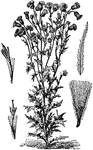
Cirsium arvense is a species of Cirsium, native throughout Europe and northern Asia, and widely introduced elsewhere. The standard English name in its native area is Creeping Thistle. It is a tall herbaceous perennial plant, forming extensive clonal colonies from an underground root system that sends up numerous erect stems each spring, reaching 1–1.2 m tall (occasionally more); the stems often lie partly flat by summer but can stay erect if supported by other vegetation. The leaves are very spiny, lobed, up to 15–20 cm long and 2–3 cm broad (smaller on the upper part of the flower stem). The inflorescence is 10–22 mm diameter, pink-purple, with all the florets of similar form (no division into disc and ray florets). The flowers are usually dioecious, but not invariably so, with some plants bearing hermaphrodite flowers. The seeds are 4–5 mm long, with a feathery pappus which assists in wind dispersal.

Canada Thistle

Cirsium arvense is a species of Cirsium, native throughout Europe and northern Asia, and widely introduced…
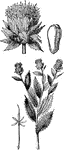
Safflower (Carthamus tinctorius L.) is a highly branched, herbaceous, thistle-like annual, usually with many long sharp spines on the leaves. Plants are 30 to 150 cm tall with globular flower heads (capitula) and commonly, brilliant yellow, orange or red flowers which bloom in July. Each branch will usually have from one to five flower heads containing 15 to 20 seeds per head. Safflower has a strong taproot which enables it to thrive in dry climates, but the plant is very susceptible to frost injury from stem elongation to maturity.

Safflower

Safflower (Carthamus tinctorius L.) is a highly branched, herbaceous, thistle-like annual, usually with…
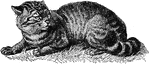
The Wildcat (Felis silvestris), sometimes Wild Cat or Wild-cat, is a small felid native to Europe, the western part of Asia, and Africa. It is a hunter of small mammals, birds, and other creatures of a similar size. There are several subspecies distributed in different regions. Sometimes included is the ubiquitous domestic cat (Felis silvestris catus), which has been introduced to every habitable continent and most of the world's larger islands, and has become feral in many of those environments.

Wildcat

The Wildcat (Felis silvestris), sometimes Wild Cat or Wild-cat, is a small felid native to Europe, the…
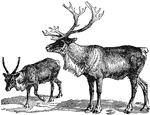
The reindeer (Rangifer tarandus), also known as the caribou when wild in North America, is an Arctic and Subarctic-dwelling deer, widespread and numerous across the northern Holarctic.

Reindeer

The reindeer (Rangifer tarandus), also known as the caribou when wild in North America, is an Arctic…
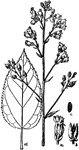
"The inflorescence of Maryland Figwort (Scrophularia Marylandica). a, the flower; b, the fruit; c, a seed; d, a leaf." -Whitney, 1911

Maryland Figwort

"The inflorescence of Maryland Figwort (Scrophularia Marylandica). a, the flower; b, the fruit; c, a…
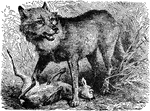
The grey wolf or gray wolf (Canis lupus), also known as the timber wolf or simply wolf, is a mammal of the order Carnivora. The gray wolf is the largest wild member of the Canidae family and an ice age survivor originating during the Late Pleistocene around 300,000 years ago. DNA sequencing and genetic drift studies indicate that the gray wolf shares a common ancestry with the domestic dog, (Canis lupus familiaris) and might be its ancestor. A number of other gray wolf subspecies have been identified, though the actual number of subspecies is still open to discussion. Gray wolves are typically apex predators in the ecosystems they occupy. Gray wolves are highly adaptable and have thrived in temperate forests, deserts, mountains, tundra, taiga, grasslands, and even urban areas.

Wolf

The grey wolf or gray wolf (Canis lupus), also known as the timber wolf or simply wolf, is a mammal…
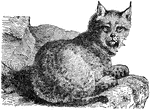
A lynx is any of four medium-sized wild cats. All are members of the genus Lynx, but there is considerable confusion about the best way to classify felids at present, and some authorities classify them as part of the genus Felis. The Caracal, despite sometimes being called Persian Lynx or African Lynx, does not belong to this genus. Lynx have short tails and characteristic tufts of black hair on the tip of the ears. They have a ruff under the neck, which has black bars (not very visible), resembling a bow tie. They have large paws padded for walking on snow and long whiskers on the face. The body color varies from medium brown to gold-ish to beige-white; and occasionally, is marked with dark brown spots, especially on the limbs. All species of lynx also have white fur on their chests, bellies and on the insides of their legs which are extensions of the chest and belly fur. Also, the lynx's coloring, fur height and paw size varies by its climate range- in the Southwest US, the fur and color are short-haired, dark and the paws are smaller and less padded, as the lynx ranges to its colder Northern climes, the fur gets progressively thicker (for warmth), the color gets lighter (for camouflage) and its paws enlarge and become more padded for snowy environments.

Lynx

A lynx is any of four medium-sized wild cats. All are members of the genus Lynx, but there is considerable…
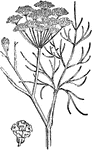
Fennel (Foeniculum vulgare) is a plant species in the genus Foeniculum (treated as the sole species in the genus by most botanists). It is a hardy, perennial, umbelliferous herb, with yellow flowers and feathery leaves, grows wild in most parts of temperate Europe, but is generally considered indigenous to the shores of the Mediterranean, whence it spreads eastwards to India and even in England in Bedfont Lakes Country Park and Thurrock . It has followed, especially where Romans have colonized, and may be found growing wild in many parts of the world upon dry soils near the sea-coast and upon river-banks. It is a member of the family Apiaceae. It is a highly aromatic and flavorful herb with culinary and medicinal uses, and is one of the primary ingredients of absinthe. Fennel is used as a food plant by the larvae of some Lepidoptera species including the Mouse Moth and the Anise Swallowtail.

Fennel

Fennel (Foeniculum vulgare) is a plant species in the genus Foeniculum (treated as the sole species…
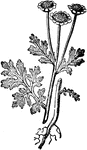
Feverfew (Tanacetum parthenium; syn. Chrysanthemum parthenium) is a traditional medicinal herb which is found in many old gardens, and is also occasionally grown for ornament. The plant grows into a small bush up to around 18 inches high, with citrus-scented leaves and is covered by flowers reminiscent of daisies. It spreads rapidly, and they will cover a wide area after a few years. Feverfew has been used for reducing fever, for treating headaches, arthritis and digestive problems. It is hypothesized that by inhibiting the release of serotonin and prostaglandins, both of which are believed to aid the onset of migraines, feverfew limits the inflammation of blood vessels in the head. This would, in theory, stop the blood vessel spasm which is believed to contribute to headaches.

Feverfew

Feverfew (Tanacetum parthenium; syn. Chrysanthemum parthenium) is a traditional medicinal herb which…
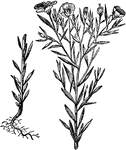
Flax (also known as common flax or linseed) (binomial name: Linum usitatissimum) is a member of the genus Linum in the family Linaceae. It is native to the region extending from the eastern Mediterranean to India and was probably first domesticated in the Fertile Crescent. Flax is an erect annual plant growing to 1.2 m tall, with slender stems. The leaves are glaucous green, slender lanceolate, 20–40 mm long and 3 mm broad. The flowers are pure pale blue, 15–25 mm diameter, with five petals; they can also be bright red. The fruit is a round, dry capsule 5–9 mm diameter, containing several glossy brown seeds shaped like an apple pip, 4–7 mm long.

Flax

Flax (also known as common flax or linseed) (binomial name: Linum usitatissimum) is a member of the…

The Great Seal of the State of Florida. The image shows a Seminole Native American sprinkling flowers. There is also a palm tree, a steamboat, and sunshine.

Seal of Florida

The Great Seal of the State of Florida. The image shows a Seminole Native American sprinkling flowers.…
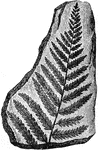
An illustration of a fossil of a toothed fern. Ferns are vascular plants differing from the more primitive lycophytes by having true leaves (megaphylls), and they differ from seed plants (gymnosperms and angiosperms) in their mode of reproduction — lacking flowers and seeds. Like all other vascular plants, they have a life cycle referred to as alternation of generations, characterized by a diploid sporophytic and a haploid gametophytic phase.

Leaf Indentations

An illustration of a fossil of a toothed fern. Ferns are vascular plants differing from the more primitive…
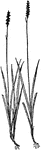
The Northern Singlespike Sedge (Carex scirpoidea): 1, male; 2, female.

Northern Singlespike

The Northern Singlespike Sedge (Carex scirpoidea): 1, male; 2, female.

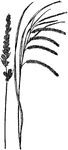
3, The Fox Sedge (Carex vulpinoidea) and 4, the Fringed Sedge (Carex crinita).

Fox Sedge and Fringed Sedge

3, The Fox Sedge (Carex vulpinoidea) and 4, the Fringed Sedge (Carex crinita).
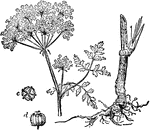
Northern Water Hemlock is a species of Cicuta, native to northern and central Europe, northern Asia and northwestern North America. It is a perennial herbaceous plant which grows up to 1–2 m tall. The stems are smooth, branching, swollen at the base, purple-striped, and hollow except for partitions at the junction of the leaves and stem. In cross section the stems have one flat side and the other sides are rounded. The leaves are alternate, tripinnate, only coarsely toothed, unlike the ferny, lacy leaves found in many other members of the family Apiaceae. The flowers are small, white and clustered in umbrella shaped inflorescences typical of the family. The many flowered umbellets have unequal pedicels that range from 5 to 11 cm long during fruiting. An oily, yellow liquid oozes from cuts to the stems and roots.

Northern Water Hemlock

Northern Water Hemlock is a species of Cicuta, native to northern and central Europe, northern Asia…
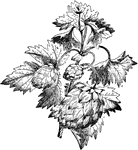
An illustration of the hop plant. Humulus, (hop) is a small genus of flowering plants, native to the temperate Northern Hemisphere. The female flowers of one species are called hops, and are used as flavoring and stabilizers, especially for brewing beer. The hop is part of the family Cannabaceae, which also includes the genus Cannabis (hemp).

Hop

An illustration of the hop plant. Humulus, (hop) is a small genus of flowering plants, native to the…
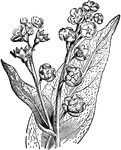
Cynoglossum officinale (hound's tongue, dog's tongue, gypsy flower, and rats and mice due to its smell) is a herbaceous plant of the family Boraginaceae, found in most parts of Europe, and also North America where it was accidentally introduced. It can be either annual or biennial, with reddish-purple flowers blooming between May and September. It lives in wet places, waste land and hedges.

Hound's Tongue

Cynoglossum officinale (hound's tongue, dog's tongue, gypsy flower, and rats and mice due to its smell)…
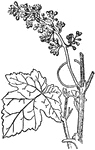
An illustration of vine foliage and inflorescence. An inflorescence is a group or cluster of flowers arranged on a stem that is composed of a main branch or a complicated arrangement of branches.

Vine

An illustration of vine foliage and inflorescence. An inflorescence is a group or cluster of flowers…
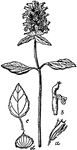
"Self-heal. (Prunella vulgaris). The upper part of the stem with flowers. a, the calyx; b, the corolla; c, a leaf; d, a bract from the inflorescence." -Whitney, 1911

Self-Heal

"Self-heal. (Prunella vulgaris). The upper part of the stem with flowers. a, the calyx; b, the corolla;…
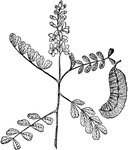
"Flowering branch of Senna (Cassia obovata). a, a pod." -Whitney, 1911

Senna

"Flowering branch of Senna (Cassia obovata). a, a pod." -Whitney, 1911

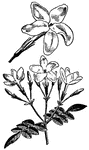
Jasminum grandiflorum (chameli in Hindi) is a species of jasmine native to South Asia. In India, its leaves are widely used as an Ayurvedic herbal medicine and its flowers are used to adorn the coiffure of women. In Pakistan, it grows wild in the Salt Range and Rawalpindi District at 500-1500 m altitude. It is closely related to, and sometimes treated as merely a form of, Jasminum officinale. It is a scrambling deciduous shrub growing to 2–4 m tall. The leaves are opposite, 5–12 cm long, pinnate with 5–11 leaflets. The flowers are produced in open cymes, the individual flowers are white having corolla with a basal tube 13–25 mm long and five lobes 13–22 mm long. The flower's fragrance is unique and sweet. It is widely cultivated as an ornamental plant in warm temperate and subtropical regions.

Jasminum grandiflorum

Jasminum grandiflorum (chameli in Hindi) is a species of jasmine native to South Asia. In India, its…
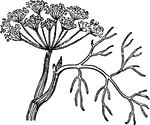
Dill (Anethum graveolens) is a short-lived perennial herb. It is the sole species of the genus Anethum, though classified by some botanists in a related genus as Peucedanum graveolens (L.) C.B.Clarke. It grows to 40–60 cm (16–24 in) 1 inch, with slender stems and alternate, finely divided, softly delicate leaves 10–20 cm (3.9–7.9 in) long. The ultimate leaf divisions are 1–2 mm (0.039–0.079 in) broad, slightly broader than the similar leaves of fennel, which are threadlike, less than 1 mm (0.039 in) broad, but harder in texture. The flowers are white to yellow, in small umbels 2–9 cm (0.79–3.5 in) diameter. The seeds are 4–5 mm (0.16–0.20 in) long and 1 mm (0.039 in) thick, and straight to slightly curved with a longitudinally ridged surface.

Dill

Dill (Anethum graveolens) is a short-lived perennial herb. It is the sole species of the genus Anethum,…
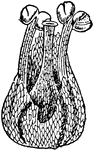
An illustration of duckweed inflorescence containing two male flowers each of one stamen and a female flower, the whole enclosed in a sheath. Duckweed is an important food source for waterfowl and are eaten by humans in some parts of Southeast Asia.

Duckweed Inflorescence

An illustration of duckweed inflorescence containing two male flowers each of one stamen and a female…
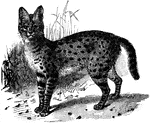
The Serval (Leptailurus serval) is a medium-sized African wild cat that also has the synonym Felis serval.
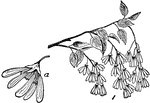
Serval

The Serval (Leptailurus serval) is a medium-sized African wild cat that also has the synonym Felis serval.

A branch of the Canadian Serviceberry (Amelanchier canadensis), a shrub or small tree, showing flowers.
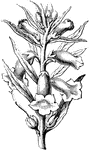
Canadian Serviceberry

A branch of the Canadian Serviceberry (Amelanchier canadensis), a shrub or small tree, showing flowers.

The Sesame (Sesamum orientale, Sesamum indicum) is a flowering plant in the Pedaliaceae family of pedaliums or sesames used for its edible seeds and oil.

Sesame

The Sesame (Sesamum orientale, Sesamum indicum) is a flowering plant in the Pedaliaceae family of pedaliums…
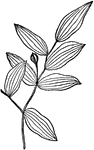
The Sessile Bellwort (Uvularia sessilifolia) is a species of bellworts, here showing its sessile leaves.

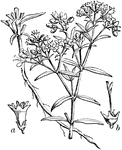
Sessile Bellwort

The Sessile Bellwort (Uvularia sessilifolia) is a species of bellworts, here showing its sessile leaves.

A flock of birds flying across a backdrop of flowers and an hour-glass.

Header, Footer

A flock of birds flying across a backdrop of flowers and an hour-glass.

The Chay Root (Oldenlandia umbellata) is a plant native to India used for the red dye that can be extracted from its root. "Shaya-root ... a, flower; b, pistil and calyx." -Whitney, 1911

Chay Root

The Chay Root (Oldenlandia umbellata) is a plant native to India used for the red dye that can be extracted…
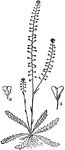
"Plant with Flowers and Fruits of Shepherd's-purse" (Capsella bursa-pastoris) "a, flower; b, a pod." -Whitney, 1911

Shepherd's Purse

"Plant with Flowers and Fruits of Shepherd's-purse" (Capsella bursa-pastoris) "a, flower; b, a pod."…
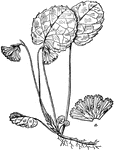
"Flowering Plant of Shortia galacifolia. a, the corolla, laid open." -Whitney, 1911

Oconee Bells

"Flowering Plant of Shortia galacifolia. a, the corolla, laid open." -Whitney, 1911

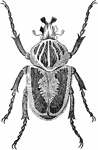
The Goliath beetles are among the largest insects on Earth, if measured in terms of size, bulk and weight. They are members of subfamily Cetoniinae, within the scarab beetle family. Goliath beetles can be found in many of Africa's tropical forests, where they feed primarily on tree sap and fruit. Little appears to be known of the larval cycle in the wild, but in captivity, Goliathus beetles have been successfully reared from egg to adult using protein-rich foods such as commercial cat and dog food. Goliath beetles measure from 60–110 millimetres (2.4–4.3 in) for males and 50–80 millimetres (2.0–3.1 in) for females, as adults, and can reach weights of up to 80–100 grams (2.8–3.5 oz) in the larval stage, though the adults are only about half this weight. The females range from a dark brown to silky white, but the males are nomally brown/white/black or black/white.

Goliath Beetle

The Goliath beetles are among the largest insects on Earth, if measured in terms of size, bulk and weight.…
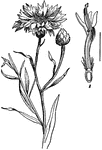
It is an annual plant growing to 40-90 cm tall, with grey-green branched stems. The leaves are lanceolate, 1-4 cm long. The flowers are most commonly an intense blue colour, produced in flowerheads (capitula) 1.5-3 cm diameter, with a ring of a few large, spreading ray florets surrounding a central cluster of disc florets.

Cornflower

It is an annual plant growing to 40-90 cm tall, with grey-green branched stems. The leaves are lanceolate,…
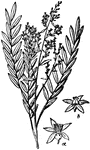
"Branch of Simarouba amara, with female flowers. a, a male flower; b, a female flower." -Whitney, 1911

Simarouba

"Branch of Simarouba amara, with female flowers. a, a male flower; b, a female flower." -Whitney, 1911

A cottage with a lovely garden and white picket fence. Sunflowers bloom and grape vines grow wild.
Cottage

A cottage with a lovely garden and white picket fence. Sunflowers bloom and grape vines grow wild.

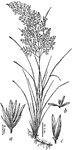
Blowout Grass (Redfieldia flexuosa) is a grass found on sand dunes. "a, spikelet; b, flower; c, glumes." -Whitney, 1911

Blowout Grass

Blowout Grass (Redfieldia flexuosa) is a grass found on sand dunes. "a, spikelet; b, flower; c,…