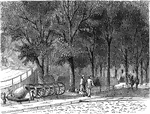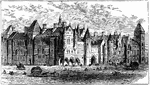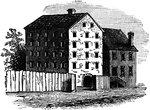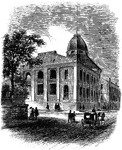
The Gratiot Street Prison was an American Civil War prison located in St. Louis, Missouri and was the largest war prison in Missouri. Run by the Union Army, it housed Confederate prisoners-of-war. The prison building was previously a medical school named McDowell's College, which was confiscated by the Union Army and converted to a prison in December 1861. Its official capacity 1,200 but at times it had 2,000 prisoners.

Gratiot Street Prison

The Gratiot Street Prison was an American Civil War prison located in St. Louis, Missouri and was the…
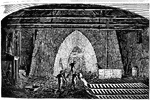
An illustration of an iron furnace located at Iron Mountain, Missouri.

Iron Furnace

An illustration of an iron furnace located at Iron Mountain, Missouri.

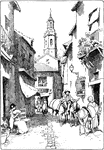
This image depicts citizens along a narrow road in Spain. A woman rests in chair while donkeys walk on the other side of the road.

Narrow Street in Spain

This image depicts citizens along a narrow road in Spain. A woman rests in chair while donkeys walk…
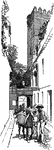
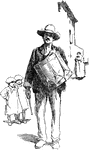
This image depicts a man and a donkey selling flowers on a street in Spain.

Flower Vendor

This image depicts a man and a donkey selling flowers on a street in Spain.

This image depicts the town crier playing a drum on a street in Spain. The town crier is employed by the town council to make public announcements in the street.

Town Crier

This image depicts the town crier playing a drum on a street in Spain. The town crier is employed by…
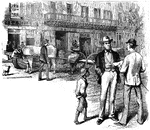
Two adult males standing on a busy street talking.

Men Talking on Street

Two adult males standing on a busy street talking.

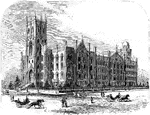
An illustration of The New York City Normal College which is now known as Hunter College of the City University of new York which is a senior college of the City University of New York. The college was founded in 1870 by Irish immigrant and social reformer Thomas Hunter as a teacher-training school for young woman. The school, which was housed in an armory and saddle store at Broadway and East Fourth Street in Manhattan, was open to all qualified women, irrespective of race, religion or ethnic background, which was incongruent to the prevailing admission practices of other schools during this era. Created by the New York State Legislature, Hunter was deemed the only approved institution for those seeking to teach in New York City during this time. The school incorporated an elementary and high school for gifted children, where students practiced teaching.

The New York City Normal College

An illustration of The New York City Normal College which is now known as Hunter College of the City…
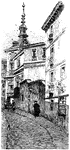
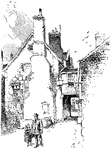
An illustration of a back street in a city.

Street

An illustration of a back street in a city.

An illustration of a man and a young girl walking along a city street.

City Street

An illustration of a man and a young girl walking along a city street.

Brooklyn Navy Yard is an American shipyard, located 1.7 miles (2.7 km) northeast of the Battery on the Brooklyn side of the East River in Wallabout Basin, a semicircular bend of the East River across from Corlear's Hook in Manhattan. The area is part of Brooklyn Community Board 2. Bounded by Navy Street, Flushing and Clinton Avenues, it covered over 200 acres (0.81 km²) at the height of its production of U.S. Navy warships.

Brooklyn Shipyard

Brooklyn Navy Yard is an American shipyard, located 1.7 miles (2.7 km) northeast of the Battery on the…
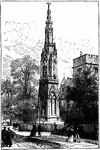
The Martyrs' Memorial is an imposing stone monument positioned at the intersection of St Giles', Magdalen Street and Beaumont Street in Oxford, England just outside Balliol College. It commemorates the 16th-century "Oxford Martyrs". The Oxford Martyrs were tried for heresy in 1555 and subsequently burnt at the stake in Oxford, England, for their religious beliefs and teachings. The three martyrs were the bishops Hugh Latimer and Nicholas Ridley, and the Archbishop Thomas Cranmer.

Martyr's Memorial, Oxford

The Martyrs' Memorial is an imposing stone monument positioned at the intersection of St Giles', Magdalen…
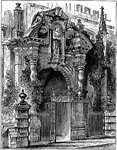
A church was established on this site, at the centre of the old walled city, in Anglo Saxon times. St Mary's has one of the most beautiful spires in England and an eccentric baroque porch, designed by Nicholas Stone, facing High Street. In the early days of Oxford University, the church was adopted as the first building of the university, congregation met there from at least 1252, and by the early 13th century it was the seat of university government and was used for lectures and the award of degrees.

Porch of St. Mary's, Oxford

A church was established on this site, at the centre of the old walled city, in Anglo Saxon times. St…
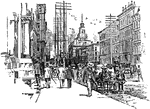
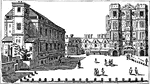
A drawing of a busy business street in Detroit in 1899.

A Business Street in Detroit in 1899

A drawing of a busy business street in Detroit in 1899.

Whitehall is a road in Westminster in London, England. It is the main artery running north from Parliament Square, towards traditional Charing Cross, now at the southern end of Trafalgar Square and marked by the statue of Charles I, which is often regarded as the heart of London. Recognised as centre of HM Government, the road is lined with government departments/ministries; "Whitehall" is therefore also frequently used as a metonym for governmental administration, as well as being a geographic name for the surrounding district.

Whitehall in the Seventeenth Century

Whitehall is a road in Westminster in London, England. It is the main artery running north from Parliament…
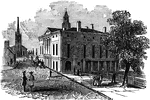
Federal Hall, located at 26 Wall Street in New York City, was the first capitol of the United States of America and the site of George Washington's first inauguration in 1789. It is also the place where the United States Bill of Rights was passed.

Federal Hall

Federal Hall, located at 26 Wall Street in New York City, was the first capitol of the United States…
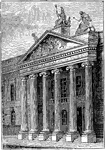
East India House in Leadenhall Street in the City of London in England was the headquarters of the British East India Company. It was rebuilt by the architect Richard Jupp in 1799–1800. Much of India was governed from here until the British government took control of the Company's possessions in India on November 1, 1858. The building was home to the famous ceiling painting, 'The East Offering Its Riches To Britannia', painted by the Italian artist Spiridione Roma in 1778.

The Old East India House

East India House in Leadenhall Street in the City of London in England was the headquarters of the British…
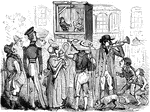
An illustration of a typical Punch and Judy show. Punch and Judy is a traditional, popular English puppet show featuring the characters of Punch and his wife Judy. The performance consists of a sequence of short scenes, each depicting an interaction between two characters, most typically the anarchic Punch and one other character. The show is traditionally performed by a single puppeteer, known since Victorian times as a Professor

Punch and Judy

An illustration of a typical Punch and Judy show. Punch and Judy is a traditional, popular English puppet…
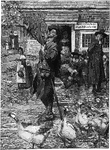
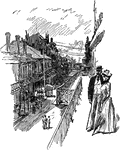
A Quaker exhorting in a street in colonial New England.

Quaker Exhorter in Colonial New England

A Quaker exhorting in a street in colonial New England.

A drawing of a street in old New Orleans, Louisiana.

A Bit of Old New Orleans

A drawing of a street in old New Orleans, Louisiana.

The New Law Courts, London.The Royal Courts of Justice, commonly called the Law Courts, is the building in London which houses the Court of Appeal of England and Wales and the High Court of Justice of England and Wales. The building is a large grey stone edifice in the Victorian Gothic style and was designed by George Edmund Street, a solicitor turned architect. It was built in the 1870s. The Royal Courts of Justice were opened by Queen Victoria in December 1882.

Royal Courts of Justice

The New Law Courts, London. The Royal Courts of Justice, commonly called the Law Courts, is the building…
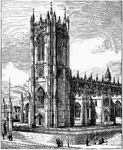
Manchester Cathedral is a Medieval church located on Victoria Street in central Manchester and is the seat of the Bishop of Manchester. Although constructed over a period of 600 years, its main architectural style is Perpendicular Gothic, replete with tall windows and flat fan-vaulted ceilings. The interior of the church contains many pieces of period art, notably the medieval woodcarvings of the Ripon Carvers.

Manchester Cathedral

Manchester Cathedral is a Medieval church located on Victoria Street in central Manchester and is the…
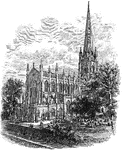
Trinity Church, at 79 Broadway in New York City, is a historic full service parish church in the Episcopal Diocese of New York. Trinity Church is located at the intersection of Broadway and Wall Street in downtown Manhattan. n 1696, Governor Benjamin Fletcher approved the purchase of land in Lower Manhattan by the Church of England community for construction of a new church. The parish received its charter from King William III of England on May 6, 1697. Its land grant specified an annual rent of one peppercorn due to the English crown. The present day Trinity Church, designed by architect Richard Upjohn, is considered a classic example of Gothic Revival architecture and was designated a National Historic Landmark in 1976 for its architectural significance and place within the history of New York City.

Trinity Church

Trinity Church, at 79 Broadway in New York City, is a historic full service parish church in the Episcopal…
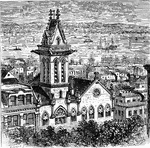
Trinity School is a private, preparatory, co-educational day school for grades K-12 located in New York City, USA, and a member of both the New York Interschool and the Ivy Preparatory School League. Founded in 1709 in the Tower of the old Trinity Church at Broadway and Wall Street, the school is the fifth oldest in the United States and the oldest continually operational school in New York City.

Trinity School

Trinity School is a private, preparatory, co-educational day school for grades K-12 located in New York…
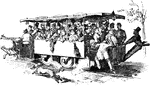
An illustration of a horse-drawn street car. The first passenger services in the world were started by the Oystermouth Railway in Wales, using specially designed carriages on an existing tram line built for horse-drawn freight dandies. Fare-paying passengers were carried on a line between Oystermouth, Mumbles and Swansea docks from 1807. Other forms of public transit developed out of the early omnibus that first ran on public streets in the 1820s. These were local versions of the stagecoach lines, and picked up and dropped off passengers on a regular route, without the need to be pre-hired. Horsecars on tram lines were an improvement over the omnibus as the low rolling resistance of metal wheels on iron or steel rails, (usually grooved from 1852 on), allowed the animals to haul a greater load for a given effort than the omnibus. The horse-drawn streetcar combined the low cost, flexibility, and safety of animal power with the efficiency, smoothness, and all-weather capability of a rail right-of-way.

Street Car

An illustration of a horse-drawn street car. The first passenger services in the world were started…
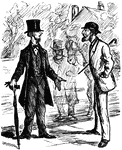
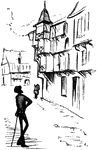
An illustration of two men talking on a street.

Two Men Talking

An illustration of two men talking on a street.

An illustration of a city street.

Street

An illustration of a city street.

An illustration of a man walking down a set of stairs to the street.

Man Walking Down Stairs

An illustration of a man walking down a set of stairs to the street.

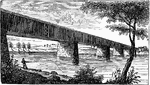
The Great Bridge over the Charles River connected Cambridge, Massachusetts to Little Cambridge, which was the name for Allston-Brighton before it separated from Cambridge in 1807, first becoming the town of Brighton and finally joining the city of Boston in 1874. The Great Bridge was built in 1660-1662 at what was then called Brighton Street, and was the first bridge to span the Charles. A toll was authorized in 1670, rebuilt in 1862.

Great Bridge at McConkey's Ferry

The Great Bridge over the Charles River connected Cambridge, Massachusetts to Little Cambridge, which…
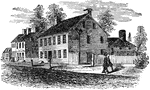
Johann Gottlieb Rall (ca. 1726 - December 26, 1776 ) was a German colonel in command of Hessian troops in Trenton, New Jersey. By 1776, Rall belonged to the infantry regiment of the 1st Division under General Phillip Leopold von Heister and commanded approximately 1,200 men fighting for Great Britain in the American Revolutionary War. He was at the Battle of Brooklyn at Flatbush, the Battle of White Plains, the Battle of Long Island, and figured prominently in the Battle of Trenton. At the Battle of Trenton, Rall was mortally wounded and taken back to his headquarters where he died.

<p>"Rall's head-quarters. This is a frame building standing upon Warren Street, opposite Perry, near the corner of Bank Alley. The buildings on the left are also of ante-Revolutionary origin. This house was a tavern at the time, kept by Stacey Potts, the grandfather of Stacey G. and Joseph C. Potts, Esqrs., of Trenton. In a pane of glass, in the front window on the left of the front door, lower story, may be seen a hole made by a bullet, shot during the battle. Colonel Rall died in the front room in the second story, immediately over this window. It is related that a daughter of Mr. Potts, who was at a neighbor's when the firing commenced, was running toward her father's house, when a musket-ball struck her comb from her head and slightly injured her scalp."—Lossing, 1851

Rall's Headquarters

Johann Gottlieb Rall (ca. 1726 - December 26, 1776 ) was a German colonel in command of Hessian troops…
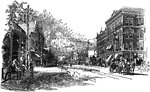
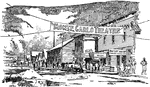
A street scene from the 1800's of Wichita, Kansas.

Street Scene in Wichita

A street scene from the 1800's of Wichita, Kansas.

A view of Main Street, Dawson City in the Yukon, Canada in July of 1897.

Main Street, Dawson City, July 1897

A view of Main Street, Dawson City in the Yukon, Canada in July of 1897.
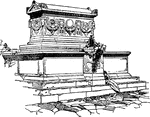
"Sarcophagus from the Street of Tombs at Assos in the Troad, excavated by the Archaeological Institute of America." -Whitney, 1911

Sarcophagus

"Sarcophagus from the Street of Tombs at Assos in the Troad, excavated by the Archaeological Institute…
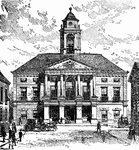
Federal Hall, located at 26 Wall Street in New York City, was the first capitol of the United States of America and the site of George Washington's first inauguration in 1789. It is also the place where the United States Bill of Rights was passed. The original building was demolished in the nineteenth century and replaced by the current structure.

Federal Hall, 1789

Federal Hall, located at 26 Wall Street in New York City, was the first capitol of the United States…
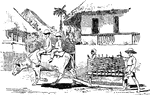
The City of Manila, or simply Manila, is the capital of the Philippines. Seen here is street traffic in the city.

Street traffic in Manila

The City of Manila, or simply Manila, is the capital of the Philippines. Seen here is street traffic…
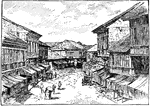
The City of Manila, or simply Manila, is the capital of the Philippines. Seen here is Escolta Street in Manila.

Escolta Street, Manila

The City of Manila, or simply Manila, is the capital of the Philippines. Seen here is Escolta Street…
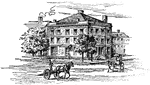
In 1789, George Washington lived on Cherry Street, in a four-story mansion that belonged to Walter Franklin, a wealthy merchant. This house served as the first Executive Mansion of the President of the United States.

George Washington's House on Cherry Street, New York (1789)

In 1789, George Washington lived on Cherry Street, in a four-story mansion that belonged to Walter Franklin,…
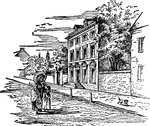
This house, located on the 500 block of Market Street, served as the executive mansion of the United States, while the nation's capital was located in Philadelphia, PA. Two Presidents occupied the house while in office, George Washington from 1790 to 1797, and John Adams, from 1797 to 1800.

The President's House in Philadelphia (1794)

This house, located on the 500 block of Market Street, served as the executive mansion of the United…
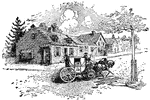
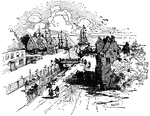
A view of Broad Street, New York in 1740.

Broad Street, New York

A view of Broad Street, New York in 1740.

The Canal on Broad Street, New York during the days of the Colony of New York.

The Canal on Broad Street, New York

The Canal on Broad Street, New York during the days of the Colony of New York.
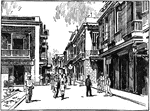
Scenery of a street in San Juan, Puerto Rico.

Street Scene in San Juan

Scenery of a street in San Juan, Puerto Rico.

Perhaps the worst of all the New York prisons during the American Revolution was the third Sugar House, which occupied the space on Liberty Street.

Sugar House in Liberty Street

Perhaps the worst of all the New York prisons during the American Revolution was the third Sugar House,…
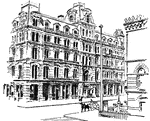
The Young Men's Christian Association ("YMCA" or "the Y") was founded on June 6, 1844 in London, England, by George Williams. The original intention of the organization was to put Christian principles into practice, as taught by Jesus Christ. The YMCA idea, which began among evangelicals, was unusual because it crossed the rigid lines that separated all the different churches and social classes in England in those days. The movement extended to the United States in December 1951. The 23rd Street Branch was torn down in 1903.

YMCA, 23rd Street Branch, New York City

The Young Men's Christian Association ("YMCA" or "the Y") was founded on June 6, 1844 in London, England,…
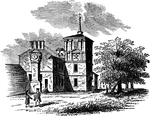
David Rittenhouse erected a temporary observatory for the purpose of observing the transit of Venus on the Walnut Street front of the State house in Philadelphia.

Walnut Street Front

David Rittenhouse erected a temporary observatory for the purpose of observing the transit of Venus…
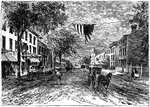
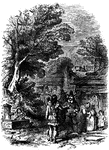
A street in Salem, Massachusetts.

A Street in Salem

A street in Salem, Massachusetts.

Samoset (ca. 1590 &ndash; 1653) was the first Native American to make contact with the Pilgrims.

Samoset in the Streets of Plymouth

Samoset (ca. 1590 – 1653) was the first Native American to make contact with the Pilgrims.
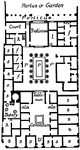
The Pompeiian house consisted of several courts or <em>atria</em>, some of which were surrounded by colonnades and called peristyles. The front portion was reserved for shops, or presented to the street a wall unbroken save by the entrance.Legend: s, shops; v, vestibule; f, family rooms; k, kitchen; l, lararium; p, peristyles

House of Pansa, Pompeii (Plan)

The Pompeiian house consisted of several courts or atria, some of which were surrounded by…
The wrought-iron signs strap-work tablet was used in modern times.

Wrought-Iron Signs Strap-Work Tablet

The wrought-iron signs strap-work tablet was used in modern times.
The wrought-iron signs strap-work tablet was used in modern times.

Wrought-Iron Signs Strap-Work Tablet

The wrought-iron signs strap-work tablet was used in modern times.
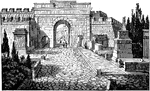
"For tombs of smaller dimensions various forms and abnormal decorations were employed. An ornamented erection of a shape similar to an altar or a temple, and resting on a solid substructure, is a by no means uncommon form. Many tombs are constructed like real temples, while others consist only of simple columns. These tombs were generally erected in rows along the main roads before the entrance to a town, so as to form a street of tombs, an arrangement which is still to be seen at Pompeii."

Street of Tombs at Pompeii

"For tombs of smaller dimensions various forms and abnormal decorations were employed. An ornamented…
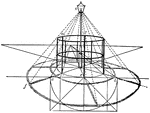
An illustration of a shadow cast by the light of a street lamp.

Shadow of an Street Lamp

An illustration of a shadow cast by the light of a street lamp.

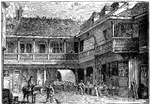
The Tabard, an inn that stood on the east side of Borough High Street in Southwark, was established in 1307, when the abbot of Hyde purchased the land to construct a hostel for himself and his brethren, when business took them to London, as well as an inn to accommodate the numerous pilgrims headed on annual pilgrimage to the Shrine of Thomas Beckett in Canterbury Cathedral. The Tabard is famous as the place owned by Harry Bailey, the host in Geoffrey Chaucer's Canterbury Tales, and is described in the first few lines of Chaucer's work as the location where the pilgrims first meet on their journey to Canterbury in the 1380s.

Tabard Inn

The Tabard, an inn that stood on the east side of Borough High Street in Southwark, was established…
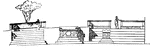
An exedra is a semicircular recess set into a building's facade. The exedra at the Street of Tombs in Assos (Turkey) is shown here.

Exedra at the Street of Tombs in Assos

An exedra is a semicircular recess set into a building's facade. The exedra at the Street of Tombs in…
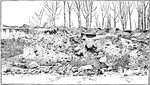
Section of frontal moraine on side of Warner Street, Glouchester, Massachusetts.

Section of Frontal Moraine

Section of frontal moraine on side of Warner Street, Glouchester, Massachusetts.
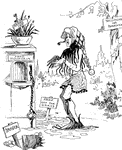
An illustration of a jester surrounded by no trespassing signs.

Jester Trespassing

An illustration of a jester surrounded by no trespassing signs.

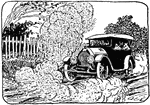
An illustration of a car on a muddy street.

Car on Muddy Street

An illustration of a car on a muddy street.

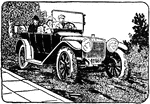
An illustration of a car stirring up dust on a dry road.

Car on Dry Dusty Street

An illustration of a car stirring up dust on a dry road.

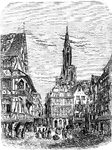
Street scene in Strasburg with public square in the foreground and a church spire in the background.
Street Scene in the City of Strasburg

Street scene in Strasburg with public square in the foreground and a church spire in the background.
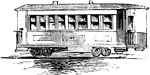
An illustration of a street car.

Street Car

An illustration of a street car.

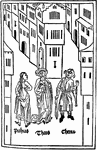
An illustration of two women and a jester standing on the street.

Two Women and Jester on Street

An illustration of two women and a jester standing on the street.

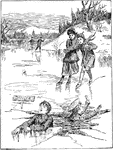
"Presumption often ventures quite too near, where danger should awaken wholesome fear" &mdash;Northdrop, 1893. A pair of ice skaters approach while another pair of skaters look on at two skaters that have fallen through the ice, near a danger sign, frantically try to get out of the icy waters.

Skating on Thin Ice

"Presumption often ventures quite too near, where danger should awaken wholesome fear" —Northdrop,…