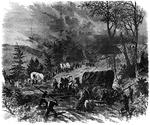
"The campaign in Georgia. A baggage train crossing the mountains in a storm. General Sherman, after the capture of Atlanta, prepared for the next move of his antagonist. Hood suddenly moved north, assailing Sherman's lines of communication; but he was repulsed at important points, and, being followed closely by Sherman, retreated southward. The mountain region was again the scene of operations just as winter was approaching. The immense labor and fatigue attendant on operations in that district may be conceived by our sketch of a baggage train crossing the mountains in a storm."— Frank Leslie, 1896

Campaign in Georgia

"The campaign in Georgia. A baggage train crossing the mountains in a storm. General Sherman, after…
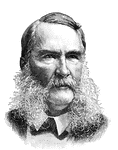
"General Longstreet, born in Edgefield district, S. C., January 8th, 1821, was graduated from the United States Military Academy in 1842, and assigned to the Fourth Infantry. He served in the Mexican war, and for gallant and meritorious conduct in the battles of Churubusco and Moleno del Rey he was brevetted captain and major. He became paymaster, July 19th, 1858, and resigned January 1st, 1861. He was commissoined a brigadier general in the Confederate service, and at the first battle of Bull Run commanded a brigade. He took part in the seven days' battles around Richmond, and at the second battle of Bull Run . He commanded the right wing of the Army of Northern Virginia at the battle of Gettysburg, and the First Corps in all the operations in 1864."— Frank Leslie, 1896

General James Longstreet

"General Longstreet, born in Edgefield district, S. C., January 8th, 1821, was graduated from the United…

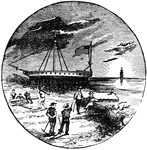
Seal, with a shovel and hoe on it.

True-temper seal

Seal, with a shovel and hoe on it.

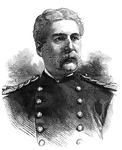
"General Hatch, born in Bangor, Me., December 22nd, 1832. In April, 1861, he was a member of the District of Columbia Volunteers, who were enlisted to defend the national capital, and subsequently had charge of the camp of instruction at Davenport, La. He was commissioned captain in the Second Iowa Cavalry August 12th, 1861; major, September 5th, and lieutenant colonel, December 11th, the same year. He commanded his regiment at New Madrid, Island No. 10, the battle of Corinth, the raid of Booneville and the battle of Iuka. He was promoted colonel, June 13th, 1862, and commanded a brigade of cavalry in General Grant's Mississippi campaign. He was afterward placed at the head of the cavalry division of the Army of the Tennessee and was present at the various engagements in which it took part. He was disabled by wounds in December, 1863, and on April 27th, 1864, was made brigadier general. Under General A. J. Smith, and still in command of a cavalry division, he was engaged in the battles of Franklin (for bravery in which he was brevetted brigadier general in the regular service) and Nashville, and in the pursuit of Hood's Confederate Army. For gallantry at Nashville he was, in 1864, brevetted major general of volunteers, and three years later promoted to the same rank by brevet in the United States Army. On January 15th, 1866, he was honorably mustered out of the volunteer service, and on July 6th following he was promoted colonel of the Ninth United States Cavalry."— Frank Leslie, 1896

General Edward Hatch

"General Hatch, born in Bangor, Me., December 22nd, 1832. In April, 1861, he was a member of the District…
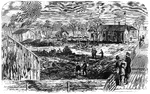
"Appearance of the prison pen at Columbia, S. C., on the arrival of Sherman's army."— Frank Leslie, 1896

Prison Pen at Columbia

"Appearance of the prison pen at Columbia, S. C., on the arrival of Sherman's army."— Frank Leslie,…
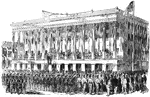
"General McGowen addressing the Thirty-Fifth Abbeville (S. C.) Volunteers, in front of the Charleston Hotel. The gallant band of Confederates known as the Abbeville Volunteers was composed of a hundred of the wealthiest citizens of the district. A number of them were accompanied by their negro servants, as the barons of old were by their armed vassals. General McGowen made a strong speech, and was loudly cheered."— Frank Leslie, 1896

General McGowen

"General McGowen addressing the Thirty-Fifth Abbeville (S. C.) Volunteers, in front of the Charleston…
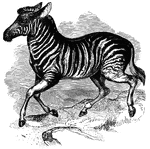
"Is of a pale brown color; the underside of the body being whitish; head, body, and upper part of the legs black streaked; tail, inside and lower part of the legs white. This species is a tenant of the plains, and it found occuring in every district noth of the Orange River, as far as travelers have penetrated." — S. G. Goodrich, 1885

Dauw

"Is of a pale brown color; the underside of the body being whitish; head, body, and upper part of the…
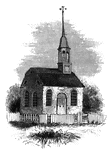
Caughnawaga church. This old church, now (1848) known as the <em>Fonda Academy</em>, under the management of Rev. Douw Van Olinda, is about half a mile east of the court-house, in the village of Fonda. It is a stone edifice, and was erected in 1763 by voluntary contributions. Sir William Johnson contributed liberally. Its first pastor was Thomas Romayne, who was succeeded in 1795 by Abraham Van Horn, one of the earliest graduates of King's (now Columbia) College, in the city of New York. He was from Kingston, Ulster county, and remained its pastor until 1840. During his ministry he united in marriage 1500 couples. The church was without a bell until the confiscated property of Sir John Johnson was sold in the Revolution, when the <em>dinner-bell</em> of his father was purchased and hung in the steeple. The bell weighs a little more than one hundred pounds, and bears the following inscription: "S. R. William Johnson, baronet, 1774. Made by Miller and Ross, in Eliz. Town."

Caughnawaga Church

Caughnawaga church. This old church, now (1848) known as the Fonda Academy, under the management…

The old Colony Seal.

Colony Seal

The old Colony Seal.

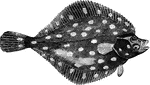
"Weighing six to twelve pounds; it feeds on mollusca, crustacea, and young fish; inhabits sandy banks and muddy grounds in the seal is sometime staken with hooks and sometimes with spears, though more generally with trawl-nets." &mdash; Goodrich, 1859

Plaice

"Weighing six to twelve pounds; it feeds on mollusca, crustacea, and young fish; inhabits sandy banks…
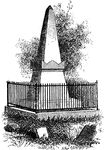
"Van Wart's monument. The following are the inscriptions upon this monument: North Side: 'Here repose the mortal remains of Isaac Van Wart, an elder in the Greenburgh church, who died on the 23d of May, 1828, in the 69th year of his age. Having lived the life, he died the death, of the Christian. South Side: 'The citizens of the county of West Chester erected this tomb in testimony of the high sense they entertained for the virtuous and patriotic conduct of their fellow-citizen, as a memorial sacred to public graditute.' East Side: 'Vincent, Amor Patriae. Nearly half a century before this monument was built, the conscript fathers of America had, in the Senate chamber, voted that Isaac Van Wart was a faithful patriot, one in whom the love of country was invincible, and this tomb bears testimony that the record is true.' West Side: 'Fidelity. On the 23d of September, 1780, Isaac Van Wart, accompanied by John Paulding and David Williams, all farmers of the county of West Chester, intercepted Major Andre, on his return from the American lines in the character of a spy, and, notwithstanding the large bribes offered them for his release, nobly disclaimed to sacrifice their country for gold, secured and carried him to the commanding officer of the district, whereby the dangerous and traitorous conspiracy of Arnold was brought to light, the insiduous designs of the enemy, baffled, the American army saved, and our beloved country free.'"—Lossing, 1851

Van Wart's Monument

"Van Wart's monument. The following are the inscriptions upon this monument: North Side: 'Here repose…
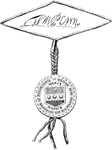
"Penn's Seal and Signature. This is a representation of the seal and signature of William Penn attached to the Pennsylvania charter. The names of the subscribing witnesses to the instrument are James Claypoole, Francis Plumsted, Thomas Barker, Philip Ford, Edward Pritchard, Andrew Soule, Christopher Taylor, Charles Lloyd, William Gibson, U. More, George Rudyard, Harbt. Springett."—Lossing, 1851

Penn's seal and signature

"Penn's Seal and Signature. This is a representation of the seal and signature of William Penn attached…
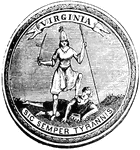
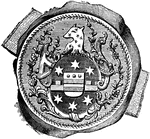
"Great Seal of Virginia."&mdash;Lossing, 1851

Virginia Seal

"Great Seal of Virginia."—Lossing, 1851

"Seal and signature of Tryon. William Tryon was a native of Ireland, and was educated to the profession of a soldier. He was an officer in the British service. He married Miss Wake, a relative of the Earl of Hillsborough, secretary for the colonies. Thus connected, he was a favorite of government, and was appointed lieutenant governor of North Carolina, in 1765. On the death of Governor Dobbs, he succeeded him in office, and exercised its functions until called to fill the same office in New York, in 1771. The history of his administration in North Carolina is a record of extortion, folly, and crime. During his administration in New York, the Revolution broke out, and he was the last royal governor of that state, though nominally succeeded in office in 1780 by General Robertson, when he was returned to England. His property in North Carolina and in New York was confiscated."—Lossing, 1851

William Tryon Seal

"Seal and signature of Tryon. William Tryon was a native of Ireland, and was educated to the profession…
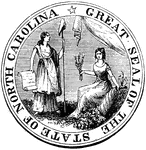
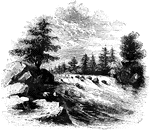
"Great Seal of the State of North Carolina."&mdash;Lossing, 1851

North Carolina Seal

"Great Seal of the State of North Carolina."—Lossing, 1851

"View of the Great Falls of the Catawba. This view is from the west side of the Catawba, looking northeast, toward Lancaster District."&mdash;Lossing, 1851

Catawba

"View of the Great Falls of the Catawba. This view is from the west side of the Catawba, looking northeast,…
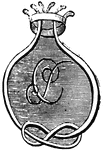
"Pulaski's seal."&mdash;Lossing, 1851

Pulaski's Seal

"Pulaski's seal."—Lossing, 1851

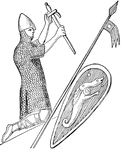
"William the Conqueror (1066-1087), as represented on his seal. Although William really ruled 'as king by the edge of the sword,' he preferred to base his title on the promise of Edward the Confessor rather than on force of arms; and he adhered to far as possible to Anglo-Saxon usages, causing himself to be crowned at Westminster and binding himself to frame good laws and observe justice, as his predecessors had done. In fact he professed to regard himself as the lawful successor of the Anglo-Saxon kings, and not merely as a feudal conqueror. He had great difficulty in making the people recognize him as such, but when this was once done, he was a far more powerful ruler as king of England than he was as Norman duke."&mdash;Colby, 1899

William the Conqueror

"William the Conqueror (1066-1087), as represented on his seal. Although William really ruled 'as king…

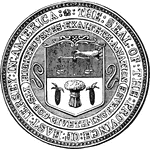
Seal of Massachusetts Bay Company

Massachusetts Seal

Seal of Massachusetts Bay Company

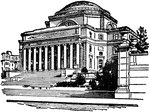
"Columbia University is a seat of learning in New York city. The charter of King's College, the original name of Columbia, was granted by George II., and finally passed the seals on Oct. 31, 1754, from which day the college dates its existence. The central library building and other costly buildings including St. Paul's Chapel, completed 1907, form a fine group."—(Charles Leonard-Stuart, 1911)

Library of Columbia University

"Columbia University is a seat of learning in New York city. The charter of King's College, the original…
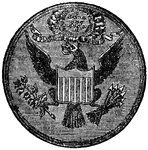
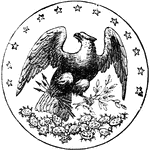
"The Eagle is a gold coin of the United States, value $10; half-eagle, $5; quarter-eagle, $2.50, double eagle, the largest gold coin of this country, $20."&mdash;(Charles Leonard-Stuart, 1911)

Eagle on Seal of United States

"The Eagle is a gold coin of the United States, value $10; half-eagle, $5; quarter-eagle, $2.50, double…
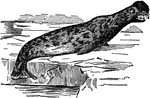
"The Seal, of the family Phocid&aelig;, or seal tribe, are, of all four-limbed mammiferous animals, those which display the most complete adaptation to residence in the water. The seal has considerable resemblance to a quadruped in some respects, and to a fish in others. The head is round, and the nose, which is broad, resembles that of a dog, with the same look of intelligence and mild and expressive physiognomy. It has large whiskers, oblong nostrils, and great black sparkling eyes. It has no external ears, but a valve exists in the orifices, which can be closed at will, so as to keep out the water; the nostrils have a similar valve; and the clothing of the body consists of stiff glossy hairs, very closely set against the skin. The body is elongated and conical, gradually tapering from the shoulders to the tail. The spine is provided with strong muscles, which bend it with considerable force; and this movement is of great assistance to the propulsion of the body."&mdash;(Charles Leonard-Stuart, 1911)

Hooded Seal

"The Seal, of the family Phocidæ, or seal tribe, are, of all four-limbed mammiferous animals,…

Seal of New Amsterdam

New Amsterdam

Seal of New Amsterdam

Seal of New Netherland

New Netherland

Seal of New Netherland

Seal of East Jersey

East Jersey

Seal of East Jersey

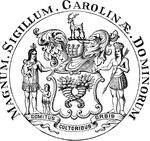
Seal of the proprietors of Carolina.

Carolina

Seal of the proprietors of Carolina.

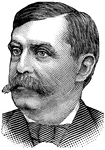
(1835-1894) Hall was a one-term Democratic U.S. Representative from Iowa's 1st congressional district in southeastern Iowa.

Benton J. Hall

(1835-1894) Hall was a one-term Democratic U.S. Representative from Iowa's 1st congressional district…
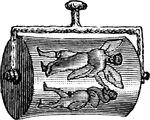
"A Cylinder Seal" &mdash; Morey, 1903

Cylinder Seal

"A Cylinder Seal" — Morey, 1903

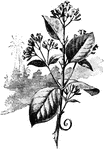
"Bolivia raises some of the best cinchona, although excellent cinchona is also raised in Peru and all along the eastern slopes of the Andes between here and Columbia." &mdash;Carpenter, 1902

Cinchona

"Bolivia raises some of the best cinchona, although excellent cinchona is also raised in Peru and all…
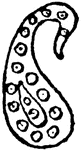
"Also known as the cone, the palm leaf, the river loop, the crown jewel, the seal, the almond, the feather, the boquet, and the flame. There is a vast difference of opinion as to the origin and meaning of this motif. Some authorities claim it was intended for the fir cone, which served as an emblem of immortality and was revered by the ancients; some say it was intended for the palm leaf, which has been handed down by the Greeks as a symbol of victory; others say it was intended to represent a loop which the river Indus makes on a vast plain in upper Cashmere as seen from the Mosque. By some it is said to represent the crown jewels or chief ornament in the old Iranian crown, which is a composite jewel of pear shape. Tradition tells us that the signing of documents in such a manner was a custom well known in the East. This design has also been called the almond, the feather, the bouquet, and the flame on account of its fancied resemblance to these objects. We have selected the name "pear" because the image it conveys is more clearly recognized by the western mind. It is that which its shape most suggests. The Pear design is common in many kinds of rugs, especially in those of Persia and Kurdistan, but it varies greatly in varieties of form and size. The large size is usually employed in the Caucasus and Southern Persia, while the small size is used more frequently in Central and Western Persia. In the Saraband, Shiraz, Herat, Khorasan, and Senna, it frequently covers the whole field. In the two former alternate rows usually have the stems of the pears turned in opposite directions, while in the three latter the stems are usually turned in the same direction."

Pear Design

"Also known as the cone, the palm leaf, the river loop, the crown jewel, the seal, the almond, the feather,…
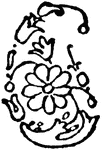
"Also known as the cone, the palm leaf, the river loop, the crown jewel, the seal, the almond, the feather, the boquet, and the flame. There is a vast difference of opinion as to the origin and meaning of this motif. Some authorities claim it was intended for the fir cone, which served as an emblem of immortality and was revered by the ancients; some say it was intended for the palm leaf, which has been handed down by the Greeks as a symbol of victory; others say it was intended to represent a loop which the river Indus makes on a vast plain in upper Cashmere as seen from the Mosque. By some it is said to represent the crown jewels or chief ornament in the old Iranian crown, which is a composite jewel of pear shape. Tradition tells us that the signing of documents in such a manner was a custom well known in the East. This design has also been called the almond, the feather, the bouquet, and the flame on account of its fancied resemblance to these objects. We have selected the name "pear" because the image it conveys is more clearly recognized by the western mind. It is that which its shape most suggests. The Pear design is common in many kinds of rugs, especially in those of Persia and Kurdistan, but it varies greatly in varieties of form and size. The large size is usually employed in the Caucasus and Southern Persia, while the small size is used more frequently in Central and Western Persia. In the Saraband, Shiraz, Herat, Khorasan, and Senna, it frequently covers the whole field. In the two former alternate rows usually have the stems of the pears turned in opposite directions, while in the three latter the stems are usually turned in the same direction."

Pear Design

"Also known as the cone, the palm leaf, the river loop, the crown jewel, the seal, the almond, the feather,…
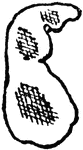
"Also known as the cone, the palm leaf, the river loop, the crown jewel, the seal, the almond, the feather, the boquet, and the flame. There is a vast difference of opinion as to the origin and meaning of this motif. Some authorities claim it was intended for the fir cone, which served as an emblem of immortality and was revered by the ancients; some say it was intended for the palm leaf, which has been handed down by the Greeks as a symbol of victory; others say it was intended to represent a loop which the river Indus makes on a vast plain in upper Cashmere as seen from the Mosque. By some it is said to represent the crown jewels or chief ornament in the old Iranian crown, which is a composite jewel of pear shape. Tradition tells us that the signing of documents in such a manner was a custom well known in the East. This design has also been called the almond, the feather, the bouquet, and the flame on account of its fancied resemblance to these objects. We have selected the name "pear" because the image it conveys is more clearly recognized by the western mind. It is that which its shape most suggests. The Pear design is common in many kinds of rugs, especially in those of Persia and Kurdistan, but it varies greatly in varieties of form and size. The large size is usually employed in the Caucasus and Southern Persia, while the small size is used more frequently in Central and Western Persia. In the Saraband, Shiraz, Herat, Khorasan, and Senna, it frequently covers the whole field. In the two former alternate rows usually have the stems of the pears turned in opposite directions, while in the three latter the stems are usually turned in the same direction."

Pear Design

"Also known as the cone, the palm leaf, the river loop, the crown jewel, the seal, the almond, the feather,…
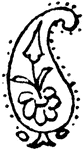
"Also known as the cone, the palm leaf, the river loop, the crown jewel, the seal, the almond, the feather, the boquet, and the flame. There is a vast difference of opinion as to the origin and meaning of this motif. Some authorities claim it was intended for the fir cone, which served as an emblem of immortality and was revered by the ancients; some say it was intended for the palm leaf, which has been handed down by the Greeks as a symbol of victory; others say it was intended to represent a loop which the river Indus makes on a vast plain in upper Cashmere as seen from the Mosque. By some it is said to represent the crown jewels or chief ornament in the old Iranian crown, which is a composite jewel of pear shape. Tradition tells us that the signing of documents in such a manner was a custom well known in the East. This design has also been called the almond, the feather, the bouquet, and the flame on account of its fancied resemblance to these objects. We have selected the name "pear" because the image it conveys is more clearly recognized by the western mind. It is that which its shape most suggests. The Pear design is common in many kinds of rugs, especially in those of Persia and Kurdistan, but it varies greatly in varieties of form and size. The large size is usually employed in the Caucasus and Southern Persia, while the small size is used more frequently in Central and Western Persia. In the Saraband, Shiraz, Herat, Khorasan, and Senna, it frequently covers the whole field. In the two former alternate rows usually have the stems of the pears turned in opposite directions, while in the three latter the stems are usually turned in the same direction."

Pear Design

"Also known as the cone, the palm leaf, the river loop, the crown jewel, the seal, the almond, the feather,…
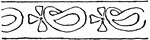
"Also known as the cone, the palm leaf, the river loop, the crown jewel, the seal, the almond, the feather, the boquet, and the flame. There is a vast difference of opinion as to the origin and meaning of this motif. Some authorities claim it was intended for the fir cone, which served as an emblem of immortality and was revered by the ancients; some say it was intended for the palm leaf, which has been handed down by the Greeks as a symbol of victory; others say it was intended to represent a loop which the river Indus makes on a vast plain in upper Cashmere as seen from the Mosque. By some it is said to represent the crown jewels or chief ornament in the old Iranian crown, which is a composite jewel of pear shape. Tradition tells us that the signing of documents in such a manner was a custom well known in the East. This design has also been called the almond, the feather, the bouquet, and the flame on account of its fancied resemblance to these objects. We have selected the name "pear" because the image it conveys is more clearly recognized by the western mind. It is that which its shape most suggests. The Pear design is common in many kinds of rugs, especially in those of Persia and Kurdistan, but it varies greatly in varieties of form and size. The large size is usually employed in the Caucasus and Southern Persia, while the small size is used more frequently in Central and Western Persia. In the Saraband, Shiraz, Herat, Khorasan, and Senna, it frequently covers the whole field. In the two former alternate rows usually have the stems of the pears turned in opposite directions, while in the three latter the stems are usually turned in the same direction."

Pear Design

"Also known as the cone, the palm leaf, the river loop, the crown jewel, the seal, the almond, the feather,…
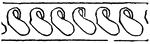
"Also known as the cone, the palm leaf, the river loop, the crown jewel, the seal, the almond, the feather, the boquet, and the flame. There is a vast difference of opinion as to the origin and meaning of this motif. Some authorities claim it was intended for the fir cone, which served as an emblem of immortality and was revered by the ancients; some say it was intended for the palm leaf, which has been handed down by the Greeks as a symbol of victory; others say it was intended to represent a loop which the river Indus makes on a vast plain in upper Cashmere as seen from the Mosque. By some it is said to represent the crown jewels or chief ornament in the old Iranian crown, which is a composite jewel of pear shape. Tradition tells us that the signing of documents in such a manner was a custom well known in the East. This design has also been called the almond, the feather, the bouquet, and the flame on account of its fancied resemblance to these objects. We have selected the name "pear" because the image it conveys is more clearly recognized by the western mind. It is that which its shape most suggests. The Pear design is common in many kinds of rugs, especially in those of Persia and Kurdistan, but it varies greatly in varieties of form and size. The large size is usually employed in the Caucasus and Southern Persia, while the small size is used more frequently in Central and Western Persia. In the Saraband, Shiraz, Herat, Khorasan, and Senna, it frequently covers the whole field. In the two former alternate rows usually have the stems of the pears turned in opposite directions, while in the three latter the stems are usually turned in the same direction."

Pear Design

"Also known as the cone, the palm leaf, the river loop, the crown jewel, the seal, the almond, the feather,…
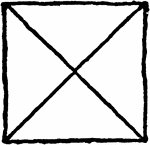
Built on the right angle triangle and, like the Signet of David, it is found in many of the Turkish and Caucasian fabrics and to it scores of patterns may be traced.

Solomon's Seal

Built on the right angle triangle and, like the Signet of David, it is found in many of the Turkish…
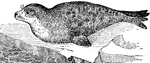
The general name of certain genera of carnivorous mammals, havin feet adapted for swimming, and being able to live both in and out of water.

Seal

The general name of certain genera of carnivorous mammals, havin feet adapted for swimming, and being…
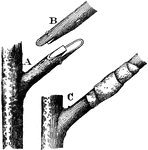
To graft two plants together using the tongue or whip grafting approach, you must first make a sloping cut in the rootstock with a 'tongue' pointing up. Next you must make a matching cut in the scion wood with a 'tongue' pointing downwards. Finally you join the two, ensuring maximum contact of the cambium layers. Bind with rafia or polythene tape and seal with grafting wax.

Tongue Grafting

To graft two plants together using the tongue or whip grafting approach, you must first make a sloping…
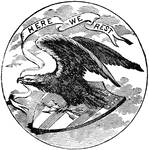
The official seal of the U.S. state of Alabama in 1889.

Alabama

The official seal of the U.S. state of Alabama in 1889.

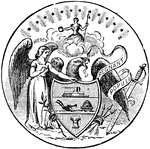
The official seal of the U.S. state of Arkansas in 1889.

Arkansas

The official seal of the U.S. state of Arkansas in 1889.

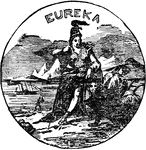
The official seal of the U.S. state of California in 1889.

California

The official seal of the U.S. state of California in 1889.

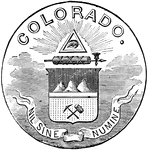
The official seal of the U.S. state of Colorado in 1889.

Colorado

The official seal of the U.S. state of Colorado in 1889.

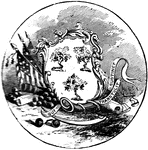
The official seal of the U.S. state of Connecticut in 1889.

Connecticut

The official seal of the U.S. state of Connecticut in 1889.

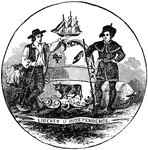
The official seal of the U.S. state of Delaware in 1889.

Delaware

The official seal of the U.S. state of Delaware in 1889.

The official seal of the U.S. state of Florida in 1889.

Florida

The official seal of the U.S. state of Florida in 1889.

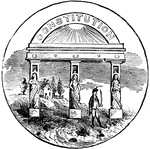
The official seal of the U.S. state of Georgia in 1889.

Georgia

The official seal of the U.S. state of Georgia in 1889.

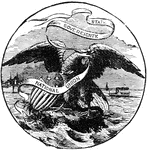
The official seal of the U.S. state of Illinois in 1889.

Illinois

The official seal of the U.S. state of Illinois in 1889.

The official seal of the U.S. state of Indiana in 1889.

Indiana

The official seal of the U.S. state of Indiana in 1889.

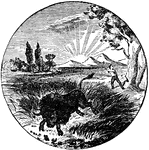
The official seal of the U.S. state of Iowa in 1889.

Iowa

The official seal of the U.S. state of Iowa in 1889.

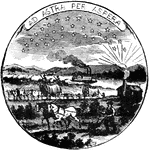
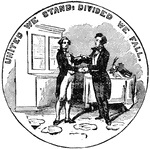
The official seal of the U.S. state of Kansas in 1889.

Kansas

The official seal of the U.S. state of Kansas in 1889.

The official seal of the U.S. state of Kentucky in 1889.

Kentucky

The official seal of the U.S. state of Kentucky in 1889.

The official seal of the U.S. state of Louisiana in 1889.

Louisiana

The official seal of the U.S. state of Louisiana in 1889.

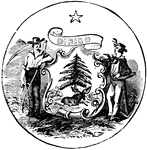
The official seal of the U.S. state of Maine in 1889.

Maine

The official seal of the U.S. state of Maine in 1889.

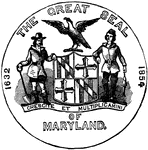
The official seal of the U.S. state of Maryland in 1889.

Maryland

The official seal of the U.S. state of Maryland in 1889.

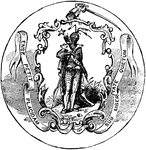
The official seal of the U.S. state of Massachusetts in 1889.

Massachusetts

The official seal of the U.S. state of Massachusetts in 1889.

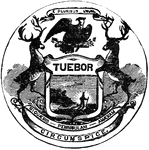
The official seal of the U.S. state of Michigan in 1889.

Michigan

The official seal of the U.S. state of Michigan in 1889.

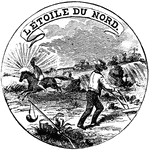
The official seal of the U.S. state of Minnesota in 1889.

Minnesota

The official seal of the U.S. state of Minnesota in 1889.

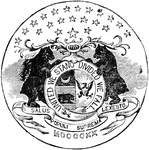
The official seal of the U.S. state of Missouri in 1889.

Missouri

The official seal of the U.S. state of Missouri in 1889.

The official seal of the U.S. state of Nebraska in 1889.

Nebraska

The official seal of the U.S. state of Nebraska in 1889.

The official seal of the U.S. state of New Hampshire in 1889.

New Hampshire

The official seal of the U.S. state of New Hampshire in 1889.