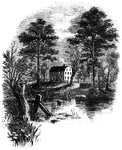
"Prescott's Headquarters. This house is on the east side of the west road, about a mile from the bay. The view is from the road where the small stream crosses, after leaving the pond seen in the picture. It is a beautiful summer residence, the grounds around it being finely shaded by willows, elms, and sycamores. The present occupant kindly showed me the room in which Prescott was lying at the time of his capture. It is on the second floor, at the southwest corner of the house, or on the right as seen in the engraving. It is a well-built frame house, and was probably then the most spacious mansion on the island out of Newport."—Lossing, 1851

Prescott's Headquarters

"Prescott's Headquarters. This house is on the east side of the west road, about a mile from the bay.…
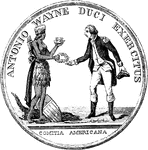
"Gold medal awarded by Congress to General Wayne. This is a representation of the medal, the size of the original. On this side is a device repesenting an Indian queen crowned, a quiver on her back, and wearing a short apron of feathers. A mantle hangs from her waist behind, the upper end of which appears as if passed through the girdle of her apron, and hangs gracefully by her side. With her right hand she is presenting a wreath to General Wayne; in her left she is holding up a mural crown toward his head. At her feet, on the left, an alligator is lying. The American shield is resting against the animal. Over the figure is the legend 'Antonio Wayne duci exercitas,' and beneath, 'Comitia Americana,' 'The American Congress to General Anthony Wayne.'"—Lossing, 1851

Wayne Medal Front

"Gold medal awarded by Congress to General Wayne. This is a representation of the medal, the size of…
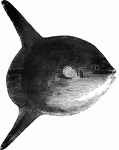
"Almost of a circular form, with long dorsal and anal fins, projecting like handles from its inder parts. It attains a great size, sometimes as much as four or five hundred pounds' wright, and measures four or five feet in length." — Goodrich, 1859

Short Sunfish

"Almost of a circular form, with long dorsal and anal fins, projecting like handles from its inder parts.…
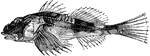
"Is five to eight inches long; is very voracious, swims rapidly, and si found under stones and sea-weed along the European shores. They are often caught in trawl-nets, but are of no value, on account of their sharp spines they are carefully handled; common in European and American waters." — Goodrich, 1859

Sea Scorpion

"Is five to eight inches long; is very voracious, swims rapidly, and si found under stones and sea-weed…
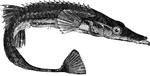
"Five to eight inches long. It is very voracious, and one six inches long being put into a pail of water with an eel three inches long, immediately swallowed all but the tail; it was obliged, however, after a short time to disgorge it in a half-digested state." — Goodrich, 1859

Fifteen-Spined Stickleback

"Five to eight inches long. It is very voracious, and one six inches long being put into a pail of water…

"Is one to three feet long, and has been celebrated from the time of Aristotle for its richness and flavor. It abounds in the Mediterranean, and also on the British coasts, where it is taken with trawl-nets, and also by angling at flood-tide with a long rod and strong line." — Goodrich, 1859

European Bass

"Is one to three feet long, and has been celebrated from the time of Aristotle for its richness and…
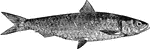
"Is eight to eleven inches long; it resembles the herring, but is smaller, and at the same time thicker." — Goodrich, 1859

Pilchard

"Is eight to eleven inches long; it resembles the herring, but is smaller, and at the same time thicker."…
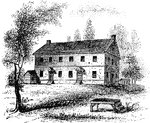
"Friends' meeting-house. This view is from the shed in the yard, looking southeast. The building stands in the center of a large square, if of imported brick, and very spacious. The Quakers were numerous in this vicinity in the time of the Revolution, and a large number of the present inhabitants are members of that sect."—Lossing, 1851

Friends' meeting-house

"Friends' meeting-house. This view is from the shed in the yard, looking southeast. The building stands…
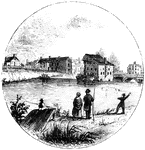
"Trenton Bridge and vicinity. This view is from the north side of the Assanpink, a few rods above the bridge, looking south. The bridge, seen upon the right, is built of stone, and very strong, and is upon the site of the old one. The creek is curbed by a dam near the bridge, and forms the sheet of water seen in the picture. The old 'Stacey Mill' of the Revolution, the largest building in the sketch, was quite dilapidated from the effects of fire and flood, when I was there. The two old houses on the left of it are of stone, covered with stucco, and were there at the time in question. On the bank, between them and the house of Mr. Timothy Abbott, seen on the extreme left, was a building used as a tavern, in the Revolution. It was demolished a few years ago. Along the high bank, from the mill eastward to the rail-way, now covered with houses and gardens, and also westward, some distance toward the Delaware, the Americans were encamped. The bank was being terraced when I visited Trenton, and will, in time, be a beautiful spot."—Lossing, 1851

Trenton

"Trenton Bridge and vicinity. This view is from the north side of the Assanpink, a few rods above the…
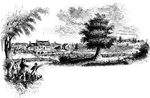
"Battle-ground at Monmouth. This view is from the orchard, upon the site of Wayne's position when Monckton fell. The old house on the left is the ancient parsonage, occupied, at the time of the battle, by a man named Freeman. Beyond the house, extending right and left, is the place of the morass, now fine meadow land, with a clear stream running through it; and in the extreme distance are seen the slopes and elevations whereon the second division of the American army, under Washington, was drawn up. Upon the rising ground on the extreme right, the British grenadiers were stationed; and two figures in the open field, about fifty yards distant from our point of view, denote the spot where Monckton was killed."—Lossing, 1851

Monmouth Battle-Ground

"Battle-ground at Monmouth. This view is from the orchard, upon the site of Wayne's position when Monckton…
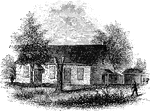
"Birmingham Meeting-house. This is a view of the southerly front of the meeting-house. The building is very substantially built of stone. Much of it is serpentine, which abounds in that region, and of which several houses are constructed. I was informed that the stains made by the blood of the wounded carried in there at the time of the battle are yet visible on the floor. The Highsite party hold present possession of the house; the Orthodox have built a place of worship near."—Lossing, 1851

Birmingham Meeting-House

"Birmingham Meeting-house. This is a view of the southerly front of the meeting-house. The building…
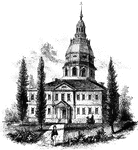
"The State House in Annapolis. This fine building is situated upon an elevation in the center of the city, and is admired by every visitor, not only for its style of architecture, but for the beauty of its location. The building is of brick. The superstructure consists of a spacious dome, surmounted by two smaller ones, with a cupola of wood. From the dome, a magnificent prospect opens to the eye. Around the spectator is spread out the city and harbor like a map, while far away to the southeast stretches the Chesapeake, with Kent Island and the eastern shore looming up in the distance. The edifice fronts Francis Street, and the hill on which it stands is surrounded by a substantial granite wall, surmounted by an iron railing, having three gateways. It was erected in 1772, upon the site of the old Court-house, built in 1706. The corner stone was laid by Governor Robert Eden. The dome was not built until after the Revolution. The architect was Joseph Clarke. Tradition relates that when Governor Eden struck the corner stone with a mallet, at the time of laying it, a severe clap of thunder burst over the city, though there was not a cloud in the sky. Thomas Dance, who executed the stucco work of the dome, fell from the scaffold, and was killed, just as he finished the center piece."—Lossing, 1851

Annapolis State House

"The State House in Annapolis. This fine building is situated upon an elevation in the center of the…
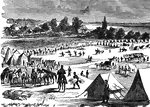
"Camp Zagonyi, encampment of Fremont's army on the prairie, near Wheatland, Mo., October 14th, 1861. This spot, where Fremont's army rested after their first day's march from Tipton, is on the vast prairies of Missouri, about fifteen miles from Tipton and two miles from Wheatland. The Grand Army of the West here pitched their tents on the afternoon of the 14th of October, 1861. A brilliant sunset fell over the whole, which looked more like a monster picnic than the advanced corps of an army bent on the destruction of traitorous brothers. The rapidity with which the evening's meal for a marching regiment is prepared has something of the marvelous in it. Appetite quickens practice, and the air is soon filled with the savory aromas of culinary processes. Then comes the hearty enjoyment of food which at another time would be passed by, but which now, under the appetizing provocative of hunger, is thankfully received. Not the least of a soldier's trials is the inroad a long march and privation makes upon that fastidiousness which plenty to eat engenders in the human diaphragm. The camp was called after the colonel of General Fremont's bodyguard, whose gallant achievements at Springfield on the 25th of October we have recorded." —Leslie, 1896

Camp Zagonyi

"Camp Zagonyi, encampment of Fremont's army on the prairie, near Wheatland, Mo., October 14th, 1861.…
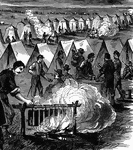
"Camp Zagonyi, encampment of Fremont's army on the prairie, near Wheatland, Mo., October 14th, 1861. This spot, where Fremont's army rested after their first day's march from Tipton, is on the vast prairies of Missouri, about fifteen miles from Tipton and two miles from Wheatland. The Grand Army of the West here pitched their tents on the afternoon of the 14th of October, 1861. A brilliant sunset fell over the whole, which looked more like a monster picnic than the advanced corps of an army bent on the destruction of traitorous brothers. The rapidity with which the evening's meal for a marching regiment is prepared has something of the marvelous in it. Appetite quickens practice, and the air is soon filled with the savory aromas of culinary processes. Then comes the hearty enjoyment of food which at another time would be passed by, but which now, under the appetizing provocative of hunger, is thankfully received. Not the least of a soldier's trials is the inroad a long march and privation makes upon that fastidiousness which plenty to eat engenders in the human diaphragm. The camp was called after the colonel of General Fremont's bodyguard, whose gallant achievements at Springfield on the 25th of October we have recorded." —Leslie, 1896

Camp Zagonyi

"Camp Zagonyi, encampment of Fremont's army on the prairie, near Wheatland, Mo., October 14th, 1861.…
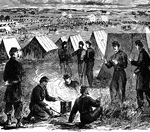
"Camp Zagonyi, encampment of Fremont's army on the prairie, near Wheatland, Mo., October 14th, 1861. This spot, where Fremont's army rested after their first day's march from Tipton, is on the vast prairies of Missouri, about fifteen miles from Tipton and two miles from Wheatland. The Grand Army of the West here pitched their tents on the afternoon of the 14th of October, 1861. A brilliant sunset fell over the whole, which looked more like a monster picnic than the advanced corps of an army bent on the destruction of traitorous brothers. The rapidity with which the evening's meal for a marching regiment is prepared has something of the marvelous in it. Appetite quickens practice, and the air is soon filled with the savory aromas of culinary processes. Then comes the hearty enjoyment of food which at another time would be passed by, but which now, under the appetizing provocative of hunger, is thankfully received. Not the least of a soldier's trials is the inroad a long march and privation makes upon that fastidiousness which plenty to eat engenders in the human diaphragm. The camp was called after the colonel of General Fremont's bodyguard, whose gallant achievements at Springfield on the 25th of October we have recorded." —Leslie, 1896

Camp Zagonyi

"Camp Zagonyi, encampment of Fremont's army on the prairie, near Wheatland, Mo., October 14th, 1861.…

"Siege of Petersburg- the Ninth Corps charging on the enemy's works after the explosion of the mine, July 30th, 1864. Immediately after the explosion of the mine a hundred cannons opened along the Federal front, and at half-past five the Ninth Corps charged, carrying the fort with a part of the line on each side. The Second Division, which was in the centre, advanced and carried the second line a short distance beyond the fort, and rested, holding ground with the utmost determination. It was at the time the [African American] Division, under General White, was pushed forward and ordered to charge and carry the crest of the hill, which would have decided the contest. The troops advanced in good order as far as the first line, where they received a galling fire, which checked them, and although quite a number kept on advancing, the greater number seemed to become utterly demoralized, part taking refuge in the fort, and the remainder running to the rear as fast as possible. They were rallied and again pushed forward, but without success, the greater part of the officers being killed or wounded."— Frank Leslie, 1896

Siege of Petersburg

"Siege of Petersburg- the Ninth Corps charging on the enemy's works after the explosion of the mine,…
"Siege of Petersburg- the Ninth Corps charging on the enemy's works after the explosion of the mine, July 30th, 1864. Immediately after the explosion of the mine a hundred cannons opened along the Federal front, and at half-past five the Ninth Corps charged, carrying the fort with a part of the line on each side. The Second Division, which was in the centre, advanced and carried the second line a short distance beyond the fort, and rested, holding ground with the utmost determination. It was at the time the [African American] Division, under General White, was pushed forward and ordered to charge and carry the crest of the hill, which would have decided the contest. The troops advanced in good order as far as the first line, where they received a galling fire, which checked them, and although quite a number kept on advancing, the greater number seemed to become utterly demoralized, part taking refuge in the fort, and the remainder running to the rear as fast as possible. They were rallied and again pushed forward, but without success, the greater part of the officers being killed or wounded."— Frank Leslie, 1896

Siege of Petersburg

"Siege of Petersburg- the Ninth Corps charging on the enemy's works after the explosion of the mine,…

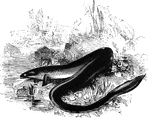
"These have an elongated form, and a soft, thick, slimy skin; the scales are very minute, and imbedded in the thick, fat, cuticle so as only to be seen when this is dried. The gill orifices are small, and cartried far back, so that the branchiae are protected, on which account these animals can live a considerable time out of water. They are averse to cold and are not found in high northern countries." — Goodrich, 1859

Common European Eel

"These have an elongated form, and a soft, thick, slimy skin; the scales are very minute, and imbedded…
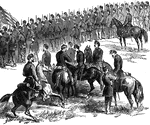
"Battle of Malvern Hill, near Turkey Bend, James River, Va., fought Tuesday, July 1st, 1862. The battle of Malvern Hill commenced with the advance of a large body of Confederates, extending quite across the country, with cavalry on each flank. The Federals at once jumped up wearily, and waited their appraoch, while all the signal officers, on their several stations, waved their cabalistic muslin. The Federal column was formed with General Couch, of General Keyes's corps, on the extreme left; Franklin and Heintzelman took up the centre, and on the right were the remnants of Porter and Sumner. Burns's brigade, being ordered to charge, advanced with the sixty-ninth Pennsylvania Regiment (Irish), Colonel Owen, and being gallantly seconded by Dana's, Meagher's and French's brigades, they dashed within fifty yards of the enemy and opened a splendid fire of musketry. The left of the line was now advanced, and the troops of General Couch really behaved wonderfully, facing the enemy wherever he appeared, and pouring volleys into him all the time. After fighting two hours, with a loss of about 400, the night fell, and having moved across Turkey Island Creek, they broke up the bridge, and soon the whole army closed up at and near Harrison's Bar, twenty-seven miles from Richmond." —Leslie, 1896

Battle of Malvern Hill

"Battle of Malvern Hill, near Turkey Bend, James River, Va., fought Tuesday, July 1st, 1862. The battle…
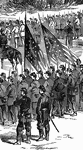
"Battle of Malvern Hill, near Turkey Bend, James River, Va., fought Tuesday, July 1st, 1862. The battle of Malvern Hill commenced with the advance of a large body of Confederates, extending quite across the country, with cavalry on each flank. The Federals at once jumped up wearily, and waited their appraoch, while all the signal officers, on their several stations, waved their cabalistic muslin. The Federal column was formed with General Couch, of General Keyes's corps, on the extreme left; Franklin and Heintzelman took up the centre, and on the right were the remnants of Porter and Sumner. Burns's brigade, being ordered to charge, advanced with the sixty-ninth Pennsylvania Regiment (Irish), Colonel Owen, and being gallantly seconded by Dana's, Meagher's and French's brigades, they dashed within fifty yards of the enemy and opened a splendid fire of musketry. The left of the line was now advanced, and the troops of General Couch really behaved wonderfully, facing the enemy wherever he appeared, and pouring volleys into him all the time. After fighting two hours, with a loss of about 400, the night fell, and having moved across Turkey Island Creek, they broke up the bridge, and soon the whole army closed up at and near Harrison's Bar, twenty-seven miles from Richmond." —Leslie, 1896

Battle of Malvern Hill

"Battle of Malvern Hill, near Turkey Bend, James River, Va., fought Tuesday, July 1st, 1862. The battle…
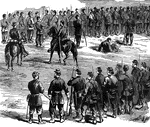
"Battle of Malvern Hill, near Turkey Bend, James River, Va., fought Tuesday, July 1st, 1862. The battle of Malvern Hill commenced with the advance of a large body of Confederates, extending quite across the country, with cavalry on each flank. The Federals at once jumped up wearily, and waited their appraoch, while all the signal officers, on their several stations, waved their cabalistic muslin. The Federal column was formed with General Couch, of General Keyes's corps, on the extreme left; Franklin and Heintzelman took up the centre, and on the right were the remnants of Porter and Sumner. Burns's brigade, being ordered to charge, advanced with the sixty-ninth Pennsylvania Regiment (Irish), Colonel Owen, and being gallantly seconded by Dana's, Meagher's and French's brigades, they dashed within fifty yards of the enemy and opened a splendid fire of musketry. The left of the line was now advanced, and the troops of General Couch really behaved wonderfully, facing the enemy wherever he appeared, and pouring volleys into him all the time. After fighting two hours, with a loss of about 400, the night fell, and having moved across Turkey Island Creek, they broke up the bridge, and soon the whole army closed up at and near Harrison's Bar, twenty-seven miles from Richmond." —Leslie, 1896

Battle of Malvern Hill

"Battle of Malvern Hill, near Turkey Bend, James River, Va., fought Tuesday, July 1st, 1862. The battle…
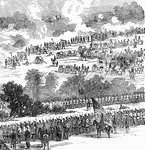
"Battle of Malvern Hill, near Turkey Bend, James River, Va., fought Tuesday, July 1st, 1862. The battle of Malvern Hill commenced with the advance of a large body of Confederates, extending quite across the country, with cavalry on each flank. The Federals at once jumped up wearily, and waited their appraoch, while all the signal officers, on their several stations, waved their cabalistic muslin. The Federal column was formed with General Couch, of General Keyes's corps, on the extreme left; Franklin and Heintzelman took up the centre, and on the right were the remnants of Porter and Sumner. Burns's brigade, being ordered to charge, advanced with the sixty-ninth Pennsylvania Regiment (Irish), Colonel Owen, and being gallantly seconded by Dana's, Meagher's and French's brigades, they dashed within fifty yards of the enemy and opened a splendid fire of musketry. The left of the line was now advanced, and the troops of General Couch really behaved wonderfully, facing the enemy wherever he appeared, and pouring volleys into him all the time. After fighting two hours, with a loss of about 400, the night fell, and having moved across Turkey Island Creek, they broke up the bridge, and soon the whole army closed up at and near Harrison's Bar, twenty-seven miles from Richmond." —Leslie, 1896

Battle of Malvern Hill

"Battle of Malvern Hill, near Turkey Bend, James River, Va., fought Tuesday, July 1st, 1862. The battle…
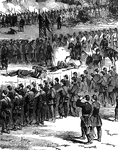
"Battle of Malvern Hill, near Turkey Bend, James River, Va., fought Tuesday, July 1st, 1862. The battle of Malvern Hill commenced with the advance of a large body of Confederates, extending quite across the country, with cavalry on each flank. The Federals at once jumped up wearily, and waited their appraoch, while all the signal officers, on their several stations, waved their cabalistic muslin. The Federal column was formed with General Couch, of General Keyes's corps, on the extreme left; Franklin and Heintzelman took up the centre, and on the right were the remnants of Porter and Sumner. Burns's brigade, being ordered to charge, advanced with the sixty-ninth Pennsylvania Regiment (Irish), Colonel Owen, and being gallantly seconded by Dana's, Meagher's and French's brigades, they dashed within fifty yards of the enemy and opened a splendid fire of musketry. The left of the line was now advanced, and the troops of General Couch really behaved wonderfully, facing the enemy wherever he appeared, and pouring volleys into him all the time. After fighting two hours, with a loss of about 400, the night fell, and having moved across Turkey Island Creek, they broke up the bridge, and soon the whole army closed up at and near Harrison's Bar, twenty-seven miles from Richmond." —Leslie, 1896

Battle of Malvern Hill

"Battle of Malvern Hill, near Turkey Bend, James River, Va., fought Tuesday, July 1st, 1862. The battle…
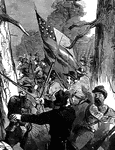
"Gallant attack by 150 of the Pennsylvania Bucktails, led by Colonel Kane, upon a portion of General Stonewall Jackson's Confederate Army, stronly posted in the woods, near Harrisonburg, Friday, June 6th, 1862. We illustrate one of the most heroic actions of the war, the attack of the famous Bucktails, under their gallant leader, Colonel Krane, upon a large portion of Stonewall Jackson's army, consisting of infantry, cavalry and artillery. The spot where this deadly conflict took place was about a mile and a half beyond Harrisonburg, on the road to Port Republic, toward which place the Confederates were in full retreat, closely but warily pursued by Generals Fremont and Shields. On Friday, June 6th, Colonel Sir Percy Wyndham, of the First New Jersey Cavalry, having been sent by General Bayard to reconnoitre, was led into an ambuscade, where his regiment was fearfully cut up, and himself wounded and taken prisoner. It will be seen that the humanity of Colonel Krane led him into a similar trap. News of what had occurred was rapidly transmitted to headquarters, and General Bayard was ordered out with fresh cavalry and a battalion of Pennsylvania Bucktails. But the Sixtieth Ohio had already beaten back the bold Confederates. The evening was waxing late; General Fremont did not wish to bring on a general engagement at this hour, and the troops were ordered back. "But do not leave poor Wyndham on the field, and all the wounded," remonstrated brave Colonel Krane of the Bucktails. "Let me at 'em, general, with my Bucktails." "Just forty minutes I'll give you, colonel," said General Bayard, pulling out his watch. "Peep through the woods on our left, see what is in there, and out again when the time is up." In go the 150 at an opening in the pines; they were soon surrounded by a cordon of fire flashing from the muzzles of more than a thousand muskets; but not a sign, nor the shadow of a sign, of yielding. Their fire met the enemy's straight and unyielding as the blade of a matador. Oh for re-enforcements! But none came. The brave Bucktails were forcd to retreat across the fields of waving green, firing as they did so- but not the 150 that went in. The rest lie under the arching dome of the treacherous forest." — Frank Leslie, 1896

Attack at Harrisonburg

"Gallant attack by 150 of the Pennsylvania Bucktails, led by Colonel Kane, upon a portion of General…
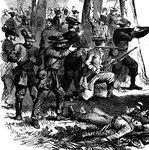
"Gallant attack by 150 of the Pennsylvania Bucktails, led by Colonel Kane, upon a portion of General Stonewall Jackson's Confederate Army, stronly posted in the woods, near Harrisonburg, Friday, June 6th, 1862. We illustrate one of the most heroic actions of the war, the attack of the famous Bucktails, under their gallant leader, Colonel Krane, upon a large portion of Stonewall Jackson's army, consisting of infantry, cavalry and artillery. The spot where this deadly conflict took place was about a mile and a half beyond Harrisonburg, on the road to Port Republic, toward which place the Confederates were in full retreat, closely but warily pursued by Generals Fremont and Shields. On Friday, June 6th, Colonel Sir Percy Wyndham, of the First New Jersey Cavalry, having been sent by General Bayard to reconnoitre, was led into an ambuscade, where his regiment was fearfully cut up, and himself wounded and taken prisoner. It will be seen that the humanity of Colonel Krane led him into a similar trap. News of what had occurred was rapidly transmitted to headquarters, and General Bayard was ordered out with fresh cavalry and a battalion of Pennsylvania Bucktails. But the Sixtieth Ohio had already beaten back the bold Confederates. The evening was waxing late; General Fremont did not wish to bring on a general engagement at this hour, and the troops were ordered back. "But do not leave poor Wyndham on the field, and all the wounded," remonstrated brave Colonel Krane of the Bucktails. "Let me at 'em, general, with my Bucktails." "Just forty minutes I'll give you, colonel," said General Bayard, pulling out his watch. "Peep through the woods on our left, see what is in there, and out again when the time is up." In go the 150 at an opening in the pines; they were soon surrounded by a cordon of fire flashing from the muzzles of more than a thousand muskets; but not a sign, nor the shadow of a sign, of yielding. Their fire met the enemy's straight and unyielding as the blade of a matador. Oh for re-enforcements! But none came. The brave Bucktails were forcd to retreat across the fields of waving green, firing as they did so- but not the 150 that went in. The rest lie under the arching dome of the treacherous forest." — Frank Leslie, 1896

Attack at Harrisonburg

"Gallant attack by 150 of the Pennsylvania Bucktails, led by Colonel Kane, upon a portion of General…
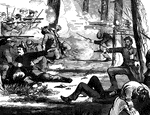
"Gallant attack by 150 of the Pennsylvania Bucktails, led by Colonel Kane, upon a portion of General Stonewall Jackson's Confederate Army, stronly posted in the woods, near Harrisonburg, Friday, June 6th, 1862. We illustrate one of the most heroic actions of the war, the attack of the famous Bucktails, under their gallant leader, Colonel Krane, upon a large portion of Stonewall Jackson's army, consisting of infantry, cavalry and artillery. The spot where this deadly conflict took place was about a mile and a half beyond Harrisonburg, on the road to Port Republic, toward which place the Confederates were in full retreat, closely but warily pursued by Generals Fremont and Shields. On Friday, June 6th, Colonel Sir Percy Wyndham, of the First New Jersey Cavalry, having been sent by General Bayard to reconnoitre, was led into an ambuscade, where his regiment was fearfully cut up, and himself wounded and taken prisoner. It will be seen that the humanity of Colonel Krane led him into a similar trap. News of what had occurred was rapidly transmitted to headquarters, and General Bayard was ordered out with fresh cavalry and a battalion of Pennsylvania Bucktails. But the Sixtieth Ohio had already beaten back the bold Confederates. The evening was waxing late; General Fremont did not wish to bring on a general engagement at this hour, and the troops were ordered back. "But do not leave poor Wyndham on the field, and all the wounded," remonstrated brave Colonel Krane of the Bucktails. "Let me at 'em, general, with my Bucktails." "Just forty minutes I'll give you, colonel," said General Bayard, pulling out his watch. "Peep through the woods on our left, see what is in there, and out again when the time is up." In go the 150 at an opening in the pines; they were soon surrounded by a cordon of fire flashing from the muzzles of more than a thousand muskets; but not a sign, nor the shadow of a sign, of yielding. Their fire met the enemy's straight and unyielding as the blade of a matador. Oh for re-enforcements! But none came. The brave Bucktails were forcd to retreat across the fields of waving green, firing as they did so- but not the 150 that went in. The rest lie under the arching dome of the treacherous forest." — Frank Leslie, 1896

Attack at Harrisonburg

"Gallant attack by 150 of the Pennsylvania Bucktails, led by Colonel Kane, upon a portion of General…
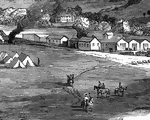
"Village of Clarksburg, Western Virginia, headquarters of General Rosecrans. Clarksburg, a post village, capital of Harrison County, is situated on the west fork of the Monongahela River, at the mouth of Elk Creek, about two hundred and twenty miles northwest of Richmond. It is built on a high tableland environed by hills. It had in 1861 several churches, academies, two printing offices and many fine stores. Stove coal abounded in its vicinity. The Northwestern Railroad, a branch of the Baltimore and Ohio, passed through it. It has about two thousand inhabitants. For a short time Clarksburg was the headquarters of General Rosecrans. The situation was briefly this: The Cheat Mountain Gaps, the key to the whole country, were held by a strong force, a portion of General Reynolds's brigade, the remainder of which was stationed at Bevery, Huttonsville, and in that vicinity. Other portions of General Rosecrans's command were scattered over almost the whole northwestern part of Virginia, guarding the railroad lines from Wheeling and Parkersburg down to Grafton, and then eastward through the Cheat River country, Oakland, Altamont, and almost to Cumberland, occupying the Kanawha Valley by General Cox's brigade, and holding towns like Weston, Buckhannon, Summerville, Philippi and Bealington." —Leslie, 1896

Village of Clarksburg

"Village of Clarksburg, Western Virginia, headquarters of General Rosecrans. Clarksburg, a post village,…
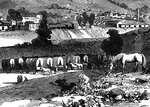
"Village of Clarksburg, Western Virginia, headquarters of General Rosecrans. Clarksburg, a post village, capital of Harrison County, is situated on the west fork of the Monongahela River, at the mouth of Elk Creek, about two hundred and twenty miles northwest of Richmond. It is built on a high tableland environed by hills. It had in 1861 several churches, academies, two printing offices and many fine stores. Stove coal abounded in its vicinity. The Northwestern Railroad, a branch of the Baltimore and Ohio, passed through it. It has about two thousand inhabitants. For a short time Clarksburg was the headquarters of General Rosecrans. The situation was briefly this: The Cheat Mountain Gaps, the key to the whole country, were held by a strong force, a portion of General Reynolds's brigade, the remainder of which was stationed at Bevery, Huttonsville, and in that vicinity. Other portions of General Rosecrans's command were scattered over almost the whole northwestern part of Virginia, guarding the railroad lines from Wheeling and Parkersburg down to Grafton, and then eastward through the Cheat River country, Oakland, Altamont, and almost to Cumberland, occupying the Kanawha Valley by General Cox's brigade, and holding towns like Weston, Buckhannon, Summerville, Philippi and Bealington." —Leslie, 1896

Village of Clarksburg

"Village of Clarksburg, Western Virginia, headquarters of General Rosecrans. Clarksburg, a post village,…
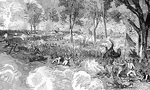
"Battle of Chancellorsville, Sunday, May 3rd, 1863. General Hooker repulsing the attack of the enemy. Early on May 3rd, Stuart renewed the attack upon Hooker's force, with the battle cry, 'Charge and remember Jackson!' and the advance was made with such impetuosity that in a short time he was in possession of the crest from which the Eleventh Corps had been driven the preceding day. No time was lost in crowning that eminence with all the heavy artillery obtainable, and as soon as this could be made to play upon the Federal lines a charge was successively ordered upon the position held by Generals Berry and French, both of whom were supported by the divisions of Williams and Whipple. After a severe struggle the Confederates succeeded in capturing the high ground where the Federals had posted some more heavy artillery, and in turning the latter upon the Federals, who soon had to fall back to their second and third lines of intrenchments. The Confederates followed close upon them, and made charge after charge in order to capture the new positions, but unayailingly and when re-enforcements arrived from Meade's corps they were forced to abadon the attack."— Frank Leslie, 1896

Battle of Chancellorsville

"Battle of Chancellorsville, Sunday, May 3rd, 1863. General Hooker repulsing the attack of the enemy.…
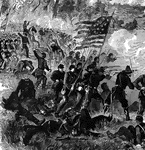
"Battle of Chancellorsville, Sunday, May 3rd, 1863. General Hooker repulsing the attack of the enemy. Early on May 3rd, Stuart renewed the attack upon Hooker's force, with the battle cry, 'Charge and remember Jackson!' and the advance was made with such impetuosity that in a short time he was in possession of the crest from which the Eleventh Corps had been driven the preceding day. No time was lost in crowning that eminence with all the heavy artillery obtainable, and as soon as this could be made to play upon the Federal lines a charge was successively ordered upon the position held by Generals Berry and French, both of whom were supported by the divisions of Williams and Whipple. After a severe struggle the Confederates succeeded in capturing the high ground where the Federals had posted some more heavy artillery, and in turning the latter upon the Federals, who soon had to fall back to their second and third lines of intrenchments. The Confederates followed close upon them, and made charge after charge in order to capture the new positions, but unayailingly and when re-enforcements arrived from Meade's corps they were forced to abadon the attack."— Frank Leslie, 1896

Battle of Chancellorsville

"Battle of Chancellorsville, Sunday, May 3rd, 1863. General Hooker repulsing the attack of the enemy.…
"Battle of Chancellorsville, Sunday, May 3rd, 1863. General Hooker repulsing the attack of the enemy. Early on May 3rd, Stuart renewed the attack upon Hooker's force, with the battle cry, 'Charge and remember Jackson!' and the advance was made with such impetuosity that in a short time he was in possession of the crest from which the Eleventh Corps had been driven the preceding day. No time was lost in crowning that eminence with all the heavy artillery obtainable, and as soon as this could be made to play upon the Federal lines a charge was successively ordered upon the position held by Generals Berry and French, both of whom were supported by the divisions of Williams and Whipple. After a severe struggle the Confederates succeeded in capturing the high ground where the Federals had posted some more heavy artillery, and in turning the latter upon the Federals, who soon had to fall back to their second and third lines of intrenchments. The Confederates followed close upon them, and made charge after charge in order to capture the new positions, but unayailingly and when re-enforcements arrived from Meade's corps they were forced to abadon the attack."— Frank Leslie, 1896

Battle of Chancellorsville

"Battle of Chancellorsville, Sunday, May 3rd, 1863. General Hooker repulsing the attack of the enemy.…
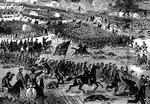
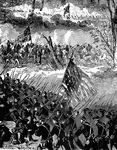
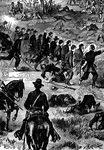
"Battle of Champion Hills, May 16th, 1863- the formidable position of General Pemberton carried by Generals Hovey, Logan and Crocker, of Grant's army. On the morning of the 16th of May, General A. P. Hovey's division, occupying the right of McClernand's corps, encountered the Confederate pickets, but no engagement took place until about eleven o'clock, when the Indiana troops, led by General McGinnis, made a deliberate attack upon the rapidly increasing force which Pemberton had brought together at Champion Hills. Two batteries which had been planted along a high ridge were doing considerable damage, and it was finally determined to assault them. They were both taken by the Eleventh and Forty-sixth Indiana and the Twenty-ninth Wisconsin, after a fierce hand-to-hand fight; but the arrival of fresh Confederate troops and the want of re-enforcements prevented their being held for any length of time. The Federals withdrew, and remained under cover of their artillery till joined by part of Quimby's late dvision, commanded by General Marcellus M. Crocker. Another advance was then ordered, and while Pemberton's right was thus engaged Logan's division attacked his left, and succeeded in flanking and in forcing it back in such manner as to completely isolate for awhile the whole of General Loring's brigade, which occupied the extreme Confederate right. The attack was so fierce that Stevenson's line became completely demoralized, yielded in turn, and by four o'clock the Confederates were in full retreat toward the Big Black River. Just then the other division of McClernand's corps came upon the scene, and a pursuit was ordered by Generals Carr and Osterhaus. This lasted until dark, and resulted in the capture of many prisoners and arms of all descriptions. The total loss in killed and wounded on both sides approximated to 4,000."— Frank Leslie, 1896

Battle of Champion Hills

"Battle of Champion Hills, May 16th, 1863- the formidable position of General Pemberton carried by Generals…
"Battle of Champion Hills, May 16th, 1863- the formidable position of General Pemberton carried by Generals Hovey, Logan and Crocker, of Grant's army. On the morning of the 16th of May, General A. P. Hovey's division, occupying the right of McClernand's corps, encountered the Confederate pickets, but no engagement took place until about eleven o'clock, when the Indiana troops, led by General McGinnis, made a deliberate attack upon the rapidly increasing force which Pemberton had brought together at Champion Hills. Two batteries which had been planted along a high ridge were doing considerable damage, and it was finally determined to assault them. They were both taken by the Eleventh and Forty-sixth Indiana and the Twenty-ninth Wisconsin, after a fierce hand-to-hand fight; but the arrival of fresh Confederate troops and the want of re-enforcements prevented their being held for any length of time. The Federals withdrew, and remained under cover of their artillery till joined by part of Quimby's late dvision, commanded by General Marcellus M. Crocker. Another advance was then ordered, and while Pemberton's right was thus engaged Logan's division attacked his left, and succeeded in flanking and in forcing it back in such manner as to completely isolate for awhile the whole of General Loring's brigade, which occupied the extreme Confederate right. The attack was so fierce that Stevenson's line became completely demoralized, yielded in turn, and by four o'clock the Confederates were in full retreat toward the Big Black River. Just then the other division of McClernand's corps came upon the scene, and a pursuit was ordered by Generals Carr and Osterhaus. This lasted until dark, and resulted in the capture of many prisoners and arms of all descriptions. The total loss in killed and wounded on both sides approximated to 4,000."— Frank Leslie, 1896

Battle of Champion Hills

"Battle of Champion Hills, May 16th, 1863- the formidable position of General Pemberton carried by Generals…
"Battle of Champion Hills, May 16th, 1863- the formidable position of General Pemberton carried by Generals Hovey, Logan and Crocker, of Grant's army. On the morning of the 16th of May, General A. P. Hovey's division, occupying the right of McClernand's corps, encountered the Confederate pickets, but no engagement took place until about eleven o'clock, when the Indiana troops, led by General McGinnis, made a deliberate attack upon the rapidly increasing force which Pemberton had brought together at Champion Hills. Two batteries which had been planted along a high ridge were doing considerable damage, and it was finally determined to assault them. They were both taken by the Eleventh and Forty-sixth Indiana and the Twenty-ninth Wisconsin, after a fierce hand-to-hand fight; but the arrival of fresh Confederate troops and the want of re-enforcements prevented their being held for any length of time. The Federals withdrew, and remained under cover of their artillery till joined by part of Quimby's late dvision, commanded by General Marcellus M. Crocker. Another advance was then ordered, and while Pemberton's right was thus engaged Logan's division attacked his left, and succeeded in flanking and in forcing it back in such manner as to completely isolate for awhile the whole of General Loring's brigade, which occupied the extreme Confederate right. The attack was so fierce that Stevenson's line became completely demoralized, yielded in turn, and by four o'clock the Confederates were in full retreat toward the Big Black River. Just then the other division of McClernand's corps came upon the scene, and a pursuit was ordered by Generals Carr and Osterhaus. This lasted until dark, and resulted in the capture of many prisoners and arms of all descriptions. The total loss in killed and wounded on both sides approximated to 4,000."— Frank Leslie, 1896

Battle of Champion Hills

"Battle of Champion Hills, May 16th, 1863- the formidable position of General Pemberton carried by Generals…
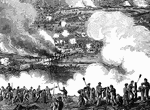
"Battle of White Oak Swamp Bridge, Monday June 30th, 1862- Ayres's, Mott's and Randall's batteries checking the advance of the Confederates. After the battle of Savage's Station the Federals continued on their retreat, and by eight o'clock on the morning of June 30th, 1862, they had crossed White Oak Swamp and Creek, after destroying the bridge over the latter and warding off the repeated attacks to which they were subjected throughout the night. After crossing White Oak Creek the Federals had quickly formed a new line of battle at Willis Church, General Hancock's forces being on the extreme right, while Porter's occupied the left, and Heintzelman's and Sumner's the intervening space. Jackson's advance was checked by the destruction of the bridge, and when he reached the creek, at about noon, he found the approaches well defended by artillery. Jackson opened upon Hancock's troops, and made repeated efforts to rebuild the bridge under cover of his heavy artillery, but he was every time repulsed. While this was going on Longstreet and Hill had come upon a Federal force at a place two miles away, called Frazier's Farm. Here stood Sumner and Hooker, on the extreme right, McCall somewhat in advance toward the centre and Kearny on the extreme left. When Longstreet found this force arrayed against him he waited for re-enforcements to come up, and it was four o'clock when he commenced the attack. McCall's left was first assailed by Kenper's brigade, which was met by the Pennsylvania Reserves under Colonel Simmons, who, after a bitter conflict, drove the Confederates into the woods with a loss of 250 killed and wounded and about 200 prisoners. Fresh troops then enabled the Confederates to drive back the Federals, who in turn lost heavily. Longstreet and Hill now pressed on, and the conflict became a severe one along the entire front. One point, then another, was vainly tried in the determined effort to break the Federal line. At length Wilcox's Alabama Brigade rushed across an open field upon McCall's left, directly against Randall's battery, which centered upon the Confederates a most galling fire. Nothing daunted, they moved on, and finally engaging in a desperate hand-to-hand fight, first captured Cooper's battery, and afterward Randall's battery, which had been doing such terrible execution. A charge was then ordered for the recapture of the guns. The Confederates bravely met the severe attacks that followed. A still more desperate hand-to-hand struggle took place for the possession of the lost batteries, which were finally recaptured. By dark the Confederates had retired into the woods, and the Federals remained on that portion of the field which they had lost earlier in the action. The Federal loss was about 1,800 killed and wounded, whilst that of the Confederates was over 2,000. Colonel Simmons and General Meade were both severely wounded, while General McCall was a made prisoner." —Leslie, 1896

Battle of White Oak Swamp Bridge

"Battle of White Oak Swamp Bridge, Monday June 30th, 1862- Ayres's, Mott's and Randall's batteries checking…
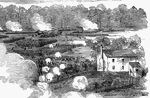
"Battle of White Oak Swamp Bridge, Monday June 30th, 1862- Ayres's, Mott's and Randall's batteries checking the advance of the Confederates. After the battle of Savage's Station the Federals continued on their retreat, and by eight o'clock on the morning of June 30th, 1862, they had crossed White Oak Swamp and Creek, after destroying the bridge over the latter and warding off the repeated attacks to which they were subjected throughout the night. After crossing White Oak Creek the Federals had quickly formed a new line of battle at Willis Church, General Hancock's forces being on the extreme right, while Porter's occupied the left, and Heintzelman's and Sumner's the intervening space. Jackson's advance was checked by the destruction of the bridge, and when he reached the creek, at about noon, he found the approaches well defended by artillery. Jackson opened upon Hancock's troops, and made repeated efforts to rebuild the bridge under cover of his heavy artillery, but he was every time repulsed. While this was going on Longstreet and Hill had come upon a Federal force at a place two miles away, called Frazier's Farm. Here stood Sumner and Hooker, on the extreme right, McCall somewhat in advance toward the centre and Kearny on the extreme left. When Longstreet found this force arrayed against him he waited for re-enforcements to come up, and it was four o'clock when he commenced the attack. McCall's left was first assailed by Kenper's brigade, which was met by the Pennsylvania Reserves under Colonel Simmons, who, after a bitter conflict, drove the Confederates into the woods with a loss of 250 killed and wounded and about 200 prisoners. Fresh troops then enabled the Confederates to drive back the Federals, who in turn lost heavily. Longstreet and Hill now pressed on, and the conflict became a severe one along the entire front. One point, then another, was vainly tried in the determined effort to break the Federal line. At length Wilcox's Alabama Brigade rushed across an open field upon McCall's left, directly against Randall's battery, which centered upon the Confederates a most galling fire. Nothing daunted, they moved on, and finally engaging in a desperate hand-to-hand fight, first captured Cooper's battery, and afterward Randall's battery, which had been doing such terrible execution. A charge was then ordered for the recapture of the guns. The Confederates bravely met the severe attacks that followed. A still more desperate hand-to-hand struggle took place for the possession of the lost batteries, which were finally recaptured. By dark the Confederates had retired into the woods, and the Federals remained on that portion of the field which they had lost earlier in the action. The Federal loss was about 1,800 killed and wounded, whilst that of the Confederates was over 2,000. Colonel Simmons and General Meade were both severely wounded, while General McCall was a made prisoner." —Leslie, 1896

Battle of White Oak Swamp Bridge

"Battle of White Oak Swamp Bridge, Monday June 30th, 1862- Ayres's, Mott's and Randall's batteries checking…
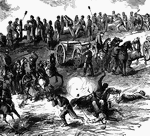
"Battle of White Oak Swamp Bridge, Monday June 30th, 1862- Ayres's, Mott's and Randall's batteries checking the advance of the Confederates. After the battle of Savage's Station the Federals continued on their retreat, and by eight o'clock on the morning of June 30th, 1862, they had crossed White Oak Swamp and Creek, after destroying the bridge over the latter and warding off the repeated attacks to which they were subjected throughout the night. After crossing White Oak Creek the Federals had quickly formed a new line of battle at Willis Church, General Hancock's forces being on the extreme right, while Porter's occupied the left, and Heintzelman's and Sumner's the intervening space. Jackson's advance was checked by the destruction of the bridge, and when he reached the creek, at about noon, he found the approaches well defended by artillery. Jackson opened upon Hancock's troops, and made repeated efforts to rebuild the bridge under cover of his heavy artillery, but he was every time repulsed. While this was going on Longstreet and Hill had come upon a Federal force at a place two miles away, called Frazier's Farm. Here stood Sumner and Hooker, on the extreme right, McCall somewhat in advance toward the centre and Kearny on the extreme left. When Longstreet found this force arrayed against him he waited for re-enforcements to come up, and it was four o'clock when he commenced the attack. McCall's left was first assailed by Kenper's brigade, which was met by the Pennsylvania Reserves under Colonel Simmons, who, after a bitter conflict, drove the Confederates into the woods with a loss of 250 killed and wounded and about 200 prisoners. Fresh troops then enabled the Confederates to drive back the Federals, who in turn lost heavily. Longstreet and Hill now pressed on, and the conflict became a severe one along the entire front. One point, then another, was vainly tried in the determined effort to break the Federal line. At length Wilcox's Alabama Brigade rushed across an open field upon McCall's left, directly against Randall's battery, which centered upon the Confederates a most galling fire. Nothing daunted, they moved on, and finally engaging in a desperate hand-to-hand fight, first captured Cooper's battery, and afterward Randall's battery, which had been doing such terrible execution. A charge was then ordered for the recapture of the guns. The Confederates bravely met the severe attacks that followed. A still more desperate hand-to-hand struggle took place for the possession of the lost batteries, which were finally recaptured. By dark the Confederates had retired into the woods, and the Federals remained on that portion of the field which they had lost earlier in the action. The Federal loss was about 1,800 killed and wounded, whilst that of the Confederates was over 2,000. Colonel Simmons and General Meade were both severely wounded, while General McCall was a made prisoner." —Leslie, 1896

Battle of White Oak Swamp Bridge

"Battle of White Oak Swamp Bridge, Monday June 30th, 1862- Ayres's, Mott's and Randall's batteries checking…
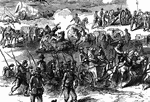
"Battle of White Oak Swamp Bridge, Monday June 30th, 1862- Ayres's, Mott's and Randall's batteries checking the advance of the Confederates. After the battle of Savage's Station the Federals continued on their retreat, and by eight o'clock on the morning of June 30th, 1862, they had crossed White Oak Swamp and Creek, after destroying the bridge over the latter and warding off the repeated attacks to which they were subjected throughout the night. After crossing White Oak Creek the Federals had quickly formed a new line of battle at Willis Church, General Hancock's forces being on the extreme right, while Porter's occupied the left, and Heintzelman's and Sumner's the intervening space. Jackson's advance was checked by the destruction of the bridge, and when he reached the creek, at about noon, he found the approaches well defended by artillery. Jackson opened upon Hancock's troops, and made repeated efforts to rebuild the bridge under cover of his heavy artillery, but he was every time repulsed. While this was going on Longstreet and Hill had come upon a Federal force at a place two miles away, called Frazier's Farm. Here stood Sumner and Hooker, on the extreme right, McCall somewhat in advance toward the centre and Kearny on the extreme left. When Longstreet found this force arrayed against him he waited for re-enforcements to come up, and it was four o'clock when he commenced the attack. McCall's left was first assailed by Kenper's brigade, which was met by the Pennsylvania Reserves under Colonel Simmons, who, after a bitter conflict, drove the Confederates into the woods with a loss of 250 killed and wounded and about 200 prisoners. Fresh troops then enabled the Confederates to drive back the Federals, who in turn lost heavily. Longstreet and Hill now pressed on, and the conflict became a severe one along the entire front. One point, then another, was vainly tried in the determined effort to break the Federal line. At length Wilcox's Alabama Brigade rushed across an open field upon McCall's left, directly against Randall's battery, which centered upon the Confederates a most galling fire. Nothing daunted, they moved on, and finally engaging in a desperate hand-to-hand fight, first captured Cooper's battery, and afterward Randall's battery, which had been doing such terrible execution. A charge was then ordered for the recapture of the guns. The Confederates bravely met the severe attacks that followed. A still more desperate hand-to-hand struggle took place for the possession of the lost batteries, which were finally recaptured. By dark the Confederates had retired into the woods, and the Federals remained on that portion of the field which they had lost earlier in the action. The Federal loss was about 1,800 killed and wounded, whilst that of the Confederates was over 2,000. Colonel Simmons and General Meade were both severely wounded, while General McCall was a made prisoner." —Leslie, 1896

Battle of White Oak Swamp Bridge

"Battle of White Oak Swamp Bridge, Monday June 30th, 1862- Ayres's, Mott's and Randall's batteries checking…
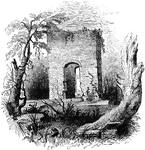
"Ruins at Jamestown. This view is from the old church-yard, looking toward James River, a glimpse of which may be seen through the arches. The stream is here about three miles wide. It is uncertain at what precise time the church, of which now only a portion of the tower remains, was erected. It ws probably built sometime between 1617 and 1620. According to Smith, a fire consumed a large portion of the town, with the palisades, at about the close of 1607, the first year of the settlement. Captain Smith and Mr. Scrivener were appointed commissioners to superintend the rebuilding of the town and church. Afterward, in speaking of the arrival of Governor Argall in 1617, he says, 'In James towne he found but five or six houses, the church downe, the pallizados broken, the bridge in pieces, the well of fresh water spoiled, the store-house used for the church.' The tower here represented was doubtless of the third church built, and is now (1852) about 234 years old. The tower is now about thirty feet high, the walls three feet thick, all of imported brick."—Lossing, 1851

Jamestown Ruins

"Ruins at Jamestown. This view is from the old church-yard, looking toward James River, a glimpse of…
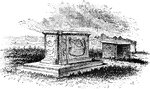
"The Nelson Tombs. This view is from the burial-ground looking down the York River toward Chesapeake Bay. The inscription upon the first monument is in Latin; the following is a translation of it: 'Here lies, in certain hope of a resurrection in Christ, Thomas Nelson, gentleman, son of Hugo and Sarah Nelson, of Penrith, in the county of Cumberland; born February 20th, A. D. 1677, died October 7th, 1745, aged sixty-eight years.' The inscription upon the second monument is much longer, and quite eulogistic. William Nelson was president of his majesty's council in Virginia, and died on the nineteenth of November, 1772, at the age of sixty-one years. No epitaph tells of the many virtues and heroic deeds of him who lies in the obscure vault beyond. History has written them upon the enduring pages of the chronicles of our republic; and in this work his biography and portrait may be found among those of the signers of the Delcaration of Independence."—Lossing, 1851

Nelson Tombs

"The Nelson Tombs. This view is from the burial-ground looking down the York River toward Chesapeake…
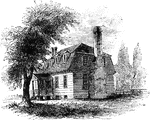
"This is a view from the lawn, looking south. It is a frame building with a brick foundation. At the time of the siege it belonged in fee to Governor Nelson, but its occupant, a widow Moore, had a life interest in it, and it was known as Moore's house. The narrow piazza in front is a modern addition. This house is upon the Temple Farm, so called from the fact that vestiges of a small temple or church, and the remains of an ancient settlement, are there seen, about a mile and a half south of Yorktown. Around the temple was a wall, and within are several tomb-stones. One of these bear the name of Major William Gooch, and the date of his death, 1655."—Lossing, 1851

Moore's House

"This is a view from the lawn, looking south. It is a frame building with a brick foundation. At the…
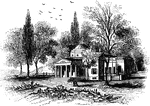
"Monticello, Governor Jefferson's place of retirement. This venerated mansion is yet standing, though somewhat dilapidated and deprived of its former beauty by neglect. The furniture of its distinguished owner is nearly all gone, except a few pictures and mirrors, otherwise the interior of the house is the same as when Jefferson died. It is upon an eminence, with many aspen-trees around it, and commands a view of the Blue Ridge for one hundred and fifty miles on one side, and on the other one of the most beautiful and extensive landscapes in the world. Wirt, writing of the interior arrangements of the house during Mr. Jefferson's life time, records that, in the spacious and lofty hall which opens to the visitor on entering, 'he marks no tawdry and unmeaning ornaments; but before, on the right, on the left, all around, the eye is struck and gratified by objects of science and taste, so classed and arranged as to produce their finest effect."—Lossing, 1851

Monticello

"Monticello, Governor Jefferson's place of retirement. This venerated mansion is yet standing, though…
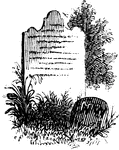
"Woodhull's Grave. Nathaniel Woodhull was born at Mastic, Long Island, December 30, 1722. Agriculture was the chief pursuit of his life. He was a major, under Abercrombie, in the attack upon Crown Point and Ticonderoga, and afterward accompanied Bradstreet against Fort Frontenac. He was a colonel, under Amherst, in 1760, and at the close of the campaign he returned home and married Ruth Floyd. He espoused the popular side in the Stamp Act movements, and, possessing the esteem of the people, he was elected, with William Nicoll, a representative of Suffolk county, in the Colonial Assembly in 1769. He represented Suffolk in the first Provincial Congress in 1775, and was elected president of that body. He was appointed a brigadier of militia in August of that year, and in July, 1776, he was summoned home to embody the militia of Suffolk and Queens, to assist in repelling invasion. He was engaged in this service when he ws made a prisoner, cruelly wounded by a British officer, and died of his injuries three weeks afterward, at New Utrecht. His wife, who was with him in his last moments, conveyed his body to Mastic, and there, in a secluded family cemetary, a short distance from his residence, his remains rest. A marble slab marks his grave, and bears the following inscription: 'In memory of General Nathaniel Woodhull, who, wounded and a prisoner, died on the twentieth of September, 1776, in the fifty-fourth year of his age; regretted by all who knew how to value his many private virtues, and that pure zeal for the rights of his country to which he perished a victim.'"—Lossing, 1851

Woodhull's Grave

"Woodhull's Grave. Nathaniel Woodhull was born at Mastic, Long Island, December 30, 1722. Agriculture…

"In 1799, the Rosetta Stone was found and gave the first key to the reading of hieroglyphics. On this stone the same inscription was given in three different sets of characters, -the hieroglyphics, the demotic text (a briefer and more running form of hieroglyphics, commonly used in the papyri or manuscripts), and the Greek. By comparing the letters in certain Greek proper names with the letters of the same words in the Egyptian texts, the sounds for which the Egyptian characters stood were discovered. The Greek text, when translated, showed that the inscription was an ordinance of the priests decreeing certain honors to Ptolemy Epiphanes on the occasion of his coronation, 196 B.C. (Ptolemy Epiphanes was one of a line of Greek sovereigns who ruled over Egypt from the time of its conquest by Alexander in the fourth century, to the first century B.C.) It contains a command that the decree should be inscribed in the sacred letters (hieroglyphics), the letters of the country (demotic), and Greek letters, -and this for the convenience of the mixed population of Egypt under its Greek rulers. It was natural to conclude that the three texts were the same in substance, and accordingly earnest efforts were made to decipher the hieroglyphics by aid of the Greek. The first clew was obtained by noticing that certain groups of the hieroglyphic characters were inclosed in oval rings, and that these groups corresponded in relative position with certain proper names, such as Ptolemy, etc., in the Greek text. The following line presents a few of the characters with a group in the oval ring. (Each word is read from right to left)." —Colby, 1899

Excerpt from the Rosetta Stone

"In 1799, the Rosetta Stone was found and gave the first key to the reading of hieroglyphics. On this…
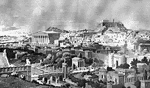
"Athens, in the time of Pericles."—Colby, 1899

Athens

"Athens, in the time of Pericles."—Colby, 1899

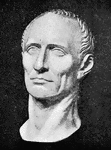
"Julius Caesar was the leader of the popular party, who in a few years was destined to prove himself the greatest of the Romans and one of the most remarkable men of all time."—Colby, 1899

Caesar

"Julius Caesar was the leader of the popular party, who in a few years was destined to prove himself…
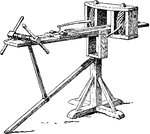
"Catapult from the Roman military system. The Roman army was divided into legions, each of which contained about 6,000 men, although at first the number was much smaller. Each legion was in turn subdivided into ten cohorts. Besides the legionary soldiers, the army comprised bodies of auxiliar troops from the provinces or the allies of Rome. The common weapons were the pilum, or javelin, and a short sword, but slings and bows were also used."—Colby, 1899

Catapult

"Catapult from the Roman military system. The Roman army was divided into legions, each of which contained…
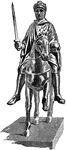
"Statue of Charlemagne, in Paris. At Pepin's death in 768 the kingdom of the Franks included the greater part of what is now France, together with a portion of Germany. This territory was divided between his two sons, Carloman and Charles, who ruled over it together for three years, until 771, when, by the death of Carloman, Charles became the sole ruler. Charles, or to give him the title by which he is best known, Charlemagne (that is, Charles the Great), is the greatest figure in the history of the Middle Ages, and one of the ablest rulers of all time. His reign is itself an epoch in history; for the work he did lived after him, and influenced the nations of Europe for centuries to come."—Colby, 1899

Charlemagne

"Statue of Charlemagne, in Paris. At Pepin's death in 768 the kingdom of the Franks included the greater…
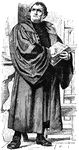
"Martin Luther was born at Eisleben in 1483. He was the son of a poor miner, had entered the Augustinian order, and had become professor of theology at Wittenberg. In the course of his studies he had come to question the practice of the Church in regard to the whole system of penance. Up to this time, however, he had made no open protest, but Tetzel's course in Germany impelled him to public opposition. In 1517 he nailed to the church door at Wittenberg ninety-five theses or propositions, appealing to men's consciences against the practice of 'selling forgiveness.' The widespread discontent in Germany gave to these theses an instant publicity. They were printed and scattered broadcast throughout the country. In them Luther showed no intention to break with the authority of the Roman Catholic Churrch. They were merely propositions for dispute, and he nailed them on the Church door as a challenge to any disuputant who might be willing to argue against them. disputants soon appeared, and the first thing they did was to appeal to the authority of the Church. This led Luther, at first, to question and finally to deny the authority of the Church, as resting not on a divine but on a human basis. He said that the Church was not the source of divine truth, and that the Bible was the sole source. The Reformation now entered on its first phase."—Colby, 1899

Martin Luther

"Martin Luther was born at Eisleben in 1483. He was the son of a poor miner, had entered the Augustinian…
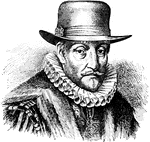
"William, Prince of Orange, called 'William the Silent,' was the natural leader of the Netherlands at this crisis, and he was chosen by Holland and Zealand as their governor. He was the determined foe of Spanish tyranny, and his strength of mind and farsighted statesmanship gave promise of success. Yet, for the little country of the Netherlands to stand out against the mighty power of Spain would have seemed fool-hardy, had it not been for the fact that the Protestants of Germany, England, and France could be relied upon for aid. In military strength and in the brilliancy of generals, Spain had greatly the advantage. her armies were commanded successively by the greatest soldiers of the time, -Don John of Austria (1576-1578) and after him Alexander Farnese, Duke of Parma. Against their skill was pitted the high courage and inflexible will of William, who, like our Washington, was greatest in the time of difficulty and defeat."—Colby, 1899

William the Silent

"William, Prince of Orange, called 'William the Silent,' was the natural leader of the Netherlands at…
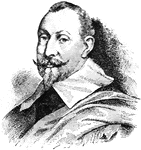
"Gustavus Adolphus entered Germany at the head of 16,000 men. Among some of the Protestants there was a reluctance to cooperate with this new ally; for they distrusted his motives, especially in regard to northern Germany, where it was known that he had dreams of making himself the master of the Baltic Sea. Nevertheless, many of the hesitating Protestants rallied to his side after the siege and sack of Magdeburg, in 1631. The taking of this city by the troops of Tilly was marked by the most brutal massacre and pillage. Women and children were murdered; and the town was burned to the ground. It is said that some 30,000 people perished at this time. Saxony now joined the side of the Swedish king, who, in 1631, encountered Tilly on the battlefield of Lepzig. Here Gustavus completely overthrew his enemy, and when Tilly again tried to check his advance into southern Germany, Gustavus won another battle, in which Tilly was slain. The successes of Gustavus led the emperor to restore Wallenstein to the command (1632), and Wallenstein accepted the leadership on condition that he was to have absolute control of the army."—Colby, 1899

Gustavus Adolphus

"Gustavus Adolphus entered Germany at the head of 16,000 men. Among some of the Protestants there was…
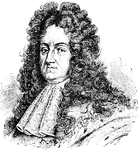
"The age of Louis XIV. during the reign of Louis XIV, the son and successor of Louis XIII (1643-1715), which lasted over seventy years, France was the leading nation of Europe. In some respects it was a brilliant period. The magnificence of the French court, the splendor of Paris, and the proud position of France in Europe were characteristics of the time. Literature flourished under the patronage of the court, and some of the greatest of the French writers lived in this reign. A striking characteristic of the time was the absolute belief of the subjects in the divine power of the king. Louis XIV was the most conspicuous type of an absolute monarch. He was the source of all power and glory."—Colby, 1899

Louis XIV

"The age of Louis XIV. during the reign of Louis XIV, the son and successor of Louis XIII (1643-1715),…
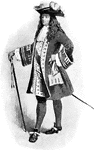
Costume of the time of Louis XIV.

Louis XIV

Costume of the time of Louis XIV.

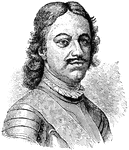
"Peter the Great. This prince is one of the most extraordinary figures in history. As a boy he showed a great eagerness for knowledge in departments which were not generally attractive to the members of royal families. He cared nothing for books, but took a keen interest in mechanical devices, in carpentering, and especially in the making and sailing of boats. He was impatient of discipline and opposition and showed at an early age serious defects of temper. In fact, except for his restless and inquisitive spirit, there was little about him to suggest the qualities which afterwards made him famous. His half-sister, Sophia, plotted against him, and at one time, through a palace revolution, his life was actually endagered. He was obliged to share the throne with his feeble-minded half-brother, and at first his position was insecure. In 1689, however, Peter, discovering the plots of Sophia, raised a party against her, took the power out of her hands, and shut her up in a convent. Ivan was wholly incompetent to rule, and from this time forth Peter, though now only seventeen years of age, ruled the state."—Colby, 1899

Peter the Great

"Peter the Great. This prince is one of the most extraordinary figures in history. As a boy he showed…
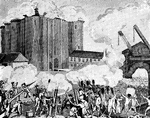
"The taking of the Bastile, July 14, 1789. The Parisian mob, not satisfied with the formation of the National Assembly, demanded to be armed in their own defense; and when this was refused, rushed off to seize the store of arms kept in the Hotel des Invalides. Angered by the report that the guns of the old prison of the Bastile were to be trained on the people, they suddenly gathered around its walls and began an attack. This ancient prison had been the scene of many oppressions in the past. Its foul dungeons and the sufferings of those who were confined there had made it an object of popular hatred. During Louis XVI's reign, however, it had fallen into disuse, and it can not be said that at that time it was worse than any other prison. Nevertheless, to the mob it still stood as the symbol of despotism. The governor of the prison surrendered, but the mob murdered him, together with some others, and carried the heads of their victims on pikes through the streets. The few prisoners that were within were set free. Although were was nothing especially heroic about the taking of the Bastile, the event was of great significance, for it seemed to say that a new age had begun. Throughout Europe it was looked upon as a triumph of the people over despotism, and by the liberals of all countries it was hailed with joy."—Colby, 1899

Bastile

"The taking of the Bastile, July 14, 1789. The Parisian mob, not satisfied with the formation of the…
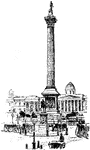
"Trafalgar Monument, Battle of Trafalgar (1805). During the early part of the Napoleonic wars, England's successes were gained by her superior navy under the command of the most brilliant naval officer of the time, Lord Nelson. Nelson's last victory was won near Cape Trafalgar, off the coast of Spain, where he met the combined fleets of France and Spain. It was on the eve of this engagement that he sent to the vessels of the fleet the famous message, 'England expects every man to do his duty.' most of the enemies' ships were captured or sunk, and the victory gave England the control of the sea, but cost the life of her brave commander, who fell at the moment of victory."—Colby, 1899

Trafalgar Monument

"Trafalgar Monument, Battle of Trafalgar (1805). During the early part of the Napoleonic wars, England's…
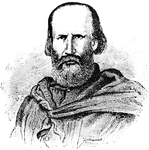
"Garibaldi was a patriot who started up a revolt in Sicily and took possession of the island, then passed over to Naples and overthrew the tyrant. This was done without the consent of Sardinia, but that kingdom profited none the less from its results. About the same time trouble with the papal states had led to the sending of a Sardinian army into the pope's dominions, and the annexation of the greater part of them to Sardinia. Garibaldi, after his success in Naples and Sicily, saluted the Sardinian king as King of Italy, and by a vote of the people Naples and Sicily joined Sardinia. A parliament of united Italy was opened in 1861, but ten years passed before unity was complete."—Colby, 1899

Garibaldi

"Garibaldi was a patriot who started up a revolt in Sicily and took possession of the island, then passed…
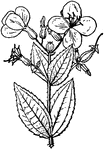
Leaves sessile or very short petioled; flowers showy.

Rhexia

Leaves sessile or very short petioled; flowers showy.

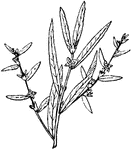
Capsule or calyx tube short and stout, not reflexed.

Ludwigia

Capsule or calyx tube short and stout, not reflexed.

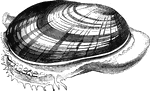
"The <em>U. elongata</em> is found in Great Britain, and formerly produced numerous pearly; these were famous even in the time of Julius Caeser. In Ireland and Scotland this species has produced pearly, in modern times, valued at between twenty to four hundred dollars." &mdash; Goodrich, 1859

Unio elongata

"The U. elongata is found in Great Britain, and formerly produced numerous pearly; these were…