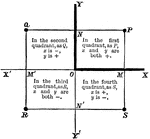
A coordinate planes with the quadrants labeled showing which value (x or y) is positive or negative.
Coordinate Plane

A coordinate planes with the quadrants labeled showing which value (x or y) is positive or negative.

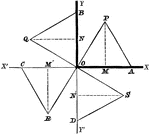
Equilateral triangles set up along a coordinate plane.

Equilateral Triangles

Equilateral triangles set up along a coordinate plane.

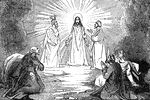
"And after six days Jesus taketh with him Peter, and James, and John his brother, and bringeth them up into a high mountain apart: and he was transfigured before them; and his face did shine as the sun, and his garments became white as the light. And behold, there appeared unto them Moses and Elijah talking with him." Matthew 17:1-3 ASV
<p>Illustration of Jesus talking with Moses (left) and Elijah (right). Peter, James, and John appear in the foreground.

The Transfiguration

"And after six days Jesus taketh with him Peter, and James, and John his brother, and bringeth them…
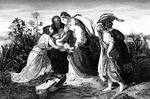
"And there went a man of the house of Levi, and took to wife a daughter of Levi. And the woman conceived, and bare a son: and when she saw him that he was a goodly child, she hid him three months. And when she could not longer hide him, she took for him an ark of bulrushes, and daubed it with slime and with pitch; and she put the child therein, and laid it in the flags by the river's brink. And his sister stood afar off, to know what would be done to him. And the daughter of Pharaoh came down to bathe at the river; and her maidens walked along by the river-side; and she saw the ark among the flags, and sent her handmaid to fetch it. And she opened it, and saw the child: and, behold, the babe wept. And she had compassion on him, and said, This is one of the Hebrews' children." Exodus 2:2-6
<p>Illustration of Pharaoh's daughter and maidens finding the infant Moses among the bulrushes.

The Finding of Moses

"And there went a man of the house of Levi, and took to wife a daughter of Levi. And the woman conceived,…
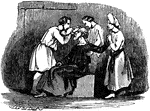
"Then Tobias taking of the gall of the fish, anointed his father's eyes. And he stayed about half an hour: and a white skin began to come out of his eyes, like the skin of an egg. And Tobias took hold of it, and drew it from his eyes, and immediately he recovered his sight. And they glorified God, both he and his wife and all that knew them." Tobit 11:13-16 DRA
<p>Following the instructions of the angel Raphael, Tobias applies the gall of a fish to his father's eyes and his sight is restored.

Tobias Anoints His Father's Eyes with the Gall of the Fish

"Then Tobias taking of the gall of the fish, anointed his father's eyes. And he stayed about half an…
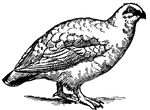
The winter plumage of a Ptarmigan, a grouse of the genus Lagopus. Usually a light reddish brown tint, it becomes pure white except for a black, white tipped tail in the winter months.

Rock Ptarmigan Winter Plumage

The winter plumage of a Ptarmigan, a grouse of the genus Lagopus. Usually a light reddish brown tint,…
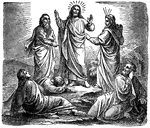
"And it came to pass about eight days after these sayings, that he took with him Peter and John and James, and went up into the mountain to pray. And as he was praying, the fashion of his countenance was altered, and his raiment became white and dazzling. And behold, there talked with him two men, who were Moses and Elijah...." Luke 9:28-30
<p>Illustration of Jesus standing with Moses on his right and Elijah on his left. One disciple lies prostrate at Jesus' feet and two others are on the ground leaning away from him. Jesus' hands are raised and he is glowing.

The Transfiguration of Jesus on a Mountain with Peter, James, and John

"And it came to pass about eight days after these sayings, that he took with him Peter and John and…
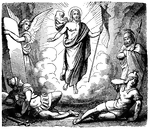
"And behold, there was a great earthquake; for an angel of the Lord descended from heaven, and came and rolled away the stone, and sat upon it. His appearance was as lightning, and his raiment white as snow: and for fear of him the watchers did quake, and became as dead men." Matthew 28:2-4 ASV
<p>Illustration of Jesus emerging from his tomb. He hovers above the ground and appears to glow. He holds a banner in his left hand. An angel (left) holds the stone that once covered the entrance. Two soldiers lie on the ground, one covers his face and turns away. One soldier stands to Christ's left, leaning against a wall with his eyes closed.

The Resurrection of Jesus after the Angel Removed the Stone from the Tomb Entrance

"And behold, there was a great earthquake; for an angel of the Lord descended from heaven, and came…
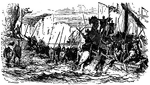
Norman ships and warriors following William the Conqueror, also called William of Normandy, land on England's shores at Pevensey. Men with shields and spears, wearing iron helmets and coats of mail, emerge from Norman ships and smaller boats. A large ship with a dragon head at the bow is on the right. Cliffs rise in the background.

William of Normandy and His Norman Forces Land on England's Shores

Norman ships and warriors following William the Conqueror, also called William of Normandy, land on…
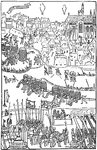
Detail from a larger engraving of the siege of Boulogne in 1544 during the campaigns of Henry VIII in France. The detail has a banner in the upper left corner that reads "Highe Bovilloigne" and another that labels one encampment, "The Duke of Al Berkinnys Campe". The detail is from the center of the larger image. Boulogne is at the top of the illustration and their are plumes of smoke and evidence of explosions. The Basilica of Notre-Dame de Boulogneis damaged. Canons are set up as trenches are dug outside the city. There are archers and men with rifles attacking. Several soldiers with spears breach one area of the city. A man is being hung. In the foreground, troops on horseback with spears and flags cluster near an encampment of tents.

Siege of Boulogne by King Henry VIII, Detail of Cowdray Engraving

Detail from a larger engraving of the siege of Boulogne in 1544 during the campaigns of Henry VIII in…
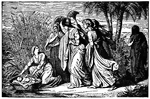
"And when she could not longer hide him, she took for him an ark of bulrushes, and daubed it with slime and with pitch; and she put the child therein, and laid it in the flags by the river's brink. And his sister stood afar off, to know what would be done to him. And the daughter of Pharaoh came down to bathe at the river; and her maidens walked along by the river-side; and she saw the ark among the flags, and sent her handmaid to fetch it." Exodus 2:3-5 ASV
<p>Illustration of Miriam, Moses' sister, kneeling over him as he lies in a basket on the edge of the river. Pharaoh's daughter approaches with four of her handmaids. Two handmaids are holding feathered fans. Pharaoh's daughter is wearing a crown.

Moses is Found by Pharaoh's Daughter as Miriam Watches

"And when she could not longer hide him, she took for him an ark of bulrushes, and daubed it with slime…
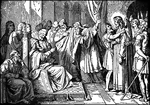
"And the chief priests and the scribes stood, vehemently accusing him.

11 And Herod with his soldiers set him at nought, and mocked him, and arraying him in gorgeous apparel sent him back to Pilate." Luke 23:10-11 ASV
<p>Illustration of Jesus standing before Herod and being clothed in a beautiful robe. Herod is sitting on a throne and wearing a crown. Priests and scribes sit and stand around the throne, making their cases to Herod. Soldiers stand behind Jesus with spears. There are arches and drapery in the background.

Jesus is Mocked by Herod Before Being Sent Back to Pontius Pilate

"And the chief priests and the scribes stood, vehemently accusing him. 11 And Herod with his soldiers…
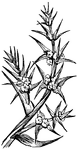
<i>Salsola kali</i>. This plant is also called a Russian Thistle, Prickly Glasswort, Tumbleweed, and Glasswort. It is a member of the amaranth family and is an annually growing herb. It has a bushy stem with many branches. It produces a small, white flower. It is native on sea beaches in Europe, western Asia, North and South America, and Australia.

Prickly Saltwort

Salsola kali. This plant is also called a Russian Thistle, Prickly Glasswort, Tumbleweed, and Glasswort.…
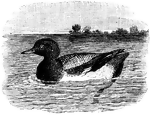
"A duck, <i>Fuligula</i> or <i>Fulix marila</i> and related species. The common scaup inhabits Europe, Asia, and North America. It is from 18 to 20 inches long, and from 30 to 35 in extent of wings." &mdash;Whitney, 1889
<p>In this illustration the duck is sitting on placid water, its feet tucked up underneath its body. Its head and upper body is dark, while its belly is white. There is a tree line in the distance.

Scaup, a Common Duck

"A duck, Fuligula or Fulix marila and related species. The common scaup inhabits Europe, Asia, and North…
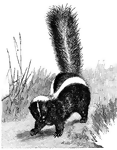
"A fetid animal of the American genus <i>Mephitis, M. mephitica</i>... The animal inhabits all of temperate North America, and continues abundant in the most thickly settled regions. It is about as large as a house-cat, but stouter-bodied, with shorter limbs, and very long bushy tail, habitually erected or turned over the back. The color is black or blackish, conspicuously but to a variable extent set off with pure white- generally as a frontal stripe, a large crown-spot, a pair of broad divergent bands along the side of the back, and white hairs mixed with the black ones of the tail." &mdash;Whitney, 1889

Common Skunk

"A fetid animal of the American genus Mephitis, M. mephitica... The animal inhabits all of temperate…
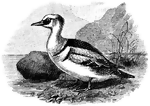
<i>Mergellus albellus</i>. "A small merganser or fishing duck...The male in adult plumage is a very beautiful bird, of a pure white, varied with black and gray, and tinged with green on the crested head; the length is about 17 inches. The female is smaller, with reddish-brown and gray plumage, and is called the red-headed smew." &mdash;Whitney, 1889

Smew - A Merganser or Fishing Duck

Mergellus albellus. "A small merganser or fishing duck...The male in adult plumage is a very beautiful…
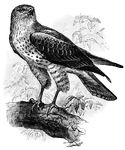
<i>Circaetus gallicus</i> is a "bird of prey inhabiting all the countries bordering the Mediterranean, and thence eastward to the whole of the Indian peninsula and part of the Malay archipelago. The male is 26 inches long; the female, 30 inches; the pointed wings are more than half as long again as the tail; the tarsi are mostly naked; the nostrils are oval perpendicularly; the head is crested with lanceolate feathers; and in the adult the breast is white, streaked with brown." &mdash;Whitney, 1889

Snake Buzzard, Also Called a Short-Toed Eagle

Circaetus gallicus is a "bird of prey inhabiting all the countries bordering the Mediterranean, and…
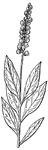
"<i>Polygala senega</i> of eastern North America. It sends up several stems from hard knotty root-stocks, bearing single close racemes of white flowers." &mdash;Whitney, 1889
<p>This illustration includes the upper portion of the stem and the flowers.

Seneca Snakeroot - Stem and Flowers

"Polygala senega of eastern North America. It sends up several stems from hard knotty root-stocks, bearing…
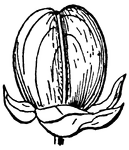
"<i>Polygala senega</i> of eastern North America. It sends up several stems from hard knotty root-stocks, bearing single close racemes of white flowers. It is the source of the officinal senegaroot, and from being much gathered is said to have become scarce in the east." &mdash;Whitney, 1889
<p>This illustration is of the fruit of the plant.

Seneca Snakeroot - the Fruit

"Polygala senega of eastern North America. It sends up several stems from hard knotty root-stocks, bearing…
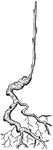
"<i>Polygala senega</i> of eastern North America. It sends up several stems from hard knotty root-stocks, bearing single close racemes of white flowers. It is the source of the officinal senegaroot, and from being much gathered is said to have become scarce in the east." &mdash;Whitney, 1889
<p>This illustration shows the knotty roots and the lower portion of the stem.

Seneca Snakeroot - Roots and Base of the Stem

"Polygala senega of eastern North America. It sends up several stems from hard knotty root-stocks, bearing…
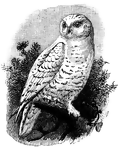
<i>Nyctea scandiaca</i>." The great white or snowy owl, <i>Strix nyctea</i> or <i>Nyctea scandiaca</i>, inhabiting arctic and northerly regions of both hemispheres, and having the plumage more or less white." &mdash;Whitney, 1889

Snow Owl

Nyctea scandiaca." The great white or snowy owl, Strix nyctea or Nyctea scandiaca, inhabiting arctic…
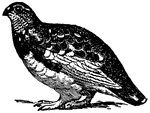
The winter plumage of a Ptarmigan, a grouse of the genus Lagopus. Usually a light reddish brown tint, it becomes pure white except for a black, white tipped tail in the winter months.

Rock Ptarmigan Summer Plumage

The winter plumage of a Ptarmigan, a grouse of the genus Lagopus. Usually a light reddish brown tint,…
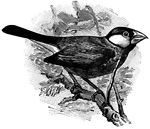
<i>Padda oryzivora</i>. "...the rice bird of Java...about as large as the bobolink, of a bluish-gray color with pink bill and white ear-coverts; a well-known cage bird." &mdash;Whitney, 1889

Java Sparrow on a Branch

Padda oryzivora. "...the rice bird of Java...about as large as the bobolink, of a bluish-gray color…
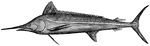
<i>Tetrapturus albidus</i>. Also called a billfish or spearfish, "the dorsal fin is low or moderately developed, and the ventrals are represented only by spines. It inhabits American waters as far north as New England in summer, and is not seldom taken in fathoms deep. The spear-fish is related to the swordfish (though of another family), and has a similar beak or sword. It attains a length of six or eight feet. In the West Indies its Spanish name is <i>aguja</i>." &mdash;Whitney, 1889

White Marlin, a Sailfish

Tetrapturus albidus. Also called a billfish or spearfish, "the dorsal fin is low or moderately developed,…
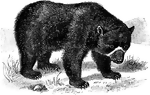
<i>Tremarctos ornatus</i>. "The only South American bear, having a light-colored mark on the face, like a pair of spectacles." &mdash;Whitney, 1889

Spectacled Bear

Tremarctos ornatus. "The only South American bear, having a light-colored mark on the face, like a pair…
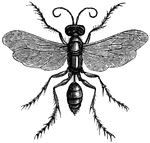
<i>Chalybion caeruleum</i>. "A family of fossorial hymenopters, or digger wasps. The prothorax is narrowed anteriorly, and forms a sort of neck; the basal segment of the abdomen is narrowed into a long, smooth, round petiole; and the head and thorax are usually clothed with a long, thin pubescence. These wasps usually burrow into sand-banks, and provision their cells with caterpillars and spiders." &mdash;Whitney, 1889

Spider Huntress Wasp

Chalybion caeruleum. "A family of fossorial hymenopters, or digger wasps. The prothorax is narrowed…
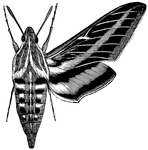
<i>Deilephila lineata</i>"...a common American moth of striking coloration, whose larva feeds on purslane." &mdash;Whitney, 1889
<p>A large moth with white and black stripes. The left wings are omitted.

White-Lined Morning Sphinx

Deilephila lineata"...a common American moth of striking coloration, whose larva feeds on purslane."…
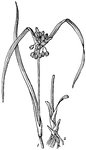
<i>Tradescantia virginica</i>. "It is a native of the central and southern United States, and was early introduced into European gardens. The petals are very delicate and ephemeral; in the wild plant they are bllue, in cultivation variable in color, often reddish-violet." -Whitney, 1889
<p>1. Illustration of the inflorescence, complete flower head of a plant including stems, stalks, bracts, and flowers, of spiderwort. 2. Illustration of the lower part of the stem and the root of the Spiderwort.

Spiderwort Inflorescence

Tradescantia virginica. "It is a native of the central and southern United States, and was early introduced…
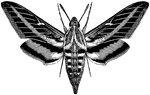
<i>Deilephila lineata</i>"...a common American moth of striking coloration, whose larva feeds on purslane." —Whitney, 1889
<p>A large moth with white and black stripes. This illustration displays the whole moth whereas the left wings are omitted as in original illustration.

White-Lined Morning Sphinx

Deilephila lineata"...a common American moth of striking coloration, whose larva feeds on purslane."…