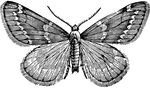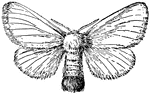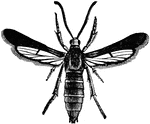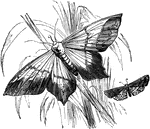
The swallow-tailed moth (Ourapteryx sambucaria) and the many-plumed moth (Ourapteryx hexadactyla).

Swallow-Tailed Moth

The swallow-tailed moth (Ourapteryx sambucaria) and the many-plumed moth (Ourapteryx hexadactyla).
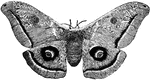
An illustration of an American Silkworm Moth.

American Silkworm Moth

An illustration of an American Silkworm Moth.

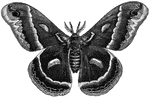
The cecropia moth is one of the largest moths found in North America. It is a member of the Saturniidae family, or giant silk moths. Females with a wingspan of 130 mm or more have been documented. It is found as far west as the Rocky Mountains and north into the maritime provinces of Canada. The larvae of these moths are most commonly found on Maple trees, but they have been known to feed on Wild Cherry and Birch trees among many others.

Cecropia Moth

The cecropia moth is one of the largest moths found in North America. It is a member of the Saturniidae…
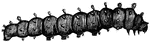
An illustration of the larva of a ceropia moth. The cecropia moth is one of the largest moths found in North America. It is a member of the Saturniidae family, or giant silk moths. Females with a wingspan of 130 mm or more have been documented. It is found as far west as the Rocky Mountains and north into the maritime provinces of Canada. The larvae of these moths are most commonly found on Maple trees, but they have been known to feed on Wild Cherry and Birch trees among many others.

Larva of Cecropia Moth

An illustration of the larva of a ceropia moth. The cecropia moth is one of the largest moths found…
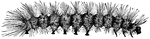
An illustration of a yellow woolly bear caterpillar. The Yellow woolly bear caterpillar, Spilosoma virginica, is the larva of the Virginia tiger moth. It has a diet of a wide range of low-growing plants, including ground cover like grass and clover. This species tends to have two to three life cycles per year, with one hibernating for the winter in temperate climates.

Yellow Woolly Bear Caterpillar

An illustration of a yellow woolly bear caterpillar. The Yellow woolly bear caterpillar, Spilosoma virginica,…
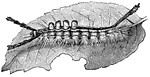
Orgyia leucostigma, the White-marked tussock moth, is a moth in the family Lymantriidae. The caterpillar is very common especially in late summer in eastern North America, as far west as Texas, Colorado, and Alberta. There are two or more generations a year in eastern North America (Wagner 2005). They overwinter in the egg stage. Eggs are laid in a single mass over the cocoon of the female, and covered in a froth (Wagner 2005). Up to 300 eggs are laid at a time. he larvae are brightly coloured, with tufts of hair-like setae. The head is bright red, the body has yellow or white stripes, with a black stripe along the middle of the back. There are bright red defensive glands on the hind end of the back. Four white toothbrush-like tufts stand out from the back, and there is a grey-brown hair pencil at the hind end. Touching the hairs will set off an allergic reaction in many humans (Wagner 2005). Young larvae skeletonize the surface of the leaf, while older larvae eat everything except the larger veins (Rose and Lindquist, 1982). They grow to about 35 mm.

White-marked Tussock Caterpillar

Orgyia leucostigma, the White-marked tussock moth, is a moth in the family Lymantriidae. The caterpillar…
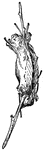
The Brown-tail (Euproctis chrysorrhoea) is a moth of the family Lymantriidae. It is distributed throughout Europe. The wings of this species are pure white, as is the body, apart from a tuft of brown hairs at the end of the abdomen. The brown colouration extends along most of the back of the abdomen in the male. In the female, the back of the abdomen is white but the tuft of brown hairs is much bigger. Ths wingspan is 36-42 mm. The species flies at night in July and August and is attracted to light.

Brown-tail Moth Web

The Brown-tail (Euproctis chrysorrhoea) is a moth of the family Lymantriidae. It is distributed throughout…
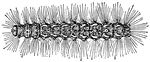
An illustration of the caterpillar of the brown-tail moth.

Brown-tail Caterpillar

An illustration of the caterpillar of the brown-tail moth.

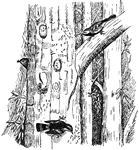
An illustration of warblers feeding on the young caterpillars of the Gipsy moth.

Warblers Eating Caterpillars

An illustration of warblers feeding on the young caterpillars of the Gipsy moth.
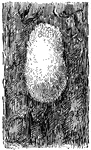
An illustration of an egg cluster of the Gipsy Moth.

Egg Cluster of Gipsy Moth

An illustration of an egg cluster of the Gipsy Moth.

An illustration of a male moth. Most species of moth are nocturnal, but there are crepuscular and diurnal species.

Moth (Male)

An illustration of a male moth. Most species of moth are nocturnal, but there are crepuscular and diurnal…
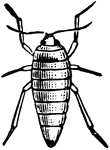
An illustration of a wingless female moth. Most species of moth are nocturnal, but there are crepuscular and diurnal species.

Wingless Moth (Female)

An illustration of a wingless female moth. Most species of moth are nocturnal, but there are crepuscular…
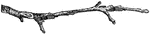
An illustration of cankerworm moth eggs laid on an apple tree twig. Cankerworm moth eggs are typically fed on by Chicadees.

Eggs of Cankerworm Moth

An illustration of cankerworm moth eggs laid on an apple tree twig. Cankerworm moth eggs are typically…
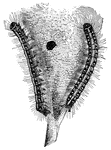
Tent caterpillars are moderately sized species in the genus Malacosoma in the moth family Lasiocampidae. Species occur in North America, Mexico, and Eurasia. Twenty-six species have been described, six of which occur in North America. Some species are considered to have subspecies as well. Although most people consider tent caterpillars only as pests due to their habit of defoliating trees, they are among the most social of all caterpillars and exhibit many noteworthy behaviors.

Tent Caterpillars

Tent caterpillars are moderately sized species in the genus Malacosoma in the moth family Lasiocampidae.…

An illustration of tent caterpillar eggs. Tent caterpillars are moderately sized species in the genus Malacosoma in the moth family Lasiocampidae. Species occur in North America, Mexico, and Eurasia. Twenty-six species have been described, six of which occur in North America. Some species are considered to have subspecies as well. Although most people consider tent caterpillars only as pests due to their habit of defoliating trees, they are among the most social of all caterpillars and exhibit many noteworthy behaviors.

Tent Caterpillar Eggs

An illustration of tent caterpillar eggs. Tent caterpillars are moderately sized species in the genus…
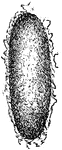
An illustration of a tent caterpillar cacoon. Tent caterpillars are moderately sized species in the genus Malacosoma in the moth family Lasiocampidae. Species occur in North America, Mexico, and Eurasia. Twenty-six species have been described, six of which occur in North America. Some species are considered to have subspecies as well. Although most people consider tent caterpillars only as pests due to their habit of defoliating trees, they are among the most social of all caterpillars and exhibit many noteworthy behaviors.

Tent Caterpillar Cocoon

An illustration of a tent caterpillar cacoon. Tent caterpillars are moderately sized species in the…
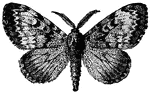
The gypsy moth, Lymantria dispar, is a moth in the family Lymantriidae of Eurasian origin. Originally ranging from Europe to Asia, it was introduced to North America in the late 1860s and has been expanding its range ever since.

Gypsy Moth

The gypsy moth, Lymantria dispar, is a moth in the family Lymantriidae of Eurasian origin. Originally…
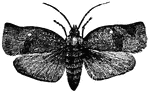
Tortricidae is a family of moths in the order Lepidoptera. They are commonly known as tortrix moths. It is a large family with over 6,300 species described, and is the sole member of the superfamily Tortricoidea. Many of these are economically important pests. Olethreutidae is a junior synonym. The typical resting posture is with the wings folded back producing a rather rounded profile.

Tortricidae

Tortricidae is a family of moths in the order Lepidoptera. They are commonly known as tortrix moths.…
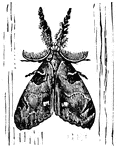
Tussock Moths, Lymantriidae or Liparidae, are a family of moths with about 350 known genera and over 2,500 known species found all over the world, in every continent except Antarctica. They are particularly concentrated in sub-Saharan Africa, India, Southeast Asia and South America; one estimate lists 258 species in Madagascar alone (Schaefer, 1989). Apart from oceanic islands, notable places that do not host Lymantriids include New Zealand, the Antilles, and New Caledonia.

Tussock Moth

Tussock Moths, Lymantriidae or Liparidae, are a family of moths with about 350 known genera and over…
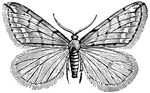
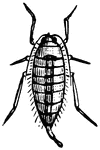
An illustration of a male spring cankerworm moth.

Spring Cankerworm Moth (Male)

An illustration of a male spring cankerworm moth.

An illustration of a female spring cankerworm moth.

Spring Cankerworm Moth (Female)

An illustration of a female spring cankerworm moth.

The Brown-tail (Euproctis chrysorrhoea) is a moth of the family Lymantriidae. It is distributed throughout Europe. The wings of this species are pure white, as is the body, apart from a tuft of brown hairs at the end of the abdomen. The brown colouration extends along most of the back of the abdomen in the male. In the female, the back of the abdomen is white but the tuft of brown hairs is much bigger. Their wingspan is 36-42 mm. The species flies at night in July and August and is attracted to light.

Brown-tail Moth

The Brown-tail (Euproctis chrysorrhoea) is a moth of the family Lymantriidae. It is distributed throughout…
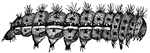
An illustration of a Io moth caterpillar. The io moth (Automeris io) is a very colorful North American moth in the Saturniidae family. It ranges from the southeast corner of Manitoba and in the southern extremes of Ontario, Quebec, and New Brunswick in Canada, and in the US it is found from North Dakota, South Dakota, Nebraska, Colorado, New Mexico, Texas, Utah, east of those states and down to the southern end of Florida.

Io Moth Caterpillar

An illustration of a Io moth caterpillar. The io moth (Automeris io) is a very colorful North American…
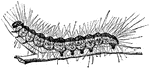
An illustration of a fallweb worm caterpillar. Fall webworm, Hyphantria cunea, is a moth in the family Arctiidae known principally for its larval stage, where it creates the characteristic webbed nests on the tree limbs of a wide variety of hardwoods in the late summer and fall. It is mainly an aesthetic pest and is not believed to harm otherwise healthy trees. It is well-known to commercial tree services and arboriculturists

Fallweb Worm Caterpillar

An illustration of a fallweb worm caterpillar. Fall webworm, Hyphantria cunea, is a moth in the family…
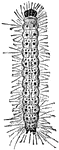
An illustration of a fallweb worm caterpillar. Fall webworm, Hyphantria cunea, is a moth in the family Arctiidae known principally for its larval stage, where it creates the characteristic webbed nests on the tree limbs of a wide variety of hardwoods in the late summer and fall. It is mainly an aesthetic pest and is not believed to harm otherwise healthy trees. It is well-known to commercial tree services and arboriculturists

Fallweb Worm Caterpillar

An illustration of a fallweb worm caterpillar. Fall webworm, Hyphantria cunea, is a moth in the family…
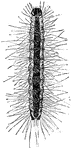
An illustration of a fallweb worm caterpillar. Fall webworm, Hyphantria cunea, is a moth in the family Arctiidae known principally for its larval stage, where it creates the characteristic webbed nests on the tree limbs of a wide variety of hardwoods in the late summer and fall. It is mainly an aesthetic pest and is not believed to harm otherwise healthy trees. It is well-known to commercial tree services and arboriculturists

Fallweb Worm Caterpillar

An illustration of a fallweb worm caterpillar. Fall webworm, Hyphantria cunea, is a moth in the family…
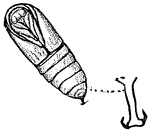
An illustration of a fallweb worm pupa. Fall webworm, Hyphantria cunea, is a moth in the family Arctiidae known principally for its larval stage, where it creates the characteristic webbed nests on the tree limbs of a wide variety of hardwoods in the late summer and fall. It is mainly an aesthetic pest and is not believed to harm otherwise healthy trees. It is well-known to commercial tree services and arboriculturists

Fallweb Worm Pupa

An illustration of a fallweb worm pupa. Fall webworm, Hyphantria cunea, is a moth in the family Arctiidae…
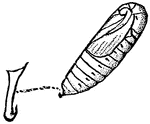
An illustration of a fallweb worm pupa. Fall webworm, Hyphantria cunea, is a moth in the family Arctiidae known principally for its larval stage, where it creates the characteristic webbed nests on the tree limbs of a wide variety of hardwoods in the late summer and fall. It is mainly an aesthetic pest and is not believed to harm otherwise healthy trees. It is well-known to commercial tree services and arboriculturists

Fallweb Worm Pupa

An illustration of a fallweb worm pupa. Fall webworm, Hyphantria cunea, is a moth in the family Arctiidae…
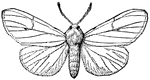
An illustration of a fallweb worm moth. Fall webworm, Hyphantria cunea, is a moth in the family Arctiidae known principally for its larval stage, where it creates the characteristic webbed nests on the tree limbs of a wide variety of hardwoods in the late summer and fall. It is mainly an aesthetic pest and is not believed to harm otherwise healthy trees. It is well-known to commercial tree services and arboriculturists

Fallweb Worm Moth

An illustration of a fallweb worm moth. Fall webworm, Hyphantria cunea, is a moth in the family Arctiidae…
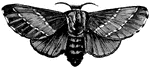
The Lackey moth, Malacosoma neustria, is a member of the genus Malacosoma, common across southern Britain and central Europe. Malacosoma species are notable for their caterpillars which are brightly coloured and form silken tents to regulate their temperature. Malacosoma neustria caterpillars are brown with blue, orange and white stripes. The adults are a fairly uniform brown. The larvae feed mainly on trees and shrubs from within their tents. In Britain the flight period is from July to August.

Lackey Moth

The Lackey moth, Malacosoma neustria, is a member of the genus Malacosoma, common across southern Britain…

The Fall Army Worm (Spodoptera frugipeda) is part of the order of Lepidoptera and are the caterpillar life stage of a moth. They are native to tropical regions of the western hemisphere, from the United States to Argentina. They are regarded as pests and are known to wreak havoc with crops if left to multiply. Their name is derived from their feeding habits. The army worms are some of the most destructive pests to agricultural crop in the world. Once the food supply is exhausted the entire "army" of worms will move to the next available food source.

Army Worm

The Fall Army Worm (Spodoptera frugipeda) is part of the order of Lepidoptera and are the caterpillar…
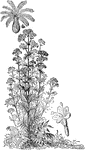
Valerian (Valeriana officinalis, Valerianaceae) is a hardy perennial flowering plant, with heads of sweetly scented pink or white flowers. The flowers are in bloom in the northern hemisphere from June to September. Valerian was used as a perfume in the sixteenth century. Native to Europe and parts of Asia, Valerian has been introduced into North America. It is consumed as food by the larvae of some Lepidoptera (butterfly and moth) species including Grey Pug.

Valerian

Valerian (Valeriana officinalis, Valerianaceae) is a hardy perennial flowering plant, with heads of…
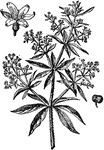
Madder is the common name of the plant genus Rubia, the type genus of the madder family Rubiaceae. The genus contains about 60 species of perennial scrambling or climbing herbs and sub-shrubs native to the Old World, Africa, temperate Asia and America. The best known species are Common Madder (Rubia tinctorum), Wild Madder (Rubia peregrina), and Indian Madder (Rubia cordifolia). The Common Madder can grow to 1.5 m in height. The evergreen leaves are 5-10 cm long and 2-3 cm broad, produced in whorls of 4-7 starlike around the central stem. It climbs with tiny hooks at the leaves and stems. The flowers are small (3-5 mm across), with five pale yellow petals, in dense racemes, and appear from June to August, followed by small (4-6 mm diameter) red to black berries. The roots can be over a metre long, up to 12 mm thick and the source of a red dye known as rose madder. It prefers loamy soils with a constant level of moisture. Madders are used as food plants for the larvae of some Lepidoptera species including Hummingbird hawk moth.

Madder

Madder is the common name of the plant genus Rubia, the type genus of the madder family Rubiaceae. The…
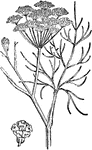
Fennel (Foeniculum vulgare) is a plant species in the genus Foeniculum (treated as the sole species in the genus by most botanists). It is a hardy, perennial, umbelliferous herb, with yellow flowers and feathery leaves, grows wild in most parts of temperate Europe, but is generally considered indigenous to the shores of the Mediterranean, whence it spreads eastwards to India and even in England in Bedfont Lakes Country Park and Thurrock . It has followed, especially where Romans have colonized, and may be found growing wild in many parts of the world upon dry soils near the sea-coast and upon river-banks. It is a member of the family Apiaceae. It is a highly aromatic and flavorful herb with culinary and medicinal uses, and is one of the primary ingredients of absinthe. Fennel is used as a food plant by the larvae of some Lepidoptera species including the Mouse Moth and the Anise Swallowtail.

Fennel

Fennel (Foeniculum vulgare) is a plant species in the genus Foeniculum (treated as the sole species…
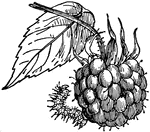
The Raspberry Spanworm (Synchlora aerata) is the larva of a species of Geometer moth.

Raspberry Spanworm

The Raspberry Spanworm (Synchlora aerata) is the larva of a species of Geometer moth.
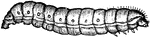
The larva of the Grapevine Root Borer (Memthyrus polistiformis).

Grapevine Root Borer (Larva)

The larva of the Grapevine Root Borer (Memthyrus polistiformis).

The moth of the Grapevine Root Borer (Memthyrus polistiformis).

Grapevine Root Borer (Moth)

The moth of the Grapevine Root Borer (Memthyrus polistiformis).

The owl moth is a moth whose larvae are known to feed on a wide array of plants including a range of plants cultivated by humans.

Owl Moth

The owl moth is a moth whose larvae are known to feed on a wide array of plants including a range of…
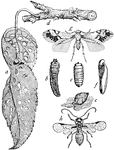
"Resplendent Shield-bearer (Coptodisca splendoriferella). a, leaf of apple showing work; b, summer larva; c, larva in case, traveling; d, cases tied up for winter; e, hibernating larva; f, pupa; g, moth; h, parasite: all enlarged." -Whitney, 1911

Resplendent Shield Bearer

"Resplendent Shield-bearer (Coptodisca splendoriferella). a, leaf of apple showing work; b, summer larva;…
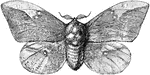
The Imperial Moth (Eacles imperialis) is an insect in the Saturniidae family of large and colorful moths.
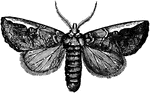
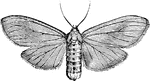
Imperial Moth

The Imperial Moth (Eacles imperialis) is an insect in the Saturniidae family of large and colorful moths.

Edema albifrons is a species of moth of the Bombycidae family.

Edema

Edema albifrons is a species of moth of the Bombycidae family.

The Milkweed Tiger Moth (Euchaetes egle) is an insect in the Arctiidae family of tiger moths.

Milkweed Tiger Moth

The Milkweed Tiger Moth (Euchaetes egle) is an insect in the Arctiidae family of tiger moths.
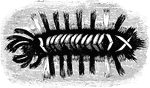
The larva Milkweed Tiger Moth (Euchaetes egle) is also known as the Milkweed Tussock caterpillar.

Milkweed Tiger Moth Larva

The larva Milkweed Tiger Moth (Euchaetes egle) is also known as the Milkweed Tussock caterpillar.
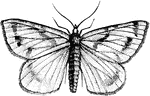
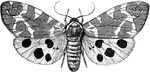
"Female Moth of Gooseberry-spanworm (Eufitchia ribearia)." -Whitney, 1911

Gooseberry Spanworm

"Female Moth of Gooseberry-spanworm (Eufitchia ribearia)." -Whitney, 1911

The Garden Tiger Moth (Arctia caja) is a species of tiger moths that are also known by the synonym Euprepia caja.

Garden Tiger Moth

The Garden Tiger Moth (Arctia caja) is a species of tiger moths that are also known by the synonym Euprepia…
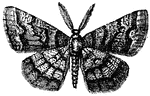
The male Fidonia faxoni, an species from the Geometridae family of geometer moths.

Male Geometer Moth

The male Fidonia faxoni, an species from the Geometridae family of geometer moths.
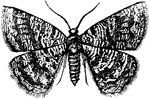
The female Fidonia faxoni, an species from the Geometridae family of geometer moths.

Female Geometer Moth

The female Fidonia faxoni, an species from the Geometridae family of geometer moths.
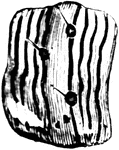
The adult Eight-Spotted Forester (Alypia octomaculata), a moth belonging to the Noctuidae family of Owlet moths.

Eight-Spotted Forester

The adult Eight-Spotted Forester (Alypia octomaculata), a moth belonging to the Noctuidae family of…

The larva Eight-Spotted Forester (Alypia octomaculata), a caterpillar belonging to the Noctuidae family of Owlet moths.

Eight-Spotted Forester Larva

The larva Eight-Spotted Forester (Alypia octomaculata), a caterpillar belonging to the Noctuidae family…
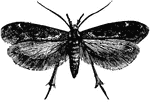
Gelechia gallae-solidaginis is a species of gall moth, an insect in the Gelechiidae family of Gelechiid moths.

Dorsal View of Gall Moth

Gelechia gallae-solidaginis is a species of gall moth, an insect in the Gelechiidae family of Gelechiid…
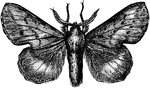
Gastropacha hildei is a species of lappet moth in the Lasiocampidae family of eggars, snout moths, and lappet moths.

Lappet Moth

Gastropacha hildei is a species of lappet moth in the Lasiocampidae family of eggars, snout moths, and…
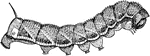
The Five-Spotted Hawkmoth (Manduca quinquemaculata) is a brown and gray hawk moth of the Sphingidae family. The caterpillar is often referred to as the tomato hornworm and can be a major pest in gardens. The tomato hornworm larva is a green caterpillar, with eight, v-shaped markings on its side and has a black horn on its rear just as other hornworms.

Tomato Worm

The Five-Spotted Hawkmoth (Manduca quinquemaculata) is a brown and gray hawk moth of the Sphingidae…
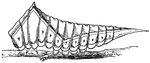
The Puss Moth (Cerura vinula) is a lepidoptera from the family Notodontidae. The puss moth is stinging caterpillar, Megalopyge opercularis, commonly called an asp. This is one of the most toxic caterpillars in North America. The mature larva is 1 to 1½ inches long with seven pairs of prolegs (suction-cup like claspers on the rear of the body). This larva of the puss moth shows as it appears when undisturbed.

Puss Moth

The Puss Moth (Cerura vinula) is a lepidoptera from the family Notodontidae. The puss moth is stinging…
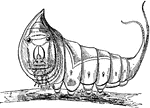
The Puss Moth (Cerura vinula) is a lepidoptera from the family Notodontidae. The puss moth is stinging caterpillar, Megalopyge opercularis, commonly called an asp. This is one of the most toxic caterpillars in North America. The mature larva is 1 to 1½ inches long with seven pairs of prolegs (suction-cup like claspers on the rear of the body). This larva of the puss moth shows as it appears when disturbed and ready to sting. Intense, throbbing pain develops almost immediately witnin contact with the caterpillar.

Puss Moth

The Puss Moth (Cerura vinula) is a lepidoptera from the family Notodontidae. The puss moth is stinging…
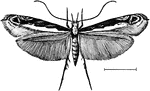
"Gracilaria salicifoliella. GRACILARIA. In entomology, the typical genus of Gracilariidae, containing very small but beautiful tineid moths, characterized by the form of the fore wings and the smoothly clothed palpi." -Whitney, 1911

Leaf Blotch Miner Moth

"Gracilaria salicifoliella. GRACILARIA. In entomology, the typical genus of Gracilariidae, containing…
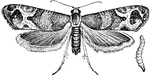
The European Grapevine Moth (Lobesia botrana) is an insect in the Tortricidae family of tortrix moths.
European Grapevine Moth

The European Grapevine Moth (Lobesia botrana) is an insect in the Tortricidae family of tortrix moths.

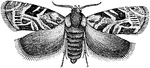
"Plum-moth (Grapholitha prunivora). GRAPHOLITHA. A genus of small and peculiarly marked tortricid moths, some of which inhabit galls." -Whitney, 1911

Plum Moth

"Plum-moth (Grapholitha prunivora). GRAPHOLITHA. A genus of small and peculiarly marked tortricid moths,…
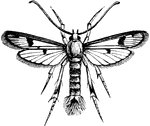
An illustration of a sugar-maple moth. A moth is an insect closely related to the butterfly, both being of the order Lepidoptera. The differences between butterflies and moths are more than just taxonomy.

Sugar-Maple Moth

An illustration of a sugar-maple moth. A moth is an insect closely related to the butterfly, both being…
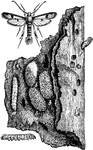
An illustration of a maple borer: a, larva; b, cocoons; c, moth; d, skin of chrysalis.

Maple Borer

An illustration of a maple borer: a, larva; b, cocoons; c, moth; d, skin of chrysalis.

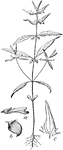
An illustration of Melampyrum stem; "a, a flower; b, the fruit; c, a bract." -Century, 1889 Melampyrum is a genus of about 10-20 species of herbaceous flowering plants in the family Orobanchaceae, native to temperate regions of the Northern Hemisphere. They are hemiparasites on other plants, obtaining some mineral nutrients from the host plant, though they are able to survive on their own without parasitising other plants.Melampyrum species are used as food plants by the larvae of some Lepidoptera species including Mouse Moth.

Melampyrum

An illustration of Melampyrum stem; "a, a flower; b, the fruit; c, a bract." -Century, 1889 Melampyrum…