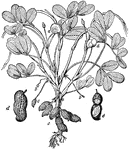
"Common Peanut (Arachis hypogæa). a, flowers; b, ovaries on lengthened stipes; c, forming fruit; d, ripe pod; e, pod opened, showing seeds."-Whitney, 1902

Common peanut

"Common Peanut (Arachis hypogæa). a, flowers; b, ovaries on lengthened stipes; c, forming fruit;…
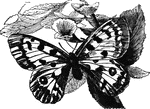
"The Apollo butterfly, <em>P. Apollo</em>, is found in the damp meadows of the high Alps; the wings are whitish, wth five black spots on each of the superior ones; on the inferior are two sparkling eye-like figures, bordered with black. It flies in June and July. Thus even wild mountain regions, as well as those of the florid tropics, are embellished by this beautiful family." &mdash; Goodrich, 1859

Apollo Butterfly

"The Apollo butterfly, P. Apollo, is found in the damp meadows of the high Alps; the wings…
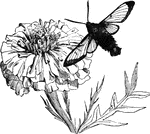
"A considerable number of insects belonging to Sphingina have transparents wings. Among them is the humming-bird moth, <em>Sesia pelasgus</em>, often seen at evening in our gardens during the moths of June and July hovering like a humming-bird over the flowers and sucking their nectar with its long tube." &mdash; Goodrich, 1859

Hummingbird Moth

"A considerable number of insects belonging to Sphingina have transparents wings. Among them is the…

"Arabesque is a style of ornamentation in which are represented men, animals (the latter consisting of mythic as well as actual forms); plants, with leaves, flowers and fruit; mathematical figures, etc.; the whole put together in a whimsical way, so that, for instance, the animals not merely rest upon the plants, but grow out of them like blossoms."&mdash;(Charles Leonard-Stuart, 1911)

Arabesque Archway

"Arabesque is a style of ornamentation in which are represented men, animals (the latter consisting…
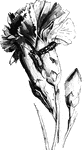
"The Foficulina includes the Earwig, <em>Forficula</em>, which appears to live principally upon vegetable substances. As this trie often attack the petals of flowers, they are regarded as enemies by the gardener." &mdash; Goodrich, 1859

Earwigs

"The Foficulina includes the Earwig, Forficula, which appears to live principally upon vegetable…
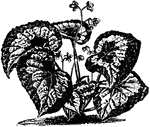
"Begonia is an extensive genus of succulent-stemmed herbaceous plants, order Begoniace&aelig;, with fleshy oblique leaves of various colors, and showy unisexual flowers, the whole perianth colored. They readily hybridize, and many fine varieties have been raised from the tuberous-rooted kinds. From the shape of their leaves they have been called elephant's ear. Almost all the plants of the order are tropical."&mdash;(Charles Leonard-Stuart, 1911)

Begonia Rex

"Begonia is an extensive genus of succulent-stemmed herbaceous plants, order Begoniaceæ, with…
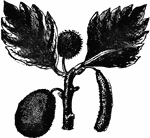
"The breadfruit is a large, globular fruit of a pale-green color, about the size of a child's head, marked on the surface with irregular six-sided depressions, and containing a white and somewhat fibrous pulp, which when ripe becomes juicy and yellow. The tree that produces it grows wild in Tahiti and other islands of the South Seas. it is about 40 feet high, with large and spreading branches, and has large bright green leaves, deeply divided into seven or nine spear-shaped lobes. The eatable part of this fruit lies between the skin and the core, and it is as white as snow and somewhat of the consistence of new bread."&mdash;(Charles Leonard-Stuart, 1911)

Breadfruit

"The breadfruit is a large, globular fruit of a pale-green color, about the size of a child's head,…
"The breadfruit is a large, globular fruit of a pale-green color, about the size of a child's head, marked on the surface with irregular six-sided depressions, and containing a white and somewhat fibrous pulp, which when ripe becomes juicy and yellow. The tree that produces it grows wild in Tahiti and other islands of the South Seas. it is about 40 feet high, with large and spreading branches, and has large bright green leaves, deeply divided into seven or nine spear-shaped lobes. The eatable part of this fruit lies between the skin and the core, and it is as white as snow and somewhat of the consistence of new bread."&mdash;(Charles Leonard-Stuart, 1911)

Breadfruit Fruit

"The breadfruit is a large, globular fruit of a pale-green color, about the size of a child's head,…
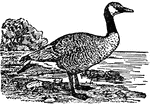
"The Canada Goose is an American wild goose 30 to 35 inches long, brownish above, lighter below, head, neck, bill and feet black, a white patch on the cheek; breeds in the N. of the continent and migrates S. when the frost becomes severe."&mdash;(Charles Leonard-Stuart, 1911)

Canada Goose

"The Canada Goose is an American wild goose 30 to 35 inches long, brownish above, lighter below, head,…
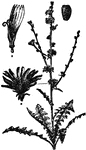
Chicory is a flowering plant with blue flowers, originally from the Old World but now seen growing wild as a weed in North America.

Chicory

Chicory is a flowering plant with blue flowers, originally from the Old World but now seen growing wild…
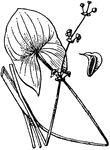
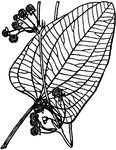
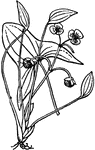
lowest flowers with only carpels, or with only stamens.

Sagittaria

lowest flowers with only carpels, or with only stamens.

All flowers with stamens and carpels.

Echinodorus

All flowers with stamens and carpels.

Upper flowers with stamens only.

Lophotocarpus

Upper flowers with stamens only.

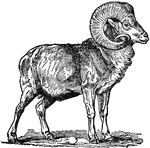
"Goat is the domestic goat, which exists, in a wild or semi-wild state, in all the European mountain ranges. The males fight furiously with each other in the rutting time. They have an offensive smell. "&mdash;(Charles Leonard-Stuart, 1911)

Big Horn Goat

"Goat is the domestic goat, which exists, in a wild or semi-wild state, in all the European mountain…
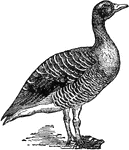
"Goose is the name of a well-known family of natatorial birds. The domestic goose is believed to have descended form the greylag goose. It is valued for the table and on account of its quills and fine soft feather. The body is large and heavy, the neck long, the head small, and the bill conical, the wings long and powerful, the feet somewhat long, with small toes. In summer the wild goose inhabits the polar regions, migrating south in flocks on the approach of winter. The nest which is of coarse grass, is generally situated in marshy places."&mdash;(Charles Leonard-Stuart, 1911)

Wild Goose

"Goose is the name of a well-known family of natatorial birds. The domestic goose is believed to have…
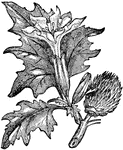
"Thorn Apple is a genus of plants. The common thorn apple is an annual plant, with smooth stem and leaves, white flowers, and erect prickly capsules, a native of the East Indies, but now often met with in North America. A variety with pale violet flowers and purplish violet stem is frequently cultivated in gardens as an ornamental plant."&mdash;(Charles Leonard-Stuart, 1911)

Thorn Apple

"Thorn Apple is a genus of plants. The common thorn apple is an annual plant, with smooth stem and leaves,…
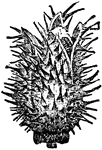
"Thorn Apple is a genus of plants. The common thorn apple is an annual plant, with smooth stem and leaves, white flowers, and erect prickly capsules, a native of the East Indies, but now often met with in North America. A variety with pale violet flowers and purplish violet stem is frequently cultivated in gardens as an ornamental plant."&mdash;(Charles Leonard-Stuart, 1911)

Thorn Apple Bud

"Thorn Apple is a genus of plants. The common thorn apple is an annual plant, with smooth stem and leaves,…
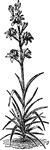
"Tuberose (Polianthus) is a genus of plants of the natural order Liliace&aelig;. The plant is in high esteem for the beauty and fragrance of its flowers, the odor of which is most powerful after sunset. The fading flowers emit, in certain states of the atmosphere, an electric light and sparks. The native country of the tuberose is Mexico. They are very extensively grown by American and British florists, who, by planting the roots successionally, manage to keep up a supply of flowers at all seasons. There are several varieties."&mdash;(Charles Leonard-Stuart, 1911)

Double Tuberose

"Tuberose (Polianthus) is a genus of plants of the natural order Liliaceæ. The plant is in high…
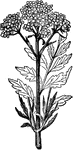
"Valerian is an order of herbs or rarely shrubs belonging to the division of monopetalous dicotyledons having the stamens arising from the petals. The order is distinguished from its congeners by the opposite leaves; small irregular flowers. It contains 12 genera and about 190 species, distributed through Northwestern America, Europe, Northern Africa, and temperate Asia&ndash; unknown in Australia, and only one species South African. It has a penetrating odor, and a bitter, acrid, somewhat aromatic taste; when distilled with water it yields a volatile oil and valerianic acid. Cats have a strange liking for the odor, and it exercises a remarkable intoxicating or stimulating power over them; the plant is sometimes called cats' valerian. It is often used to tempt cats to an unhappy fate."&mdash;(Charles Leonard-Stuart, 1911)

Valerian

"Valerian is an order of herbs or rarely shrubs belonging to the division of monopetalous dicotyledons…
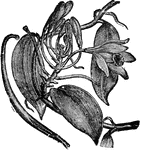
"Vanilla is a genus of epiphytal Orchide&aelig;, natives of tropical America and Asia. They are distinguished from most other orchids by their climbing habit; they cling with their aerial roots to the stems of trees or to rocks, attain the height of 20 or 30 feet, and obtain their chief sustenance from the atmosphere. There are about 20 species comprised in the genus. The flowers are thick, fleshy, and fragrant, but dull in color. Vanilla is remarkable among orchids as possessing the only species of the order that has any economical value. From the fruit of several species the vanilla of commerce is obtained, the best being produced by the West Indian species, which is now cultivated in many tropical countries. <em>A,</em> a seed pod"&mdash;(Charles Leonard-Stuart, 1911)

Vanilla Planifolia

"Vanilla is a genus of epiphytal Orchideæ, natives of tropical America and Asia. They are distinguished…
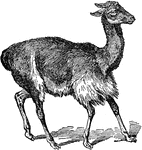
"Vicuna is a native of the most elevated localities of Bolivia and northern Chile. It is very wild, and has resisted all attempts to reduce it to a state of domestication. It is the smallest species of the genus, standing only about 30 inches at the shoulder. It is extremely active and sure-footed, and is seldom taken alive. In habit it somewhat resembles the chamois, as it lives in herds in the regions of perpetual snow. The soft, silky fur is in much demand for making delicate fabrics, and many thousands of these animals are slaughtered annually for the sake of the skins. "—(Charles Leonard-Stuart, 1911)

Vicuna

"Vicuna is a native of the most elevated localities of Bolivia and northern Chile. It is very wild,…
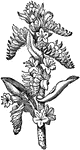
"Viper's Bugloss is a genus of plants. The species are large herbaceous plants or shrubs, rough with tubercles and hairs. Their flowers are often very beautiful. the common viper's bugloss, a large annual plant, is a native of Great Britain and of most parts of Europe growing in dry places, not infrequently in cornfields. Its flowers are at first reddish, and afterward blue. It derives its name, viper's bugloss, from spots on its stem, which somehat resemble those of the viper, and the property of healing viper's bites was therefore ascribed to it. Other herbaceous species are found in North and South America, and other parts of the world. Shrubby species are found chiefly in the Canaries and South Africa."&mdash;(Charles Leonard-Stuart, 1911)

Viper's Bugloss

"Viper's Bugloss is a genus of plants. The species are large herbaceous plants or shrubs, rough with…
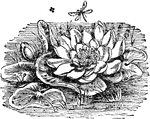
"The Water Lily is an exogenous aquatic plant including eight genera, and all possessing submerged root stocks. They are found in all temperate climates, and attain great size in the tropics. The white water lily is the familiar flower of ponds and placid streams throughout North America, its large and chaste flowers claiming precedence for beauty among the indigenous flora."&mdash;(Charles Leonard-Stuart, 1911)

White Water Lily

"The Water Lily is an exogenous aquatic plant including eight genera, and all possessing submerged root…
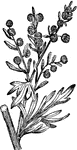
"Wormwood is the genus Artemisia. The stem is one to three feet high, grooved, and angled; the leaves silky on both sides, twice or thrice pinnatified, dotted; the yellow flowers in racemes, the heads drooping, silky, the outer flowers fertile. It is wild in North America in various waste places, also in Continental Europe, the North of Africa and Great Britain."&mdash;(Charles Leonard-Stuart, 1911)

Wormwood

"Wormwood is the genus Artemisia. The stem is one to three feet high, grooved, and angled; the leaves…
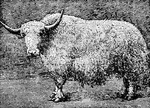
"Yak is a species of ox from the mountainous regions of Tibet. There are two races: the wild yak, generally black, which is found near the snow line, descending into the valleys in winter, and a domesticated race of various colors, black and white being most common. The yak is about the size of the common ox, to which it has a general resemblance, but it is covered with a thick coat of long, silky hair, hanging down like the fleece of a sheep, completely investing the tail, and forming a lengthy fringe along the shoulders, flanks, and thighs. This fringe, which exists in both races, was apparently developed as a protection to the animal, as the long hair forms a sort of mat which defends the body from the effects of the cold when the animal is reposing in the snow. The domesticated race is of great importance to the natives of Tibet. The yak is employed as a beast of burden, but never for tillage or draught; the milk is very rich, and yields excellent butter; the flesh is of the finest quality, and that of the calves far superior to ordinary veal. The hair is spun into ropes, and made into coverings for tents, and the soft fur of the hump and withers is woven into a fine strong cloth. The tails, often dyed red, are made into the chowries or fly-flappers, used in India. Yaks are often seen in zoological gardens and menageries."&mdash;(Charles Leonard-Stuart, 1911)

Yak

"Yak is a species of ox from the mountainous regions of Tibet. There are two races: the wild yak, generally…
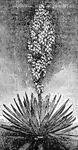
"Yucca is a genus of American plants, natural order Liliace&aelig; popularly known as Adam's needle. They are evergreen shrubs, their stem tending to arborescence, crowned by a circle of linear, lanceolate, rigid leaves, from the center of which rises a large panicle of snow-white, whitish-green or cream-colored flowers."&mdash;(Charles Leonard-Stuart, 1911)

Yucca

"Yucca is a genus of American plants, natural order Liliaceæ popularly known as Adam's needle.…
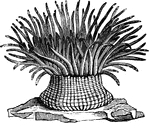
"Their tentacles, which are disposed in regular circles, and tinged with a variety of bright lively colors, very nearly represent the beautiful petals of some f the most elegantly fringed and radiated flowers, such as the carnation, marygold, and anemone. They are of various sizes, from that of the smallest thimble to the largest apple; and have considerable power of locomotion, being able not only to move along upon the base, but also in a reversed position upon their entacles." &mdash; Goodrich, 1859

Sea-anemone

"Their tentacles, which are disposed in regular circles, and tinged with a variety of bright lively…
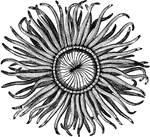
"Their tentacles, which are disposed in regular circles, and tinged with a variety of bright lively colors, very nearly represent the beautiful petals of some f the most elegantly fringed and radiated flowers, such as the carnation, marygold, and anemone. They are of various sizes, from that of the smallest thimble to the largest apple; and have considerable power of locomotion, being able not only to move along upon the base, but also in a reversed position upon their entacles." &mdash; Goodrich, 1859

Mouth of the sea-anemone

"Their tentacles, which are disposed in regular circles, and tinged with a variety of bright lively…
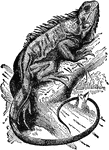
"Iguana is a genus of saurian reptiles, natives of Brazil, Cayenne, the Bahamas, and neighboring localities in the New World. It was formerly very common in Jamaica, but is now becoming gradually rarer. It has a lizard-like form, with a long tail, and an average length of about four feet, though it sometimes reaches a length of fully six feet. Its head is large and covered with large scales. The food of the Iguana consists almost entirely of fruits, fungi, and other vegetable substances, though it occasionally feeds on eggs, insects, and various animal substances. When domesticated it eats leaves and flowers. Along the whole length of the back to the tip of the tail there is a crest of elevated, compressed, pointed scales, while over the lower part of the head and neck there is a deep, thin dewlap or throat pouch, the border describing a curved line and dentilated at the part nearest the chin."&mdash;(Charles Leonard-Stuart, 1911)

Iguana

"Iguana is a genus of saurian reptiles, natives of Brazil, Cayenne, the Bahamas, and neighboring localities…
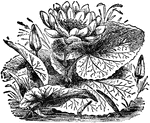
"Lotus is a name given to various flowers, including several beautiful species of water lily, especially the blue water lily, and the Egyptian water lily which grow in stagnant and slowly running water in the S. of Asia and N. of Africa. The latter grows in the Nile and adjacent rivulets and has a large white flower. The root is eaten by the people who live near the lake Manzaleh. It was the rose of ancient Egypt, the favorite flower of the country, and was often made into wreaths or garlands."—(Charles Leonard-Stuart, 1911)

Egyptian Water Lily

"Lotus is a name given to various flowers, including several beautiful species of water lily, especially…
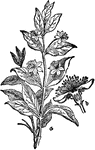
"Myrtle is a genus of plants, natural order Myrtace&aelig;, consisting of aromatic trees or shrubs, with simple opposite leaves sprinkled with pellucid glandular points, and having axillary or terminal white or rose colored flowers. One species, common myrtle, is a native of the south of Europe and countries bordering on the Mediterranean."&mdash;(Charles Leonard-Stuart, 1911)

Myrtle

"Myrtle is a genus of plants, natural order Myrtaceæ, consisting of aromatic trees or shrubs,…
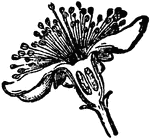
"Myrtle is a genus of plants, natural order Myrtace&aelig;, consisting of aromatic trees or shrubs, with simple opposite leaves sprinkled with pellucid glandular points, and having axillary or terminal white or rose colored flowers. One species, common myrtle, is a native of the south of Europe and countries bordering on the Mediterranean."&mdash;(Charles Leonard-Stuart, 1911)

Myrtle Flower

"Myrtle is a genus of plants, natural order Myrtaceæ, consisting of aromatic trees or shrubs,…
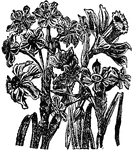
"Narcissus is an extensive genus of bulbous plants. The species are numerous, and from their hardiness, delicate shape, gay yellow or white flowers, and smell, have long been favorite objects of cultivation, especially the daffodil, the jonquil, polyanthus, narcissus, and white narcissus."&mdash;(Charles Leonard-Stuart, 1911)

Narcissus

"Narcissus is an extensive genus of bulbous plants. The species are numerous, and from their hardiness,…
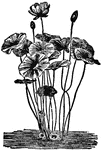
"Nelumbium is the typical and only genus of the order Nelumbiace&aelig;. The species are remarkable for the beauty of their flowers. N. speciosum has magnificent flowers, magenta or white. It does not now grow in Egypt, but is found in India. The rhizome, stalks, and seeds are eaten by the Hindus. A fiber derived from the stalk is used as a wick for lamps in Hindu temples, the plant being considered sacred. The North American Indians eat the rhizomes of N. luteum."&mdash;(Charles Leonard-Stuart, 1911)

Nelumbium

"Nelumbium is the typical and only genus of the order Nelumbiaceæ. The species are remarkable…
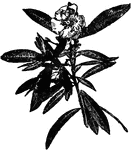
"The Oleander is the common and sweet-scented oleander. They have lanceolate coriaceous leaves, with parallel veins and fine roseate flowers. The former is a native of India, now naturalized in many warm countries. Sweet-scented oleander is wild in Central India, Scinde, Afghanistan, and the outer Himalayas to 5,500 feet. Often cultivated in India, etc. All parts of the plants, especially the root, are poisonous."&mdash;(Charles Leonard-Stuart, 1911)

Oleander

"The Oleander is the common and sweet-scented oleander. They have lanceolate coriaceous leaves, with…
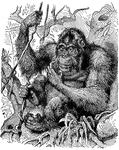
"The Orang Outang is the Mias of the Dyaks; also known as the 'wild man of the wood.' It is a dull, slothful animal, but possessed of great strength. These animals are now confined to the swampy forests of Sumatra and Borneo. Their height has been variously stated, but we have not the least reliable evidence of the existence of orangs in Borneo more than four feet two inches high. The legs are very short, the arms are disproportionately long, reaching to the ankle when the animal is placed in an erect position. The males have a longish beard, and they sometimes develop warty protuberances on each side of the face. The resemblance to man in appearance is greatest in the females and in young animals. The head of a baby orang is not very different from that of an average child; but in the adult the muzzle is as well-marked a feature as in the Carnivora. It never walks erect, unless when supporting itself by branches."&mdash;(Charles Leonard-Stuart, 1911)

Orang Outang

"The Orang Outang is the Mias of the Dyaks; also known as the 'wild man of the wood.' It is a dull,…
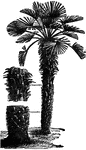
"Palm is a natural order of endogenous plants, the products of which are of extreme importance and utility to man. The size of the leaves varies, some being only a few inches in length, while in others they attain the enormous proportions of 35 feet in length by 5 or 6 feet in breadth. The flowers are small individually, but numerous, usually of a yellow tint, and in some species powerfully odorous. The fruit when ripe is berry-like, drupaceous, plum-like, or, as in the cocoanut, nut-like."&mdash;(Charles Leonard-Stuart, 1911)

Chamaerops Humilis Palm

"Palm is a natural order of endogenous plants, the products of which are of extreme importance and utility…
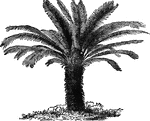
"Palm is a natural order of endogenous plants, the products of which are of extreme importance and utility to man. The size of the leaves varies, some being only a few inches in length, while in others they attain the enormous proportions of 35 feet in length by 5 or 6 feet in breadth. The flowers are small individually, but numerous, usually of a yellow tint, and in some species powerfully odorous. The fruit when ripe is berry-like, drupaceous, plum-like, or, as in the cocoanut, nut-like. The sugar palm is a native of the Moluccas, Cochin-China, and the Indian Archipelago, and is of immense value to the natives of these countries on account of its various products. It yields an abundant sweet sap, from which a chocolate-colored sugar is made. The sap fermented makes an intoxicating drink variously named by the inhabitants of the different countries. From the pith of the stem sago is obtained in great quantity, a single stem yielding as much as from 150 to 200 pounds."&mdash;(Charles Leonard-Stuart, 1911)

Cycas Revoluta Sago Palm

"Palm is a natural order of endogenous plants, the products of which are of extreme importance and utility…
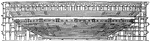
"An amphitheatre was a place for the exhibitions of public shows of combatants and wild beasts, entirely surrounded by seats for the spectators; whereas, in those for dramatic performances, the seats were arranged in a semicircle facing he stage. Longitudinal section of the Flavian Amphitheatre." &mdash; Smith, 1873

Amphitheatrum

"An amphitheatre was a place for the exhibitions of public shows of combatants and wild beasts, entirely…
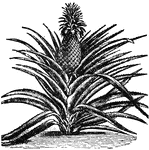
"Pineapple is a plant of the natural order Bromeliac&aelig;. The flowers rise from the center of the plant, and are in a large conical spike, surmounted by spiny leaves called the crown. The conical spike of flowers ultimately becomes enlarged and juicy, constituting the pineapple, considered one of the finest of fruits. More than 50 varieties have been produced. The plant grows in the S. portion of the United States and in Hawaii. In the islands they sometimes reach the weight of 17 pounds, though the average weight is six. Since 1883 there have been large exports of this fruit from the various islands."&mdash;(Charles Leonard-Stuart, 1911)

Pineapple

"Pineapple is a plant of the natural order Bromeliacæ. The flowers rise from the center of the…
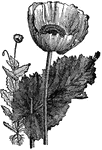
"Poppy is a genus of plants, of which there are numerous species, mostly natives of Europe and Asia, some of them found in the very N. regions, but most of them in the warmer temperate parts. By far the most important species is that known as the opium poppy, also called the white poppy and the oil poppy. But the same species is important on account of the bland fixed oil of the seeds, and is much cultivated as an oil plant. Poppy oil is as sweet as olive oil, and is used for similar purposes. It is imported into the United States in considerable quantities from India. A variety with double flowers is cultivated in flower gardens, under the name of carnation poppy. <em>a,</em> whole plant"&mdash;(Charles Leonard-Stuart, 1911)

Opium Poppy

"Poppy is a genus of plants, of which there are numerous species, mostly natives of Europe and Asia,…
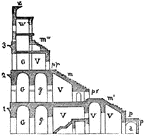
"An amphitheatre was a place for the exhibitions of public shows of combatants and wild beasts, entirely surrounded by seats for the spectators; whereas, in those for dramatic performances, the seats were arranged in a semicircle facing he stage. Elevation of one side of the preceding section." — Smith, 1873

Amphitheatrum

"An amphitheatre was a place for the exhibitions of public shows of combatants and wild beasts, entirely…
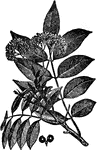
"The Quassia is a tree cultivated in the West Indies and the parts adjacent. It has terminal clusters of large, red flowers, and unequally pinnate leaves. It comes to this country in logs or billets, and is retained as chips or raspings. It is given as an extract, an infusion, or a tincture. An infusion of it is used to poison flies."&mdash;(Charles Leonard-Stuart, 1911)

Quassia

"The Quassia is a tree cultivated in the West Indies and the parts adjacent. It has terminal clusters…

"The Quatrefoil is a piercing or panel divided by cusps or foliations into four leaves, or more correctly the leaf-shaped figure formed by the cusps. The name is also given to flowers and leaves of a similar form carved as ornaments on moldings, etc. It differs from the cinquefoil only in the number of cusps."&mdash;(Charles Leonard-Stuart, 1911)

Quatrefoil

"The Quatrefoil is a piercing or panel divided by cusps or foliations into four leaves, or more correctly…
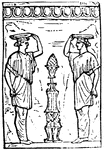
"A virgin who carried a flat circular basket at sacrifices, in which the chaplet of flowers, the knife to slay the victim, and sometimes the frankincense were deposited. The name, however, was more particularly applied to two virgins of the first Athenian families whowere appointed to officiate as canephori at the Panathenaea. The preceding cut represents the to canephori approaching a candelabrum. Each of hem elevates one arm to support the basket while she slightly raises her tunic with the other." &mdash; Smith, 1873;

Canephoros

"A virgin who carried a flat circular basket at sacrifices, in which the chaplet of flowers, the knife…
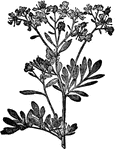
"The common rue is a half-shrubby plant, two or three feet high, of a fetid odor and an acrid taste. The bluish-green leaves are pinnate, the flowers yellow; a native of Southern Europe but grown in gardens in the United States, the East and West Indies, etc."&mdash;(Charles Leonard-Stuart, 1911)

Rue

"The common rue is a half-shrubby plant, two or three feet high, of a fetid odor and an acrid taste.…
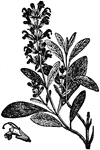
"Sage is a plant much used for flavoring meats, etc. It has blue flowers, and has run into many varieties. The Chinese use it as a tonic for debility of the stomach and nerves."&mdash;(Charles Leonard-Stuart, 1911)

Sage

"Sage is a plant much used for flavoring meats, etc. It has blue flowers, and has run into many varieties.…
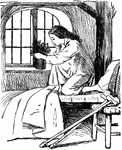
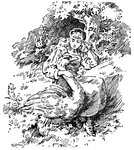
Sick child in bed.

Sick Child

Sick child in bed.

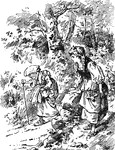
Scene from "The Wild Swans."

Elsa and the Swans

Scene from "The Wild Swans."

Scene from "The Wild Swans."

Elsa

Scene from "The Wild Swans."

Elsa from "The Wild Swans."

Elsa

Elsa from "The Wild Swans."

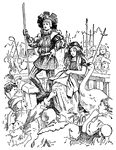
The King and Elsa, a scene from "The Wild Swans."

The King and Elsa

The King and Elsa, a scene from "The Wild Swans."

Elsa and the Prince, a scene from "The Wild Swans."

Elsa and the Prince

Elsa and the Prince, a scene from "The Wild Swans."

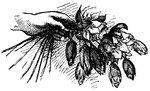
Hand holding flowers

Hand with Flowers

Hand holding flowers

Violets

Violets

Violets

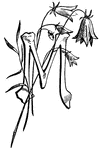
The letter M

M, Letter

The letter M

Flowers

Flowers

Flowers

Flower design

Flower

Flower design

Flower design

Flowers

Flower design

Flowers

Flowers

Flowers