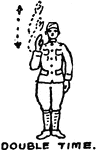
Marching at twice the cadence of "Forward March;" 100 to 180 steps per min. something of a light jog. The unit is still required to keep in step.

Double Time

Marching at twice the cadence of "Forward March;" 100 to 180 steps per min. something of a light jog.…
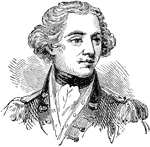
General Sir Banastre Tarleton, 1st Baronet, GCB (21 August 1754 – 16 January 1833) was a British soldier and politician. His reputation for ruthlessness and his involvement in the Waxhaw Massacre earned him the nickname "Bloody Ban" and "Butcher" amongst American revolutionaries. The British and American loyalists hailed him as an outstanding leader of light cavalry.

Banastre Tarleton

General Sir Banastre Tarleton, 1st Baronet, GCB (21 August 1754 – 16 January 1833) was a British…

The Brown-tail (Euproctis chrysorrhoea) is a moth of the family Lymantriidae. It is distributed throughout Europe. The wings of this species are pure white, as is the body, apart from a tuft of brown hairs at the end of the abdomen. The brown colouration extends along most of the back of the abdomen in the male. In the female, the back of the abdomen is white but the tuft of brown hairs is much bigger. Ths wingspan is 36-42 mm. The species flies at night in July and August and is attracted to light.

Brown-tail Moth Web

The Brown-tail (Euproctis chrysorrhoea) is a moth of the family Lymantriidae. It is distributed throughout…
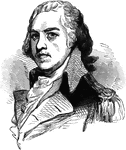
Henry Lee III (January 29, 1756–March 25, 1818) was an early American patriot who served as the Governor of Virginia and as the Virginia Representative to the United States Congress. During the American Revolution, Lee served as a cavalry officer in the Continental Army and earned the name Light Horse Harry.

Henry Lee

Henry Lee III (January 29, 1756–March 25, 1818) was an early American patriot who served as the Governor…
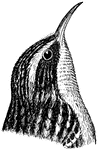
The Brown Creeper (Certhia americana), also known as the American Tree Creeper, is a small songbird, the only North American member of the treecreeper family Certhiidae. Adults are brown on the upperparts with light spotting, resembling a piece of tree bark, with white underparts. They have a long thin bill with a slight downward curve and a long tail. The male creeper has a slightly larger bill than the female. The Brown creeper is 11.7-13.5 cm long (4.6-5.3 in).

Brown Creeper

The Brown Creeper (Certhia americana), also known as the American Tree Creeper, is a small songbird,…
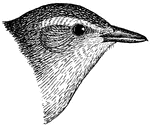
The Warbling Vireo, Vireo gilvus, is a small songbird. Adults are 12 cm long and weigh 12 g. They are mainly olive-grey on the head and upperparts with white underparts; they have brown eyes and the front of the face is light. There is a white supercilium. They have thick blue-grey legs and a stout bill. Western birds are generally smaller.

Warbling Vireo

The Warbling Vireo, Vireo gilvus, is a small songbird. Adults are 12 cm long and weigh 12 g. They are…
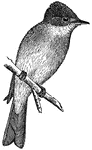
The Western Wood-Pewee, Contopus sordidulus, is a small tyrant flycatcher. Adults are gray-olive on the upperparts with light underparts, washed with olive on the breast. They have two wing bars and a dark bill with yellow at the base of the lower mandible. This bird is very similar in appearance to the Eastern Wood-Pewee; the two birds were formerly considered to be one species.

Western Wood Pewee

The Western Wood-Pewee, Contopus sordidulus, is a small tyrant flycatcher. Adults are gray-olive on…
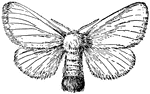
The Brown-tail (Euproctis chrysorrhoea) is a moth of the family Lymantriidae. It is distributed throughout Europe. The wings of this species are pure white, as is the body, apart from a tuft of brown hairs at the end of the abdomen. The brown colouration extends along most of the back of the abdomen in the male. In the female, the back of the abdomen is white but the tuft of brown hairs is much bigger. Their wingspan is 36-42 mm. The species flies at night in July and August and is attracted to light.

Brown-tail Moth

The Brown-tail (Euproctis chrysorrhoea) is a moth of the family Lymantriidae. It is distributed throughout…
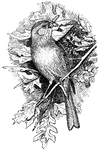
The Field Sparrow, Spizella pusilla, is a small sparrow. Adults have brown upperparts, a light brown breast, a white belly, wing bars and a forked tail. They have a grey face, a rusty crown, a white eye ring and a pink bill. Their breeding habitat is shrubby fields across eastern North America. The nest is an open cup on the ground under a clump of grass or in a small thicket.

Field Sparrow

The Field Sparrow, Spizella pusilla, is a small sparrow. Adults have brown upperparts, a light brown…
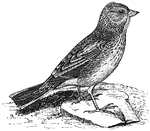
The Vesper Sparrow, Pooecetes gramineus, is a medium-sized sparrow. It is the only member of the genus Pooecetes (Baird 1858). Adults have light brown upperparts and light underparts, both with darker streaking. They have a white eye ring and a long dark brown tail which shows white outer feathers in flight. Their breeding habitat is open grassy areas across most of North America. The nest is an open cup on the ground under a clump of grass. These birds migrate to the southern and central United States and Mexico.

Vesper Sparrow

The Vesper Sparrow, Pooecetes gramineus, is a medium-sized sparrow. It is the only member of the genus…
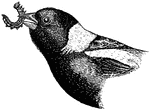
The Bobolink, Dolichonyx oryzivorus, is a small New World blackbird and the only member of genus Dolichonyx. Adults are 16-18 cm long with short finch-like bills. Adult males are mostly black, although they do display creamy napes, and white scapulars, lower backs and rumps. Adult females are mostly light brown, although their coloring includes black streaks on the back and flanks, and dark stripes on the head; their wings and tails are darker. Their breeding habitats are open grassy fields, especially hay fields, across North America. In high-quality habitats, males are often polygynous. Females lays 5 to 6 eggs in a cup-shaped nest, which is always situated on the ground and is usually well-hidden in dense vegetation. Both parents feed the young.

Bobolink (Male)

The Bobolink, Dolichonyx oryzivorus, is a small New World blackbird and the only member of genus Dolichonyx.…
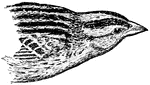
The Bobolink, Dolichonyx oryzivorus, is a small New World blackbird and the only member of genus Dolichonyx. Adults are 16-18 cm long with short finch-like bills. Adult males are mostly black, although they do display creamy napes, and white scapulars, lower backs and rumps. Adult females are mostly light brown, although their coloring includes black streaks on the back and flanks, and dark stripes on the head; their wings and tails are darker. Their breeding habitats are open grassy fields, especially hay fields, across North America. In high-quality habitats, males are often polygynous. Females lays 5 to 6 eggs in a cup-shaped nest, which is always situated on the ground and is usually well-hidden in dense vegetation. Both parents feed the young.

Bobolink (Female)

The Bobolink, Dolichonyx oryzivorus, is a small New World blackbird and the only member of genus Dolichonyx.…

The Whip-poor-will or whippoorwill, Caprimulgus vociferus, is a medium-sized (22-27 cm) nightjar from North and Central America. The Whip-poor-will is commonly heard within its range, but less often seen. It is named onomatopoeically after its call. This bird is sometimes confused[1] with the related Chuck-will's-widow (Caprimulgus carolinensis) which has a similar but lower-pitched and slower call. Adults have mottled plumage: the upperparts are grey, black and brown; the lower parts are grey and black. They have a very short bill and a black throat. Males have a white patch below the throat and white tips on the outer tail feathers; in the female, these parts are light brown.

Whip-poor-will

The Whip-poor-will or whippoorwill, Caprimulgus vociferus, is a medium-sized (22-27 cm) nightjar from…
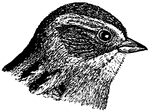
The Swamp Sparrow, Melospiza georgiana, is a medium-sized sparrow. Adults have streaked rusty and black upperparts with a grey breast, light belly and a white throat. They have a rust-coloured cap and wings. Their face is grey with a dark line through the eye. They have a short bill and fairly long legs. Their breeding habitat is marshes, including salt marshes, across eastern North America and central Canada. The bulky nest is attached to marsh vegetation, often with leaves arching over the top. On the central Atlantic coast, in the southern parts of their summer range, they are permanent residents. Other birds migrate to the southern United States.

Swamp Sparrow

The Swamp Sparrow, Melospiza georgiana, is a medium-sized sparrow. Adults have streaked rusty and black…
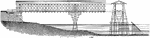
A lattice bridge is a form of truss bridge that uses a large number of small and closely spaced diagonal elements that form a lattice. It was patented by architect Ithiel Town in 1820 and 1835 as Town's lattice truss. Originally a design to allow a substantial bridge to be made from planks employing lower–skilled labor, rather than heavy timbers and more expensive carpenters, this type of bridge has also been constructed using a large number of relatively light iron or steel members.

Lattice Bridge

A lattice bridge is a form of truss bridge that uses a large number of small and closely spaced diagonal…
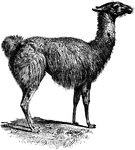
The guanaco (Lama guanicoe) is a camelid animal native to South America that stands between 107 and 122 centimeters (3.5 and 4 feet) at the shoulder and weighs about 90 kg (200 lb). The colour varies very little, ranging from a light brown to dark cinnamon and shading to white underneath. Guanacos have grey faces and small straight ears. They are extremely striking with their large, alert brown eyes, streamlined form, and energetic pace. They are particularly ideal for keeping in large groups in open parklands.

Guanaco

The guanaco (Lama guanicoe) is a camelid animal native to South America that stands between 107 and…
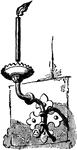
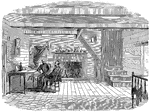
A sconce is a light fixture attached to the wall to support a a candle, torch, or bulb.

Sconce

A sconce is a light fixture attached to the wall to support a a candle, torch, or bulb.

In light of overwhelming enemy strength and the relatively heavy casualties his army suffered in the Battle of Bentonville, Johnston surrendered to Sherman little more than a month later at Bennett Place, near Durham Station.

Johnston's Surrender

In light of overwhelming enemy strength and the relatively heavy casualties his army suffered in the…
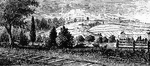
While Washington was inspecting the terrain, seeing where it was best to station his troops, he ran into several light horseman and told him that the British were advancing. Washington rode back to camp to prepare his men. He quickly stationed a couple hundred Continentals and a couple of artillery pieces onto Chatterton Hill, to support the militia. The skirmishers, who had the job of slowing the British advance, retired soon after Washington reinforced Chatterton Hill.

Chatterton's Hill, From the Railway Station

While Washington was inspecting the terrain, seeing where it was best to station his troops, he ran…

An illustration of the Order of the Garder's garter. The Garter is worn on ceremonial occasions around the left calf by knights and around the left arm by ladies, and is depicted on several insignia. The Garter is a buckled dark-blue (originally light-blue) velvet strap, and bears the motto in gold letters. The garters of Stranger Knights and Ladies were once set with several jewels.

Order of the Garter's Garter

An illustration of the Order of the Garder's garter. The Garter is worn on ceremonial occasions around…
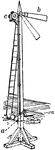
"Railway Semaphore. a, lever, which operates both b, blade, and c, lantern." -Whitney, 1911

Railroad Semaphore

"Railway Semaphore. a, lever, which operates both b, blade, and c, lantern." -Whitney, 1911
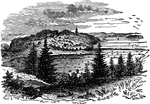
The Battle of Stony Point was a battle of the American Revolutionary War. Here is a view of Stony Point from the Southwest.

<p>"View of Stony Point from the southwest. This view shows a large portion of the morass, and the place where the assaulting party divided and prepared for an attack upon the fort, which was situated where the light-house is seen. The place of the causeway is on the left, denoted by the cattle. When I made this sketch it was quite high water, and the morass, there about one hundred feet wide, was almost covered. There was another place near the river shore, on the right, where the Point was accessible at times. It is distinguished in the sketch by the narrow strip of land extending nearly across the mouth of the morass. Upon this the enemy had dug pits and placed sharpened stakes within them, so that, had the Americans attempted to reach the Point by that way many would have been impaled."—Lossing, 1851

Stony Point

The Battle of Stony Point was a battle of the American Revolutionary War. Here is a view of Stony Point…
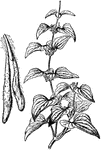
Yam is the common name for some species in the genus Dioscorea (family Dioscoreaceae).These are perennial herbaceous vines cultivated for the consumption of their starchy tubers in Africa, Asia, Latin America and Oceania. There are hundreds of cultivars among the cultivated species. The sweet potato (Ipomoea batatas) has traditionally been referred to as a "yam" in parts of the southern United States and Canada even though it is not part of the Dioscoreaceae family. The vegetable has a rough skin which is difficult to peel, but which softens after heating. The skins vary in color from dark brown to light pink

Yam

Yam is the common name for some species in the genus Dioscorea (family Dioscoreaceae).These are perennial…
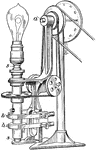
"In photometry (measure of light), a mounting for an incandescent lamp ... Rotator. The lamp to be tested is mounted upon a revolving spindle, ss, current being supplied through the brushes bb. The axis of rotation may be varied by turning the spindle about the horizontal shaft a." -Whitney, 1911

Rotator

"In photometry (measure of light), a mounting for an incandescent lamp ... Rotator. The lamp to be tested…
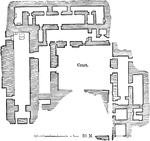
One peculiarity is visible in all Assyrian buildings, namely, that all the chambers are very narrow in proportion to their length. It may, however, be accepted as established that the chambers were in general lighted by windows, which were inserted in the walls either high up or immediately under the roof, and that only large halls received their light from above through openings in the roof.

Floor Plan of the Palace at Nimrud

One peculiarity is visible in all Assyrian buildings, namely, that all the chambers are very narrow…

The Etruscan earring is light in weight, usually made out of precious metals, in sheet or wire filigree.
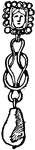
Etruscan Earring

The Etruscan earring is light in weight, usually made out of precious metals, in sheet or wire filigree.

The Etruscan earring is usually light in weight, usually made out of precious metals, in sheet or wire filigree.

Etruscan Earring

The Etruscan earring is usually light in weight, usually made out of precious metals, in sheet or wire…
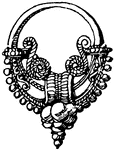
The Roman earring is light in weight, usually made out of precious metals, in sheet or wire filigree.
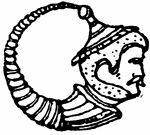
Roman Earring

The Roman earring is light in weight, usually made out of precious metals, in sheet or wire filigree.

The Etruscan earring is light in weight, usually made out of precious metals, in sheet or wire filigree.
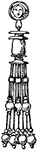
Etruscan Earring

The Etruscan earring is light in weight, usually made out of precious metals, in sheet or wire filigree.
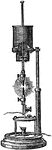
The Etruscan earring is light in weight, usually made out of precious metals, in sheet or wire filigree.

Etruscan Earring

The Etruscan earring is light in weight, usually made out of precious metals, in sheet or wire filigree.

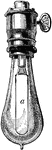
The incandescent lamp or globe lamp, showing carbon filament at a.

Incandescent Lamp

The incandescent lamp or globe lamp, showing carbon filament at a.

An electric arc lamp by Brush Electric Company. Arc lamps produce light by an electric or voltaic arc.
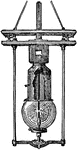
Arc Lamp

An electric arc lamp by Brush Electric Company. Arc lamps produce light by an electric or voltaic arc.
An electric arc lamp by Brush Electric Company. Arc lamps produce light by an electric or voltaic arc.

Arc Lamp

An electric arc lamp by Brush Electric Company. Arc lamps produce light by an electric or voltaic arc.

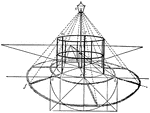
An illustration of a shadow cast by the light of a street lamp.

Shadow of an Street Lamp

An illustration of a shadow cast by the light of a street lamp.

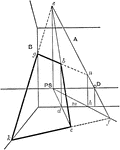
"A pole is leaning against a wall A, against which it casts part of its shadow, and the remainder upon another wall B, at right angles with A. Let D be the source of light." (Britannica, 1891)

Shadow of an Pole

"A pole is leaning against a wall A, against which it casts part of its shadow, and the remainder upon…
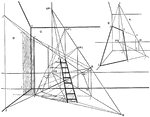
"A ladder leaning against a wall casts it shadow partly on the wall C; it is continued on an open door not perpendicular with its connecting wall; and lastly upon the ground. Project also the shadow of the door. Let A be the source of light" (Britannica, 1891)

Shadow of an Ladder

"A ladder leaning against a wall casts it shadow partly on the wall C; it is continued on an open door…
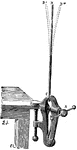
"If a light strip of steel is firmly gripped at one end in a vice and the other end plucked aside, it will, when let go, vibrate backwards and forwards as shown; and if the vibrations are sufficiently rapid, a musical note will be produced." -New, 1891

Tone

"If a light strip of steel is firmly gripped at one end in a vice and the other end plucked aside, it…
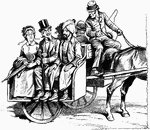
An illustration of a jaunting car; The Irish form of the sprung cart, called a jaunting car or jaunty car, was a light, horse-drawn, two-wheeled open vehicle with seats placed lengthwise, either face to face or back to back.

Jaunting Car

An illustration of a jaunting car; The Irish form of the sprung cart, called a jaunting car or jaunty…
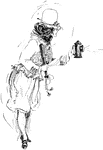
An illustration of a woman wearing a cop costume and shining a light.

Woman in Cop Costume

An illustration of a woman wearing a cop costume and shining a light.

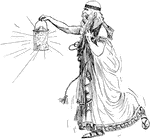
An illustration of an elderly man with a lantern.

Elderly Man with Lantern

An illustration of an elderly man with a lantern.

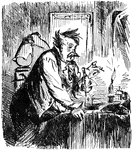
An illustration of a man with a candle.

Man with Candle

An illustration of a man with a candle.

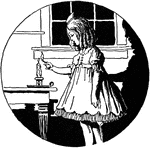
An illustration of a young girl lighting a candle on a table.

Girl Lighting a Candle

An illustration of a young girl lighting a candle on a table.

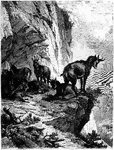
The chamois (Rupicapra rupicapra) is a goat-like animal, living at moderately high altitudes and are adapted to living in steep, rugged, rocky terrain. A fully grown chamois reaches a height of about 2&frac12; feet and weighs about 110 pounds. Males and females have short horns which are slightly curled in the posterior direction. In summer, the fur has a rich brown colour which turns to a light grey in winter. Distinct characteristics are a white face with pronounced black infraorbital stripes, a white rump and a black dorsal stripe. Chamois can reach an age of up to 20 years. Female chamois and their young live in herds; adult males tend to live solitarily for most of the year. During the rut (late November/early December in Europe, May in New Zealand), males engage in fierce battles for the attention of unbred females. An impregnated female undergoes a gestation period of 20 weeks, after which a single kid is born. The kid is fully grown by three years of age.

Chamois

The chamois (Rupicapra rupicapra) is a goat-like animal, living at moderately high altitudes and are…
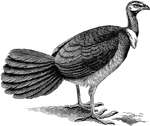
"Catheturus lathami, the "Brush Turkey" of Eastern Australia, is blackish-brown with greyish under surface, shewing conspicuous light margins to the feathers. It has a bright yellow neck-wattle, forms mounds of earth and decayed leaves, sometimes as much as six feet high and fourteen feet in diameter at the base, and covers the course outer layers with fresh leaves and sticks." A. H. Evans, 1900

Brush Turkey

"Catheturus lathami, the "Brush Turkey" of Eastern Australia, is blackish-brown with greyish under surface,…
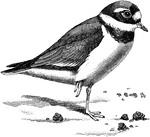
"Aegialitis hiaticola, the Ringed Plover, Sand-Lark, or Stone-runner, mistakenly called the "Ring-Dotterel" which is common on the British coasts and even inland, extends from Smith's Sound eastward to Bering Strait, and migrates to South Africa, North India, or accidentally, Australia. It breeds as far south as the Atlantic Islands, North Africa, and Turkestan. The plumage is light brown, with white forehead, post-ocular streak, upper neck, alar bar, outer rectrices, and under surface; the crown, lores, cheeks, and a collar-broader in front-being black. The young lack the black crown." A. H. Evans, 1900

Ringed Plover

"Aegialitis hiaticola, the Ringed Plover, Sand-Lark, or Stone-runner, mistakenly called the "Ring-Dotterel"…
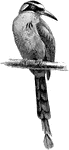
"Momotus brasiliensis, the Motmot, from Guiana to Northern Brazil, is somewhat similar in colour (to the Eumomota superciliaris), but has little red on the back; the head is cobalt-blue with black on the crown and sides; the under parts are green with rufous tinge. the long throat-feathers are black with light blue edges." A. H. Evans, 1900

Motmot

"Momotus brasiliensis, the Motmot, from Guiana to Northern Brazil, is somewhat similar in colour (to…
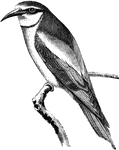
"Merops Apiaster, the Bee-eater, has ruddy-brown head, neck, upper back, and broad alar bar, buff lower back, green wings and tail with black tips to the long median rectrices, light blue upper tail-coverts, pale green and white forehead, black ear-coverts, and bright yellow throat, divided from the greenish-blue under parts by a black band." A. H. Evans, 1900

Bee Eater

"Merops Apiaster, the Bee-eater, has ruddy-brown head, neck, upper back, and broad alar bar, buff lower…
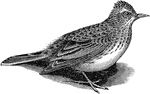
"Alauda arvensis, the Sky-Lark, breed in Britain. The normal coloration is light-brown with darker longitudinal streaks, the under parts being whitish and frequently spotted anteriorly." A. H. Evans, 1900

Skylark

"Alauda arvensis, the Sky-Lark, breed in Britain. The normal coloration is light-brown with darker longitudinal…
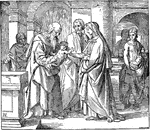
"Then took he him up in his arms, and blessed God, and said, Lord, now lettest thou thy servant depart in peace, according to thy word: For mine eyes have seen thy salvation, Which thou hast prepared before the face of all people; A light to lighten the Gentiles, and the glory of thy people Israel. And Joseph and his mother marvelled at those things which were spoken of him. 3And Simeon blessed them, and said unto Mary his mother, Behold, this child is set for the fall and rising again of many in Israel; and for a sign which shall be spoken against." Luke 2:28-34 KJV

Simeon Taking the Child in His Arms

"Then took he him up in his arms, and blessed God, and said, Lord, now lettest thou thy servant depart…
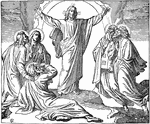
"And after six days Jesus taketh Peter, James, and John his brother, and bringeth them up into an high mountain apart, And was transfigured before them: and his face did shine as the sun, and his raiment was white as the light." Matthew 17:1-2 KJV

The Transfiguration

"And after six days Jesus taketh Peter, James, and John his brother, and bringeth them up into an high…
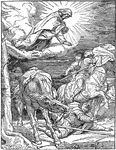
"And as he journeyed, he came near Damascus: and suddenly there shined round about him a light from heaven: And he fell to the earth, and heard a voice saying unto him, Saul, Saul, why persecutest thou me?" Acts 9:3-4 KJV

Saul Struck to the Earth on His Way to Damascus

"And as he journeyed, he came near Damascus: and suddenly there shined round about him a light from…
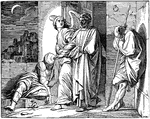
"And, behold, the angel of the Lord came upon him, and a light shined in the prison: and he smote Peter on the side, and raised him up, saying, Arise up quickly. And his chains fell off from his hands." Acts 12:7

Peter Delivered from Prison by an Angel

"And, behold, the angel of the Lord came upon him, and a light shined in the prison: and he smote Peter…
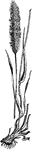
The Meadow Foxtail (Alopecurus pratensis) has an erect, smooth stem, two or three feet high with swelling sheaths. The spikes are cylindrical and obtuse. The awn is twisted and twice the length of the blossom. It has only one palea. The spike or head of the Meadow Foxtail is soft. There are few light stems and leaves. It thrives best in rich, moist strong soil.

Meadow Foxtail Grass

The Meadow Foxtail (Alopecurus pratensis) has an erect, smooth stem, two or three feet high with swelling…
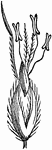
The Meadow Foxtail (Alopecurus pratensis)has an erect, smooth stem, two or three feet high with swelling sheaths. The spikes are cylindrical and obtuse. The awn is twisted and twice the length of the blossom. It has only one palea. The spike or head of the Meadow Foxtail is soft. There are few light stems and leaves. It thrives best in rich, moist strong soil, and flowers from late spring to early summer.

Meadow Foxtail Grass

The Meadow Foxtail (Alopecurus pratensis)has an erect, smooth stem, two or three feet high with swelling…

Wood Meadow Grass (Poa nemoralis) grows from eighteen inches to two feet high. It has a perennial, creeping root and an erect, slender, smooth stem. The upper sheath is no longer than its leaf, with a very short ligule, the base of the floret having a silky web suspending the calyx. The leaves are light green. The grass is common in light shady places and appears as a tall, rank grass, with a long, finely-arched panicle.

Wood Meadow Grass

Wood Meadow Grass (Poa nemoralis) grows from eighteen inches to two feet high. It has a perennial, creeping…
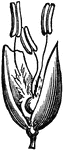
Wood Meadow Grass (Poa nemoralis) grows from eighteen inches to two feet high. It has a perennial, creeping root and an erect, slender, smooth stem. The upper sheath is no longer than its leaf, with a very short ligule, the base of the floret having a silky web suspending the calyx. The leaves are light green. The grass is common in light shady places and appears as a tall, rank grass, with a long, finely-arched panicle. It flowers in July. A magnified flower is seen here.

Wood Meadow Grass

Wood Meadow Grass (Poa nemoralis) grows from eighteen inches to two feet high. It has a perennial, creeping…
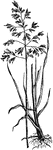
June grass (Poa prstensis) is also known as Green Meadow grass, Common Spear Grass, Kentucky Blue grass. The lower florets in the June Grass are connected at the base by a web of long silky filaments holding the calyx. The outter palea is five-ribbed with the marginal ribs hairy. The upper sheath is longer than its leaf. June Grass grows from ten to fifteen inches with and erect, smooth, round stem. The root is perennial and creeping. The plants grows a light greenish color while the spikelets are brownsh purple.

June Grass

June grass (Poa prstensis) is also known as Green Meadow grass, Common Spear Grass, Kentucky Blue grass.…
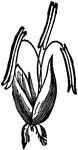
June grass (Poa prstensis) is also known as Green Meadow grass, Common Spear Grass, Kentucky Blue grass. The lower florets in the June Grass are connected at the base by a web of long silky filaments holding the calyx. The outter palea is five-ribbed with the marginal ribs hairy. The upper sheath is longer than its leaf. June Grass grows from ten to fifteen inches with and erect, smooth, round stem. The root is perennial and creeping. The plants grows a light greenish color while the spikelets are brownsh purple. Shown here is a magnified flower.

June Grass

June grass (Poa prstensis) is also known as Green Meadow grass, Common Spear Grass, Kentucky Blue grass.…
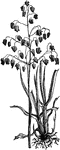
Quaking Grass (Briza media) has an erect panicle with very slender spreading branches. The spikelets are large and purplish, from five to nine flowered. The inner glume is finely fringed and entired at the end. The grass is very light and slender and flowers in June and July. It grows about a foot high and is perennial.

Quaking Grass

Quaking Grass (Briza media) has an erect panicle with very slender spreading branches. The spikelets…
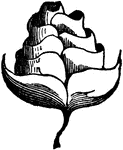
Quaking Grass (Briza media) has an erect panicle with very slender spreading branches. The spikelets (magnified here) are large and purplish, from five to nine flowered. The inner glume is finely fringed and entired at the end. The grass is very light and slender and flowers in June and July. It grows about a foot high and is perennial.

Quaking Grass

Quaking Grass (Briza media) has an erect panicle with very slender spreading branches. The spikelets…