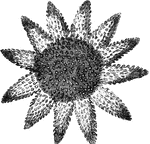
"The colors in this are variable but brilliant - red, purple, green, and white. It measures from nine to twelve inches across, and feeds ravenously on shell-fish." — Goodrich, 1859

Common European sea-star

"The colors in this are variable but brilliant - red, purple, green, and white. It measures from nine…
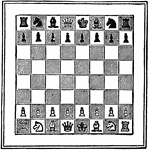
"Chess is the most purely intellectual of all games of skill, the origin of which has been much disputed, but probably arose in India 5,000 years ago, and thence spread through Persia and Arabia, to Europe and America. The game has undergone many modifications during its diffusion throughout the world, but retains marked traces of its Oriental origin. The game is played by two persons on a board which consists of 64 squares, arranged in 8 rows of 8 squares each, alternately black and white. Each player has two sets of pieces of opposite colors of 16 men each, and of various powers, according to their rank."—(Charles Leonard-Stuart, 1911)

Chess Board

"Chess is the most purely intellectual of all games of skill, the origin of which has been much disputed,…
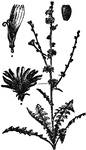
Chicory is a flowering plant with blue flowers, originally from the Old World but now seen growing wild as a weed in North America.

Chicory

Chicory is a flowering plant with blue flowers, originally from the Old World but now seen growing wild…
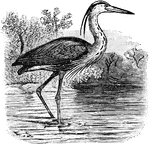
"Great Blue Heron (Ardea herodias)."-Whitney, 1902

Great Blue Heron

"Great Blue Heron (Ardea herodias)."-Whitney, 1902

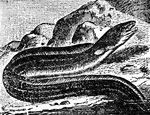
"Conger is a large sea-eel, 5, 6, or, in rare cases, even 10 feet long. Its upper parts are brownish-white, and the lower dirty-white; the lateral line spotted with white, the dorsal and anal fins white margined with black. A smaller species is found in the Mediterranean."—(Charles Leonard-Stuart, 1911)

Conger Eel

"Conger is a large sea-eel, 5, 6, or, in rare cases, even 10 feet long. Its upper parts are brownish-white,…
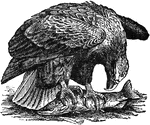
"Eagle is a name given to many birds of prey in the family Falconidæ. The golden eagle, the white-headed eagle, and the sea eagles are characteristic examples. The white-tailed or sea eagles are absent only in South America."—(Charles Leonard-Stuart, 1911)

Sea Eagle

"Eagle is a name given to many birds of prey in the family Falconidæ. The golden eagle, the white-headed…
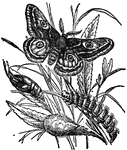
"The Emperor Moth, the general color greyish, with white hairs and purple tinges; wings with a hinder white band. Two white-purplish and dark-brown transverse stripes and an ocellus on each wing. Expansion of wings in the female occasionally three inches, but in the male only two and a half. The caterpillar feeds on the common ling or heath, on the black-thorn, the bramble, etc."—(Charles Leonard-Stuart, 1911)

Emperor Moth

"The Emperor Moth, the general color greyish, with white hairs and purple tinges; wings with a hinder…
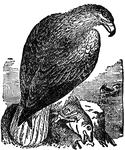
"The Erne is one of the 'bare-legged' eagles. The genus includes some seven species, represented apparently in all parts of the world except South America. A notable species is the white-headed or bald eagle, the emblem of the United States. This erne is common in North America, both by the coasts and by inland lakes, and also occurs in Northern Europe. The general color is brown, but the head and neck of the adults are milky-white, and the same is true of the rounded tail."—(Charles Leonard-Stuart, 1911)

Erne

"The Erne is one of the 'bare-legged' eagles. The genus includes some seven species, represented apparently…
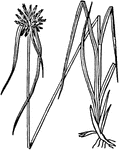
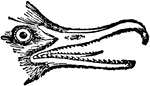
Spikelets subtended by conspicuous white or partly white bracts.

Dichromena

Spikelets subtended by conspicuous white or partly white bracts.

"The Goosander is a web-footed bird in the duck family. The adult male, which measures 26 inches in length, has the head and upper part of the neck of a rich shining green, the feathers of the crown and back of the head elongated, the back black and gray, the wings black and white, the breast and belly of a delicate reddish-buff color. The bill, legs, and feet are orange-red. the female, which is rather smaller, has the head reddish-brown, with a less decided tuft than the male, and much grayer plumage. The goosander is a native of the Arctic regions, extending into the temperate parts of America, Europe and Asia."—(Charles Leonard-Stuart, 1911)

Goosander

"The Goosander is a web-footed bird in the duck family. The adult male, which measures 26 inches in…
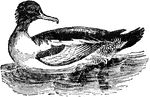
"The Goosander is a web-footed bird in the duck family. The adult male, which measures 26 inches in length, has the head and upper part of the neck of a rich shining green, the feathers of the crown and back of the head elongated, the back black and gray, the wings black and white, the breast and belly of a delicate reddish-buff color. The bill, legs, and feet are orange-red. the female, which is rather smaller, has the head reddish-brown, with a less decided tuft than the male, and much grayer plumage. The goosander is a native of the Arctic regions, extending into the temperate parts of America, Europe and Asia."—(Charles Leonard-Stuart, 1911)

Goosander

"The Goosander is a web-footed bird in the duck family. The adult male, which measures 26 inches in…
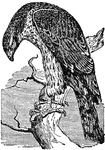
"Goshawk, or Goshauk (properly goose-hawk) is a bird of prey. It is brown above, white underneath, barred across with brown, with five browner bands on the tail; the eyelids whitish. When immature it has dots instead of bars. The female is 24 or 25 inches long, the male almost one-third less. It pursues its prey directly, instead of swooping down on it from above like a Falcon."—(Charles Leonard-Stuart, 1911)

Goshawk

"Goshawk, or Goshauk (properly goose-hawk) is a bird of prey. It is brown above, white underneath, barred…
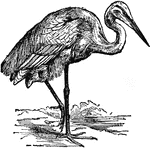
"Heron is the common name of birds of the genus Ardea. The herons are distinguished by having a long bill cleft beneath the eyes, a compressed body, long slender legs naked above the tarsal joint, three toes in front, the two outer united by a membrane, and by moderate wings. The tail is short, rounded, and composed of 10 or 12 feathers. The common heron is about three feet in length from the point of the bill to the end of the tail, builds its nest in high trees, many being sometimes on one tree. Its food consists of fish, frogs, mollusks, mice, moles, and similar small animals. It has an insatiable voracity, and digests its food with great rapidity. It haunts fresh water streams, marshes, ponds, and lakes, as also the seashore."—(Charles Leonard-Stuart, 1911)

Heron

"Heron is the common name of birds of the genus Ardea. The herons are distinguished by having a long…
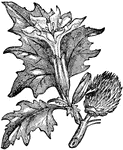
"Thorn Apple is a genus of plants. The common thorn apple is an annual plant, with smooth stem and leaves, white flowers, and erect prickly capsules, a native of the East Indies, but now often met with in North America. A variety with pale violet flowers and purplish violet stem is frequently cultivated in gardens as an ornamental plant."—(Charles Leonard-Stuart, 1911)

Thorn Apple

"Thorn Apple is a genus of plants. The common thorn apple is an annual plant, with smooth stem and leaves,…
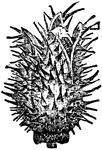
"Thorn Apple is a genus of plants. The common thorn apple is an annual plant, with smooth stem and leaves, white flowers, and erect prickly capsules, a native of the East Indies, but now often met with in North America. A variety with pale violet flowers and purplish violet stem is frequently cultivated in gardens as an ornamental plant."—(Charles Leonard-Stuart, 1911)

Thorn Apple Bud

"Thorn Apple is a genus of plants. The common thorn apple is an annual plant, with smooth stem and leaves,…
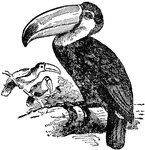
"The Toucan, in ornithology, is the popular name of any bird of the genus Rhamphastos. They are all natives of tropical America, and are easily distinguished by their enormous bill, irregularly toothed along the margin of the mandibles. In the true toucans the ground color of the plumage is generally black; the throat, breast, and rump adorned with white, yellow, and red; the body is short and thick; tail rounded or even, varying in length in the different species, and capable of being turned up over the back when the bird goes to roost."—(Charles Leonard-Stuart, 1911)

Toucan

"The Toucan, in ornithology, is the popular name of any bird of the genus Rhamphastos. They are all…
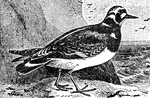
"Turnstone is a small genus of birds of the plover family, intermediate between the true plovers and sandpipers. In winter the turnstone is found on the seashore all over the world, being probably the most cosmopolitan of all birds. It derives its name from its habit of turning over stones with its bill in search of its food, which consists of small crustaceans and mollusks. The common turnstone is nine inches in length, and is handsomely marked with black, white, and chestnut; the last-named color is reduced in autumn, when the plumage becomes duller; the legs and feet are orange."—(Charles Leonard-Stuart, 1911)

Turnstone

"Turnstone is a small genus of birds of the plover family, intermediate between the true plovers and…
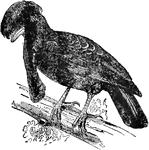
"The Umbrella Bird is a native of Peru. It is about the size of a crow, with deep black plumage; the head is adorned with a large spreading crest, which arises from a contractile skin, and capable of being erected at will; the shafts of the crest-feathers are white, and the plumes glossy blue, hair-like and curved outward at the tips. When the crest is laid back the shafts form a compact white mass, sloping up from the back of the head; when it is erected the shafts radiate on all sides from the top of the head, reaching in front beyond and below the beak, which is thus completely concealed from view. A long cylindrical plume hangs down from the middle of the neck; the feathers of the plume lap over each other like scales, and are bordered with metallic blue. Umbrella birds associate in small flocks, and live almost entirely upon fruits. Their cry, which resembles the lowing of a cow, is most frequently heard just before sunrise and after sunset."—(Charles Leonard-Stuart, 1911)

Umbrellabird

"The Umbrella Bird is a native of Peru. It is about the size of a crow, with deep black plumage; the…
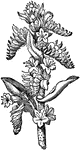
"Viper's Bugloss is a genus of plants. The species are large herbaceous plants or shrubs, rough with tubercles and hairs. Their flowers are often very beautiful. the common viper's bugloss, a large annual plant, is a native of Great Britain and of most parts of Europe growing in dry places, not infrequently in cornfields. Its flowers are at first reddish, and afterward blue. It derives its name, viper's bugloss, from spots on its stem, which somehat resemble those of the viper, and the property of healing viper's bites was therefore ascribed to it. Other herbaceous species are found in North and South America, and other parts of the world. Shrubby species are found chiefly in the Canaries and South Africa."—(Charles Leonard-Stuart, 1911)

Viper's Bugloss

"Viper's Bugloss is a genus of plants. The species are large herbaceous plants or shrubs, rough with…
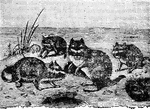
"Viscacha is a stout-built rodent, resembling a marmot, from 18 inches to two feet long, exclusive of the tail, which is from six to eight inches. Four digits on the fore and three on the hind limbs, the latter furnished with long, compressed and pointed nails; muzzle broad, and covered with a velvet-like coat of brown hair; fur mottled gray above, yellowish-white beneath; dark band on each cheek, a white band on muzzle, running back on each side almost as far as the eye. They are nocturnal, and resemble rabbits in their movements, but are less active. They are found on the pampas, from Buenos Ayres to Patagonia. These animals have the strange habit of dragging all sorts of hard and apparently useless objects to the mouth of their burrow, where bones, stones, thistle stalks, and lumps of earth may be found collected into a large heap, sufficient, according to Darwin to fill a wheel-barrow."—(Charles Leonard-Stuart, 1911)

Viscacha

"Viscacha is a stout-built rodent, resembling a marmot, from 18 inches to two feet long, exclusive of…
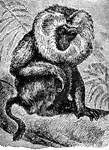
"The Wanderoo, or Wanderu, is the Macacus silenus, from the S. of Hindustan, especially the country bordering the Malabar coast. It is about 2 feet in length, tail 10 to 12 inches. The Wanderoos have long, slim bodies, covered with black hair, tail of the same color, tufted. The head looks very large because of a mane, or ruff, and beard which sticks out round the face. This mass of long hair is either gray or white, and adds to the sly look of the broad face, soft dull eyes, and broad muzzle."—(Charles Leonard-Stuart, 1911)

Wanderoo

"The Wanderoo, or Wanderu, is the Macacus silenus, from the S. of Hindustan, especially the country…
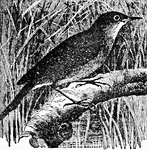
"Warbler is a popular name often applied to well-known singing birds of northern climes, whose notes are heard in wood, and hedge, and orchard, many of which commonly receive other popular names, as the blackcap, nightingale, hedgesparrow, redbreast, redstart, stonechat, wheatear, whitethroat, etc., while many receive the name warbler with some adjunct– reed warbler, etc. The more typical genera comprise birds of small size and plain plumage, usually alike in both sexes; most of them are migratory, going a long way S. of their breeding haunts to winter. Numerous species of warblers are found in North America, as suburban and country residents know, when the sunshine of May ushers in the summertime. They are birds of brighter plumage than the Old World warblers, but resemble them in their habits, and are also migrants."—(Charles Leonard-Stuart, 1911)

Reed Warbler

"Warbler is a popular name often applied to well-known singing birds of northern climes, whose notes…
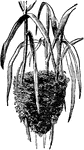
"Warbler is a popular name often applied to well-known singing birds of northern climes, whose notes are heard in wood, and hedge, and orchard, many of which commonly receive other popular names, as the blackcap, nightingale, hedgesparrow, redbreast, redstart, stonechat, wheatear, whitethroat, etc., while many receive the name warbler with some adjunct– reed warbler, etc. The more typical genera comprise birds of small size and plain plumage, usually alike in both sexes; most of them are migratory, going a long way S. of their breeding haunts to winter. Numerous species of warblers are found in North America, as suburban and country residents know, when the sunshine of May ushers in the summertime. They are birds of brighter plumage than the Old World warblers, but resemble them in their habits, and are also migrants."—(Charles Leonard-Stuart, 1911)

Nest of Reed Warbler

"Warbler is a popular name often applied to well-known singing birds of northern climes, whose notes…
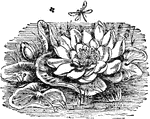
"The Water Lily is an exogenous aquatic plant including eight genera, and all possessing submerged root stocks. They are found in all temperate climates, and attain great size in the tropics. The white water lily is the familiar flower of ponds and placid streams throughout North America, its large and chaste flowers claiming precedence for beauty among the indigenous flora."—(Charles Leonard-Stuart, 1911)

White Water Lily

"The Water Lily is an exogenous aquatic plant including eight genera, and all possessing submerged root…
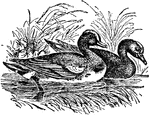
"Wigeon is one of the most popular birds with the American sportsman. Length about eighteen inches; the male has the forehead and top of head white, cheeks and hinged part of the neck reddish-chestnut, upper parts grayish-white, irregularly zigzagged with black, wing coverts white tipped with black, primaries dark brown, speculum green, edged with black; throat rufous, breast and belly white; the female has sober plumage of various shades of brown. The wigeon is one of the commonest ducks of the extreme N. of Europe, frequenting grassy swamps, lakes, and rivers, and feeding in the daytime, chiefly on aquatic vegetation. The American wigeon is larger than the European or common wigeon, and has the upper parts finely waved transversely with black and reddish-brown, top of head and under parts white. It breeds chiefly in the N. parts of America and is common in winter on the coasts of the United States and in the rice fields. The flesh of both species is esteemed for the table, and they are hunted both for food and for sport."—(Charles Leonard-Stuart, 1911)

Wigeon

"Wigeon is one of the most popular birds with the American sportsman. Length about eighteen inches;…
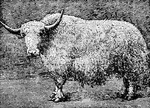
"Yak is a species of ox from the mountainous regions of Tibet. There are two races: the wild yak, generally black, which is found near the snow line, descending into the valleys in winter, and a domesticated race of various colors, black and white being most common. The yak is about the size of the common ox, to which it has a general resemblance, but it is covered with a thick coat of long, silky hair, hanging down like the fleece of a sheep, completely investing the tail, and forming a lengthy fringe along the shoulders, flanks, and thighs. This fringe, which exists in both races, was apparently developed as a protection to the animal, as the long hair forms a sort of mat which defends the body from the effects of the cold when the animal is reposing in the snow. The domesticated race is of great importance to the natives of Tibet. The yak is employed as a beast of burden, but never for tillage or draught; the milk is very rich, and yields excellent butter; the flesh is of the finest quality, and that of the calves far superior to ordinary veal. The hair is spun into ropes, and made into coverings for tents, and the soft fur of the hump and withers is woven into a fine strong cloth. The tails, often dyed red, are made into the chowries or fly-flappers, used in India. Yaks are often seen in zoological gardens and menageries."—(Charles Leonard-Stuart, 1911)

Yak

"Yak is a species of ox from the mountainous regions of Tibet. There are two races: the wild yak, generally…
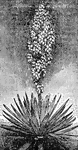
"Yucca is a genus of American plants, natural order Liliaceæ popularly known as Adam's needle. They are evergreen shrubs, their stem tending to arborescence, crowned by a circle of linear, lanceolate, rigid leaves, from the center of which rises a large panicle of snow-white, whitish-green or cream-colored flowers."—(Charles Leonard-Stuart, 1911)

Yucca

"Yucca is a genus of American plants, natural order Liliaceæ popularly known as Adam's needle.…
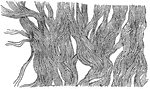
"The connective tissue with white fibers sometimes forms a very thin sheet, as in the delicate covering of a bone known as the periosteum, or it may be made up into ropelike bands, as in the ligaments of joints and the tendons of muscles." — Blaisedell, 1904

White fibrous tissue

"The connective tissue with white fibers sometimes forms a very thin sheet, as in the delicate covering…
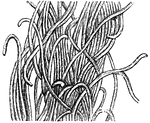
"Along with white fibrous tissue, the yellow fibrous tissue... makes the coats of the arteries, and certain ligaments, elastic." — Blaisedell, 1904

Yellow elastic tissue

"Along with white fibrous tissue, the yellow fibrous tissue... makes the coats of the arteries, and…
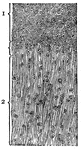
"Showing (1) cartilage with martrix and cells; (2) cartilage with matrix containing cells and white fibers." — Blaisedell, 1904

Longitudinal section of cartilage

"Showing (1) cartilage with martrix and cells; (2) cartilage with matrix containing cells and white…
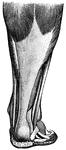
"Tendons are white, glistening cords, or straps, which connect the muscles with the bones." — Blaisedell, 1904

Achillles tendon

"Tendons are white, glistening cords, or straps, which connect the muscles with the bones." —…
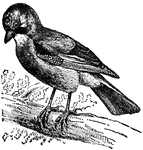
"Jay is the popular name of a species of birds belonging to the crow family, of a vinous red color; the back pale gray; the rump and upper tail coverts white; the tail black or gray, with bluish-gray bars; the wing coverts light gray, in the median series light gray inclining to chestnut; the bastard wing or primary coverts barred with black or bright cobalt blue; headed with an erectile crest; forehead white, streaked with black. Length about 13 inches. It is a beautiful bird, but attacks peas and other garden crops, to which it is very destructive, especially in the vicinity of woods and forests, alnd also easts worms, larvæ, and snails. It is often kept as a cage bird. The common blue jay is found over a large portion of North and South America. The green jay of the Unites States is well known."—(Charles Leonard-Stuart, 1911)

Jay

"Jay is the popular name of a species of birds belonging to the crow family, of a vinous red color;…
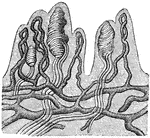
"In each papilla are seen vascular loops (dark lines) running up from the vascular network below; the tactile corpuscules (white lines) which supply the papillae are also shown." — Blaisedell, 1904

Papillae of the skin

"In each papilla are seen vascular loops (dark lines) running up from the vascular network below; the…
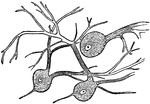
"Wherever nerve cells are abundant, the nerve tissue has a gray color; in other places, it looks white. Most of the gray matter of the brain is on the surface." — Blaisedell, 1904

Nerve Cells of the Brain

"Wherever nerve cells are abundant, the nerve tissue has a gray color; in other places, it looks white.…

"The axis cylinder is in the center. On either side is seen the medullary sheath, represented by dark lines. The primitive sheath, or neurilemma, is on the outside and represented by white lines in which is a nerve corpuscle with an oval nucleus." — Blaisedell, 1904

Portion of a medullated nerve fiber

"The axis cylinder is in the center. On either side is seen the medullary sheath, represented by dark…
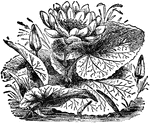
"Lotus is a name given to various flowers, including several beautiful species of water lily, especially the blue water lily, and the Egyptian water lily which grow in stagnant and slowly running water in the S. of Asia and N. of Africa. The latter grows in the Nile and adjacent rivulets and has a large white flower. The root is eaten by the people who live near the lake Manzaleh. It was the rose of ancient Egypt, the favorite flower of the country, and was often made into wreaths or garlands."—(Charles Leonard-Stuart, 1911)

Egyptian Water Lily

"Lotus is a name given to various flowers, including several beautiful species of water lily, especially…
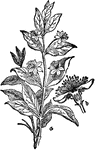
"Myrtle is a genus of plants, natural order Myrtaceæ, consisting of aromatic trees or shrubs, with simple opposite leaves sprinkled with pellucid glandular points, and having axillary or terminal white or rose colored flowers. One species, common myrtle, is a native of the south of Europe and countries bordering on the Mediterranean."—(Charles Leonard-Stuart, 1911)

Myrtle

"Myrtle is a genus of plants, natural order Myrtaceæ, consisting of aromatic trees or shrubs,…
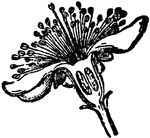
"Myrtle is a genus of plants, natural order Myrtaceæ, consisting of aromatic trees or shrubs, with simple opposite leaves sprinkled with pellucid glandular points, and having axillary or terminal white or rose colored flowers. One species, common myrtle, is a native of the south of Europe and countries bordering on the Mediterranean."—(Charles Leonard-Stuart, 1911)

Myrtle Flower

"Myrtle is a genus of plants, natural order Myrtaceæ, consisting of aromatic trees or shrubs,…
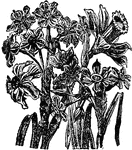
"Narcissus is an extensive genus of bulbous plants. The species are numerous, and from their hardiness, delicate shape, gay yellow or white flowers, and smell, have long been favorite objects of cultivation, especially the daffodil, the jonquil, polyanthus, narcissus, and white narcissus."—(Charles Leonard-Stuart, 1911)

Narcissus

"Narcissus is an extensive genus of bulbous plants. The species are numerous, and from their hardiness,…
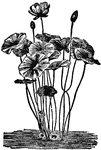
"Nelumbium is the typical and only genus of the order Nelumbiaceæ. The species are remarkable for the beauty of their flowers. N. speciosum has magnificent flowers, magenta or white. It does not now grow in Egypt, but is found in India. The rhizome, stalks, and seeds are eaten by the Hindus. A fiber derived from the stalk is used as a wick for lamps in Hindu temples, the plant being considered sacred. The North American Indians eat the rhizomes of N. luteum."—(Charles Leonard-Stuart, 1911)

Nelumbium

"Nelumbium is the typical and only genus of the order Nelumbiaceæ. The species are remarkable…
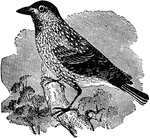
"The Nut Cracker is a bird of Southern Europe. They feed on the seeds of pine and beech, and on nuts, which they fix in some convenient crevice and hammer with the beak till the kernel is exposed. The plumage is of different shades of brown, studded with long white spots."—(Charles Leonard-Stuart, 1911)

Nutcracker

"The Nut Cracker is a bird of Southern Europe. They feed on the seeds of pine and beech, and on nuts,…
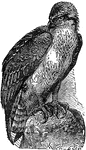
"The Osprey, the fish hawk, bald buzzard, or fishing eagle. A bird of prey, of almost world wide distribution usually near the seashore, and, unlike rapacious birds generally, are in some measure gregarious. In North America large communities of ospreys are found, and the purple grakle often builds close by. The osprey lays three or four eggs of a rich red to buffy white, with large reddish and brown markings."—(Charles Leonard-Stuart, 1911)

Osprey

"The Osprey, the fish hawk, bald buzzard, or fishing eagle. A bird of prey, of almost world wide distribution…
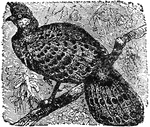
"The Pheasant is one of the most highly prized game birds. The adult male pheasant is a beautiful bird, about three feet long. Head and neck deep steel-blue, shot with greenish-purple and brown; eye surrounded by a patch of scarlet skin, speckled with blue-black; ear-coverts brown; back a light golden-red, the feathers of the upper part tipped with velvet-black, the lower part marked with brown. Quill feathers brown, of various shades, tail feathers oaken-brown, barred with a darker shade and with black. Breast and front of the abdomen golden-red with purple reflections, feathers edged with black; rest of abdomen and under tail-coverts blackish-brown. The female has yellowish-brown plumage, and is about two feet in length. Such is the common pheasant. There are several other species."—(Charles Leonard-Stuart, 1911)

Pheasant

"The Pheasant is one of the most highly prized game birds. The adult male pheasant is a beautiful bird,…
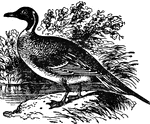
"The Pintail Duck has the upper parts and flanks ash, with narrow stripes of black; under parts white; head umber-brown; tail pointed. It inhabits the N. of America and Europe."—(Charles Leonard-Stuart, 1911)

Pintail Duck

"The Pintail Duck has the upper parts and flanks ash, with narrow stripes of black; under parts white;…
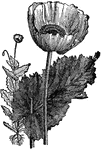
"Poppy is a genus of plants, of which there are numerous species, mostly natives of Europe and Asia, some of them found in the very N. regions, but most of them in the warmer temperate parts. By far the most important species is that known as the opium poppy, also called the white poppy and the oil poppy. But the same species is important on account of the bland fixed oil of the seeds, and is much cultivated as an oil plant. Poppy oil is as sweet as olive oil, and is used for similar purposes. It is imported into the United States in considerable quantities from India. A variety with double flowers is cultivated in flower gardens, under the name of carnation poppy. <em>a,</em> whole plant"&mdash;(Charles Leonard-Stuart, 1911)

Opium Poppy

"Poppy is a genus of plants, of which there are numerous species, mostly natives of Europe and Asia,…
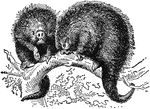
"The Porcupine is a rodent quadruped. The North American porcupine is about two feet long, and of sluggish habits. The quills are short, and concealed among the fur, and the tail is short. The 'tree porcupine' of South America has a prehensile tail, about 10 inches long. The porcupine of Southern Europe and Africa is about 28 inches long, exclusive of the tail. The head, fore quarters, and under surface are clothed with short spines, intermixed with hairs, crest on head and neck, hind quarters covered with long sharp spines, ringed with black and white, and erectile at will. They are but loosely attached to the skin and readily fall out, a circumstance which probably gave rise to the belief that the animal was able to project them at an enemy."&mdash;(Charles Leonard-Stuart, 1911)

Prehensile Tailed Porcupine

"The Porcupine is a rodent quadruped. The North American porcupine is about two feet long, and of sluggish…
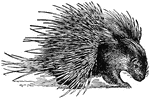
"The Porcupine is a rodent quadruped. The North American porcupine is about two feet long, and of sluggish habits. The quills are short, and concealed among the fur, and the tail is short. The 'tree porcupine' of South America has a prehensile tail, about 10 inches long. The porcupine of Southern Europe and Africa is about 28 inches long, exclusive of the tail. The head, fore quarters, and under surface are clothed with short spines, intermixed with hairs, crest on head and neck, hind quarters covered with long sharp spines, ringed with black and white, and erectile at will. They are but loosely attached to the skin and readily fall out, a circumstance which probably gave rise to the belief that the animal was able to project them at an enemy."&mdash;(Charles Leonard-Stuart, 1911)

Hystrix Crystata Porcupine

"The Porcupine is a rodent quadruped. The North American porcupine is about two feet long, and of sluggish…
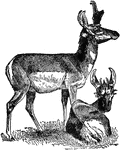
"The Prong-horn Antelope inhabits the W. parts of North America, from 53 degrees N. to the plains of Mexico and California. It is rather more than four feet in length, and stands three feet at the shoulder. Pale fawn above and on the limbs; breast, abdomen, and rump white. The horns are branched, and are shed annually."&mdash;(Charles Leonard-Stuart, 1911)

Prong-horn Antelope

"The Prong-horn Antelope inhabits the W. parts of North America, from 53 degrees N. to the plains of…
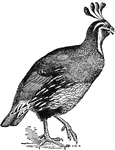
"The Quail is a small game bird; the Virginia species is common in North America, and so far south as Honduras. It is larger than the European quail, and is better eating. The California crested quail is another American species. THe quail, genus Coturnix, is widely distributed over the Eastern Hemisphere, visiting Europe in early summer and returning S. in the autumn, when immense numbers are caught and fattened for the market. Length about seven inches, general color reddish-brown, with buff streaks on the upper surface; throat rufous; head, dark brown above, striped with ocherous white, sides reddish-brown, lower parts pale buff, fading into white on belly. Color less bright in the hen bird, and the rufous tinge absent from the throat. They nest on the ground, laying from 9 to 15 pyriform, yellowish-white eggs, blotched with dark-brown. The males are polygamous and extremely pugnacious."&mdash;(Charles Leonard-Stuart, 1911)

Lophortyx Californicus Quail

"The Quail is a small game bird; the Virginia species is common in North America, and so far south as…
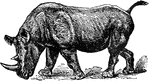
"Rhinoceros Atelodus, with two well-marked species, peculiar to Africa. Incisors rudimentary or wanting, well-developed anterior and posterior horns in close contact; skin without definite permanent folds. R. bicornis, the common two-horned rhinoceros, is the smaller, and has a pointed prehensile lip. It ranges from Abyssinia to Cape Colony, but the progress of civilization and the attacks of sportsmen are rapidly reducing its numbers. Two varieties are said to exist, the square-mouthed, or white rhinoceros, has a square truncated lip, browses on grasses and frequents open country. It is the largest of the family, an adult male standing over six feet at the shoulder."&mdash;(Charles Leonard-Stuart, 1911)

Rhinoceros Bicornis

"Rhinoceros Atelodus, with two well-marked species, peculiar to Africa. Incisors rudimentary or wanting,…
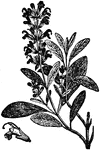
"Sage is a plant much used for flavoring meats, etc. It has blue flowers, and has run into many varieties. The Chinese use it as a tonic for debility of the stomach and nerves."&mdash;(Charles Leonard-Stuart, 1911)

Sage

"Sage is a plant much used for flavoring meats, etc. It has blue flowers, and has run into many varieties.…
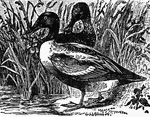
"The Shoveler is the broadbill or spoonbill duck, widely distributed over the Northern Hemisphere. Length about 20 inches; bill much widened on each side near tip, somewhat resembling that of the spoonbill; head and upper part of neck in adult male rich green, lower part white, back brown, breast and abdomen chestnut brown."&mdash;(Charles Leonard-Stuart, 1911)

Shoveler Duck

"The Shoveler is the broadbill or spoonbill duck, widely distributed over the Northern Hemisphere. Length…
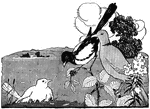
Scene from the story, "The White Blackbird."

White Blackbird

Scene from the story, "The White Blackbird."

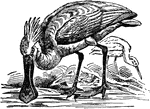
"Spoonbill is the popular name of the birds of the genus Platalea, belonging to the heron family (Ardeid&aelig;), order Grallatores, from the shape of the bill, which is somewhat like a spoon, being curiously widened out at the tip. Live in society in wooded marshes, and on the sea-shore. Adult male is about 32 inches long; plumage white with pale pink tinge; at the junction of the neck with the breast there is a band of buffy yellow; the naked skin on the throat is yellow; legs and feet black; bill about eight inches long, very much flattened and grooved at the base, the expanded portion yellow, the rest black. There is a white occipital crest in both sexes. The spoonbill possesses no power of modulating its voice. The windpipe is bent on itself, like the figure 8 , the coils applied to each other and held in place by a thin membrane. This peculiarity does not exist in young birds. The roseate spoonbill, a native of the United States, has rose-colored plumage."&mdash;(Charles Leonard-Stuart, 1911)

Spoonbill

"Spoonbill is the popular name of the birds of the genus Platalea, belonging to the heron family (Ardeidæ),…
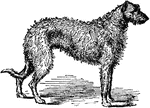
"The Staghound is the Scotch deerhound, called also the wolf dog, a breed that is rapidly dying out. These dogs hunt chiefly by sight and are used for stalking deer, for which purpose a cross between the rough Scotch greyhound and colley or the foxhound is also often employed. True staghounds are wiry-coated, shaggy, generally yellowish-gray, but the most valuable are dark iron-gray, with white breast."—(Charles Leonard-Stuart, 1911)

Staghound

"The Staghound is the Scotch deerhound, called also the wolf dog, a breed that is rapidly dying out.…
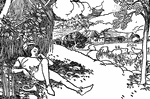
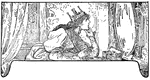
Little Boy Blue

Little Boy Blue

Little Boy Blue

Scene from the story, "Snow-White."

Snow-White

Scene from the story, "Snow-White."

Scene from the story, "Snow-White."

Snow-White

Scene from the story, "Snow-White."

Scene from the story, "The Blue Light."

Blue Light

Scene from the story, "The Blue Light."

"The Taj Mahal, or Mehal, ('Gem of Buildings'), is a famous mausoleum, erected at Agra, India, by Shah Jehan for his favorite wife. It is 186 feet square with the corners cut off, and consists of two tiers of arches, with a single-arched porch in the middle of each side, the whole surmounted by a dome 58 feet in diameter and about 210 feet in height, flanked by four octagonal kiosks. The interior is divided into four domed chambers in the corners, and a large central arcaded octagon, all connecting by corridors. The central octagon contains two cenotaphs surrounded by a very noticeable openwork marble rail. The only light admitted enters through the delicately pierced marble screens of the windows. The decoration is especially noticeable for the stone mosaics of flower themes and arabesques, much of them in agate, jasper, and bloodstone. The entire structure stands on a white marble platform 18 feet high and 313 feet square, with tapering cylindrical minarets 133 feet high at the corners."&mdash;(Charles Leonard-Stuart, 1911)

Taj Mahal

"The Taj Mahal, or Mehal, ('Gem of Buildings'), is a famous mausoleum, erected at Agra, India, by Shah…