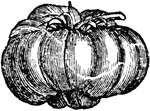
"Tomato, or Love Apple, is a plant of the natural order Solanaceæ. It is one of a genus of several species, all natives of South America, chiefly on the Peruvian side. In the United States and other countries in which the summer is warm and prolonged, it has long been cultivated for the excellent qualities of the fruit as an article of diet. Though belonging to a natural order of plants usually regarded with suspicion on account of the powerfully poisonous properties of many of the species comprised in it, it is now recognized as one of the most important and valuable of vegetables grown for human food."—(Charles Leonard-Stuart, 1911)

Tomato

"Tomato, or Love Apple, is a plant of the natural order Solanaceæ. It is one of a genus of several…
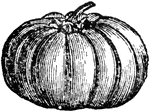
"Tomato, or Love Apple, is a plant of the natural order Solanaceæ. It is one of a genus of several species, all natives of South America, chiefly on the Peruvian side. In the United States and other countries in which the summer is warm and prolonged, it has long been cultivated for the excellent qualities of the fruit as an article of diet. Though belonging to a natural order of plants usually regarded with suspicion on account of the powerfully poisonous properties of many of the species comprised in it, it is now recognized as one of the most important and valuable of vegetables grown for human food."—(Charles Leonard-Stuart, 1911)

Tomato

"Tomato, or Love Apple, is a plant of the natural order Solanaceæ. It is one of a genus of several…

"Tuberose (Polianthus) is a genus of plants of the natural order Liliaceæ. The plant is in high esteem for the beauty and fragrance of its flowers, the odor of which is most powerful after sunset. The fading flowers emit, in certain states of the atmosphere, an electric light and sparks. The native country of the tuberose is Mexico. They are very extensively grown by American and British florists, who, by planting the roots successionally, manage to keep up a supply of flowers at all seasons. There are several varieties."—(Charles Leonard-Stuart, 1911)

Double Tuberose

"Tuberose (Polianthus) is a genus of plants of the natural order Liliaceæ. The plant is in high…
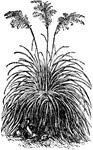
"Tussock Grass is a large grass, same genus with the cock's-foot grass of the United States; native of the Falkland Islands, Fuegia, and South Patagonia. It grows in great tufts or tussocks sometimes five or six feet in height, the long tapering leaves hanging over in graceful curves. The plant is a useful food for cattle."—(Charles Leonard-Stuart, 1911)

Tussock Grass

"Tussock Grass is a large grass, same genus with the cock's-foot grass of the United States; native…
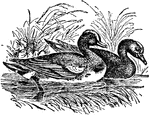
"Wigeon is one of the most popular birds with the American sportsman. Length about eighteen inches; the male has the forehead and top of head white, cheeks and hinged part of the neck reddish-chestnut, upper parts grayish-white, irregularly zigzagged with black, wing coverts white tipped with black, primaries dark brown, speculum green, edged with black; throat rufous, breast and belly white; the female has sober plumage of various shades of brown. The wigeon is one of the commonest ducks of the extreme N. of Europe, frequenting grassy swamps, lakes, and rivers, and feeding in the daytime, chiefly on aquatic vegetation. The American wigeon is larger than the European or common wigeon, and has the upper parts finely waved transversely with black and reddish-brown, top of head and under parts white. It breeds chiefly in the N. parts of America and is common in winter on the coasts of the United States and in the rice fields. The flesh of both species is esteemed for the table, and they are hunted both for food and for sport."—(Charles Leonard-Stuart, 1911)

Wigeon

"Wigeon is one of the most popular birds with the American sportsman. Length about eighteen inches;…
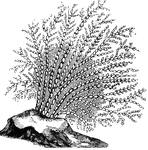
"In the family of the Gorgonidae the substance of the polypidom is collected into a solid central axis, covered by the fleshy mass in which the polypes are imbedded. The axis is cometimes calcareous, sometimes horny; in certain casees it is formed of a series of joints united by horny rings. Many species grow in a more or less aborescent form, of which the <em>Sea-Fans</em> are an example." &mdash; Goodrich, 1859

Sea-fan

"In the family of the Gorgonidae the substance of the polypidom is collected into a solid central axis,…
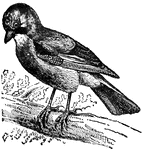
"Jay is the popular name of a species of birds belonging to the crow family, of a vinous red color; the back pale gray; the rump and upper tail coverts white; the tail black or gray, with bluish-gray bars; the wing coverts light gray, in the median series light gray inclining to chestnut; the bastard wing or primary coverts barred with black or bright cobalt blue; headed with an erectile crest; forehead white, streaked with black. Length about 13 inches. It is a beautiful bird, but attacks peas and other garden crops, to which it is very destructive, especially in the vicinity of woods and forests, alnd also easts worms, larv&aelig;, and snails. It is often kept as a cage bird. The common blue jay is found over a large portion of North and South America. The green jay of the Unites States is well known."&mdash;(Charles Leonard-Stuart, 1911)

Jay

"Jay is the popular name of a species of birds belonging to the crow family, of a vinous red color;…

"The Statue of Lberty is a colossal statue on Bedloe's Island, N.Y. On Oct. 28, 1886, after more than 12 years of preparation, the colossal statue of Liberty, given by the people of France to the United States, was dedicated and unveiled in New York harbor. The statue was the conception of M. Bartholdi, who designed it for the Franco-American Union in 1874. It was built by popular subscriptions of the people of France."&mdash;(Charles Leonard-Stuart, 1911)

Statue of Liberty

"The Statue of Lberty is a colossal statue on Bedloe's Island, N.Y. On Oct. 28, 1886, after more than…

"The Military Order of the Loyal Legion is the first society formed by officers honorably discharged from the service of the United States in the Civil War. On the day after the assassination of President Lincoln, Col. S. B. Wylie Mitchell, Capt. Peter D. Keyser, M. D., and Lieut.-Col. T. Ellwood Zell met in Philadelphia to arrange for a meeting of ex-officers of the army and navy to adopt resolutions relative to the death of President Lincoln. It was decided to effect a permanent organization, and an adjourned meeting was held for this purpose in Philadelphia, May 3, 1865. Total membership of its three classes, over 8,500."&mdash;(Charles Leonard-Stuart, 1911)

Badge of the Loyal Legion

"The Military Order of the Loyal Legion is the first society formed by officers honorably discharged…
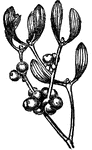
"Mistletoe is a plant parasitic on the apple and other fruit trees, on the thorn, the oak, the poplar, the lime, the ash, etc. It sometimes kills the branch or even the tree on which it is a parasite. Found in the United States, also in Europe, and the N. of Asia. It was deemed sacred by the Druids, and still finds a large market in the United States and England when preparation is being made for Christmas festivities ad sports. Bird lime is made from the berries."&mdash;(Charles Leonard-Stuart, 1911)

Mistletoe

"Mistletoe is a plant parasitic on the apple and other fruit trees, on the thorn, the oak, the poplar,…

"New York is a city in Southern New York; coextensive with New York, Kings, Queens, and Richmond counties, on New York Bay, the Hudson and East rivers, Long Island Sound and the Atlantic Ocean; the first city in the United States in population and commercial importance, and after London, the largest metropolitan center in the world. Among the public buildings is the City Hall, 216 by 105 feet, and three stories high: completed in 1812 at a cost of $500,000. In the rear of the City Hall is the Court House."—(Charles Leonard-Stuart, 1911)

City Hall of New York

"New York is a city in Southern New York; coextensive with New York, Kings, Queens, and Richmond counties,…
"New York is a city in Southern New York; coextensive with New York, Kings, Queens, and Richmond counties, on New York Bay, the Hudson and East rivers, Long Island Sound and the Atlantic Ocean; the first city in the United States in population and commercial importance, and after London, the largest metropolitan center in the world. New York is noted for the number and height of its office buildings. In 1911 there were 50 such structures in occupancy, ranging from 14 to 50 stories in height, or from 179 to 700 feet above ground level, and 16 more were nearing completion. The tallest building was that of the Metropolitan Life Insurance Company, 700 and one quarter feet to top of lantern on its majestic tower. Other conspicuous ones [include the] Park Row, 382 [feet]."&mdash;(Charles Leonard-Stuart, 1911)

Park Row Building of New York

"New York is a city in Southern New York; coextensive with New York, Kings, Queens, and Richmond counties,…

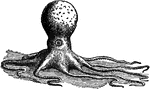
"The Octopus is the typical genus of the family Octopodid&aelig;. The body is oval, warty, or cirrose, finless; arms long, unequal, suckers in two rows, mantle supported in front by the branchial septum. In the male the third right arm is hectocotylized. Found on the coasts of the temperate and tropical zones. Forty-six species are known, varying in length from one inch only to a number of feet. They are solitary animals, frequenting rocky shores, and are very active and voracious, the females oviposit on seaweeds or in empty shells. The term 'octopus' is applied in the United States to monopolies supposed to resemble the octopus in their grasping and voracious character."&mdash;(Charles Leonard-Stuart, 1911)

Octopus

"The Octopus is the typical genus of the family Octopodidæ. The body is oval, warty, or cirrose,…
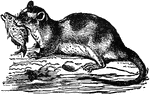
"Opossom is the popular name for the pouched mammals which have a geographical range from the United States to Patagonia. They vary from the size of a mouse to that of a large cat, and have long noses, ears, and (generally) naked prehensile tails. The Virginian opossum, common over all temperate America, is the best-known of the family, and is found even in towns, where it acts as a scavenger by night. The crab-eating opossom inhabits Central and tropical South America."&mdash;(Charles Leonard-Stuart, 1911)

Water Opossom

"Opossom is the popular name for the pouched mammals which have a geographical range from the United…

"Greek Philosophy, which reached its highest excellence in Athens in the fourth century before Christ, had its origin two hundred years earlier i nthe ourlying settlements of the Hellenic race in Asia Minor, Thrace, Sicily, and Southern Italy, rather than in Greece proper. The founding of colonies and frequent changes of government in the older states led thoughtful men to study the constitution of man and of society." &mdash; The Delphian Society, 1913

Greek philosophers

"Greek Philosophy, which reached its highest excellence in Athens in the fourth century before Christ,…
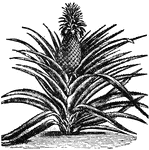
"Pineapple is a plant of the natural order Bromeliac&aelig;. The flowers rise from the center of the plant, and are in a large conical spike, surmounted by spiny leaves called the crown. The conical spike of flowers ultimately becomes enlarged and juicy, constituting the pineapple, considered one of the finest of fruits. More than 50 varieties have been produced. The plant grows in the S. portion of the United States and in Hawaii. In the islands they sometimes reach the weight of 17 pounds, though the average weight is six. Since 1883 there have been large exports of this fruit from the various islands."&mdash;(Charles Leonard-Stuart, 1911)

Pineapple

"Pineapple is a plant of the natural order Bromeliacæ. The flowers rise from the center of the…
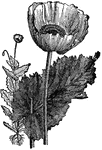
"Poppy is a genus of plants, of which there are numerous species, mostly natives of Europe and Asia, some of them found in the very N. regions, but most of them in the warmer temperate parts. By far the most important species is that known as the opium poppy, also called the white poppy and the oil poppy. But the same species is important on account of the bland fixed oil of the seeds, and is much cultivated as an oil plant. Poppy oil is as sweet as olive oil, and is used for similar purposes. It is imported into the United States in considerable quantities from India. A variety with double flowers is cultivated in flower gardens, under the name of carnation poppy. <em>a,</em> whole plant"&mdash;(Charles Leonard-Stuart, 1911)

Opium Poppy

"Poppy is a genus of plants, of which there are numerous species, mostly natives of Europe and Asia,…
"Porcelain is a fictile material intermediate between glass and pottery, being formed of two substances, fusible and infusible, the latter enabling it to withsantd the heat necessary to vitrify the former, thus producing its peculiar semi-translucency. The infusible material is alumina, called kaolin; the fusible substance is felspar, and is called pe-tun-tse, both Chinese terms. Large quantities of porcelain are produced in New Jersy, Ohio, and other states, while European porcelain, and Chinese and Japanese ware, are famous."&mdash;(Charles Leonard-Stuart, 1911)

Porcelain Marks

"Porcelain is a fictile material intermediate between glass and pottery, being formed of two substances,…

"Porcelain is a fictile material intermediate between glass and pottery, being formed of two substances, fusible and infusible, the latter enabling it to withsantd the heat necessary to vitrify the former, thus producing its peculiar semi-translucency. The infusible material is alumina, called kaolin; the fusible substance is felspar, and is called pe-tun-tse, both Chinese terms. Large quantities of porcelain are produced in New Jersy, Ohio, and other states, while European porcelain, and Chinese and Japanese ware, are famous."&mdash;(Charles Leonard-Stuart, 1911)

Porcelain Marks

"Porcelain is a fictile material intermediate between glass and pottery, being formed of two substances,…

"Porcelain is a fictile material intermediate between glass and pottery, being formed of two substances, fusible and infusible, the latter enabling it to withsantd the heat necessary to vitrify the former, thus producing its peculiar semi-translucency. The infusible material is alumina, called kaolin; the fusible substance is felspar, and is called pe-tun-tse, both Chinese terms. Large quantities of porcelain are produced in New Jersy, Ohio, and other states, while European porcelain, and Chinese and Japanese ware, are famous."&mdash;(Charles Leonard-Stuart, 1911)

Porcelain Marks

"Porcelain is a fictile material intermediate between glass and pottery, being formed of two substances,…

"Porcelain is a fictile material intermediate between glass and pottery, being formed of two substances, fusible and infusible, the latter enabling it to withsantd the heat necessary to vitrify the former, thus producing its peculiar semi-translucency. The infusible material is alumina, called kaolin; the fusible substance is felspar, and is called pe-tun-tse, both Chinese terms. Large quantities of porcelain are produced in New Jersy, Ohio, and other states, while European porcelain, and Chinese and Japanese ware, are famous."&mdash;(Charles Leonard-Stuart, 1911)

Porcelain Marks

"Porcelain is a fictile material intermediate between glass and pottery, being formed of two substances,…

"Porcelain is a fictile material intermediate between glass and pottery, being formed of two substances, fusible and infusible, the latter enabling it to withsantd the heat necessary to vitrify the former, thus producing its peculiar semi-translucency. The infusible material is alumina, called kaolin; the fusible substance is felspar, and is called pe-tun-tse, both Chinese terms. Large quantities of porcelain are produced in New Jersy, Ohio, and other states, while European porcelain, and Chinese and Japanese ware, are famous."&mdash;(Charles Leonard-Stuart, 1911)

Porcelain Marks

"Porcelain is a fictile material intermediate between glass and pottery, being formed of two substances,…
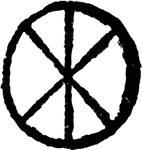
"Porcelain is a fictile material intermediate between glass and pottery, being formed of two substances, fusible and infusible, the latter enabling it to withsantd the heat necessary to vitrify the former, thus producing its peculiar semi-translucency. The infusible material is alumina, called kaolin; the fusible substance is felspar, and is called pe-tun-tse, both Chinese terms. Large quantities of porcelain are produced in New Jersy, Ohio, and other states, while European porcelain, and Chinese and Japanese ware, are famous."&mdash;(Charles Leonard-Stuart, 1911)

Porcelain Marks

"Porcelain is a fictile material intermediate between glass and pottery, being formed of two substances,…
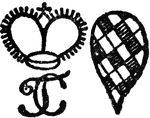
"Porcelain is a fictile material intermediate between glass and pottery, being formed of two substances, fusible and infusible, the latter enabling it to withsantd the heat necessary to vitrify the former, thus producing its peculiar semi-translucency. The infusible material is alumina, called kaolin; the fusible substance is felspar, and is called pe-tun-tse, both Chinese terms. Large quantities of porcelain are produced in New Jersy, Ohio, and other states, while European porcelain, and Chinese and Japanese ware, are famous."&mdash;(Charles Leonard-Stuart, 1911)

Porcelain Marks

"Porcelain is a fictile material intermediate between glass and pottery, being formed of two substances,…
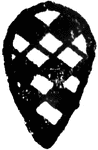
"Porcelain is a fictile material intermediate between glass and pottery, being formed of two substances, fusible and infusible, the latter enabling it to withsantd the heat necessary to vitrify the former, thus producing its peculiar semi-translucency. The infusible material is alumina, called kaolin; the fusible substance is felspar, and is called pe-tun-tse, both Chinese terms. Large quantities of porcelain are produced in New Jersy, Ohio, and other states, while European porcelain, and Chinese and Japanese ware, are famous."&mdash;(Charles Leonard-Stuart, 1911)

Porcelain Marks

"Porcelain is a fictile material intermediate between glass and pottery, being formed of two substances,…
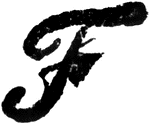
"Porcelain is a fictile material intermediate between glass and pottery, being formed of two substances, fusible and infusible, the latter enabling it to withsantd the heat necessary to vitrify the former, thus producing its peculiar semi-translucency. The infusible material is alumina, called kaolin; the fusible substance is felspar, and is called pe-tun-tse, both Chinese terms. Large quantities of porcelain are produced in New Jersy, Ohio, and other states, while European porcelain, and Chinese and Japanese ware, are famous."&mdash;(Charles Leonard-Stuart, 1911)

Porcelain Marks

"Porcelain is a fictile material intermediate between glass and pottery, being formed of two substances,…
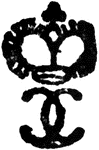
"Porcelain is a fictile material intermediate between glass and pottery, being formed of two substances, fusible and infusible, the latter enabling it to withsantd the heat necessary to vitrify the former, thus producing its peculiar semi-translucency. The infusible material is alumina, called kaolin; the fusible substance is felspar, and is called pe-tun-tse, both Chinese terms. Large quantities of porcelain are produced in New Jersy, Ohio, and other states, while European porcelain, and Chinese and Japanese ware, are famous."&mdash;(Charles Leonard-Stuart, 1911)

Porcelain Marks

"Porcelain is a fictile material intermediate between glass and pottery, being formed of two substances,…

"Porcelain is a fictile material intermediate between glass and pottery, being formed of two substances, fusible and infusible, the latter enabling it to withsantd the heat necessary to vitrify the former, thus producing its peculiar semi-translucency. The infusible material is alumina, called kaolin; the fusible substance is felspar, and is called pe-tun-tse, both Chinese terms. Large quantities of porcelain are produced in New Jersy, Ohio, and other states, while European porcelain, and Chinese and Japanese ware, are famous."&mdash;(Charles Leonard-Stuart, 1911)

Porcelain Marks

"Porcelain is a fictile material intermediate between glass and pottery, being formed of two substances,…

"Porcelain is a fictile material intermediate between glass and pottery, being formed of two substances, fusible and infusible, the latter enabling it to withsantd the heat necessary to vitrify the former, thus producing its peculiar semi-translucency. The infusible material is alumina, called kaolin; the fusible substance is felspar, and is called pe-tun-tse, both Chinese terms. Large quantities of porcelain are produced in New Jersy, Ohio, and other states, while European porcelain, and Chinese and Japanese ware, are famous."&mdash;(Charles Leonard-Stuart, 1911)

Porcelain Marks

"Porcelain is a fictile material intermediate between glass and pottery, being formed of two substances,…
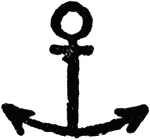
"Porcelain is a fictile material intermediate between glass and pottery, being formed of two substances, fusible and infusible, the latter enabling it to withsantd the heat necessary to vitrify the former, thus producing its peculiar semi-translucency. The infusible material is alumina, called kaolin; the fusible substance is felspar, and is called pe-tun-tse, both Chinese terms. Large quantities of porcelain are produced in New Jersy, Ohio, and other states, while European porcelain, and Chinese and Japanese ware, are famous."&mdash;(Charles Leonard-Stuart, 1911)

Porcelain Marks

"Porcelain is a fictile material intermediate between glass and pottery, being formed of two substances,…

"Porcelain is a fictile material intermediate between glass and pottery, being formed of two substances, fusible and infusible, the latter enabling it to withsantd the heat necessary to vitrify the former, thus producing its peculiar semi-translucency. The infusible material is alumina, called kaolin; the fusible substance is felspar, and is called pe-tun-tse, both Chinese terms. Large quantities of porcelain are produced in New Jersy, Ohio, and other states, while European porcelain, and Chinese and Japanese ware, are famous."&mdash;(Charles Leonard-Stuart, 1911)

Porcelain Marks

"Porcelain is a fictile material intermediate between glass and pottery, being formed of two substances,…

"Porcelain is a fictile material intermediate between glass and pottery, being formed of two substances, fusible and infusible, the latter enabling it to withsantd the heat necessary to vitrify the former, thus producing its peculiar semi-translucency. The infusible material is alumina, called kaolin; the fusible substance is felspar, and is called pe-tun-tse, both Chinese terms. Large quantities of porcelain are produced in New Jersy, Ohio, and other states, while European porcelain, and Chinese and Japanese ware, are famous."&mdash;(Charles Leonard-Stuart, 1911)

Porcelain Marks

"Porcelain is a fictile material intermediate between glass and pottery, being formed of two substances,…
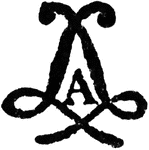
"Porcelain is a fictile material intermediate between glass and pottery, being formed of two substances, fusible and infusible, the latter enabling it to withsantd the heat necessary to vitrify the former, thus producing its peculiar semi-translucency. The infusible material is alumina, called kaolin; the fusible substance is felspar, and is called pe-tun-tse, both Chinese terms. Large quantities of porcelain are produced in New Jersy, Ohio, and other states, while European porcelain, and Chinese and Japanese ware, are famous."&mdash;(Charles Leonard-Stuart, 1911)

Porcelain Marks

"Porcelain is a fictile material intermediate between glass and pottery, being formed of two substances,…
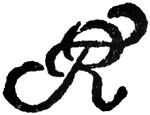
"Porcelain is a fictile material intermediate between glass and pottery, being formed of two substances, fusible and infusible, the latter enabling it to withsantd the heat necessary to vitrify the former, thus producing its peculiar semi-translucency. The infusible material is alumina, called kaolin; the fusible substance is felspar, and is called pe-tun-tse, both Chinese terms. Large quantities of porcelain are produced in New Jersy, Ohio, and other states, while European porcelain, and Chinese and Japanese ware, are famous."&mdash;(Charles Leonard-Stuart, 1911)

Porcelain Marks

"Porcelain is a fictile material intermediate between glass and pottery, being formed of two substances,…

"Porcelain is a fictile material intermediate between glass and pottery, being formed of two substances, fusible and infusible, the latter enabling it to withsantd the heat necessary to vitrify the former, thus producing its peculiar semi-translucency. The infusible material is alumina, called kaolin; the fusible substance is felspar, and is called pe-tun-tse, both Chinese terms. Large quantities of porcelain are produced in New Jersy, Ohio, and other states, while European porcelain, and Chinese and Japanese ware, are famous."&mdash;(Charles Leonard-Stuart, 1911)

Porcelain Marks

"Porcelain is a fictile material intermediate between glass and pottery, being formed of two substances,…

"Porcelain is a fictile material intermediate between glass and pottery, being formed of two substances, fusible and infusible, the latter enabling it to withsantd the heat necessary to vitrify the former, thus producing its peculiar semi-translucency. The infusible material is alumina, called kaolin; the fusible substance is felspar, and is called pe-tun-tse, both Chinese terms. Large quantities of porcelain are produced in New Jersy, Ohio, and other states, while European porcelain, and Chinese and Japanese ware, are famous."&mdash;(Charles Leonard-Stuart, 1911)

Porcelain Marks

"Porcelain is a fictile material intermediate between glass and pottery, being formed of two substances,…

"Porcelain is a fictile material intermediate between glass and pottery, being formed of two substances, fusible and infusible, the latter enabling it to withsantd the heat necessary to vitrify the former, thus producing its peculiar semi-translucency. The infusible material is alumina, called kaolin; the fusible substance is felspar, and is called pe-tun-tse, both Chinese terms. Large quantities of porcelain are produced in New Jersy, Ohio, and other states, while European porcelain, and Chinese and Japanese ware, are famous."&mdash;(Charles Leonard-Stuart, 1911)

Porcelain Marks

"Porcelain is a fictile material intermediate between glass and pottery, being formed of two substances,…
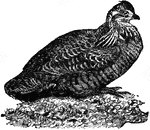
"Prairie Chicken is the popular name of the pinnated grouse of the United States. The neck of the male is furnished with tufts of 18 feathers, and is remarkable also for two loose, pendulous, wrinkled skins, which somewhat resemble an orange on inflation. The prairie hen is much prized for the table."&mdash;(Charles Leonard-Stuart, 1911)

Prairie Chicken

"Prairie Chicken is the popular name of the pinnated grouse of the United States. The neck of the male…

"The bow used for shooting arrows, is one of the most ancient of all weapons, but is characteristic of Asia rather than of Europe. In the Roman armies it was scarcely ever employed except by auxiliaries; and these auxiliaries, called sagittarii, were chiefly Cretans and Arabians. This image shows the usual form of the Grecian bow, which had a double curvature, consisting of two circular portions united by the handle. When not used the bow was put into a case which was made of leather, and sometimes ornamented." &mdash; Smith, 1873

Arcus

"The bow used for shooting arrows, is one of the most ancient of all weapons, but is characteristic…
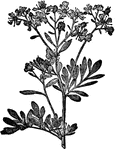
"The common rue is a half-shrubby plant, two or three feet high, of a fetid odor and an acrid taste. The bluish-green leaves are pinnate, the flowers yellow; a native of Southern Europe but grown in gardens in the United States, the East and West Indies, etc."&mdash;(Charles Leonard-Stuart, 1911)

Rue

"The common rue is a half-shrubby plant, two or three feet high, of a fetid odor and an acrid taste.…
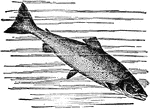
"The Salmon is a well-known fish, inhabiting both salt and fresh waters, and ranking prominent among the food fishes of the United States and other countries. It generally attains a length of from three to four feet, and an average weight of from 12 to 30 pounds. In the fall the salmon ascends rivers for the purpose of spawning, and often encounters obstacles. In many streams they are assisted by structures known as 'salmon ladders.'"&mdash;(Charles Leonard-Stuart, 1911)

Salmon

"The Salmon is a well-known fish, inhabiting both salt and fresh waters, and ranking prominent among…
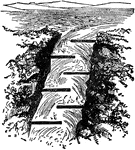
"The Salmon is a well-known fish, inhabiting both salt and fresh waters, and ranking prominent among the food fishes of the United States and other countries. It generally attains a length of from three to four feet, and an average weight of from 12 to 30 pounds. In the fall the salmon ascends rivers for the purpose of spawning, and often encounters obstacles. In many streams they are assisted by structures known as 'salmon ladders.'"&mdash;(Charles Leonard-Stuart, 1911)

Salmon Ladder

"The Salmon is a well-known fish, inhabiting both salt and fresh waters, and ranking prominent among…
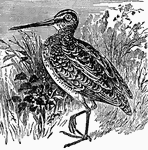
"Snipe is the name of a common family of birds. The common American snipe is about equal in size to the common snipe of Europe, and much resembles it also in plumage. The tail has 16 feathers. This species is abundant in summer in the N. parts of the United States and in Canada, and in the more S. States in winter. It is much in request for the table, and is often caught in snares. It is much esteemed as a delicious and well-flavored dish."&mdash;(Charles Leonard-Stuart, 1911)

Snipe

"Snipe is the name of a common family of birds. The common American snipe is about equal in size to…
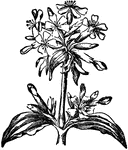
"Soapwort (Saponaria), a genus of plants of the natural order Caryophyllace&aelig;; so called because the bruised leaves produce a lather like soap when agitated in the water. Common soapwort grows by the roadside in the United States from New England to Georgia. It is a native of many parts of Europe, and is found on way sides, river banks, and thickets; in Great Britain it is found in alluvial meadows and under hedges. It has handsome pink-like flowers."&mdash;(Charles Leonard-Stuart, 1911)

Soapwort

"Soapwort (Saponaria), a genus of plants of the natural order Caryophyllaceæ; so called because…
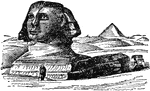
"Sphinx is a Greek word signifying 'strangler,' applied to certain symbolical forms of Egyptian origin, having the body of a lion, a human or an animal head, and two wings. Various other combinations of animal forms have been called by this name, though they are rather griffins or chim&aelig;ras. Human-headed sphinxes have been called andro-sphinxes; that with the head of a ram, a criosphinx; and that with a hawk's head, a hieracosphinx. The form when complete had the wings added at the sides; but these are of a later period and seem to have originated with the Babylonians or Assyrians. In Egypt the sphinx also occurs as the symbolical form of the monarch considered as a conqueror, the head of the reigning king being placed on a loin's body, the face bearded, and the usual head dress. Thus used, the sphinx was generally male; but in the case of female rulers that figure has a female head and the body of a lioness. The most remarkable sphinx is the Great Sphinx at Gizeh (Giza), a colossal form hewn out of the natural rock, and lying about a quarter of a mile S.E. of the Great Pyramid. It is sculptured out of a spur of the rock itself, to which masonry has been added in certain places to complete the shape, and it measures 172 feet 6 inches long by 56 feet high."&mdash;(Charles Leonard-Stuart, 1911)

Sphinx

"Sphinx is a Greek word signifying 'strangler,' applied to certain symbolical forms of Egyptian origin,…
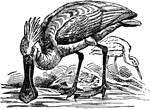
"Spoonbill is the popular name of the birds of the genus Platalea, belonging to the heron family (Ardeid&aelig;), order Grallatores, from the shape of the bill, which is somewhat like a spoon, being curiously widened out at the tip. Live in society in wooded marshes, and on the sea-shore. Adult male is about 32 inches long; plumage white with pale pink tinge; at the junction of the neck with the breast there is a band of buffy yellow; the naked skin on the throat is yellow; legs and feet black; bill about eight inches long, very much flattened and grooved at the base, the expanded portion yellow, the rest black. There is a white occipital crest in both sexes. The spoonbill possesses no power of modulating its voice. The windpipe is bent on itself, like the figure 8 , the coils applied to each other and held in place by a thin membrane. This peculiarity does not exist in young birds. The roseate spoonbill, a native of the United States, has rose-colored plumage."&mdash;(Charles Leonard-Stuart, 1911)

Spoonbill

"Spoonbill is the popular name of the birds of the genus Platalea, belonging to the heron family (Ardeidæ),…
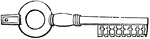
"A key. The key was used in very early times, and was probably introduced into Greece from Egypt; although Eustathius states, that in early times all fastenings were made by chains, and that keys were comparatively of a much later invention, which invention he attributes to the Laconians. We have no evidence respecting the materials of which the Greeks made their keys, but among te Romans the larger and coarser sort were made of iron. Those discovered at Pompeii and elsewhere are mostly of bronze. The annexed woodcut represents a key found at Pompeii, the size of which indicated that it was used as a door key." &mdash; Smith, 1873

Clavis

"A key. The key was used in very early times, and was probably introduced into Greece from Egypt; although…

"The principal silver coin among the Greeks. The two chief standards in the currencies of the Greek states were the Attic and Aeginetan." &mdash; Smith, 1873. This image shows Attic Drachma.

Drachma

"The principal silver coin among the Greeks. The two chief standards in the currencies of the Greek…
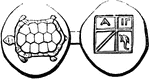
"The principal silver coin among the Greeks. The two chief standards in the currencies of the Greek states were the Attic and Aeginetan." &mdash; Smith, 1873. This image shows Aeginetan Drachma.

Drachma

"The principal silver coin among the Greeks. The two chief standards in the currencies of the Greek…
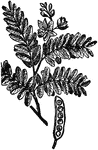
"The Tamarind is an evergreen tree, 80 feet high by 25 in circumference, cultivated in India as far N. as the Jhelum, and very largely planted in avenues and 'topes.' The wood, which is yellowish-white, sometimes with red streaks, is hard and close-grained. It weighs about 83 pounds per cubic foot, is highly prized, but is very difficult to work, and is used in India for turning wheels, mallets, planes, furniture, rice-pounders, oil and sugar mills, etc. The West Indian and South American variety has legumes only three times as long as the broad, whereas the Indian tree has them six times as long. The tamarinds sold in the United States are chiefly West Indian tamarinds. They differ from the Black or East Indian tamarinds, of which the preserved pulp is black."&mdash;(Charles Leonard-Stuart, 1911)

Tamarind

"The Tamarind is an evergreen tree, 80 feet high by 25 in circumference, cultivated in India as far…
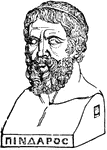
"Pindar, though the contemporary of Simonides, was considerably his junior. He was born either at, or in the neighborhood of Thebes in Baeotia, about the year 522 B.C. Later writers tell us that his future glory as a poet was miraculously foreshadowed by a swarm of bees which rested upon his lips when he was asleep, and that this miracle first led him to compose poetry. He commenced his profesional career at an early age, and soon acquired so great a reputation, that he was employed by various states and princes of the Hellenic race to compose choral songs." &mdash; Smith, 1882

Bust of Pindar

"Pindar, though the contemporary of Simonides, was considerably his junior. He was born either at, or…
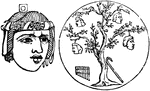
"A diminutive through osculum from os, meaning "a little face," was the term applied to faces or heads of Bacchus, which were suspended in the vineyards to be turned in every direction by the wind. Whichsoever way they looked they were supposed to make, the vines in that quarter fruitful. The figure represents the countenance of Bacchus with a beautiful, mild, and propitious expression. the other figure represents a tree with four oscilla hung upon its branches. A syrinx and a pedum are placed at the root of the tree." &mdash; Smith, 1873

Oscillum

"A diminutive through osculum from os, meaning "a little face," was the term applied to faces or heads…
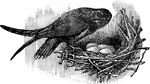
A well known black chimney swift of the United States. So called because the shafts of the tail feathers project beyond the webs in a hard, sharp point or mucro.

Spine Tailed Chimney Swift

A well known black chimney swift of the United States. So called because the shafts of the tail feathers…
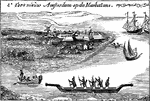

Earliest picture of New Amsterdam

New Amsterdam

Earliest picture of New Amsterdam

A clock that says it is quarter past 12

Quarter Past 12

A clock that says it is quarter past 12

A clock that says it is quarter to 1

Quarter to 1

A clock that says it is quarter to 1

The front of a French gold coin first issued by Louis IX. in the thirteenth century. It was equal to aout three United States gold dollars.

Chaise

The front of a French gold coin first issued by Louis IX. in the thirteenth century. It was equal to…

The rear of a French gold coin first issued by Louis IX. in the thirteenth century. It was equal to aout three United States gold dollars.

Chaise

The rear of a French gold coin first issued by Louis IX. in the thirteenth century. It was equal to…
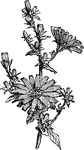
A composite plant common in waste places, found throughout Europe and Asia as far as India, and naturalized in the United States.

Chicory

A composite plant common in waste places, found throughout Europe and Asia as far as India, and naturalized…
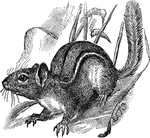
A name of a hackee or chirping squirrel of the United States. usually a small striped species about 6 inches long, with a tail about 4 inches long. it is reddish brown in the upper parts and has two white stripes and four black ones on the sides.

Chipmunk

A name of a hackee or chirping squirrel of the United States. usually a small striped species about…