"Camp Dennison, sixteen miles above Cincinnati, on the banks of the Miami River, General Cox commanding- the Cleveland, Cincinnati and Columbus Railroad passed directly through the camp grounds. This camp, which was organized for a camp of instruction and drill, was situated about sixteen miles above Cincinnati, on a field of seventy-five acres, on the banks of the Miami River, surrounded by high bluffs. The Cleveland, Cincinnati and Columbus Railroad passed directly through the grounds, and this road was guarded for miles by sentries in order to watch bridges, telegraph wires and culverts, as spies were infesting the whole country. There were 18,000 men in camp, including the splendid Kentucky Regiment of Guthrie Grays, and quarters were erected for 20,000 men, who were soon on the ground. The tents were rough-board shanties, but were comfortable, and the officers had marquees erected in the rear of the regimental quarters. This brigade was under the command of General Cox, a West Point officer, and under the immediate supvervision of General George B. McClellan. It was in a beautiful location, and the troops were kept under a very strict surveillance, there being but few spectators allowed to visit the ground." — Frank Leslie, 1896

Camp Dennison

"Camp Dennison, sixteen miles above Cincinnati, on the banks of the Miami River, General Cox commanding-…
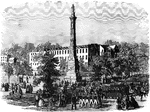
"Review of Confederate troops on their march to Virginia, in front of the Pulaski Monument, Monument Square, Savannah, Ga., August 7th, 1861. The Pulaski Monument is situated in Johnson or Monument Square. It is a fine Doric obelisk of marble, 53 feet in height. The base of the pedestal is 10 feet 4 inches by 6 feet 8 inches, and its elevation is about 12 feet. The corner stone was laid by Lafayette during his visit to the United States in 1825. The needle which surmounts the pedestal is 37 feet high. Another and very elegant structure has also been erected to the memory of this gallant foreigner in Chippewa Square. Pulaski was killed in the attack made by the allied American and French armies in 1779, when the British held possession of Savannah." —Leslie, 1896

Pulaski Monument

"Review of Confederate troops on their march to Virginia, in front of the Pulaski Monument, Monument…

"The Plantation Police, or Patrol, was an institution peculiar to the Slave States. It was a semi-military organization, raised and supported by the planters, but recognized by the old State authorities. Their principal duty was to visit the various plantations and patrol the roads at night, arresting all [African Americans] and others not having proper passes. The war, the President's proclomation, and the actual possession of most of the State of Louisiana by the Federal authorities, rendered these patrols doubly rigorous. Some of the [African Americans] submitted reluctantly. The [African American] in the foreground is a speciman of this class. He seems to yield to the superior force of a tottering power, satisfied that his day is at hand; others show the obsequious, submissive stamp- the [African American] satisfied with his lot if he is clothed and fed."— Frank Leslie, 1896

Plantation Police

"The Plantation Police, or Patrol, was an institution peculiar to the Slave States. It was a semi-military…
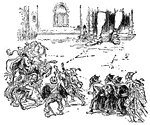
The lilliputian Emperor arriving on horseback to visit Gulliver at his house.

Emperor Visits

The lilliputian Emperor arriving on horseback to visit Gulliver at his house.

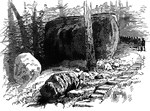
"Visit of Union and Confederate officers to Gettysburg, the ascent of Round Top."— Frank Leslie, 1896

Ascent of Round Top

"Visit of Union and Confederate officers to Gettysburg, the ascent of Round Top."— Frank Leslie,…
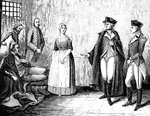
"Washington's visit to Colonel Rall. This is a copy, by permission, of a picture by Flagg, in the possession of Joseph C. Potts, Esq., of Trenton. On the left is seen Generals Washington and Greene; in the center is Mrs. Potts, and near her stands her husband. On the left Colonel Rall reclines upon a couch, and behind him, supporting his pillow, is his servant. I was informed that the portrait of Rall was painted from a description given by a person who knew him, and who pronounced the likeness good, as he remembered him."—Lossing, 1851

Colonel Rall

"Washington's visit to Colonel Rall. This is a copy, by permission, of a picture by Flagg, in the possession…
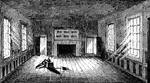
"The Apollo Room. The room used for public meetings is in the rear building of the old Raleigh tavern at Williamsburg, and up to the day of my visit it had remained unaltered. Carpenters were then at work remodeling its style, for the purpose of making it a ball-room; and now, I suppose, that apartment, hallowed by so many associations connected with our war for independence, has scarcely an original feature left. Had my visit been deferred a day longer, the style of the room could never have been portrayed. Neat wainscoting of Virginia pine ornamented the sides below and partly between the windows, and over the fire-place, which was spacious. This view is from the entrance door from the front portion of the building. On the left were two large windows; on the right were two windows and a door; and on each side of the fire-place was a door opening into small passage ways, from the exterior. Through the door on the left is seen a flight of stairs leading to the dormitory. The walls were whitewashed, and the wood-work painted a lead color. In this room the leading patriots of Virginia, including Washington, held many secret caucuses, and planned many schemes for the overthrow of royal rule in the colonies. The sound of the hammer and saw engaged in the work of change seemed to me like actual desecration; for the Raleigh tavern, and the Apollo room are to Virginia, relatively, what Faneuil Hall is to Massachusetts."—Lossing, 1851

Apollo Room

"The Apollo Room. The room used for public meetings is in the rear building of the old Raleigh tavern…
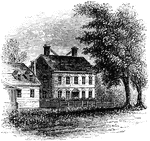
"The Nelson Mansion. This view is from the street looking northwest. A long wooden building, with steep roof and dormer windows, a portion of which is seen on the left, is also a relic of the Revolutionary era. It, too, was much damaged by the bombardment. A few feet from the door of Mr. Nelson's dwelling is a fine laurel-tree. On the occasion of La Fayette's visit to Yorktown in 1824, a large concourse of people were assembled; branches were taken from this laurel-tree, woven into a civic crown, and placed upon that of Preserved Fish, who accompanied him, remarked that none in all that company was better entitled to wear the mark of honor than he."—Lossing, 1851

Nelson Mansion

"The Nelson Mansion. This view is from the street looking northwest. A long wooden building, with steep…
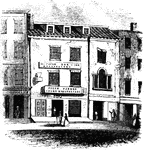
"Washington's head-quarters. I was informed by the venerable Anna van Antwerp, about a fortnight before her death, in the autumn of 1851, that Washington made his head-quarters, on first entering the city, at the spacious house (half of which is yet standing at 180 Pearl Street, opposite Cedar Street), delineated in the engraving. The large window, with no arch, toward the right, indicates the center of the original building. It is of brick, stuccoed, and roofed with tiles. There Washington remained until sommoned to visit Congress at Philadelphia, toward the last of May. On his return, he went to the Kennedy House, No. 1 Broadway, where he remained until the evacuation in September."—Lossing, 1851

Washington's Head-Quarters

"Washington's head-quarters. I was informed by the venerable Anna van Antwerp, about a fortnight before…
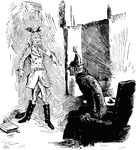
Scene from the story, "A Christmas Carol." Jacob Marley comes to visit.

Christmas Carol

Scene from the story, "A Christmas Carol." Jacob Marley comes to visit.

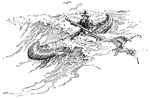
Roger Williams on his way to visit the Chief of the Narragansett Indians.

Roger Williams

Roger Williams on his way to visit the Chief of the Narragansett Indians.

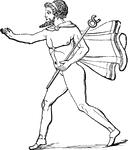
"Mercury, with his caduceus, summons the souls of the departed from Orcus, or the low world, as in the case of Protesilaus, for example, who obtained permission from Pluto and Proserpina to visit for a short period the regions of light." — Anthon, 1891

Mercury with caduceus

"Mercury, with his caduceus, summons the souls of the departed from Orcus, or the low world, as in the…

"Used with indistinct or invisible targets and to define sectors." — Moss, 1914

Finger system

"Used with indistinct or invisible targets and to define sectors." — Moss, 1914

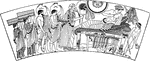
"Priam's Visit to Achilles" — Gayley, 1893

Achilles Priam

"Priam's Visit to Achilles" — Gayley, 1893

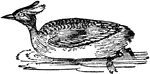
Freshwater diving birds, some of which visit the sea when migrating and in the winter.

Horned Grebe

Freshwater diving birds, some of which visit the sea when migrating and in the winter.

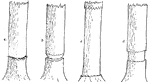
This illustration shows the different methods of girdling trees: a, back girdled; b, girdled to heartwood; c, hack girdled and peeled; d, belt girdled.

Girdling Tree

This illustration shows the different methods of girdling trees: a, back girdled; b, girdled to heartwood;…
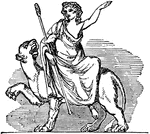
"The god of wine, was the son of Zeus and Semele, the daughter of Cadmus. Before his birth, Semele fell a victim to the insidious counsels of the jealous Here, who induced her to petition Zeus to visit her in his proper form and majesty." — Chambers' Encyclopedia, 1875

Bacchus

"The god of wine, was the son of Zeus and Semele, the daughter of Cadmus. Before his birth, Semele fell…
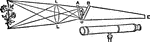
"A modification of the simple kaleidoscope was introduced by Sir David Brewster, whereby the images of large and distant objects can be introduced into the picture. This is effected by removing the object box and replacing it by a tube carrying at its outer end a double convex lens, represented by LL. By a screw adjustment the lens can be so placed as to focus the distant object exactly in the plane of the sector AOB, and so bring its image into the very best position for producing symmetrical patterns. When this instrument is directed towards a tree in full bloom, a very beautiful effect is produced, which can be varied by gradually moving the instrument. This form was called by Brewster the telescopic kaleidoscope." —The Encyclopedia Britannica, 1910

Convex Lens

"A modification of the simple kaleidoscope was introduced by Sir David Brewster, whereby the images…
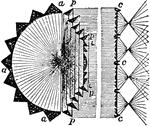
"Fixed Conensing Light for a Single Sector, 1850.—The holophote Light pLp throws its whole light on straight condensing prisms c, each of which distributes the rays over the required sector." —The Encyclopedia Britannica, 1910

Condensing Light

"Fixed Conensing Light for a Single Sector, 1850.—The holophote Light pLp throws its whole light on…
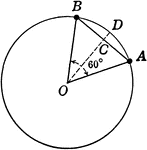
Illustration of circle with sector and segment used to find area.

Circle With Sector and Segment labeled

Illustration of circle with sector and segment used to find area.
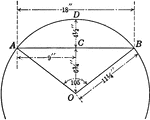
Illustration of partial circle with sector and segment used to find area.

Circle With Sector and Segment labeled

Illustration of partial circle with sector and segment used to find area.
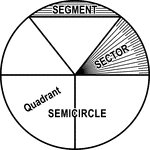
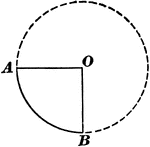
Illustrations of a circle with segment, semicircle, sector, quadrant, and central angles drawn.

Circle with Segment, Semicircle, Sector, Quadrant, and Central Angle

Illustrations of a circle with segment, semicircle, sector, quadrant, and central angles drawn.
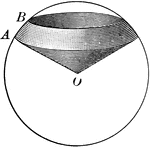
Illustration of a spherical sector.

Spherical Sector

Illustration of a spherical sector.

Illustration of a circle with a sector. "A sector of a circle is the space included between an arc and two radii drawn to the extremities of the arc."

Sector of Circle

Illustration of a circle with a sector. "A sector of a circle is the space included between an arc and…
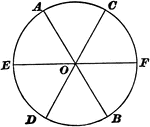
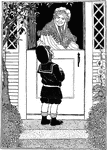
Illustration of a circle with 6 equal sectors.

Sectors of Circle

Illustration of a circle with 6 equal sectors.

A boy visits an old woman.

Old Woman and Boy

A boy visits an old woman.

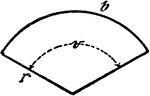
An illustration showing a circle sector with radius r, center/central angle v, and length of circle arc b.

Circle Sector

An illustration showing a circle sector with radius r, center/central angle v, and length of circle…
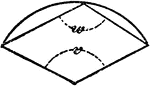
An illustration showing a circle sector with center/central angle v and polygon angle w.

Circle Sector

An illustration showing a circle sector with center/central angle v and polygon angle w.
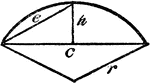
An illustration showing a circle sector with height of segment h and radius r.

Circle Sector

An illustration showing a circle sector with height of segment h and radius r.

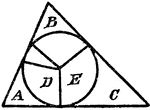
An illustration showing a circle with sectors D and E inscribed in a triangle with angles, A, B, and C.

Circle Inscribed In A Triangle

An illustration showing a circle with sectors D and E inscribed in a triangle with angles, A, B, and…
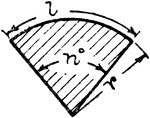
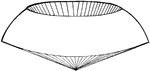
Illustration of a sector of a circle. A sector is the space between an arc and two radii drawn to the extremities of the arc.

Sector Of Circle

Illustration of a sector of a circle. A sector is the space between an arc and two radii drawn to the…
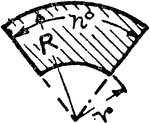
Illustration of a sector of a hollow circle. A sector is the space between an arc and two radii drawn to the extremities of the arc.

Sector Of A Hollow Circle

Illustration of a sector of a hollow circle. A sector is the space between an arc and two radii drawn…
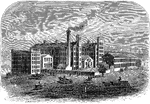
An illustration of a cotton mill in Columbus, Georgia. A cotton mill is a factory housing spinning and weaving machinery. Cotton was the leading sector in the Industrial Revolution, as a cotton spinning was mechanized in mills.

Cotton Mill

An illustration of a cotton mill in Columbus, Georgia. A cotton mill is a factory housing spinning and…
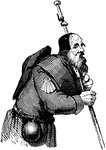
A pilgrim is one who undertakes a pilgrimage, literally 'far afield'. This is traditionally a visit to a place of some religious or historic significance; often a considerable distance is traveled.

A Pilgrim

A pilgrim is one who undertakes a pilgrimage, literally 'far afield'. This is traditionally a visit…
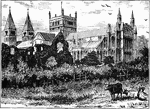
The earliest church on the site is believed to have been founded in 627 by Paulinus, the first Archbishop of York, on a visit to the town when he was baptising believers in the River Trent. This legend is commemorated in the Minster's baptistry window. It is considered an outstanding example of Norman and Early English architecture. The distinctive pyramidal spires of lead (or Rhenish caps or "pepperpot" spires as they are known locally), the only example of their kind in the UK, uniquely overlap the footprint of the tower walls and are particularly noteworthy.

Southwell Minster

The earliest church on the site is believed to have been founded in 627 by Paulinus, the first Archbishop…
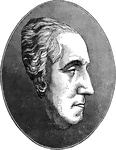
Houdon's portrait sculpture of Washington was the result of a specific invitation by Benjamin Franklin to cross the Atlantic specifically to visit Mount Vernon, so that Washington could model for him. Washington sat for wet clay life models and a plaster life mask in 1785.

Houdon's Mask of Washington

Houdon's portrait sculpture of Washington was the result of a specific invitation by Benjamin Franklin…
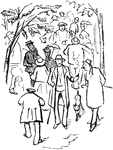
An illustration of a crowded promenade. An esplanade is a long, open, level area, usually next to a river or large body of water, where people may walk. This allows people to promenade along the sea front, usually for recreational purposes, whatever the state of the tide, without having to walk on the beach. Esplanades became popular in Victorian times when it was fashionable to visit seaside resorts. The original meaning of esplanade was a large, open, level area outside fortress or city walls. Esplanade and promenade are sometimes used interchangeably, but that is a mistake. A promenade can be anywhere, and it is exclusively for walking, while an esplanade is for walking but also can include large boulevards or avenues with cars.

Promenade

An illustration of a crowded promenade. An esplanade is a long, open, level area, usually next to a…
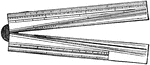
The sector is a hinged rule with scales used for various mathematical calculations.

Sector

The sector is a hinged rule with scales used for various mathematical calculations.

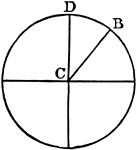
"In geometry: (a) A plane figure inclosed between the arc of a circle, ellipse, or other central curve and two radii to its extremities from the center. Thus, in the figure, CDB is a sector of a circle." -Whitney, 1911

Sector

"In geometry: (a) A plane figure inclosed between the arc of a circle, ellipse, or other central curve…
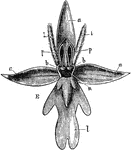
Fly orchid (Ophrys insectifera) is a plant of the family Orchidaceae, a native of the British Isles and Europe favouring sites with alkaline soil. The name arises because it resembles a fly, being totally dependent on flies and bees for pollination. However this is fairly unsuccessful as they seldom visit the flower and it forms seed only infrequently. The plants use scent to attract male flies, which pollinate the flowers as they attempt to mate with the flower. The scent released by the flowers mimic female fly sexual pheromones.

Fly Orchid

Fly orchid (Ophrys insectifera) is a plant of the family Orchidaceae, a native of the British Isles…
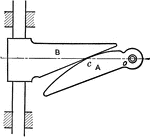
In this illustration, "the driven surface of the slide coincides with the tangent to the spiral, the line of centres being from o through c to infinity and perpendicular to the direction of motion of the slide.""

Logarithmic Spiral Sector

In this illustration, "the driven surface of the slide coincides with the tangent to the spiral, the…
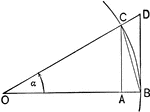
Illustration of an angle &alpha with the vertex at the center, O, of a circle with radius OB. AC and BD are perpendicular to OB and join B with C. The are of the triangle OBC is less than the are of the sector OBC, and the sector OBC is less than the triangle OBD.

Triangles and Sectors in Quadrant I

Illustration of an angle &alpha with the vertex at the center, O, of a circle with radius OB. AC and…
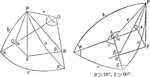
Illustration used, with the law of sines, to find the relation between two sides of a spherical triangle and the angles opposite.

Relationships In A Spherical Triangle

Illustration used, with the law of sines, to find the relation between two sides of a spherical triangle…
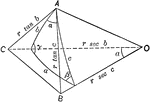
Illustration used, with the law of cosines, to find the relation between the three sides and an angle of a spherical triangle.

Relationships In A Spherical Triangle

Illustration used, with the law of cosines, to find the relation between the three sides and an angle…
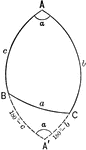
Illustration used to extend the law of cosines when finding the relation between the three sides and an angle of a spherical triangle. In this case both angles b and c are greater than 90°.

Relationships In A Spherical Triangle

Illustration used to extend the law of cosines when finding the relation between the three sides and…
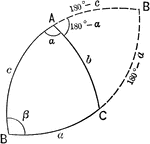
Illustration used to extend the law of cosines when finding the relation between the three sides and an angle of a spherical triangle. In this case angle b<90&deg; and angle c>90&deg;.

Relationships In A Spherical Triangle

Illustration used to extend the law of cosines when finding the relation between the three sides and…
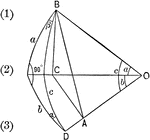
Illustration of a right spherical triangle with a and b the sides, and &alpha; and &beta; the angles opposite them. Side c is the hypotenuse.

Right Spherical Triangle

Illustration of a right spherical triangle with a and b the sides, and α and β the angles…
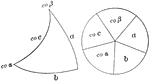
Illustration of a right spherical triangle and the five circular parts placed in the sectors of a circle in the order in which they occur in the triangle. "The ten formulas used in the solution of spherical right triangles can be expressed by means of two rules, known as Napier's rules of circular parts."

Napier's Right Spherical Triangle

Illustration of a right spherical triangle and the five circular parts placed in the sectors of a circle…
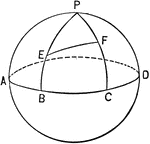
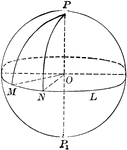
Illustration of a sphere with sectors and arcs.

Sphere With Sectors and Arcs

Illustration of a sphere with sectors and arcs.

Diagram of a sphere with sectors and arcs drawn.

Sphere With Sectors and Arcs

Diagram of a sphere with sectors and arcs drawn.

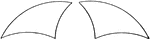
Diagram showing 2 symmetrical spherical triangles.

Symmetrical Spherical Triangles

Diagram showing 2 symmetrical spherical triangles.

Diagram showing 2 superimposed symmetrical spherical triangles.

Superimposed Symmetrical Spherical Triangles

Diagram showing 2 superimposed symmetrical spherical triangles.
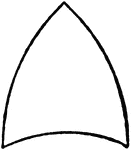
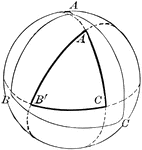
Diagram showing a spherical triangle.

Spherical Triangle

Diagram showing a spherical triangle.

Diagram showing a spherical triangle constructed by the intersection of polar arcs.

Spherical Triangle

Diagram showing a spherical triangle constructed by the intersection of polar arcs.
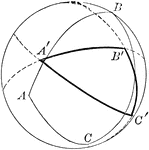
Diagram showing a spherical triangle constructed by the intersection of polar arcs.

Spherical Triangle

Diagram showing a spherical triangle constructed by the intersection of polar arcs.
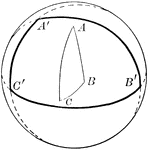
Diagram showing a spherical triangle constructed by the intersection of polar arcs.

Spherical Triangle

Diagram showing a spherical triangle constructed by the intersection of polar arcs.
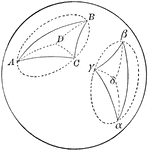
Diagram showing a 2 symmetrical spherical triangles.

Two Symmetrical Spherical Triangles

Diagram showing a 2 symmetrical spherical triangles.

"If a sector revolves about its bounding radius as an axis, it generates what may be called a spherical cone."

Spherical Cone

"If a sector revolves about its bounding radius as an axis, it generates what may be called a spherical…
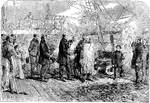
Farewell visit of Garibaldi to Admiral Mundy on board the "Hannibal" at Naples.

Giuseppe Garibaldi's Farewell Visit to Admiral Mundy

Farewell visit of Garibaldi to Admiral Mundy on board the "Hannibal" at Naples.
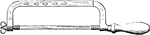
"The hack saw frame which is here illustrated is intended to use blades of various lengths, especially those the ends of which have been broken off. The advantage of being able to use on very wide articles pieces of a broken band saw is apparent to any one who considers the thing a moment." &mdash; Grimshaw, 1902

Adjustable Hacksaw Frame

"The hack saw frame which is here illustrated is intended to use blades of various lengths, especially…