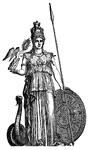
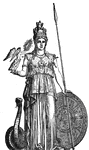
Personification of the city of Rome

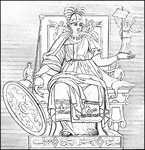
Roma

Personification of the city of Rome

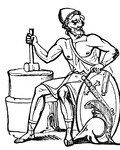
Roman god of fire

Vulcan

Roman god of fire

Roman god of fire

Vulcan

Roman god of fire

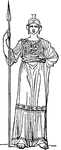
Roman goddess of wisdom

Minerva

Roman goddess of wisdom

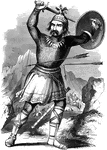
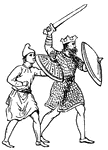
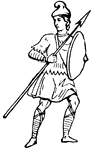
Saxon military costume

Saxon Military Costume

Saxon military costume

Saxon military costume

Saxon Military Costume

Saxon military costume

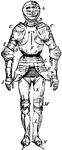
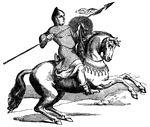
Knight in the lists

Knight in the lists

Knight in the lists

Ornate divider with bird on shield

Ornate divider

Ornate divider with bird on shield

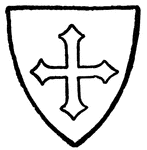
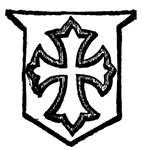
A cross-urdee is one in which the extremities are drawn to a sharp paint instead of being cut straight.
Cross urdee

A cross-urdee is one in which the extremities are drawn to a sharp paint instead of being cut straight.

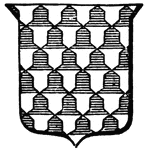
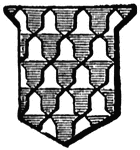
Vair is one of the furs in heraldry composed of several silver and blue pieces representing little shields.
Vair

Vair is one of the furs in heraldry composed of several silver and blue pieces representing little shields.

Voided, in heraldry, a term applied to a charge or ordinary pierced through, or having the inner part cut away, so that the field appears, and nothing remains of the charge except its outer edges.

Voided Cross

Voided, in heraldry, a term applied to a charge or ordinary pierced through, or having the inner part…
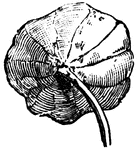
Here is a leaf that is shaped like a shield.

Leaf

Here is a leaf that is shaped like a shield.

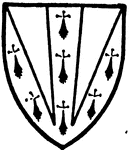
Four red pales in a golden shield were borne by Eleanor of Provence, queen of Henry III

Provence

Four red pales in a golden shield were borne by Eleanor of Provence, queen of Henry III

Hollis bore Black piles in the ermine shield

Hollis

Hollis bore Black piles in the ermine shield

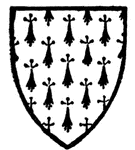
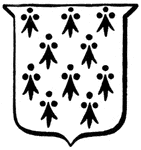
The Duke of Brittany's shield bore Plain ermine

Brittany

The Duke of Brittany's shield bore Plain ermine

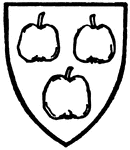
Applegarth's shield of three red apples in a silver field.

Applegarth

Applegarth's shield of three red apples in a silver field.

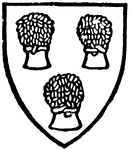
Out of the cornfield English armory took the sheaf, three sheaves being on the shield of an earl of Chester early in the 13th century

Chester

Out of the cornfield English armory took the sheaf, three sheaves being on the shield of an earl of…
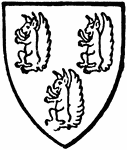
Talbot of Lancashire had three purple squirrels in a silver shield.

Talbot

Talbot of Lancashire had three purple squirrels in a silver shield.

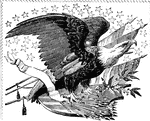
American eagle with flags, shield and stars.

American Eagle

American eagle with flags, shield and stars.

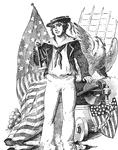
Sailor with American flag, shield, and eagle.

Sailor

Sailor with American flag, shield, and eagle.

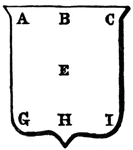
Points of the Shield

Heraldry, Points of the Shield

Points of the Shield

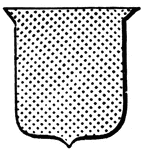
Or (gold) represented on a shield.

Or

Or (gold) represented on a shield.

Argent (silver) represented on a shield.

Argent

Argent (silver) represented on a shield.

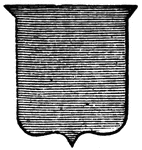
Azure (blue) represented on a shield.

Azure

Azure (blue) represented on a shield.

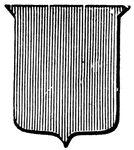
Gules (red) represented on a shield.

Gules

Gules (red) represented on a shield.

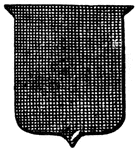
Sable (black) represented on a shield.

Sable

Sable (black) represented on a shield.

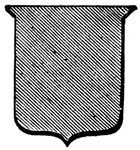
Vert (green) represented on a shield.

Vert Shield

Vert (green) represented on a shield.

Ermine pattern on a shield.

Ermine

Ermine pattern on a shield.

Vair pattern on a shield

Vair

Vair pattern on a shield

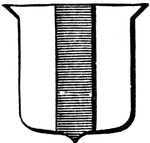
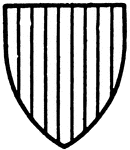
Pale, vertical stripe on shield

Heraldry, Pale

Pale, vertical stripe on shield

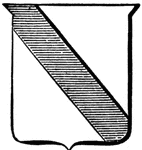
Bend, slanted stripe on shield.

Heraldry, Bend

Bend, slanted stripe on shield.

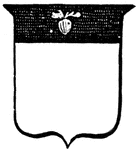
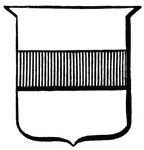
Fesse, broader horizontal stripe

Heraldry, Fesse

Fesse, broader horizontal stripe

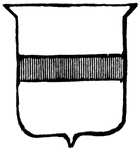
Narrower horizontal stripe on shield

Heraldry, Bar

Narrower horizontal stripe on shield

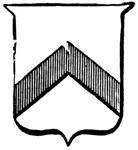
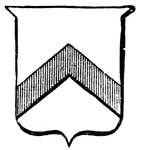
Chevron on shield

Heraldry, Chevron

Chevron on shield

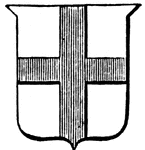
Cross design on shield

Heraldry, Cross

Cross design on shield

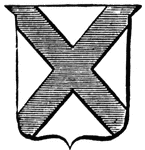
Saltire (X) on shield

Heraldry, Saltire

Saltire (X) on shield

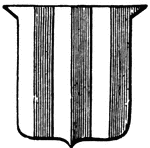
Paly, vertical stripes

Heraldry, Paly

Paly, vertical stripes

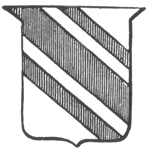
Bendlet, slanted stripes on shield.

Heraldry, Bendlet

Bendlet, slanted stripes on shield.

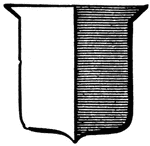
Two-tone shield, divided vertically.

Heraldry, Party per pale

Two-tone shield, divided vertically.

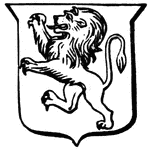
Shield with a rearing lion.

Heraldry, Rampant

Shield with a rearing lion.

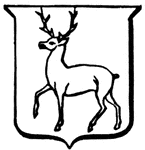
Trippant, depicts a male deer.

Heraldry, Trippant

Trippant, depicts a male deer.

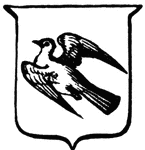
Depicts a bird in flight.

Heraldry, Volant

Depicts a bird in flight.

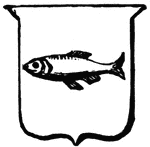
Fish on a shield

Heraldry, Naiant

Fish on a shield

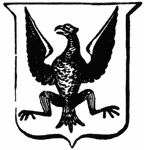
Bird with wings spread, displayed on a shield.

Heraldry, Displayed

Bird with wings spread, displayed on a shield.

A heraldic and ornamental form, supposed to represent two rafters meeting.

Chevron

A heraldic and ornamental form, supposed to represent two rafters meeting.

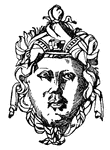
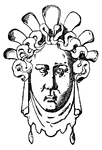
Female metal shield, German Renascence.

German Renascence Mask

Female metal shield, German Renascence.

Female metal shield, German Renascence.

German Renascence Mask

Female metal shield, German Renascence.

Genghis Khan wielding a shield and sword.

Genghis Khan

Genghis Khan wielding a shield and sword.

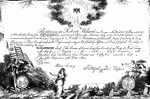
"Society of the Cincinnati, member's certificate. This engraving is a fac simile of a certificate, about one fourth the size of the original, which is thirteen inches and a half in breadth, and twenty inches in length. The originals are printed on fine vellum. The plate was engraved in France by J. J. le Veau, from a drawing by Aug. le Belle. I am indebted to the late James G. Wilson, son of Ensign Wilson, named in the certificate, for the use of the orginal in making this copy. The former was engraved on copper; this is engraved on wood. The design represents American liberty as a strong man armed, bearing in one hand the Union flag, and in the other a naked sword. Beneath his feet are British flags, and a broken spear, shield, and chain. Hovering by his side is the eagle, our national emblem, from whose talons the lightning of destruction is flashing upon the British lion. Britannia, with the crown falling from her head, is hastening toward a boat to escape to a fleet, which denotes the departure of British power from our shore. Upon a cloud, on the right, is an angel blowing a trumpet, from which flutters a loose scroll."—Lossing, 1851

Society of the Cincinnati

"Society of the Cincinnati, member's certificate. This engraving is a fac simile of a certificate, about…
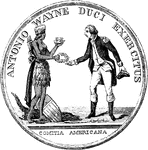
"Gold medal awarded by Congress to General Wayne. This is a representation of the medal, the size of the original. On this side is a device repesenting an Indian queen crowned, a quiver on her back, and wearing a short apron of feathers. A mantle hangs from her waist behind, the upper end of which appears as if passed through the girdle of her apron, and hangs gracefully by her side. With her right hand she is presenting a wreath to General Wayne; in her left she is holding up a mural crown toward his head. At her feet, on the left, an alligator is lying. The American shield is resting against the animal. Over the figure is the legend 'Antonio Wayne duci exercitas,' and beneath, 'Comitia Americana,' 'The American Congress to General Anthony Wayne.'"—Lossing, 1851

Wayne Medal Front

"Gold medal awarded by Congress to General Wayne. This is a representation of the medal, the size of…
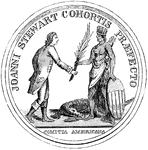
"Medal awarded to Major Stewart. This represents the medal the size of the original. The device is America personified by an Indian queen, who is presenting a palm branch to Major Stewart. A quiver is at her back; her left hand is resting on the American shield, and at her feet is an alligator crouchant. The legend is, 'Joanni Stewart Cohortis Prefecto, Comitia Americana,' 'The American Congress to Major John Stewart.'"—Lossing, 1851

Stewart Medal Front

"Medal awarded to Major Stewart. This represents the medal the size of the original. The device is America…
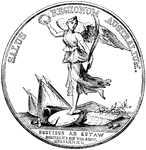
"Gold medal awarded to Greene. This is a representation of the back side of the medal, the full size of the original. On this side is a figure of Victory, lighting upon the Earth, and stepping upon a broken shield. Under her feet are broken weapons, colors, and a shield. The legend is, Salus Regionum Australium; 'The Safety of the Southern Department.' Exergue- Hostibus Ad Eutaw Debellatis VIII Sept. MDCCLXXXI; 'The Foe conquered at Eutaw, 8th of September, 1781.'"—Lossing, 1851

Greene Medal Back

"Gold medal awarded to Greene. This is a representation of the back side of the medal, the full size…
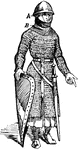
"Complete Armor of 1195-1205."-Whitney, 1902

Armor

"Complete Armor of 1195-1205."-Whitney, 1902

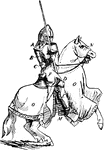
"Armor and Equipment for man and horse, about 1290."-Whitney, 1902

Armor

"Armor and Equipment for man and horse, about 1290."-Whitney, 1902

"Complete Armor, about 1395"-Whitney, 1902

Armor

"Complete Armor, about 1395"-Whitney, 1902

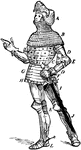
"Complete suit of Plate-Armor, now in Paris, date about 1440- the epoch of greatest perfection of defensive arms."-Whitney, 1902

Armor

"Complete suit of Plate-Armor, now in Paris, date about 1440- the epoch of greatest perfection of defensive…
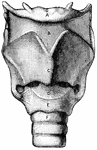
"Cartilages and Ligaments of the Larynx. (Front view.) <em>A</em>, hyoid bone; <em>B</em>, membrane attached to hyoid bone and the shield-shaped cartilage below (thyroid); edges of this shield-shaped cartilage unite at <em>C</em> (Adam's apple is the V-shaped groove on a line with <em>B</em> and <em>C</em>; <em>D</em>, membrane between the shield-shaped cartilage and the signet-ring cartilage below; <em>E</em> cricoid, or signet-ring, cartilage; <em>F</em>, upper ring of the windpipe." &mdash; Blaisedell, 1904

Front view of the larynx

"Cartilages and Ligaments of the Larynx. (Front view.) A, hyoid bone; B, membrane…
Women playing a lyre.

Greek border

Women playing a lyre.

"signifies, literally, a goat skin. According to ancient mythology, the aegis worn by Jupiter was the hide of the goat Amaltheia, which had suckled him in his infancy. Homer always represents it as part of the armour of Jupiter, whom on this account he distinguishes by the epithet aegis-bearing. He, however, asserts, that it was borrowed on different occasions, both by Apollo and Minerva. The aegis was connected with the shield of Jupiter, either serving as a covering over it, or as a belt by which it was suspended from the right shoulder. Homer accordingly uses the word to denote not only the goat-skin, which it properly signified, but also the shield to which it belonged. The aegis was aorned in a style corresponding to the might and majesty of the father of the gods. In the middle of it was fixed the appalling Gorgon's head, and its border was surrounded with golden tassels, each of which was worth a hecatomb. The aegis is usually seen on the statues of Minerva, in which it is a sort of scarf falling obliquely over the right shoulder, so as to pass round the body under the left arm. The serpents of the Gorgon's head are transferred to the border of the skin. The later poets and artists represent the aegis as breastplate covered with metal in the form of scales." &mdash; Smith, 1873

Aegis

"signifies, literally, a goat skin. According to ancient mythology, the aegis worn by Jupiter was the…