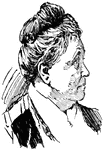

(1831-1919) US Author, Born in Scotland

Amelia E. Barr

(1831-1919) US Author, Born in Scotland

(1837-1898) German author who studied Early Egyptian life and wrote many books such as <I>Egypt and the Books of Moses, An Egyptian Princess</I> and <I>Uarda</I>

George M. Ebers

(1837-1898) German author who studied Early Egyptian life and wrote many books such as Egypt and the…
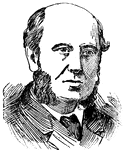
(1835--) Lead British geologist, wrote the book <I>The Life of a Boulder: Textbook of Geology</I>

Sir Archibald Geikie

(1835--) Lead British geologist, wrote the book The Life of a Boulder: Textbook of Geology

(1834-1894) Writer of the Intellectual Life

Philip G. Hamerton

(1834-1894) Writer of the Intellectual Life

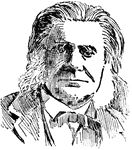
(1825-1895) British biologist that had many studies in medicine and marine life. He was a supporter of Darwinism and intrduced the term "agnostic" viewpoint.

Thomas H. Huxley

(1825-1895) British biologist that had many studies in medicine and marine life. He was a supporter…

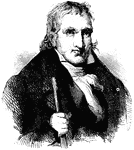
(1595-1617) Powhatan who helped save the life of Captain John Smith.

Pocahontas

(1595-1617) Powhatan who helped save the life of Captain John Smith.

(1755-1836) Early American Frontiersman. Said to have saved the life of Daniel Boone

Simon Kenton

(1755-1836) Early American Frontiersman. Said to have saved the life of Daniel Boone

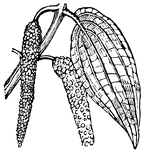
An evergreen vine which attaches itself to the ground like ivy. The betel pepper has larger berries than most peppers. In the East Indies and South Pacific inhabitants consider the betel pepper as a necessity of life, and the leaf, with quicklime and the areca nut is chewed.

Betel pepper

An evergreen vine which attaches itself to the ground like ivy. The betel pepper has larger berries…
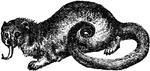
The kinkajou lives in S. America and spends most of its life in trees. It hunts at night for insects and fruits. It has a strong muscular tail that it uses to hold on to tree branches and it has a long tongue that it may use to gather honey.

Kinkajou

The kinkajou lives in S. America and spends most of its life in trees. It hunts at night for insects…
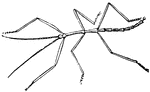
Walking sticks lead a sluggish life among the branches of shrubs, living on the young shoots. Their color and shape being so much like those of things around them, enable them commonly to escape observation.

Walking Stick

Walking sticks lead a sluggish life among the branches of shrubs, living on the young shoots. Their…
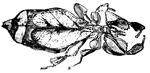
Walking Sticks and Leaf Insects lead a sluggish life among the branches of shrubs, living on the young shoots. Their color and shape being so much like those of things around them, enable them commonly to escape observation.

Leaf Insect

Walking Sticks and Leaf Insects lead a sluggish life among the branches of shrubs, living on the young…
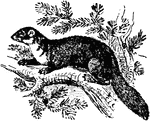
The pine marten lives most of its life in trees, but does hunt on the ground. It feeds primarily on mice, squirrel, birds, frogs and fish.

Pine Marten

The pine marten lives most of its life in trees, but does hunt on the ground. It feeds primarily on…
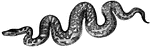
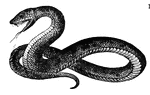
This gigantic snake kills its prey by constricting around it, squeezing it to death, then swallowing it whole.

Boa constrictor

This gigantic snake kills its prey by constricting around it, squeezing it to death, then swallowing…
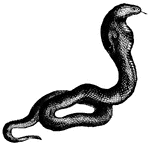
When irritated, the neck of a cobra swells at the same time it raises the front part of its body vertically, holding it straight and rigid.

Cobra

When irritated, the neck of a cobra swells at the same time it raises the front part of its body vertically,…
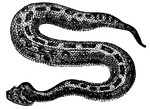
These venomous snakes have triangular heads and short stocky bodies.  They are a highly poisonous snake.

Puff-adder

These venomous snakes have triangular heads and short stocky bodies. They are a highly poisonous snake.
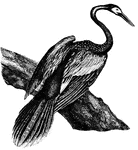
The head of the anhinga is slender and cylindrical, on a slim and excessively long neck, which makes it resemble a snake when in the water.

Anhinga

The head of the anhinga is slender and cylindrical, on a slim and excessively long neck, which makes…
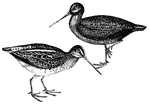
The snipe does not live so solitary a life as the Woodcock; it is occasionally seen in flocks.

Snipe

The snipe does not live so solitary a life as the Woodcock; it is occasionally seen in flocks.

Snakes on shelf

Snakes on shelf

Snakes on shelf

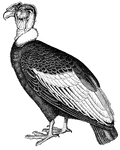
The Condor possesses extraordinary tenacity of life. Humboldt relates that he found it impossible to strangle one, and that he was compelled to shoot it to put an end to its existence, (Figuier, 1869). This bird is now extremely rare and on the endangered species list.

Condor

The Condor possesses extraordinary tenacity of life. Humboldt relates that he found it impossible to…

Rodolphus Agricola (Phrisius) (?February 17, 1444, August 28, 1443?[1] – October 27, 1485) was a pre-Erasmian humanist of the northern Low Countries, famous for his supple Latin and one of the first north of the Alps to know Greek well. Agricola was a Hebrew scholar towards the end of his life, an educator, musician and builder of a church organ, a poet in Latin as well as the vernacular, a diplomat and a sportsman of sorts (boxing). He is best known today as the author of De inventione dialectica, as the father of northern European humanism and as a zealous anti-scholastic in the late-fifteenth century. Born at Baflo, in the Dutch province of Groningen, Agricola was originally named Roelof Huusman.

Rodolphus Agricola

Rodolphus Agricola (Phrisius) (?February 17, 1444, August 28, 1443?[1] – October 27, 1485) was a pre-Erasmian…
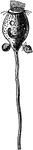
Vorticella is a protozoan. Except for when young, it is usually found attached to dead leaves or sticks throughout its life. This shows free-swimming individuals conjugating with a large, stalked individual.

Vorticella

Vorticella is a protozoan. Except for when young, it is usually found attached to dead leaves or sticks…
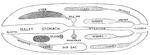
Structure of internal anatomy of a snake.

Snake

Structure of internal anatomy of a snake.

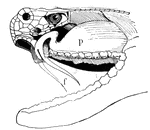
Dissection of head of rattlesnake; showing fangs (f) and poison sac (p).

Rattlesnake

Dissection of head of rattlesnake; showing fangs (f) and poison sac (p).

Snakes belong to the group known as Squamata.

Snake

Snakes belong to the group known as Squamata.

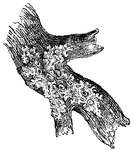
Mosses can withstand a variety of temperatures. They grow on rocks or plant life.

Moss

Mosses can withstand a variety of temperatures. They grow on rocks or plant life.

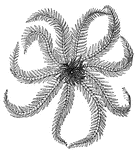
Crinoids are Echinoderms. They are distinguished by the fact that they are fixed, during the whole or a portion of the life of the animal, to submarine objects by means of a jointed flexible stalk or column.

Crinoid

Crinoids are Echinoderms. They are distinguished by the fact that they are fixed, during the whole or…
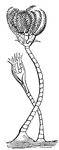
Crinoids are Echinoderms. They are distinguished by the fact that they are fixed, during the whole or a portion of the life of the animal, to submarine objects by means of a jointed flexible stalk or column.

Crinoid

Crinoids are Echinoderms. They are distinguished by the fact that they are fixed, during the whole or…
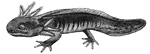
The axolotl is a salamander found in areas of Mexico. The external gills are retained throughout life, this is known as neoteny.

Axolotl

The axolotl is a salamander found in areas of Mexico. The external gills are retained throughout life,…
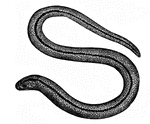
The blind worm is a good example of a snakelike lizard. It is harmless, and looks like a snake.

Blind Worm

The blind worm is a good example of a snakelike lizard. It is harmless, and looks like a snake.
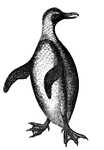
Penguins are adopted for a completely aquatic life. The body is boat-shaped, the neck long, and legs short and placed behind the point of equilibrium of the body.

Penguin

Penguins are adopted for a completely aquatic life. The body is boat-shaped, the neck long, and legs…
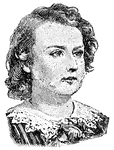
(1822-1899) Marie Bonheur was a famous animal painter.

Marie R. Bonheur

(1822-1899) Marie Bonheur was a famous animal painter.

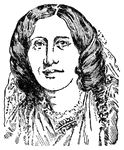
(1820-1880) George Eliot is the literary name assumed by Marian Evans, who was a novelist.

George Eliot

(1820-1880) George Eliot is the literary name assumed by Marian Evans, who was a novelist.
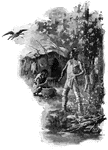
A picture showing typical indian life.

Indian Life

A picture showing typical indian life.

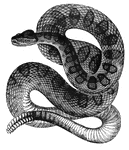
A snake with a rattle for its tail. Rattles its tail to scare off enemies.

Rattle Snake

A snake with a rattle for its tail. Rattles its tail to scare off enemies.

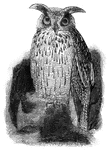
A night-life bird whose huge eyes help it see.

Owl

A night-life bird whose huge eyes help it see.

The scaraboeus or beetle appears isolated on mummy-cases and elsewhere, as a symbol of creation and life, and was the commonest of amulets.

Amulet

The scaraboeus or beetle appears isolated on mummy-cases and elsewhere, as a symbol of creation and…
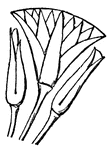
The lotus flower has been called the sacred flower of Ancient Egypt. As a product of the life-giving, wealth-bestowing Nile it was symbolic both of that river and of the solar divinities which ruled the river's inundations and imparted to it its fertility and life-renewing powers.

Conventionalized Lotus Flower

The lotus flower has been called the sacred flower of Ancient Egypt. As a product of the life-giving,…
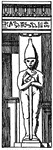
In several Egyptian temples there are square or rectangular piers fronted with colossal sculptured figures of Osirid holding a scourge and a "Nile key" or "key of life."

Osirid Pier

In several Egyptian temples there are square or rectangular piers fronted with colossal sculptured figures…


The head of Medusa from the Farnese dish (onyx patera) Naples Museum.

Medusa Head

The head of Medusa from the Farnese dish (onyx patera) Naples Museum.

The head of Medusa from center of an antique patera, Roman.

Medusa Head

The head of Medusa from center of an antique patera, Roman.

The head of Medusa from a French medallion.

Medusa Head

The head of Medusa from a French medallion.

The head of Medusa as a grotesque from a tympanum in Paris.

Medusa Head

The head of Medusa as a grotesque from a tympanum in Paris.

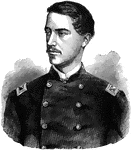
"Colonel Ulric Dahlgren, born in Bucks County, Pa., in 1842, died near King and Queen's Courthouse, Va., March 4th 1864. At the beginning of the Civil War he was sent by his father to plan and take charge of a naval battery on Maryland Heights. He then became aid to General Sigel, and served through Fremont's and Pope's campaigns, acting as sigel's chief of artillery at the second battle of Bull Run; served on General Hooker's staff, distinguishing himself at Chancellorsville, and as aid to General Meade at Gettysburg rendering important service. He lost his life in a raid planned by him, in concert with General Kilpatrick, to release the Federal prisoners at Libby Prison and Belle Isle." &mdash; Frank Leslie, 1896

Ulric Dahlgren

"Colonel Ulric Dahlgren, born in Bucks County, Pa., in 1842, died near King and Queen's Courthouse,…
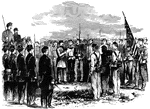
"Taking away the colors of the Seventy-ninth New York Regiment for insubordination and mutiny, Washington, D. C., August 14th, 1861. The scene during the reading of the order of General McClellan was exceedingly impressive. The sun was just going down, and in hazy mountain twilight the features and forms of officers and men could scarcely be distinguished. Immediately behind his aid was General Porter, firm and self-possessed. Colonel Stevens was in front of the regiment, endeavoring to quiet his rather nervous horse. In the rear of the regulars, and a little distance apart, General Sickles sat carelessly on horseback, cooly smoking a cigar and conversing with some friends. At one time during the reading a murmur passed through the lines of the mutineers; and when the portion of the order directing the regiment to surrentder its colors was read a private in one of the rear lines cried out, in broad Scotch tones, "Let's keep the colors, boys!" No response was made by the remainder of the regiment. Major Sykes at once rode up the line to where the voice was heard. It would have been more than the soldier's life was worth had he been discovered at the moment in pistol range by any of the officers." &mdash; Frank Leslie, 1896

Seventy-ninth Regiment

"Taking away the colors of the Seventy-ninth New York Regiment for insubordination and mutiny, Washington,…
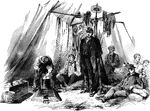
"Scene in camp life- company mess of the Thirteenth Illinois Volunteers in their camp before Corinth, Miss." — Frank Leslie, 1896

Thirteenth Illinois Volunteers

"Scene in camp life- company mess of the Thirteenth Illinois Volunteers in their camp before Corinth,…

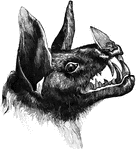
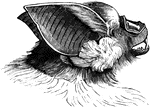
The head of a roussette bat, in life size.

Head of Roussette Bat

The head of a roussette bat, in life size.

The head of a spectre bat, in life size.

Head of Spectre Bat

The head of a spectre bat, in life size.

The head of a javelin bat, in life size.

Javelin Bat

The head of a javelin bat, in life size.

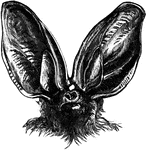
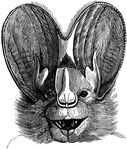
The head of a long-eared bat, in life size.

Long-Eared Bat

The head of a long-eared bat, in life size.

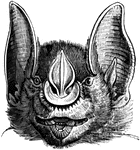
The head of a rhinolophus nobilis bat, in life size.

Rhinolophus Nobilis

The head of a rhinolophus nobilis bat, in life size.

The head of a megaderm bat, in life size.

Head of Megaderm Bat

The head of a megaderm bat, in life size.

"Encampment of Colonel Ellsworth's New York Fire Zuoaves, on the heights opposite the Navy Yard, Washington, D. C. This famous body of fiery and active soldiers at length got free from the trammels and confinement of their city quarters, a change which was both pleasant and beneficial to them. They were encamped on the heights opposite the Navy Yard, Washington, D. C., and, as our sketch will show, were most comfortably situated. Colonel Ellsworth was indefatigable in drilling his regiment, and his men most willingly seconded his efforts by close attention to duty and alacrity in the performance of all the details of camp life. The Zuoaves proved to be one of the most effective regiments in the field; they rendered efficent service in building breastworks on the outskirts of Alexandria, thereby preyenting the possibility of a surprise from the enemy, and distinguished themselves at the Battle of Bull Run in their successful assault on a confederate battery at the point of the bayonet." —Leslie, 1896

Zouaves

"Encampment of Colonel Ellsworth's New York Fire Zuoaves, on the heights opposite the Navy Yard, Washington,…
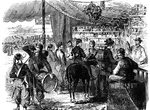
"A sutler's store, Harper's Ferry, Va. The sutler's store at Harper's Ferry represents one of those apparently inevitable evils which attend even the best-arranged armies. The negligence and delay of the government in settling with the troops rendered the sutler's a necessary evil, which a more regular course would have obviated. As a study of human life, a sutler's store is full of the most sorrowful reflections, and demands the most earnest care of the superior officers. A little pure stimulant, when administered with the rations, is capable of warding off many ills which flesh is heir to, more especially when under the prostration of fatigue or privation." —Leslie, 1896

Sutler's Store

"A sutler's store, Harper's Ferry, Va. The sutler's store at Harper's Ferry represents one of those…
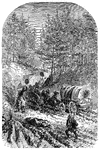
"Federal baggage train on its way to the army at Falmouth, VA., December, 1862. Our illustration represents a Federal baggage train hastening on to Falmouth with commissary stores for General Burnside's army before the crossing of the Rappahannock to attack Fredericksburg. The immense labor and fatigue attendant on operations in this region may be conceived by our sketch. The fearful road over rocks and cliffs, the storms, the constant fear of surprise by the enemy, where escape and defense are alike impossible, give to the life of the army train all the perils of romance."— Frank Leslie, 1896

Federal Baggage Train

"Federal baggage train on its way to the army at Falmouth, VA., December, 1862. Our illustration represents…
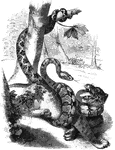
A giant Boa contrictor crushing a jaguar.

Boa Constricting a Jaguar

A giant Boa contrictor crushing a jaguar.

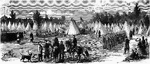
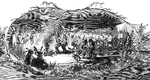
"Camp life in the West. During one of the pauses in the active part of the Missouri campaign our special artist sent us some sketches which belong more to the romance of war than its struggle. Among them is a most characteristic scene in which two phases of civilization meet. We allude to the sketch where the Indian warriors are giving a war dance by firelight in the presence of the officers and soldiers of General Asboth's division. Sad and suggestive spectacle! Pagans and Christians traveling as companions on the same war path."— Frank Leslie, 1896

War Dance

"Camp life in the West. During one of the pauses in the active part of the Missouri campaign our special…
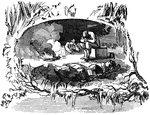
"Camp life in the West. During one of the pauses in the active part of the Missouri campaign our special artist sent us some sketches which belond more to the romance of war than its struggle. This image shows midnight outside the tent in the West."&mdash; Frank Leslie, 1896

Midnight in the West

"Camp life in the West. During one of the pauses in the active part of the Missouri campaign our special…
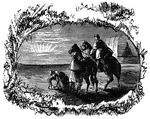
"Camp life in the West. During one of the pauses in the active part of the Missouri campaign our special artist sent us some sketches which belond more to the romance of war than its struggle. This image shows sunrise in the West."&mdash; Frank Leslie, 1896

Sunrise in the West

"Camp life in the West. During one of the pauses in the active part of the Missouri campaign our special…
"Camp life in the West. During one of the pauses in the active part of the Missouri campaign our special artist sent us some sketches which belond more to the romance of war than its struggle. While, as though to show the folly and vanity of the whole gigantic struggle, the dead horse, the vultures, and the last two of the army cavalcade as it travels over that magnificent sollitude, the Hundred Mile Prairie of Missouri, close the melancholy series."— Frank Leslie, 1896

Hundred Mile Prairie

"Camp life in the West. During one of the pauses in the active part of the Missouri campaign our special…
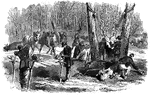
"Butchering and dressing cattle for distribution to the Federal Army. The romance and reality of life were never so strikingly displayed as in the Civil War. Fact and fiction never seemed more apart than the soldier waving his sword when leading the forlorn hope and when sitting before his tent cooking rations; for, despite all the commissariat arrangements, there was much room for improvement in these particulars. We give a couple of sketches which will enable our readers to see how matter-of-fact and mechanically base were some of the soldier's employments when in camp. Men who would shrink from turning butcher in New York, boston or Philadelphia were forced by the resistless tide of circumstances to lend a hand to the killing a beeve and afterward to the dressing and cooking it."&mdash; Frank Leslie, 1896

Butchering Cattle

"Butchering and dressing cattle for distribution to the Federal Army. The romance and reality of life…